Balloon Inflation Device Market Size, Share & Demand Report By Type (Analog Balloon Inflation Devices, Digital Balloon Inflation Devices), By Application (Cardiovascular Procedures, Urological Procedures, Gastrointestinal Procedures), By End Use (Hospitals, Ambulatory Surgical Centers, Specialty Clinics), By Distribution Channel (Direct Sales, Medical Device Distributors, Online Medical Supply Platforms) & Segment Forecasts, 2025–2034
USD 3950
Market Overview
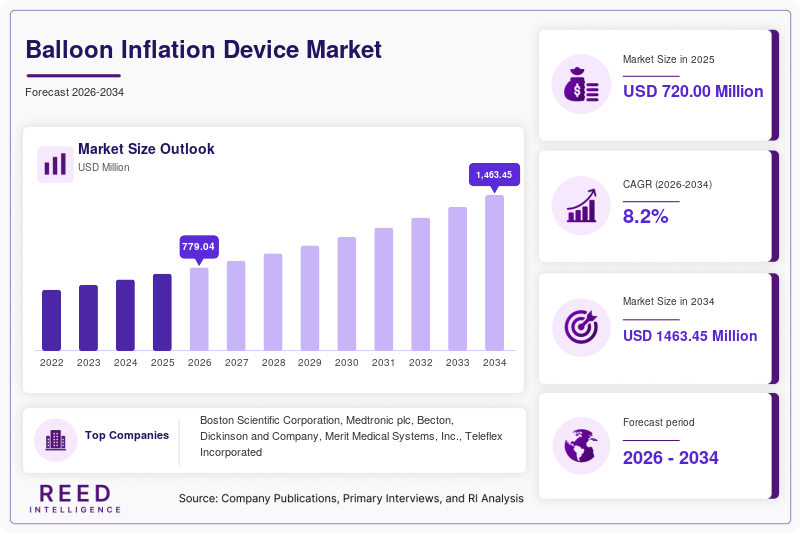
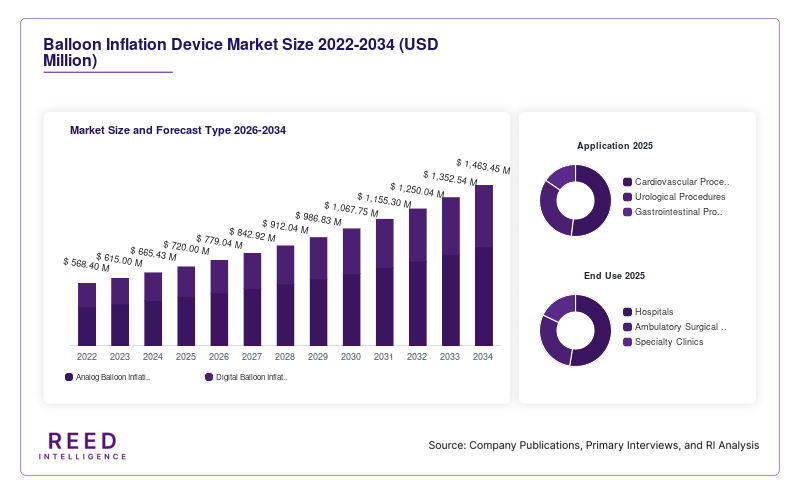
The Balloon Inflation Device Market size was valued at USD 720 million in 2025 and is projected to reach USD 1.46 billion by 2034, registering a compound annual growth rate (CAGR) of 8.2% from 2025 to 2034. Balloon inflation devices are specialized medical instruments used to inflate angioplasty balloons during interventional procedures such as coronary angioplasty, peripheral vascular interventions, and urological treatments. These devices enable clinicians to maintain controlled pressure levels to dilate narrowed vessels or anatomical structures, making them essential tools in modern minimally invasive procedures.
A major global factor supporting the growth of the Balloon Inflation Device Market is the rapid shift toward minimally invasive cardiovascular procedures. Healthcare providers worldwide increasingly prefer catheter-based interventions due to shorter recovery times, reduced surgical risks, and improved patient outcomes. Balloon inflation devices play a critical role in such procedures by delivering precise pressure control during balloon dilation, ensuring procedural accuracy and safety.
Key Highlights
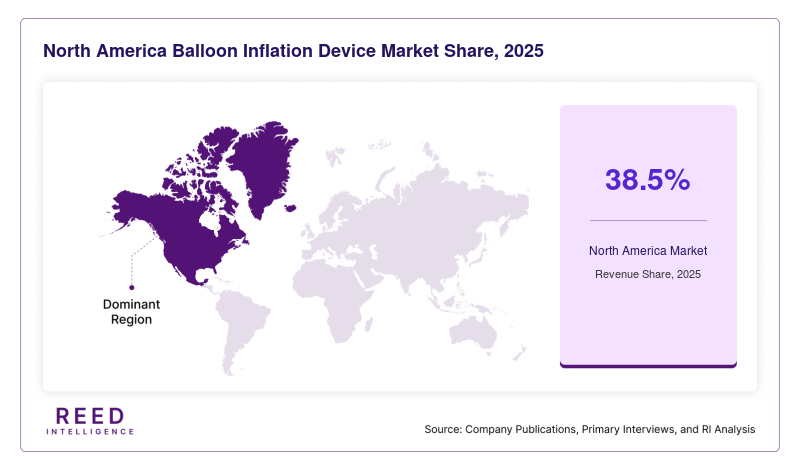
- Dominant Region: North America held 38.5% market share in 2025, while Asia Pacific is projected to grow at a CAGR of 9.7% through 2034.
- Leading Segment: Analog balloon inflation devices accounted for 54% share in 2025, while digital balloon inflation devices are projected to grow at a CAGR of 9.1%.
- Dominant End-Use: Hospitals represented 61% of the market share in 2025, while ambulatory surgical centers are projected to grow at a CAGR of 9.4%.
- Dominant Country: The United States Balloon Inflation Device Market was valued at USD 210 million in 2025 and reached USD 223 million in 2026.
Market Trends
Integration of Digital Pressure Monitoring Systems
A key trend influencing the Balloon Inflation Device Market is the integration of digital pressure monitoring technologies into balloon inflation systems. Traditional analog devices are gradually being supplemented by digital models that provide real-time pressure readings and automated control features. These devices improve procedural accuracy by allowing clinicians to monitor pressure changes more precisely during balloon dilation procedures.
Healthcare facilities increasingly adopt digital inflation devices because they reduce the risk of vessel injury caused by excessive pressure. In addition, digital interfaces enable easier data tracking and integration with catheterization laboratory systems, improving workflow efficiency.
Growth in Disposable and Single-Use Devices
Another notable trend in the Balloon Inflation Device Market is the growing preference for disposable balloon inflation devices. Hospitals and outpatient surgical centers increasingly prioritize infection control and device sterility during procedures. Single-use devices reduce the need for sterilization and eliminate the risk of cross-contamination.
Manufacturers are responding by developing cost-effective disposable inflation systems designed for high procedural volumes. This trend is particularly visible in emerging healthcare markets where hospital efficiency and procedural turnover rates are improving.
Market Drivers
Rising Prevalence of Cardiovascular Diseases
The rising incidence of cardiovascular diseases is a major driver of the Balloon Inflation Device Market. Coronary artery disease and peripheral artery disease are increasing globally due to lifestyle changes, aging populations, and metabolic disorders. Balloon angioplasty remains a common treatment option for restoring blood flow in blocked arteries.
Balloon inflation devices are essential during these procedures as they help physicians precisely inflate angioplasty balloons to restore vessel patency. The growing number of interventional cardiology procedures directly supports demand for reliable balloon inflation equipment across hospitals and specialized cardiac centers.
Expansion of Interventional Cardiology Infrastructure
Healthcare infrastructure development is another key factor driving the Balloon Inflation Device Market. Hospitals across developed and emerging economies are investing in advanced catheterization laboratories to perform minimally invasive procedures.
As the number of cardiac catheterization labs increases, the demand for supportive interventional tools such as balloon inflation devices also rises. Healthcare providers are focusing on improving procedural efficiency and patient safety, encouraging the adoption of technologically advanced inflation devices.
Market Restraint
High Cost of Advanced Interventional Devices
One major restraint affecting the Balloon Inflation Device Market is the high cost associated with advanced interventional equipment. Modern digital balloon inflation systems often include sophisticated pressure monitoring components and ergonomic designs, which can increase overall procurement costs.
Smaller healthcare facilities, particularly in low-income regions, may face budget constraints when investing in advanced devices. In addition, the presence of alternative interventional technologies and price-sensitive procurement policies in public healthcare systems can limit rapid adoption of premium balloon inflation products. These cost-related challenges can slow market penetration in developing healthcare markets.
Market Opportunities
Growth of Ambulatory Surgical Centers
The rapid growth of ambulatory surgical centers (ASCs) represents a major opportunity in the Balloon Inflation Device Market. Many cardiovascular and urological procedures are gradually shifting from large hospitals to outpatient settings due to improved procedural efficiency and lower healthcare costs.
ASCs require compact, easy-to-use inflation devices that support quick turnaround times during procedures. This shift toward outpatient care models is expected to create new demand for lightweight and user-friendly balloon inflation systems.
Technological Innovation in Pressure Control Systems
Technological advancements in pressure control mechanisms provide another opportunity for market expansion. Manufacturers are focusing on developing precision pressure regulators, digital monitoring interfaces, and ergonomic syringe-based designs.
These innovations enhance procedural safety and allow physicians to maintain consistent pressure levels during balloon dilation. The introduction of advanced features such as automatic pressure release mechanisms and integrated displays will likely create additional growth opportunities for device manufacturers.
Segmental Analysis
By Type
Analog balloon inflation devices dominated the Balloon Inflation Device Market and accounted for 54% share in 2025. These devices are widely used due to their simple design, cost-effectiveness, and ease of operation during balloon angioplasty procedures. Many healthcare facilities continue to rely on analog systems because they provide reliable pressure control without requiring complex electronic components.
Digital balloon inflation devices will represent the fastest-growing subsegment with a projected CAGR of 9.1% through 2034. Growth will be supported by the increasing adoption of digital pressure monitoring technologies. These systems enable clinicians to track pressure levels with higher precision and maintain consistent inflation during procedures.
By Application
Cardiovascular procedures represented the dominant application segment in the Balloon Inflation Device Market and accounted for 63% of the market share in 2025. Balloon angioplasty procedures are widely used to treat coronary artery disease and peripheral vascular conditions. The high volume of cardiovascular interventions worldwide continues to drive the demand for balloon inflation devices.
Urological procedures will be the fastest-growing application segment with a projected CAGR of 9.0% during the forecast period. Growth will be supported by the increasing use of balloon dilation techniques in urology treatments such as ureteral and renal procedures.
By End Use
Hospitals dominated the Balloon Inflation Device Market and held 61% share in 2025. Large hospitals typically perform a high volume of interventional procedures and maintain dedicated catheterization laboratories. These facilities require reliable balloon inflation systems to support angioplasty and vascular procedures.
Ambulatory surgical centers will emerge as the fastest-growing end-use segment with a CAGR of 9.4% through 2034. These facilities are increasingly performing minimally invasive procedures due to their operational efficiency and lower treatment costs.
By Distribution Channel
Direct sales dominated the Balloon Inflation Device Market with 57% share in 2025. Many medical device manufacturers prefer direct sales models because they allow stronger relationships with hospitals and healthcare providers.
Online and third-party distribution channels will grow at the fastest rate with a projected CAGR of 8.8% during the forecast period. Growth will be supported by the increasing digitalization of medical device procurement processes and the expansion of online healthcare supply platforms.
Regional Analysis
North America
North America accounted for 38.5% of the Balloon Inflation Device Market share in 2025 and represented the largest regional market. The region will continue to expand steadily and is expected to grow at a CAGR of 7.5% from 2025 to 2034. Growth in this region has been associated with the high adoption of minimally invasive cardiovascular procedures and well-established interventional cardiology infrastructure. Healthcare facilities across the region maintain strong demand for precision-based procedural tools, including balloon inflation systems.
The United States dominated the North American Balloon Inflation Device Market due to the widespread availability of advanced catheterization laboratories. A distinct growth factor is the rapid adoption of digital medical devices in interventional cardiology procedures. Hospitals increasingly implement digital monitoring equipment to improve procedural safety and accuracy, which supports the demand for technologically advanced balloon inflation systems.
Europe
Europe represented 27.2% of the Balloon Inflation Device Market in 2025. The regional market will expand at a CAGR of 7.8% through 2034. Demand in Europe has been influenced by the strong presence of medical device manufacturers and the expansion of interventional cardiology procedures across the region. Healthcare providers continue to adopt specialized devices that support high-precision angioplasty and vascular interventions.
Germany emerged as the dominant country in the European Balloon Inflation Device Market. The country’s growth factor is the large network of specialized cardiovascular treatment centers that perform high volumes of angioplasty procedures annually. These facilities require reliable balloon inflation systems to support advanced interventional procedures.
Asia Pacific
Asia Pacific held 22.1% of the Balloon Inflation Device Market share in 2025 and will record the fastest growth rate with a CAGR of 9.7% during the forecast period. Rapid healthcare infrastructure development and expanding access to cardiovascular treatment services have contributed to regional market expansion.
China dominated the Asia Pacific Balloon Inflation Device Market. A key growth factor is the rapid expansion of hospital infrastructure and interventional cardiology services across major urban centers. Increasing healthcare investment and the modernization of cardiac care facilities continue to drive demand for procedural devices.
Middle East & Africa
The Middle East & Africa region accounted for 7.6% of the Balloon Inflation Device Market in 2025. The market will grow at a CAGR of 8.3% through 2034. Growth in the region has been associated with improving healthcare infrastructure and rising investments in specialized medical services.
The United Arab Emirates emerged as the dominant country in the regional market. A distinct factor supporting growth is the expansion of specialized cardiovascular hospitals and medical tourism facilities, which continue to increase demand for interventional medical devices.
Latin America
Latin America represented 4.6% of the Balloon Inflation Device Market in 2025 and will expand at a CAGR of 8.0% during the forecast period. The market has been influenced by gradual improvements in healthcare access and the increasing availability of specialized treatment centers.
Brazil dominated the regional market due to the presence of major public and private hospitals offering cardiovascular procedures. A unique growth factor is the expansion of public healthcare programs aimed at improving cardiac treatment accessibility, which supports the demand for interventional devices.
Competitive Landscape
The Balloon Inflation Device Market is moderately competitive with the presence of several global and regional medical device manufacturers. Companies focus on product innovation, ergonomic device design, and improved pressure monitoring capabilities to maintain their competitive positions.
Boston Scientific Corporation is considered a market leader due to its extensive portfolio of interventional cardiology products. The company recently introduced an enhanced balloon inflation device featuring improved pressure accuracy and ergonomic design to support complex angioplasty procedures.
Other companies continue to expand their product portfolios and strengthen their distribution networks to capture market share in emerging healthcare markets.
Key Players
- Boston Scientific Corporation
- Medtronic plc
- Becton Dickinson and Company
- Merit Medical Systems Inc.
- Teleflex Incorporated
- Cook Medical
- Abbott Laboratories
- Cardinal Health Inc.
- B. Braun Melsungen AG
- Terumo Corporation
- ConMed Corporation
- Nipro Corporation
- Smiths Medical
- Argon Medical Devices Inc.
- Lepu Medical Technology
Recent Developments
- 2024: Boston Scientific launched a new digital balloon inflation system designed to provide improved pressure stability during angioplasty procedures.
- 2024: Merit Medical Systems introduced a disposable balloon inflation device aimed at high-volume cardiac catheterization laboratories.
- 2023: Teleflex expanded its interventional cardiology product portfolio with an upgraded inflation syringe designed for enhanced control.
- 2023: Medtronic strengthened its distribution partnerships across Asia Pacific to improve accessibility of interventional devices.
- 2023: B. Braun announced the development of advanced pressure-monitoring inflation devices targeting emerging healthcare markets.
Balloon Inflation Device Market Segments
Type
- Analog Balloon Inflation Devices
- Digital Balloon Inflation Devices
Application
- Cardiovascular Procedures
- Urological Procedures
- Gastrointestinal Procedures
End Use
- Hospitals
- Ambulatory Surgical Centers
- Specialty Clinics
Distribution Channel
- Direct Sales
- Medical Device Distributors
- Online Medical Supply Platforms
By Region
- North America
- Europe
- APAC
- Middle East and Africa
- LATAM