Band Ligators Market Size, Share & Demand Report By Product Type (Multi-Band Ligators, Single-Band Ligators, Disposable Band Ligators), By Application (Esophageal Variceal Ligation, Hemorrhoid Treatment, Gastrointestinal Bleeding Management), By End User (Hospitals, Ambulatory Surgical Centers, Specialty Gastroenterology Clinics, Academic and Research Institutes) By Region & Segment Forecasts, 2026–2034
USD 3950
Market Overview
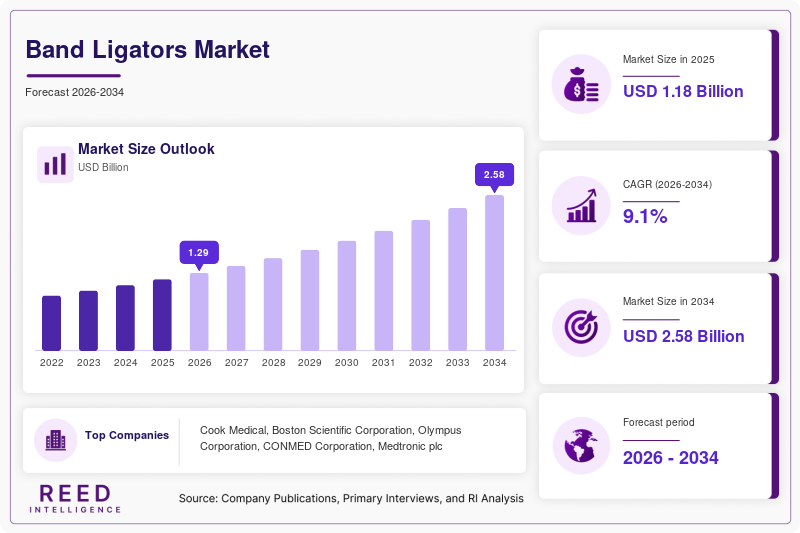
The global Band Ligators Market size was valued at approximately USD 1.18 billion in 2026 and is projected to reach nearly USD 2.36 billion by 2034, expanding at a CAGR of 9.1% during the forecast period from 2026 to 2034. The market is witnessing steady expansion due to the increasing prevalence of gastrointestinal disorders, rising adoption of minimally invasive procedures, and growing investments in endoscopic treatment technologies across developed and emerging economies. Band ligators are widely used in endoscopic variceal ligation procedures for the treatment of esophageal varices, hemorrhoids, and gastrointestinal bleeding conditions, creating sustained demand from hospitals and ambulatory surgical centers.
The rising global burden of chronic liver diseases has remained one of the major factors supporting industry growth. Increasing alcohol consumption, obesity-related liver complications, and hepatitis infections have significantly raised the incidence of portal hypertension and esophageal varices. As healthcare systems continue emphasizing early intervention and minimally invasive therapies, healthcare providers are increasingly adopting advanced band ligation systems with improved precision, safety, and operational efficiency.
Key Highlights
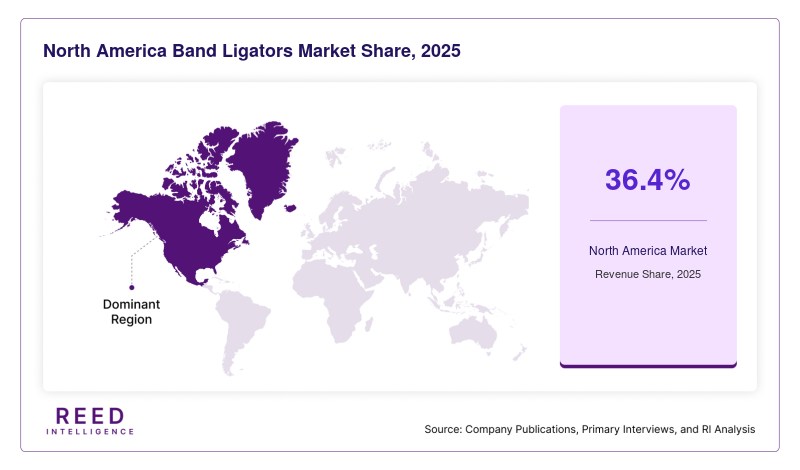
- North America dominated the market with a 36.4% share in 2025.
- Asia Pacific is expected to grow at the fastest CAGR of 10.8% during 2026–2034.
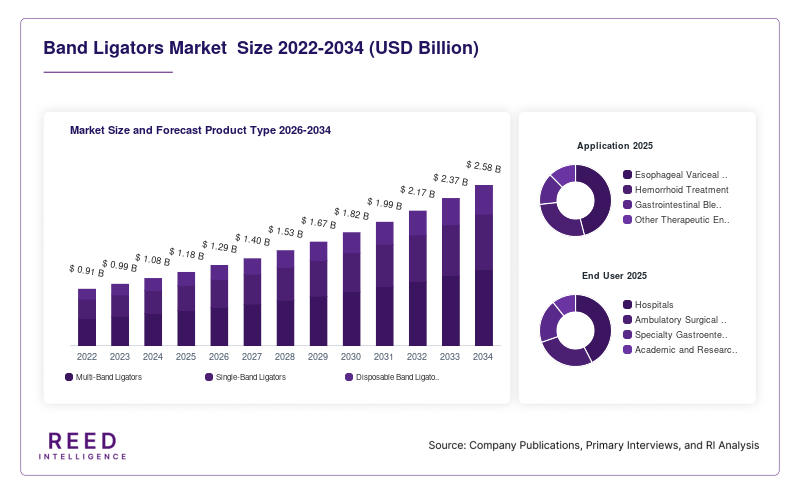
- By product type, multi-band ligators accounted for the largest share of 61.3%.
- while disposable band ligators are projected to grow at a CAGR of 11.5%.
- By application, esophageal variceal ligation led with a 48.6% share.
- whereas hemorrhoid treatment is expected to expand at a CAGR of 10.9%.
- The United States remained the dominant country, with market values of USD 412 million in 2024 and USD 448 million in 2025.
Market Trends
Rising Adoption of Disposable Endoscopic Devices
Healthcare facilities are increasingly shifting toward disposable and single-use endoscopic accessories, creating a significant trend in the Band Ligators Market. Concerns regarding hospital-acquired infections and cross-contamination risks have encouraged hospitals and ambulatory surgical centers to adopt disposable ligator systems. These devices reduce sterilization requirements and improve operational efficiency, particularly in high-volume gastrointestinal procedure centers. Manufacturers are responding by launching cost-effective disposable systems with enhanced elastic band deployment capabilities and simplified compatibility with endoscopes.
The trend is particularly visible in developed healthcare markets where infection prevention regulations have become more stringent. Hospitals are prioritizing patient safety and procedural standardization, resulting in stronger procurement of disposable ligation systems. Emerging economies are also witnessing increased adoption as healthcare providers modernize endoscopy units and invest in advanced procedural equipment. This trend is expected to support long-term revenue growth for manufacturers focused on single-use product innovation.
Integration of Advanced Visualization Technologies
Another important trend influencing the market is the integration of advanced imaging and visualization technologies with band ligation procedures. Endoscopy systems equipped with high-definition imaging, narrow-band imaging, and AI-assisted lesion detection are improving procedural accuracy and enhancing clinical outcomes. These technologies assist physicians in identifying bleeding sites and varices more effectively, thereby improving the efficiency of band ligation procedures.
Healthcare providers are increasingly adopting technologically integrated systems that support minimally invasive gastrointestinal treatment pathways. Demand for compatibility between ligators and advanced endoscopic imaging platforms is rising across tertiary hospitals and specialty gastroenterology clinics. Furthermore, growing investments in digital healthcare infrastructure are enabling broader adoption of smart endoscopic systems. This trend is encouraging manufacturers to design ligation devices that offer improved maneuverability, precision placement, and compatibility with modern visualization technologies.
Market Drivers
Increasing Incidence of Gastrointestinal and Liver Disorders
The growing prevalence of gastrointestinal diseases and chronic liver conditions continues to drive the Band Ligators Market globally. Rising cases of liver cirrhosis, portal hypertension, and esophageal varices are increasing the need for endoscopic ligation procedures. Sedentary lifestyles, alcohol consumption, obesity, and viral hepatitis infections have contributed to a higher burden of digestive and liver-related disorders, particularly among aging populations.
Healthcare systems are increasingly focusing on early-stage intervention and minimally invasive therapies to reduce hospitalization costs and improve patient outcomes. Band ligation procedures are widely preferred due to lower complication rates and faster recovery periods compared to surgical alternatives. Increasing awareness regarding gastrointestinal screening and improved access to endoscopic care are also contributing to higher procedural volumes. As the number of patients requiring therapeutic endoscopy continues rising, the demand for advanced band ligation systems is expected to increase steadily across hospitals and specialty clinics.
Expansion of Ambulatory Surgical Centers and Endoscopy Units
The rapid expansion of ambulatory surgical centers and specialized endoscopy facilities is another major growth driver for the market. Healthcare providers are increasingly shifting gastrointestinal procedures from traditional inpatient settings to outpatient facilities in order to reduce treatment costs and improve operational efficiency. Band ligation procedures are particularly suitable for ambulatory environments because they are minimally invasive and involve shorter recovery durations.
Governments and private healthcare organizations are investing heavily in modern endoscopy infrastructure across emerging economies. The increasing availability of trained gastroenterologists and endoscopic specialists is also supporting procedural growth. In addition, reimbursement improvements for minimally invasive gastrointestinal procedures in several developed countries are encouraging broader adoption of band ligators. These factors are collectively strengthening the market outlook for manufacturers supplying advanced ligation devices to outpatient healthcare settings.
Market Restraint
High Procedure Costs and Limited Access in Developing Regions
Despite strong market potential, the Band Ligators Market faces challenges associated with high procedural costs and limited access to advanced endoscopic care in low-income and developing regions. The installation and maintenance of endoscopic systems require significant capital investment, making advanced gastrointestinal treatment less accessible for smaller healthcare facilities. Many hospitals in underdeveloped regions continue relying on conventional treatment methods due to budget limitations and inadequate reimbursement support.
The shortage of trained endoscopic specialists further restricts market expansion in rural and underserved healthcare environments. In several countries, patients delay gastrointestinal treatment because of affordability concerns and limited awareness regarding minimally invasive procedures. Additionally, disposable band ligators may increase procedural expenses for healthcare facilities operating under strict cost constraints. These factors collectively create barriers to widespread adoption, particularly in regions with underdeveloped healthcare infrastructure and limited insurance coverage for endoscopic procedures.
Market Opportunities
Growing Healthcare Investments in Emerging Economies
Emerging economies are presenting substantial opportunities for companies operating in the Band Ligators Market. Countries across Asia Pacific, Latin America, and parts of the Middle East are increasing investments in healthcare infrastructure modernization, including the expansion of endoscopy departments and specialty gastrointestinal clinics. Governments are implementing healthcare reforms aimed at improving access to minimally invasive procedures and reducing the burden on tertiary care hospitals.
Rising disposable income levels and improving medical insurance coverage are encouraging patients to seek advanced gastrointestinal treatment options. International medical device manufacturers are also expanding distribution networks and strategic partnerships in developing regions to strengthen market penetration. As awareness regarding liver disease management and gastrointestinal screening continues increasing, demand for advanced ligation systems is expected to accelerate significantly across emerging healthcare markets.
Increasing Demand for Minimally Invasive Therapeutic Procedures
The growing preference for minimally invasive medical procedures is creating strong growth opportunities for the market. Patients and healthcare providers increasingly favor endoscopic interventions because they reduce hospital stays, minimize surgical trauma, and improve recovery timelines. Band ligation procedures align closely with this healthcare transition toward non-surgical therapeutic approaches.
Technological advancements are further improving procedural safety and efficiency, encouraging physicians to adopt ligation systems for a wider range of gastrointestinal applications. Expanding geriatric populations worldwide are also contributing to higher demand for minimally invasive digestive disease treatment. In addition, healthcare providers are integrating advanced endoscopy technologies into routine care pathways, enabling broader adoption of therapeutic band ligation systems. These developments are expected to create favorable long-term growth opportunities for manufacturers and healthcare service providers.
Segmental Analysis
By Product Type
Multi-band ligators accounted for the largest share of the Band Ligators Market in 2024, representing approximately 61.3% of total revenue. These devices are widely preferred because they allow physicians to deploy multiple bands during a single procedure, improving efficiency and reducing procedural time. Hospitals and ambulatory surgical centers increasingly favor multi-band systems due to their operational convenience and ability to enhance patient outcomes in esophageal variceal ligation procedures. The growing prevalence of gastrointestinal bleeding disorders and increasing demand for therapeutic endoscopy continue supporting adoption of these systems. In addition, advancements in ergonomic device design and improved compatibility with flexible endoscopes are strengthening product demand across developed healthcare markets.
Disposable band ligators are expected to witness the fastest CAGR of 11.5% during the forecast period. Increasing concerns regarding infection control and cross-contamination risks are encouraging healthcare providers to adopt single-use devices. Disposable systems eliminate sterilization requirements and help improve workflow efficiency in high-volume healthcare facilities. Regulatory emphasis on patient safety and infection prevention is also contributing to stronger market adoption. Manufacturers are increasingly introducing cost-efficient disposable products with enhanced deployment precision and simplified procedural handling. Furthermore, expanding healthcare infrastructure in emerging economies and increasing awareness regarding minimally invasive treatment procedures are expected to accelerate growth within this subsegment over the coming years.
By Application
Esophageal variceal ligation represented the dominant application segment in 2024, accounting for nearly 48.6% of the global Band Ligators Market. The increasing prevalence of chronic liver diseases and portal hypertension has significantly raised the number of patients requiring variceal treatment procedures. Endoscopic band ligation remains one of the most widely preferred treatment methods because it offers effective bleeding control with lower complication rates compared to surgical alternatives. Hospitals and specialty gastroenterology centers continue expanding therapeutic endoscopy services to address growing patient demand. Additionally, increasing physician awareness regarding early intervention strategies for gastrointestinal bleeding disorders is supporting continued growth within this application category.
Hemorrhoid treatment is anticipated to record the fastest CAGR of 10.9% during the forecast period. Rising incidence of hemorrhoidal disease associated with sedentary lifestyles, aging populations, and dietary changes is contributing to higher procedural demand globally. Band ligation procedures for hemorrhoids are increasingly preferred due to shorter recovery durations and reduced procedural discomfort. Healthcare providers are also promoting minimally invasive outpatient treatment options to reduce hospitalization costs and improve patient convenience. Technological improvements in ligation devices are enabling more precise treatment delivery, encouraging broader adoption across ambulatory surgical centers and specialized colorectal clinics worldwide.
By End User
Hospitals accounted for the largest share of the Band Ligators Market in 2024, contributing approximately 54.1% of total revenue. Large hospitals continue dominating the market due to their advanced endoscopy infrastructure, availability of trained specialists, and ability to handle complex gastrointestinal procedures. The increasing number of therapeutic endoscopy procedures performed in tertiary care facilities is supporting sustained demand for advanced ligation systems. Hospitals also benefit from stronger reimbursement frameworks and higher procurement budgets, enabling adoption of technologically advanced devices. Rising admissions related to gastrointestinal bleeding and liver disorders are further strengthening demand for band ligators across hospital-based gastroenterology departments.
Ambulatory surgical centers are projected to experience the fastest growth rate, registering a CAGR of 10.7% during the forecast period. These facilities are increasingly preferred for minimally invasive gastrointestinal procedures because they offer lower treatment costs and shorter patient recovery timelines. Improvements in outpatient endoscopy technologies and increasing healthcare emphasis on cost optimization are driving procedural migration from inpatient hospitals to ambulatory settings. In addition, growing patient preference for convenient and same-day treatment options is supporting expansion of ambulatory surgical centers globally. Manufacturers are also developing compact and user-friendly ligation systems specifically designed for outpatient procedural environments.
Regional Analysis
North America
North America accounted for the largest share of the Band Ligators Market in 2025, representing approximately 36.4% of global revenue. The region is projected to maintain steady growth with a CAGR of 8.6% during the forecast period. Strong healthcare infrastructure, widespread availability of advanced endoscopy systems, and high awareness regarding gastrointestinal disease management continue supporting regional demand. The increasing prevalence of liver cirrhosis and gastrointestinal bleeding disorders has also contributed to rising procedural volumes across hospitals and ambulatory surgical centers.
The United States remains the dominant country within the regional market due to strong adoption of minimally invasive treatment procedures and favorable reimbursement policies. The country benefits from the presence of leading medical device manufacturers and advanced clinical research capabilities. Rising healthcare expenditure and expanding outpatient endoscopy services are encouraging broader utilization of band ligation systems. Furthermore, growing demand for disposable endoscopic accessories is supporting continued market expansion across major healthcare networks.
Europe
Europe held a significant share of the Band Ligators Market in 2025 and is expected to witness stable growth throughout the forecast period at a CAGR of 8.1%. The region benefits from established healthcare systems, strong physician awareness, and increasing adoption of minimally invasive gastrointestinal treatment procedures. Countries across Western Europe continue investing in modern endoscopy infrastructure to improve digestive disease diagnosis and treatment efficiency.
Germany represents the leading country within the European market due to its advanced healthcare facilities and strong presence of gastroenterology specialists. The country has witnessed increasing adoption of technologically advanced endoscopic devices in tertiary hospitals and specialty clinics. Growing elderly populations and higher incidence of digestive diseases are also contributing to rising demand for therapeutic endoscopy procedures. Additionally, supportive healthcare reimbursement structures are encouraging healthcare providers to expand minimally invasive treatment services.
Asia Pacific
Asia Pacific is projected to register the fastest CAGR of 10.8% during the forecast period, driven by expanding healthcare infrastructure and rising awareness regarding gastrointestinal disorders. The region accounted for a notable share of global market revenue in 2025 and continues attracting investments from international medical device manufacturers. Rapid urbanization, improving healthcare accessibility, and increasing prevalence of liver diseases are major factors supporting regional growth.
China dominates the regional market due to large patient populations and ongoing healthcare modernization initiatives. Government investments in hospital infrastructure and expansion of diagnostic endoscopy services are creating favorable growth conditions for band ligator manufacturers. The increasing number of gastroenterologists and rising adoption of minimally invasive procedures are further strengthening market demand. In addition, improving insurance coverage and healthcare spending among middle-income populations are accelerating adoption across urban healthcare facilities.
Middle East & Africa
The Middle East & Africa region is experiencing gradual growth in the Band Ligators Market, supported by improving healthcare infrastructure and increasing awareness regarding digestive disease treatment. The market is forecast to expand at a CAGR of 7.5% between 2026 and 2034. Several countries in the Gulf region are investing in advanced medical technologies and specialty healthcare facilities to improve clinical outcomes and reduce dependence on overseas treatment services.
Saudi Arabia remains the dominant country within the region due to ongoing healthcare transformation initiatives and increasing investments in hospital modernization. Rising incidence of obesity-related liver disorders and gastrointestinal complications has increased demand for advanced endoscopic procedures. The country is also witnessing growth in private healthcare facilities equipped with modern diagnostic and therapeutic technologies. These developments are supporting wider adoption of band ligation systems in both public and private healthcare institutions.
Latin America
Latin America accounted for a moderate share of the Band Ligators Market in 2025 and is expected to grow steadily over the forecast period with a CAGR of 7.9%. Expanding healthcare access, increasing prevalence of gastrointestinal diseases, and growing investments in endoscopic treatment infrastructure are supporting market development. Several countries are improving healthcare delivery systems to address rising demand for minimally invasive therapeutic procedures.
Brazil dominates the regional market owing to its relatively advanced healthcare network and growing number of specialized gastroenterology centers. Increasing public awareness regarding digestive disease diagnosis and treatment has contributed to higher demand for endoscopic procedures. The country is also benefiting from rising private healthcare investments and expanding availability of trained endoscopy professionals. These factors are creating favorable opportunities for manufacturers supplying band ligation devices and related gastrointestinal treatment equipment.
Competitive Landscape
The Band Ligators Market is characterized by moderate competition, with established medical device manufacturers focusing on technological innovation, product portfolio expansion, and geographic expansion strategies. Companies are increasingly investing in research and development activities to introduce advanced ligation systems with improved precision, enhanced compatibility, and infection prevention features. Strategic collaborations with hospitals and gastroenterology centers are also helping manufacturers strengthen their distribution capabilities and market presence.
Cook Medical remains one of the leading participants in the market due to its extensive portfolio of endoscopic therapeutic devices and strong global distribution network. The company continues focusing on product innovation and physician training initiatives to maintain competitive positioning. Boston Scientific Corporation recently introduced upgraded ligation technologies designed to improve deployment efficiency and procedural accuracy in gastrointestinal applications.
Other major companies are actively pursuing acquisitions and partnerships to expand their endoscopy product portfolios and strengthen regional market penetration. Increasing emphasis on disposable medical devices and minimally invasive gastrointestinal procedures is expected to intensify competition among key industry participants throughout the forecast period.
Key Players
- Cook Medical
- Boston Scientific Corporation
- Olympus Corporation
- CONMED Corporation
- Medtronic plc
- FUJIFILM Holdings Corporation
- STERIS plc
- B. Braun Melsungen AG
- Endo-Flex GmbH
- Medi-Globe Corporation
- US Endoscopy
- Hobbs Medical Inc.
- Smart Medical Systems Ltd.
Recent Developments
- Boston Scientific Corporation expanded its gastrointestinal endoscopy portfolio in 2025 through the launch of an advanced multi-band ligation device with enhanced deployment control features.
- Olympus Corporation introduced upgraded visualization-compatible ligation accessories aimed at improving precision during therapeutic endoscopic procedures in 2024.
- Cook Medical announced the expansion of its disposable endoscopic accessory manufacturing capabilities to meet rising global demand for infection-control-focused products in 2025.
Band Ligators Market Segments
Product Type
- Multi-Band Ligators
- Single-Band Ligators
- Disposable Band Ligators
Application
- Esophageal Variceal Ligation
- Hemorrhoid Treatment
- Gastrointestinal Bleeding Management
- Other Therapeutic Endoscopy Procedures
End User
- Hospitals
- Ambulatory Surgical Centers
- Specialty Gastroenterology Clinics
- Academic and Research Institutes
By Region
- North America
- Europe
- APAC
- Middle East and Africa
- LATAM