Barbell Bar Market Size, Share & Trends Analysis Report By Bar Type (Olympic Weightlifting Bars, Powerlifting Bars, Multipurpose Bars, Specialty Bars), By Application (Commercial Gyms & Fitness Centers, Home Gyms, Professional & Competitive Training, Institutional & Sports Facilities), By Distribution Channel (Online, Offline) and By Region (North America, Europe, APAC, Middle East and Africa, LATAM) Forecasts, 2026–2034
USD 3950
Barbell Bar Market Size
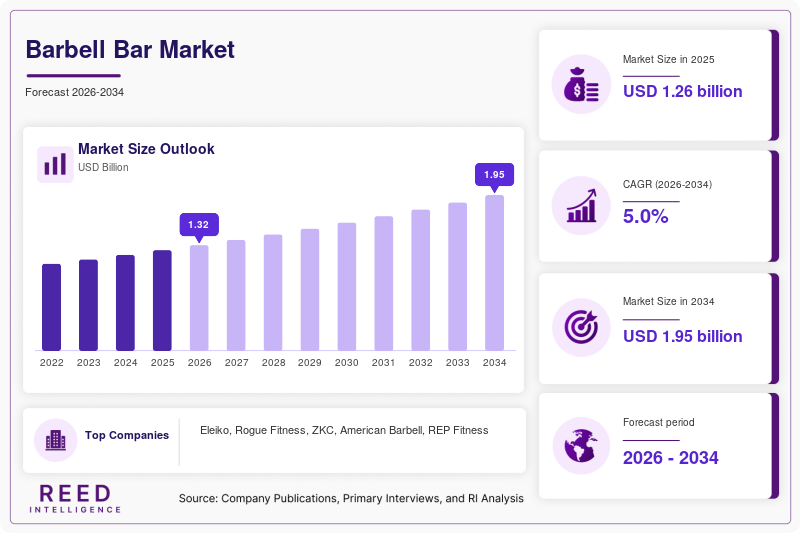
The global barbell bar market size was valued at USD 1.26 billion in 2025 and is projected to grow from USD 1.32 billion in 2026 to USD 1.95 billion by 2034, registering a CAGR of 5.00% during the forecast period from 2026 to 2034.
The barbell bar market is benefiting from the continued importance of traditional strength training, functional fitness, weightlifting, powerlifting and home-based resistance exercise. The American College of Sports Medicine (ACSM) ranked traditional strength training among the leading fitness trends for 2026 and notes that it includes free-weight exercises using barbells, dumbbells and kettlebells. ACSM also highlights strength and muscle-preservation requirements among older adults, broadening the user base beyond competitive athletes.
Product demand is becoming more specialized. Manufacturers now offer separate bars for Olympic weightlifting, powerlifting, multipurpose training, technique work and specialty exercises. Rogue's current portfolio, for example, includes men's and women's bars, Olympic weightlifting bars, powerlifting bars, multipurpose bars, technique bars and specialty bars with different diameters, tensile strengths, knurling patterns and bearing configurations.
Competition-grade specifications remain an important market differentiator. The International Weightlifting Federation (IWF) specifies 20 kg men's and 15 kg women's competition barbells and requires approved barbells for competitions under its jurisdiction. In 2025, the IWF also updated its technical regulations, including changes affecting barbell rim diameter.
At the premium end, manufacturers are adding durability, sustainability and connected-training features. Eleiko launched a new generation of bars in 2025 with sensor-readiness, refined geometry and updated finishes, while its 2025 sustainability report highlighted bars manufactured with recycled steel and fossil-free energy.
Barbell Bar Market Drivers
Traditional strength training remains a durable fitness category
Traditional strength training continues to provide a broad demand base for barbells across gyms, home fitness and athletic training. ACSM ranked traditional strength training among the top fitness trends for 2026 and describes free-weight training as important for muscular strength, endurance, function, bone density and metabolic health. The category also extends into older-adult fitness, where ACSM's 2026 research highlights maintaining muscle mass, strength, balance and mobility. This creates demand beyond competitive lifting: commercial gyms require durable general-purpose bars, home users seek multipurpose equipment, and athletic facilities require discipline-specific products. The mechanism is therefore broad participation in resistance exercise rather than dependence on a single sport. As training becomes more individualized, consumers are also more willing to purchase separate bars optimized for powerlifting, Olympic lifting, functional fitness or specialty movements.
Expansion of home and multipurpose strength-training setups
The barbell has become a core component of home strength-training environments because one bar can support squats, presses, deadlifts, Olympic movements and other compound exercises. Rogue describes barbells as fundamental equipment for both home and commercial gyms and offers multipurpose products designed across multiple movements. This creates a relatively simple equipment proposition: one high-quality bar can be combined with plates and a rack to create a broad training platform. Manufacturers are responding with multipurpose bars that balance knurling, shaft diameter, tensile strength and sleeve rotation across different exercises. This category also benefits from replacement demand because bars experience repeated loading, impact and environmental exposure. Premium coatings, stainless-steel shafts and improved manufacturing tolerances therefore create opportunities to trade customers upward from basic bars.
Competitive weightlifting and powerlifting standards support premium equipment demand
Organized strength sports create a market for precisely manufactured and certified barbells. The IWF requires competition barbells to meet defined specifications and only permits approved equipment in competitions under its jurisdiction. In June 2025, the IWF formally appointed Eleiko and ZKC as official barbell suppliers for 2025–2028, giving the manufacturers access to major international events including Olympic and IWF competitions. The IWF subsequently appointed Eleiko as the sole weightlifting equipment supplier for the Los Angeles 2028 Olympic Games. These requirements create a premium segment in which dimensional accuracy, rotation, knurling, stiffness, durability and certification influence purchasing decisions. Competitive specifications also influence recreational buyers who seek equipment modeled on professional training environments.
Barbell Bar Market Restraints
Premium barbells carry relatively high upfront prices
High-performance barbells can be expensive compared with basic fitness equipment. Current specialist portfolios span entry-level, multipurpose, Olympic, powerlifting and specialty products, with price differences reflecting steel grade, coatings, tensile strength, bearings, machining and certification. Rogue's current portfolio illustrates this wide price and specification range, while its Ohio Power Bar uses a 205,000 PSI shaft and specialized powerlifting knurling. For commercial gyms purchasing dozens of bars, upfront equipment cost can materially affect procurement decisions. Home users may also choose less expensive multipurpose bars instead of discipline-specific premium models. This creates a two-tier market in which premium brands must demonstrate longer service life and performance benefits to justify higher prices.
Product durability and material requirements increase manufacturing complexity
Barbells need to withstand repeated bending, impact, loading and unloading. Manufacturers therefore differentiate through steel composition, tensile strength, surface treatment, sleeve design, knurling and corrosion resistance. Eleiko's current products emphasize calibrated construction, certification, precision rotation and different finishes for specific training environments. Sustainability requirements add another layer: Eleiko reported in 2026 that its new-generation bars use steel composed of 97% recycled material and produced with fossil-free energy. These manufacturing requirements can increase production complexity and material costs. At the same time, customers increasingly expect long warranties and consistent performance, putting pressure on manufacturers to balance premium specifications with competitive pricing.
Barbell Bar Market Opportunities
Connected and Sensor-Ready Barbells
Barbell technology is beginning to incorporate measurement and connected-training capabilities. Eleiko's 2025 next-generation bars expanded sensor readiness across more products, allowing integration with lifting analysis and programming capabilities. This creates an opportunity to connect a traditionally mechanical product with digital training ecosystems. Sensors can potentially support measurement of movement characteristics, repetitions and training performance while allowing coaches and athletes to integrate bar data with broader strength programs. The commercial model can therefore extend beyond the physical bar into analytics, coaching and training software. The opportunity is particularly relevant to professional athletes, sports-performance facilities and technology-oriented gyms, although mass adoption will depend on whether connected features deliver measurable benefits without materially increasing equipment cost.
Sustainable and Longer-Life Barbell Manufacturing
Sustainability is becoming a product-differentiation opportunity in premium strength equipment. Eleiko reported that its 2025 generation of barbells uses 97% recycled steel and fossil-free energy, resulting in an 80% lower CO₂ footprint compared with the global average for steel according to the company's sustainability reporting. Longer product life also has commercial value because commercial gyms and athletic facilities prioritize equipment reliability and replacement intervals. Manufacturers can therefore differentiate through recycled materials, lower-carbon manufacturing, corrosion-resistant finishes, repairability and extended warranties. This positioning can be particularly relevant for institutional buyers that incorporate sustainability requirements into procurement. The opportunity remains dependent on maintaining mechanical performance, since strength athletes generally prioritize reliability and bar feel over environmental attributes when the two appear to conflict.
Segmental Analysis
By Bar Type
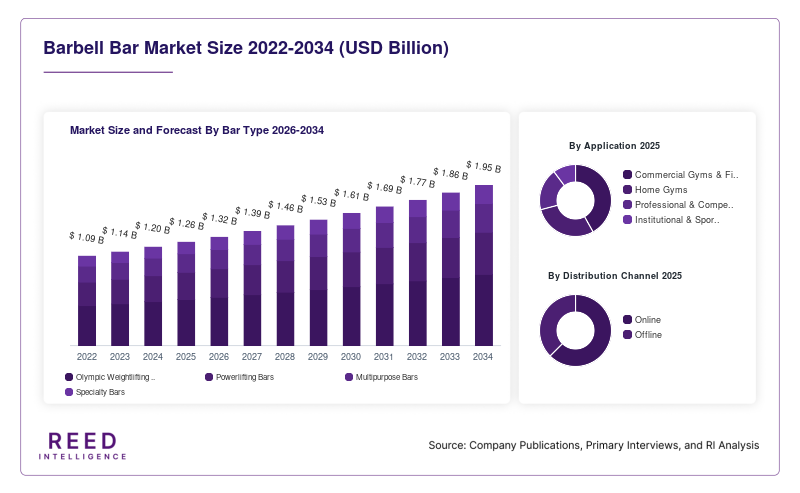
Multipurpose Bars represent approximately 38% of the global market in 2025, making them the dominant bar category. Their broad exercise compatibility allows one bar to support squats, bench presses, deadlifts, cleans and other movements. Rogue's Ohio Bar, for example, is positioned as a multipurpose bar designed for exercises spanning powerlifting and Olympic lifting, while the company's broader catalog separates multipurpose products from powerlifting, Olympic and specialty bars.
Multipurpose Bars are also among the fastest-growing categories, with a projected CAGR of approximately 6.1%. Their growth is linked to home gyms, general commercial facilities and users who want one versatile bar rather than several discipline-specific products. Their balance of stiffness, knurling and sleeve rotation makes them particularly suitable for mixed training programs.
Olympic Weightlifting Bars account for approximately 28%, while Powerlifting Bars represent around 24%. Specialty Bars account for the remaining 10%.
By Application
Commercial Gyms & Fitness Centers account for approximately 42% of the global market in 2025, making them the dominant application. Commercial facilities purchase multiple bars to support high member utilization and different training zones. Durability, warranty support, corrosion resistance and standardized specifications therefore have a direct effect on procurement decisions.
Home Gyms are the fastest-growing application, with a projected CAGR of approximately 6.3%. The barbell's ability to support several compound movements makes it an efficient core purchase for home strength setups. Manufacturers increasingly offer multipurpose products that can serve several training styles, reducing the need for consumers to buy separate bars.
By Distribution Channel
Offline channels account for approximately 54% of the global market in 2025, reflecting the importance of specialist fitness-equipment dealers, sporting-goods stores, gym-equipment suppliers and direct commercial sales. Buyers can physically evaluate knurling, bar stiffness, finish and sleeve rotation before purchasing, which remains relevant for premium equipment.
Online channels are the fastest-growing distribution route, with a projected CAGR of approximately 6.8%. Standardized specifications allow buyers to compare bars remotely, while direct-to-consumer fitness brands can offer a wider selection without maintaining extensive physical retail networks. Rogue's online catalog demonstrates how manufacturers can sell highly specialized bars directly while providing detailed specifications for weight, diameter, tensile strength and intended use.
Regional Analysis
North America Barbell Bar Market
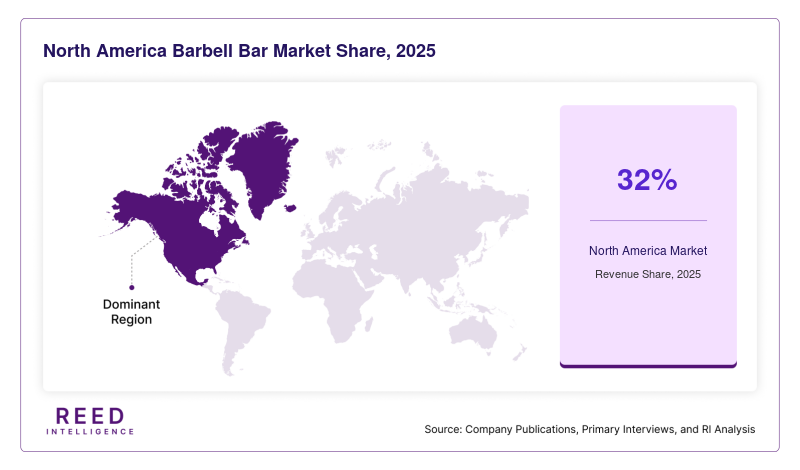
North America represents approximately 32% of the global barbell bar market in 2025, making it the largest regional market. The region has a mature commercial fitness industry, extensive home-gym adoption and strong participation in powerlifting, Olympic weightlifting, CrossFit and strength-and-conditioning programs.
The United States is also home to major equipment manufacturers and brands, including Rogue Fitness. Rogue's current catalog spans more than 100 barbell products, covering men's and women's Olympic bars, powerlifting bars, multipurpose bars, specialty bars, and technique bars. This product breadth reflects the region's highly segmented consumer base.
North America is projected to register a CAGR of approximately 4.7% through 2034. Replacement purchases, commercial-gym refurbishment and continued home strength training will support demand, while relatively high penetration limits the growth rate compared with developing markets.
Europe Barbell Bar Market
Europe accounts for approximately 27% of the global market in 2025, supported by established gym networks, organized weightlifting and powerlifting, sports clubs and strong demand for premium strength equipment.
Sweden-based Eleiko is a major European barbell manufacturer and maintains a portfolio covering IWF- and IPF-certified competition equipment, training bars, functional-fitness products and specialty bars. The company's involvement in global competitions also gives European manufacturing strong visibility in professional strength sports.
Europe is projected to grow at approximately 4.8% CAGR. Demand will be supported by fitness participation, replacement of aging equipment and continued investment in professional and institutional training facilities. Sustainability requirements may become an increasingly important procurement factor as manufacturers introduce lower-carbon steel and longer-life products.
APAC Barbell Bar Market
APAC represents approximately 25% of the global market in 2025 and is the fastest-growing region, with a projected CAGR of approximately 6.4%. China, Japan, South Korea, Australia and India are important demand centers, supported by expanding fitness facilities, growing strength-training participation, sports development and rising home-gym adoption.
China has a particularly important position in competition-grade weightlifting equipment. The IWF formally appointed ZKC and Eleiko as official barbell suppliers for the 2025–2028 cycle, with both companies receiving access to major IWF events. The region therefore combines a substantial consumer market with significant manufacturing capability.
Japan also has a strong equipment-development ecosystem, while India and Southeast Asian markets provide expansion opportunities as organized fitness and strength training become more established. The commercial mechanism is primarily increased gym penetration and consumer spending on home fitness equipment.
Price sensitivity remains a constraint across several emerging APAC markets, favoring multipurpose and mid-priced bars over highly specialized premium products.
Middle East and Africa Barbell Bar Market
Middle East and Africa represent approximately 8% of the global market in 2025, with demand concentrated in major metropolitan areas, commercial gyms, hotels, sports facilities and premium fitness centers.
Strength training is increasingly integrated into broader wellness and fitness offerings, particularly within high-income urban markets in the Gulf. Commercial fitness operators require durable equipment capable of handling high utilization, while hospitality and residential developments provide additional demand for compact gym installations.
The region is projected to grow at approximately 5.6% CAGR through 2034. New fitness facilities, sports infrastructure and premium residential developments should support equipment procurement. However, imported-equipment costs, distribution networks and differences in consumer purchasing power can affect market penetration.
LATAM Barbell Bar Market
LATAM represents approximately 8% of the global market in 2025, with Brazil, Mexico, Argentina, Colombia and Chile serving as important fitness-equipment markets.
The region has a strong culture of gym-based resistance training and a growing network of commercial fitness facilities. Barbells are particularly relevant because they support multiple exercises without requiring extensive equipment, which makes them suitable for both independent gyms and home setups.
LATAM is projected to grow at approximately 5.4% CAGR. Online retail can expand access to specialist equipment beyond major cities, while commercial gym expansion should sustain institutional purchases. Currency fluctuations, import costs and lower purchasing power for premium equipment remain important constraints.
Competitive Landscape
The barbell bar market contains a mix of specialist strength-equipment manufacturers, fitness-equipment companies and broader sporting-goods brands. Competition is based on steel quality, tensile strength, bar stiffness, knurling, sleeve rotation, corrosion resistance, certification, durability, warranty and price.
Eleiko occupies a premium position in competition and professional strength equipment. Its portfolio includes IWF- and IPF-certified bars as well as training, functional-fitness and specialty products. The company launched its next-generation bars in September 2025, incorporating refined geometry, new finishes and sensor readiness. In January 2026, the IWF appointed Eleiko sole supplier of weightlifting equipment for the Los Angeles 2028 Olympic Games, strengthening its association with elite competition equipment.
Rogue Fitness competes across a much broader product range, including Olympic weightlifting, powerlifting, multipurpose, specialty and technique bars. Its current portfolio differentiates products by diameter, tensile strength, coatings, bearings, knurling and intended application. This allows the company to serve both home users and professional facilities.
Key Market Players
- Eleiko
- Rogue Fitness
- ZKC
- American Barbell
- REP Fitness
- Kabuki Strength
- Ivanko Barbell
- Texas Power Bars
- Gymleco
- Vulcan Strength
- Again Faster
- York Barbell
- Strength Shop
- Fringe Sport
- Bells of Steel
Recent Market Developments
- June 2026 – Eleiko: Eleiko released its 2025 Sustainability Report, highlighting its new-generation bars made from steel containing 97% recycled material and produced using fossil-free energy. The company reported an 80% lower CO₂ footprint compared with the global steel average for the material.
- January 2026 – IWF: The International Weightlifting Federation appointed Eleiko as sole weightlifting-equipment supplier for the Los Angeles 2028 Olympic Games, covering competition, warm-up, and training equipment.
Barbell Bar Market Segments
By Bar Type
- Olympic Weightlifting Bars
- Powerlifting Bars
- Multipurpose Bars
- Specialty Bars
By Application
- Commercial Gyms & Fitness Centers
- Home Gyms
- Professional & Competitive Training
- Institutional & Sports Facilities
By Distribution Channel
- Online
- Offline
By Region
- North America
- Europe
- APAC
- Middle East and Africa
- LATAM