Barbie Doll Market Size, Share, Demand Report By Type (Fashion Dolls, Career Dolls, Collectible Dolls), By Application (Children, Collectors, Gifting) By Region & Segment Forecasts, 2026–2034
USD 3950
Barbie Doll Market Size
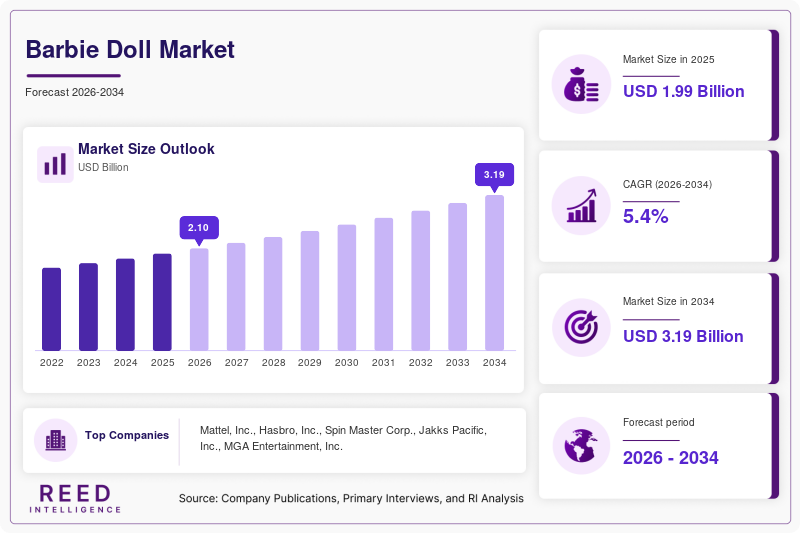
Barbie Doll market size is projected at USD 2.1 billion in 2026 and is expected to hit USD 3.19 billion by 2034, with a CAGR of 5.4%. Market participants increasingly require detailed data covering product formats, consumer applications, regional demand, pricing dynamics, production volumes, and competitive positioning. Detailed segmentation and competitive landscape analysis help manufacturers and retailers identify high-growth consumer groups, optimize product portfolios, and capture emerging opportunities.
Key Takeaways
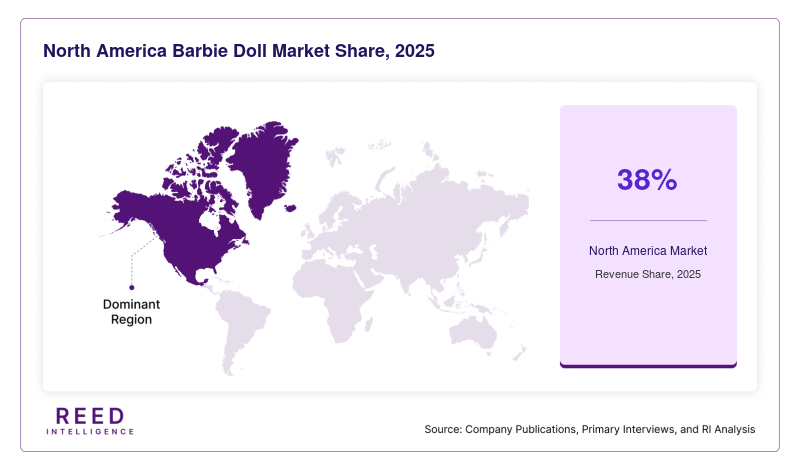
- North America dominated the Barbie Doll Market with an estimated 38% share in 2025, while Asia Pacific is projected to be the fastest-growing region at approximately 7.0% CAGR through 2034.
- Fashion Dolls represented the leading product category with approximately 52% market share in 2025, while Collectible Dolls are expected to record the fastest growth at about 6.5% CAGR.
- Children accounted for nearly 61% of application demand in 2025, supported by continued demand for imaginative, role-play, and fashion-oriented toys.
- Collectors represented approximately 22% of demand in 2025 and are expected to expand rapidly as limited editions, collaborations, premium dolls, and nostalgia-driven purchases gain traction.
- India is an emerging high-growth country market, projected to reach approximately USD 125 million by 2034, expanding at an estimated CAGR of 8.1% during 2026–2034.
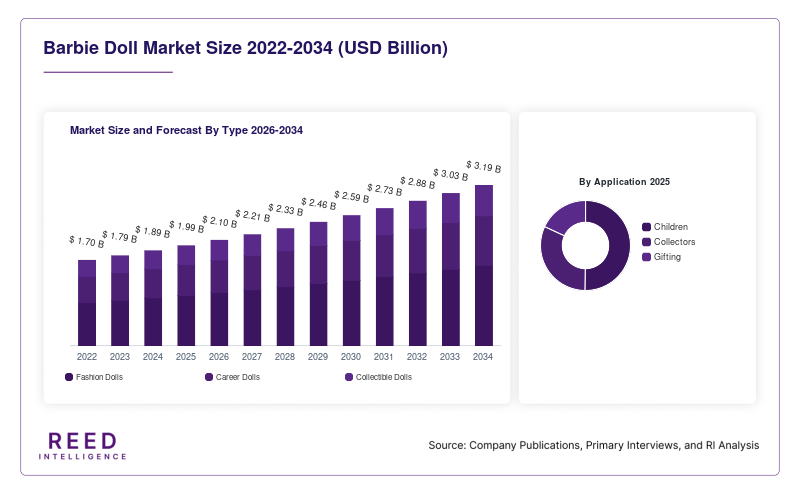
The Barbie Doll Market comprises the design, manufacturing, licensing, distribution, and retail sale of Barbie-branded dolls and associated fashion, career, collectible, and play-oriented formats. Global Barbie-related production is estimated at more than 50 million doll units annually across core dolls and selected related formats, with production distributed across large-scale manufacturing networks in Asia and other international locations. Adoption remains strongest among children, while adult collectors and nostalgia-driven consumers are expanding the addressable market. Fashion Dolls account for approximately 52% of market value, followed by Career Dolls at around 27% and Collectible Dolls at nearly 21%. Digital entertainment, social media exposure, film-related visibility, licensed merchandise, and e-commerce have strengthened brand penetration across age groups and geographies.
Barbie Doll Market Trends
Personalization, Digital Engagement, and Collectible Expansion
Technology and product development are shifting Barbie from a conventional fashion doll toward a broader entertainment and personalization platform. Manufacturers are increasingly incorporating diverse body types, skin tones, hairstyles, professions, accessories, and themed playsets to address changing consumer expectations. Digital marketing, social media content, virtual storytelling, influencer activity, and e-commerce recommendations are also influencing product discovery and purchase decisions. Collectible-oriented releases increasingly use premium packaging, limited production runs, special-edition styling, and character-based storytelling to attract adult consumers.
Sector-specific demand is also being shaped by entertainment franchises, fashion collaborations, career representation, and gifting occasions. Barbie dolls are increasingly purchased not only as children's toys but also as collectible products and cultural merchandise. Sustainability is influencing packaging and material decisions, while retailers are expanding online assortments to provide wider access to regional and limited-edition products.
Barbie Doll Market Drivers
Expansion of Character and Career-Based Play
Increasing demand for imaginative play and representation across professions, lifestyles, and cultural backgrounds is a major market driver. Career-themed dolls allow children to explore occupations and aspirational identities while expanding product variety. The continued introduction of new characters, accessories, clothing collections, and playsets encourages repeat purchases and supports higher engagement across multiple age groups.
Barbie Doll Market Restraints
Premium Pricing and Manufacturing Costs
Rising polymer, textile, packaging, labor, logistics, and compliance costs can increase retail prices and restrict affordability in price-sensitive markets. Premium collectible formats may also experience slower volume turnover because consumers compare them with lower-priced competing dolls and alternative entertainment products. Currency fluctuations and international distribution costs further affect pricing across emerging economies.
Barbie Doll Market Opportunities
Growth of Adult Collectibles and Emerging Markets
Adult collectors, nostalgia-driven consumers, limited-edition releases, fashion collaborations, and premium character collections represent significant opportunities. Emerging markets in Asia Pacific, Latin America, and the Middle East also offer strong potential as organized retail, e-commerce penetration, disposable incomes, and branded toy awareness increase. Localized characters, culturally relevant fashion, and region-specific marketing can further improve penetration.
Challenges in Barbie Doll Market
Intense Competition and Changing Consumer Preferences
The market faces competition from fashion dolls, collectible figures, character merchandise, digital games, entertainment franchises, and private-label toy products. Children's entertainment preferences are also changing rapidly because of mobile devices and digital platforms. Maintaining relevance requires frequent product innovation while preserving brand identity, controlling inventory risk, and responding to changing safety, sustainability, and consumer expectations.
Barbie Doll Market Segmentation Analysis
By doll type, Fashion Dolls dominated the market with approximately 52% share in 2025, supported by broad children's adoption and extensive fashion and accessory assortments. Career Dolls accounted for nearly 27%, while Collectible Dolls contributed around 21%. By application, Children represented approximately 61% of market demand, followed by Collectors at 22% and Gifting at 17%. These segments reflect the market's transition from a predominantly children's toy category toward a broader lifestyle and collectible ecosystem.
By Type
Fashion Dolls accounted for approximately 52% of the market in 2025, representing an estimated 26 million units of annual production and sales across the broader Barbie product ecosystem. These dolls generally use molded polymer or vinyl components, rooted hair or synthetic fibers, articulated limbs in selected ranges, removable clothing, footwear, and fashion accessories. Demand is supported by frequent outfit changes, themed collections, playsets, and seasonal releases.
Career Dolls represented approximately 27% of the market, corresponding to an estimated 13.5 million units. These products typically feature standard fashion-doll dimensions with occupation-specific clothing, accessories, tools, and themed packaging. Career themes include healthcare, science, education, sports, aviation, business, technology, and creative professions. Their technical design emphasizes recognizable accessories and durable components suitable for repeated role-play.
Collectible Dolls contributed around 21% of market value, equivalent to approximately 10.5 million units across core collectible formats. These products frequently feature specialized styling, premium outfits, display-oriented packaging, detailed accessories, limited editions, anniversary themes, or collaborations. Higher-quality finishing, distinctive facial styling, rooted hair, articulated bodies, and premium packaging enable higher average selling prices than standard play dolls.
By Application
Children remained the largest application, accounting for approximately 61% of market demand and an estimated 30.5 million units. Purchases are driven by imaginative play, fashion styling, storytelling, social play, and career exploration. Products targeted toward children generally emphasize durable construction, accessible accessories, age-appropriate design, bright visual presentation, and compatibility with complementary Barbie furniture, vehicles, clothing, and playsets.
Collectors accounted for approximately 22% of demand, representing nearly 11 million units. This segment favors limited-edition releases, premium dolls, historical recreations, celebrity-inspired collections, fashion collaborations, anniversary products, and highly detailed display pieces. Collector demand generates higher average transaction values and supports direct-to-consumer, specialty retail, and online limited-release strategies.
Gifting represented around 17% of the market, corresponding to approximately 8.5 million units. Birthday celebrations, holidays, festivals, seasonal promotions, and milestone occasions support demand. Gift-oriented purchasing favors attractive packaging, recognizable characters, themed collections, and products positioned at multiple price points, allowing retailers to address both value-conscious and premium consumers.
Barbie Doll Market Outlook
North America Barbie Doll Market
North America accounted for approximately 38% of the global market in 2025. The United States contributes the majority of regional demand, supported by strong brand recognition, developed toy retail infrastructure, e-commerce, collector communities, and entertainment-driven marketing. Children account for the largest regional application segment, while collectors generate a disproportionately high share of premium-value sales.
Europe Barbie Doll Market
Europe represented nearly 25% of the market in 2025, with the UK, Germany, France, Italy, and Spain serving as major contributors. The region benefits from established toy retailers and strong demand for fashion, career, and collectible dolls. Premium and sustainability-oriented products are gaining attention, while online retail continues to broaden access to specialized collections.
Asia Pacific Barbie Doll Market
Asia Pacific held approximately 23% market share in 2025 and is expected to register the fastest regional growth at around 7.0% CAGR. China, Japan, South Korea, India, and Australia are important contributors. Japan and South Korea show strong collectible and fashion-oriented demand, while India and China offer substantial growth potential through expanding middle-class consumption, e-commerce, organized retail, and increasing branded-toy penetration.
Latin America Barbie Doll Market
Latin America contributed approximately 8% of global demand. Brazil and Mexico are the leading markets, supported by expanding modern retail and e-commerce. Children remain the dominant application, although collectible and gifting demand is increasing in major urban centers. Currency volatility and price sensitivity remain important considerations for manufacturers and distributors.
Middle East & Africa Barbie Doll Market
The Middle East & Africa region represented roughly 6% of the market in 2025. The UAE and Saudi Arabia are key contributors due to higher purchasing power, modern retail infrastructure, tourism-related shopping, and premium toy demand. South Africa provides an important African market, while gifting and children's applications account for the majority of regional sales.
Top Players in the Barbie Doll Market
- Mattel, Inc.
- Hasbro, Inc.
- Spin Master Corp.
- Jakks Pacific, Inc.
- MGA Entertainment, Inc.
- Bandai Namco Holdings Inc.
- Moose Toys Pty Ltd.
- Funko, Inc.
- Jazwares, LLC
- Jakks Pacific Asia Limited
- Simba Dickie Group
- Bandai Co., Ltd.
Recent Developments in Barbie Doll Market
- January 2025: Barbie expanded its product and entertainment ecosystem with continued character, fashion, and storytelling-led product development aimed at maintaining engagement beyond traditional doll play.
- March 2025: Barbie's product strategy increasingly emphasized representation, varied career themes, and diverse styling to address evolving expectations among children and parents.
- June 2024: Barbie continued expanding its fashion and collectible portfolio with themed products and collaborations designed to strengthen demand among both children and adult collectors.
- September 2024: Barbie strengthened digital and social engagement around its product ecosystem, supporting discovery of dolls, accessories, entertainment content, and collector-oriented releases.
- July 2023: The global release of the Barbie feature film significantly increased brand visibility and stimulated consumer interest across dolls, fashion products, collectibles, and licensed merchandise.
Barbie Doll Market Segments
By Type
- Fashion Dolls
- Career Dolls
- Collectible Dolls
By Application
- Children
- Collectors
- Gifting
By Region
- North America
- Europe
- APAC
- Middle East and Africa
- LATAM