Barge Transportation Market Size, Share Demand Report By Product Type (Dry Cargo Barges, Liquid Cargo Barges, Others), By Application (Agriculture, Mining, Construction, Oil & Gas, Others), By Barge Type (Covered Hopper Barges, Open Hopper Barges, Tank Barges, Deck Barges) & Segment Forecasts, 2026–2034
USD 3950
Barge Transportation Market Size
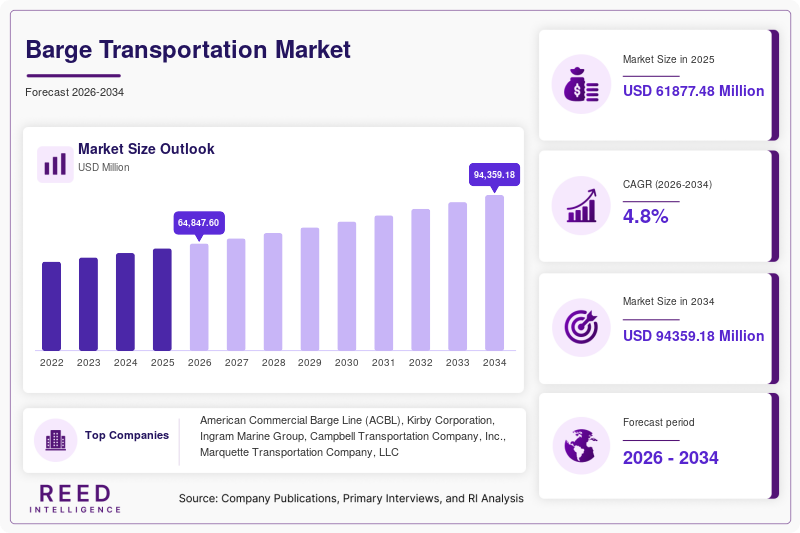
Barge Transportation market size is projected at USD 64,847.6 million in 2026 and is expected to hit USD 94,847.5 million by 2034 with a CAGR of 4.8% during the forecast period. The increasing demand for cost-effective and environmentally friendly freight transport for bulk commodities, coupled with the growing investment in inland waterway infrastructure and the need to reduce road congestion, underpins market expansion. This report delivers a comprehensive analysis of the Barge Transportation market, including segmentation by type and application, competitive dynamics, and regional growth patterns, equipping stakeholders with critical intelligence. The Barge Transportation market continues to demonstrate steady growth potential, fueled by the global trade of bulk goods, the focus on sustainable logistics, and continuous innovation in barge design and fleet management.
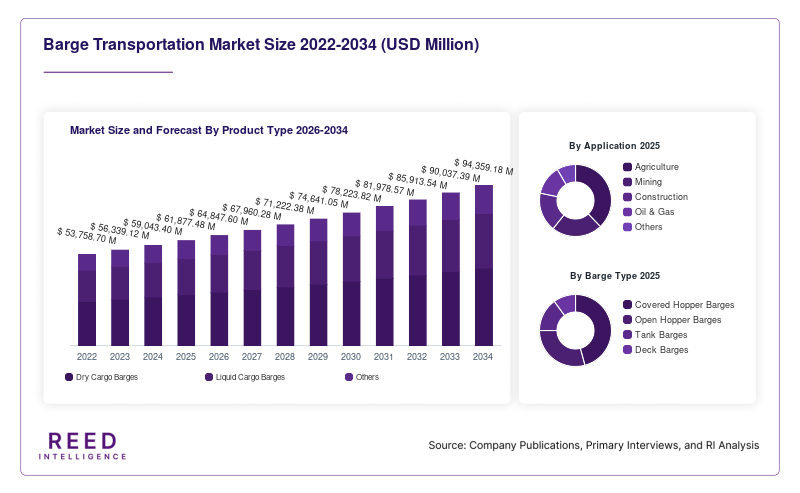
Barge transportation is a mode of freight transport that uses flat-bottomed boats (barges) to carry cargo along inland waterways, rivers, and canals. It is a highly efficient and cost-effective method for moving large volumes of bulk commodities such as grains, coal, aggregates, and liquids. The global barge transportation market is substantial, with the total volume of cargo transported exceeding 1.2 billion metric tons in 2025, reflecting a 5% increase from 2023, driven by the growing demand for bulk transport in agriculture and energy sectors. Adoption patterns reveal that the Dry Cargo Barges type dominates the market, accounting for 58% of total demand by volume, followed by Liquid Cargo Barges at 32%, and Others at 10%. The Barge Transportation market's trajectory is closely linked to the growth of the global logistics and freight market, which is projected to reach USD 8 trillion by 2028, and the increasing need for sustainable and efficient supply chain solutions.
Barge Transportation Market Trends
Adoption of Digitalization and IoT in Fleet Management
The Barge Transportation market is witnessing a significant trend toward the adoption of digitalization and IoT in fleet management, driven by the need for operational efficiency, real-time tracking, and predictive maintenance. The revenue from digitalized barge services grew to USD 18 billion in 2025, a year-on-year increase of 12%, as 40% of new barge fleets in 2025 specified IoT-enabled tracking and monitoring systems. Adoption rates of digital solutions in inland waterway logistics reached 30%, with this figure projected to exceed 55% by 2030. The Barge Transportation market's trend toward digitalization is reinforced by the need for improved supply chain visibility, the increasing focus on reducing operational costs, and the continuous innovation in sensor and communication technologies.
Growing Focus on Sustainable and Green Shipping Initiatives
The increasing focus on sustainable and green shipping initiatives is a major trend shaping the Barge Transportation market, with the development of cleaner, more fuel-efficient barges and the use of alternative fuels. The market has seen a 15% increase in the demand for eco-friendly barges since 2022, with 25% of new vessel orders in 2025 featuring LNG or hybrid propulsion systems. The use of electric and battery-powered barges for short-haul routes has also gained significant traction. The Barge Transportation market's trend toward sustainability is reinforced by the need to reduce emissions, the increasing regulatory pressure on the shipping industry, and the continuous innovation in green marine technologies.
Barge Transportation Market Drivers
The Barge Transportation market's expansion is primarily driven by the increasing demand for cost-effective and efficient bulk freight transport, with the global freight market valued at USD 6 trillion in 2025 and growing at a steady pace. The need to reduce road congestion and shift freight to inland waterways has been a major driver, with barges offering a lower cost per ton-mile. The growing investment in inland waterway infrastructure and the focus on sustainable logistics have also fueled market growth. Additionally, the expansion of agriculture, mining, and construction sectors has spurred demand. The Barge Transportation market's growth is further reinforced by the continuous improvement in barge design and propulsion, leading to better efficiency and environmental performance.
Barge Transportation Market Restraints
Despite favorable growth prospects, the Barge Transportation market faces significant constraints, primarily related to the limited reach of inland waterways, which can restrict market access in some regions. The impact of weather conditions and water levels on navigation can also be a limitation. The Barge Transportation market's growth is also tempered by the high capital investment required for fleet modernization and the competition from other transport modes such as rail and trucking.
Barge Transportation Market Opportunities
The Barge Transportation market presents significant opportunities in the rapidly expanding market for sustainable and green logistics, where barges offer a lower carbon footprint. The development of autonomous and remotely controlled barges is expected to grow at a CAGR of 10% through 2034. Emerging opportunities also exist in the integration of barge transport with intermodal logistics networks and the use of digital platforms for freight matching. The Barge Transportation market's opportunity profile is further enhanced by the growing trend of supply chain optimization and the increasing focus on multimodal transport.
Challenges in Barge Transportation Market
The Barge Transportation market faces persistent challenges related to the need for continuous investment in aging infrastructure, such as locks and dams, to maintain navigability. The complexity of managing varying water levels and seasonal conditions can also be a challenge. The market is also contending with the challenge of attracting younger talent and skilled labor for the maritime industry. Additionally, the Barge Transportation market is challenged by the need to adopt cleaner technologies while maintaining cost competitiveness.
Barge Transportation Market Segmentation
The Barge Transportation market is segmented by Type and Application to provide a comprehensive market perspective. By Type, Dry Cargo Barges dominate with a 58% share by volume, driven by the high volume of agricultural and mineral transport. The Application segment is led by Agriculture, which accounts for 30% of the market, followed by Mining at 25%, Construction at 20%, Oil & Gas at 15%, and Others at 10%.
By Type
Dry Cargo Barges represent the largest segment in the Barge Transportation market by volume, commanding a 58% share, with cargo volume exceeding 696 million metric tons in 2025. These are characterized by their use in transporting dry bulk commodities like grain, coal, aggregates, and ores. Technical specifications include cargo capacity, dimensions, and loading/unloading equipment. The Barge Transportation market's Dry Cargo segment is driven by its use in agriculture, mining, and construction.
Liquid Cargo Barges capture a 32% share of the Barge Transportation market, with cargo volume of 384 million metric tons in 2025. These are characterized by their use in transporting liquid commodities like crude oil, chemicals, and petrochemicals. Technical specifications include tank capacity, safety features, and pumping systems. The Barge Transportation market's Liquid Cargo segment is driven by its use in the oil & gas and chemical industries.
Others represent the remaining 10% of the Barge Transportation market, with cargo volume of 120 million metric tons in 2025. This includes specialized barges for vehicles, containers, and other cargo. The Barge Transportation market's Others segment is driven by its use in niche and specialized transport applications.
By Application
Agriculture dominates the Barge Transportation market, accounting for 30% of cargo volume, representing 360 million metric tons in 2025. This segment includes use in transporting grains, soybeans, and other agricultural products. Usage penetration exceeds 40% in the sector. The Barge Transportation market's Agriculture segment is characterized by its focus on large-volume, seasonal transport.
Mining accounts for 25% of the Barge Transportation market, with cargo volume of 300 million metric tons in 2025. This segment encompasses use in transporting ores, coal, and minerals. The segment is growing at a steady CAGR, driven by global mining activity. The Barge Transportation market's Mining segment is characterized by its focus on high-volume, long-distance transport.
Construction represents 20% of the Barge Transportation market, with cargo volume of 240 million metric tons in 2025. This segment includes use in transporting sand, gravel, aggregates, and cement. The segment is growing at a moderate rate. The Barge Transportation market's Construction segment is characterized by its focus on regional, short-haul transport.
Oil & Gas accounts for 15% of the Barge Transportation market, with cargo volume of 180 million metric tons in 2025. This segment includes use in transporting crude oil and refined petroleum products. The segment is growing at a steady pace. The Barge Transportation market's Oil & Gas segment is characterized by its focus on high-value, liquid cargo.
Others comprises the remainder of the Barge Transportation market, accounting for 10% of total cargo volume, with 120 million metric tons in 2025. This includes use in chemical, industrial, and other niche applications. The segment is projected to grow at a moderate CAGR through 2034. The Barge Transportation market's Others segment is characterized by its diverse and evolving applications.
Barge Transportation Market Regional Outlook
North America Barge Transportation Market
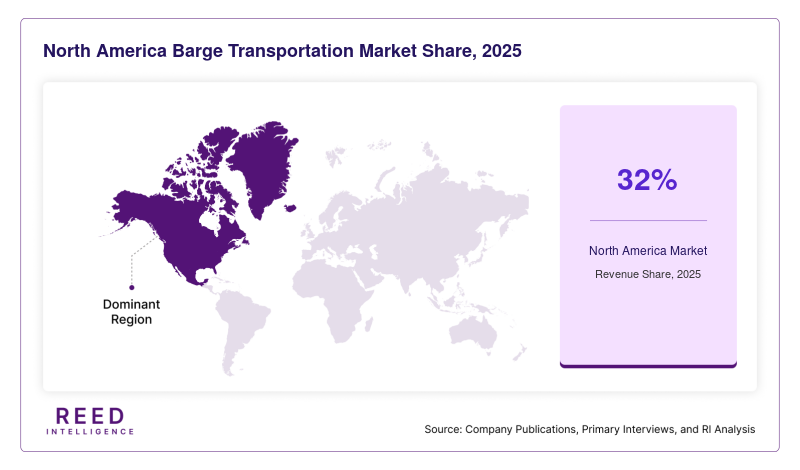
Leads the Barge Transportation market, commanding a 32% share of global cargo volume, with a revenue of USD 20.7 billion in 2025. The United States is the primary driver, accounting for 85% of regional demand, driven by the extensive Mississippi River system, large agricultural exports, and strong industrial base. The North American Barge Transportation market is characterized by its focus on efficiency and technology.
Europe Barge Transportation Market
Represents the second-largest market, capturing a 28% share with a revenue of USD 18.1 billion in 2025. The Netherlands, Germany, and France are the primary drivers, collectively accounting for 60% of regional demand, driven by the dense network of rivers and canals, and strong trade in bulk commodities. The European Barge Transportation market is characterized by its focus on sustainability and multimodal integration.
Asia-Pacific Barge Transportation Market
Accounts for 25% of the global Barge Transportation market, with a revenue of USD 16.2 billion in 2025. China, India, and Bangladesh are the primary drivers, together accounting for 70% of regional demand, driven by large river systems, rapid industrialization, and growing demand for bulk transport. The Asia-Pacific Barge Transportation market is projected to grow at the fastest CAGR of 7% through 2034.
Middle East & Africa and Latin America Barge Transportation Market
Together account for the remaining 15% of the Barge Transportation market, with the UAE leading the Middle East market and Brazil leading the Latin American market. Both regions are projected to grow at CAGRs exceeding 5%, driven by infrastructure development and commodity exports.
Top players in Barge Transportation Market
- American Commercial Barge Line (ACBL)
- Kirby Corporation
- Ingram Marine Group
- Campbell Transportation Company, Inc.
- Marquette Transportation Company, LLC
- Superior Marine Ways, Inc.
- Parker Towing Company, Inc.
- Blessey Marine Services, Inc.
- Canal Barge Company, Inc.
- Hines Furlong Line, Inc.
- Western Rivers Boat Management, Inc.
- Bouchard Transportation Co., Inc.
- Vane Brothers Company
- Moran Towing Corporation
- McAllister Towing & Transportation Co., Inc.
American Commercial Barge Line (ACBL)
American Commercial Barge Line (ACBL) holds a dominant position in the Barge Transportation market, with an estimated 12% market share in the US inland waterways segment. The company's fleet of dry cargo barges is widely recognized for its capacity, reliability, and efficiency. ACBL's market leadership is reinforced by its extensive network, its strong relationships with agricultural and industrial shippers, and its focus on operational excellence. ACBL commands over 15% of the North American market, positioning it as a key player in the Barge Transportation market.
Kirby Corporation
Kirby Corporation is a leading player in the Barge Transportation market, commanding approximately 10% of the US market share through its comprehensive portfolio of liquid and dry cargo barge services. The company's expertise in marine transportation and its focus on the petrochemical and refining sectors have solidified its position. Kirby's barges are known for their safety, reliability, and efficiency. The company's commitment to sustainability and its strong presence in the Gulf Coast and Mississippi River regions have enhanced its competitive advantage.
Ingram Marine Group holds a significant 8% market share, with particular strength in the dry cargo segment. Campbell Transportation is a major player in the Ohio River and Illinois River systems, holding a 6% share.
Recent Developments in Barge Transportation Market
- 2025: ACBL announced a significant investment in new, more efficient dry cargo barges to expand its fleet capacity and improve sustainability.
- 2025: Kirby Corporation introduced a new LNG-powered towboat to reduce emissions and fuel costs in its barge operations.
Barge Transportation Market Segments
By Product Type
- Dry Cargo Barges
- Liquid Cargo Barges
- Others
By Application
- Agriculture
- Mining
- Construction
- Oil & Gas
- Others
By Barge Type
- Covered Hopper Barges
- Open Hopper Barges
- Tank Barges
- Deck Barges
By Region
- North America
- Europe
- APAC
- Middle East and Africa
- LATAM