Barium Chloride Market Size, Share & Demand Report By Type (Industrial Grade, High Purity Grade), By Application (Water Treatment, Chemical Intermediates, Pigments Manufacturing, Metal Heat Treatment), By End-Use Industry (Chemical Industry, Oil & Gas, Manufacturing, Electronics), By Form (Powder, Liquid), By Region & Segment Forecasts, 2025–2034
USD 3950
Market Overview
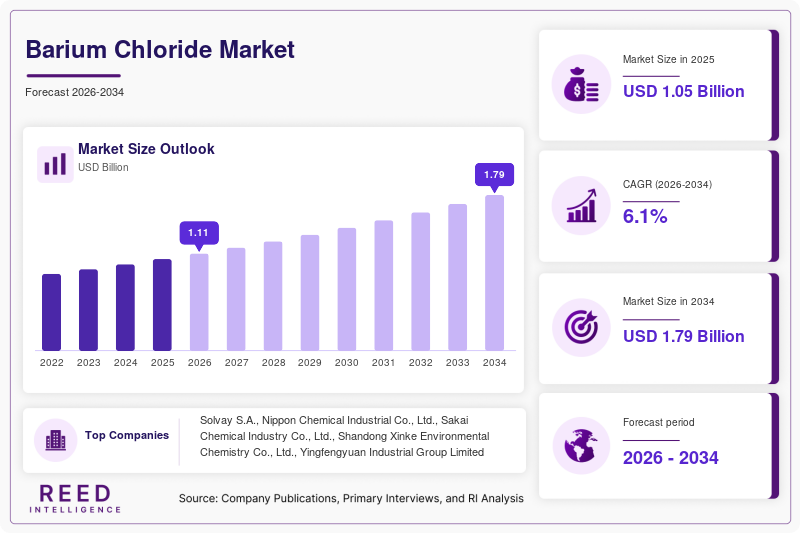
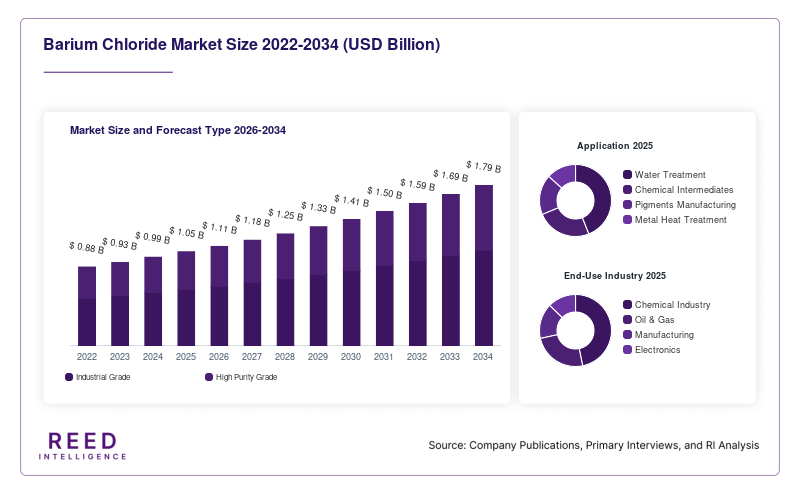
The global Barium Chloride Market size was valued at approximately USD 1.05 billion in 2025 and is projected to reach USD 1.78 billion by 2034, expanding at a CAGR of 6.1% during the forecast period (2025–2034). The market growth has been supported by increasing industrial demand for high-purity inorganic salts across sectors such as water treatment, metal processing, and chemical manufacturing. Barium chloride plays a critical role in removing sulfates in industrial processes and is widely utilized as a precursor in pigment and heat treatment applications.
A significant global factor contributing to market expansion is the steady growth of the chemical manufacturing sector, particularly in emerging economies. The increasing need for specialty chemicals and intermediate compounds has driven the adoption of barium chloride in multiple production cycles. Furthermore, advancements in industrial purification processes have enhanced its application scope.
Key Highlights:
- Asia Pacific dominated the market with a share of 42% in 2025 and is expected to register the fastest CAGR of 6.8% through 2034.
- By application, the water treatment segment led with 34% share, while the chemical intermediates segment is projected to grow at a CAGR of 6.9%.
- Industrial-grade barium chloride was the dominant type with a 61% share, while high-purity grade is expected to expand at a CAGR of 7.2%.
- China remained the dominant country, with market values of USD 310 million in 2024 and USD 328 million in 2025.
Market Trends
Rising Demand for Water Treatment Solutions
The growing emphasis on industrial wastewater management has increased the use of barium chloride as a sulfate-removal agent. Industries such as textiles, oil & gas, and chemical processing are investing in efficient water purification technologies. This trend has elevated the importance of barium chloride due to its effectiveness in reducing scaling and corrosion in pipelines and equipment. Governments are also tightening regulations around wastewater discharge, further driving demand.
Shift Toward High-Purity Chemical Applications
The increasing use of high-purity chemicals in electronics, pharmaceuticals, and advanced manufacturing has influenced the Barium Chloride Market. High-purity barium chloride is being adopted for specialized applications where consistency and chemical stability are critical. This shift reflects a broader trend toward precision manufacturing and improved product quality standards. Manufacturers are investing in refining processes to meet the stringent requirements of end-use industries.
Market Drivers
Growth in Metal Heat Treatment Industry
The expanding metal processing and heat treatment industry has significantly contributed to the demand for barium chloride. It is widely used in salt baths for hardening steel and improving durability. As industries such as automotive and machinery manufacturing grow, the need for efficient heat treatment chemicals is increasing, driving consistent demand.
Expansion of Chemical Manufacturing Sector
The rapid development of the global chemical sector has boosted the consumption of barium chloride as an intermediate compound. It is used in producing pigments, stabilizers, and other chemical derivatives. The rising production of specialty chemicals and industrial compounds has created a stable demand base, supporting long-term market growth.
Market Restraint
Toxicity and Environmental Concerns
One of the key challenges in the Barium Chloride Market is its inherent toxicity and environmental impact. Barium compounds can pose risks to human health and aquatic ecosystems if not handled properly. Strict regulations regarding chemical storage, transportation, and disposal have increased compliance costs for manufacturers. Additionally, industries are exploring alternative compounds with lower environmental impact, which may limit the widespread adoption of barium chloride. These concerns have created barriers to entry for new players and have slowed down expansion in regions with stringent environmental laws.
Market Opportunities
Increasing Use in Specialty Pigments
The growing demand for high-performance pigments in paints, coatings, and plastics presents an opportunity for barium chloride manufacturers. It is used as a precursor in the production of barium-based pigments that offer enhanced brightness and durability. The expansion of the construction and automotive industries is expected to support this opportunity.
Emerging Demand in Oil & Gas Sector
The oil & gas industry is increasingly adopting barium chloride for drilling fluid treatment and scale prevention. As exploration activities expand, particularly in offshore regions, the need for efficient chemical solutions is expected to rise. This creates new growth avenues for market participants focusing on industrial-grade products.
Segmental Analysis
By Type
Industrial-grade barium chloride dominated the market, accounting for approximately 61% of the share in 2024. Its widespread use in water treatment, metal processing, and drilling applications contributed to its leading position. The affordability and availability of industrial-grade variants made them suitable for large-scale applications.
High-purity barium chloride is expected to grow at a CAGR of 7.2% during the forecast period. The increasing demand for precision chemicals in electronics and pharmaceuticals will drive this segment. The need for consistent quality and performance will further accelerate adoption.
By Application
The water treatment segment held the largest share of 34% in 2024. The use of barium chloride for sulfate removal and scale prevention made it a critical component in industrial water systems. Increasing regulatory focus on wastewater management supported this segment.
The chemical intermediates segment is projected to grow at a CAGR of 6.9%. Its expanding use in producing pigments and stabilizers will drive growth. The rising demand for specialty chemicals will further enhance its adoption.
By End-Use Industry
The chemical industry dominated the market with a share of 39% in 2024. Barium chloride is widely used in synthesizing various compounds, making it essential in this sector.
The oil & gas industry is expected to grow at a CAGR of 6.6%. The increasing use of chemical treatments in drilling operations will drive demand. The expansion of exploration activities will further support growth.
By Form
Powder form accounted for 55% of the market share in 2024 due to its ease of handling and storage. It is widely used in industrial applications where precise dosing is required.
Liquid form is projected to grow at a CAGR of 6.5%. Its convenience in automated systems and faster dissolution rates will support adoption.
Regional Analysis
North America
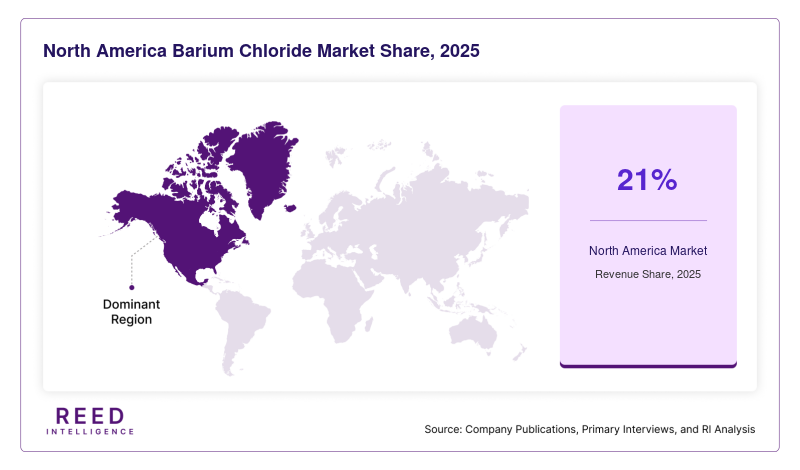
North America accounted for approximately 21% of the Barium Chloride Market share in 2025 and is projected to grow at a CAGR of 5.4% during the forecast period. The region’s growth is supported by established industrial infrastructure and steady demand from the chemical and water treatment sectors.
The United States dominated the regional market due to its advanced manufacturing base. The presence of large-scale chemical processing facilities and increasing investments in wastewater treatment technologies contributed to market expansion. Industrial modernization initiatives further supported demand.
Europe
Europe held around 18% of the market share in 2025 and is expected to grow at a CAGR of 5.2% through 2034. The region has shown consistent demand driven by environmental regulations and industrial applications.
Germany emerged as the leading country, supported by its strong chemical manufacturing sector. The country’s focus on sustainable industrial practices has increased the use of efficient sulfate-removal chemicals, including barium chloride.
Asia Pacific
Asia Pacific captured the largest share of 42% in 2025 and will register the fastest CAGR of 6.8% during the forecast period. Rapid industrialization and infrastructure development have significantly contributed to regional growth.
China led the region due to its extensive chemical production capabilities. The availability of raw materials and cost-effective manufacturing processes have strengthened the country’s position in the global market. Increasing investments in industrial water treatment have further driven demand.
Middle East & Africa
The Middle East & Africa accounted for 10% of the market share in 2025 and is projected to grow at a CAGR of 6.0%. Growth in this region is primarily driven by expanding oil & gas operations and infrastructure projects.
Saudi Arabia dominated the regional market due to its strong energy sector. The use of barium chloride in drilling and refining processes has supported steady demand. Industrial diversification initiatives are also contributing to market growth.
Latin America
Latin America held approximately 9% of the market share in 2025 and is expected to grow at a CAGR of 5.7% during the forecast period. The region’s growth is supported by increasing industrial activities and infrastructure development.
Brazil emerged as the leading country, driven by its expanding manufacturing and chemical sectors. The demand for water treatment chemicals and industrial intermediates has contributed to the growth of the Barium Chloride Market in the region.
Competitive Landscape
The Barium Chloride Market is moderately fragmented, with key players focusing on capacity expansion, product innovation, and strategic partnerships. Leading companies are investing in advanced production technologies to improve product quality and reduce environmental impact.
Solvay S.A. is a prominent market leader, known for its strong global presence and diversified chemical portfolio. The company recently expanded its specialty chemicals production capacity to meet growing industrial demand.
Other major players are focusing on regional expansion and strengthening distribution networks to enhance market reach. Competitive strategies include mergers, acquisitions, and collaborations to gain a competitive edge.
Key Players
- Solvay S.A.
- Nippon Chemical Industrial Co., Ltd.
- Sakai Chemical Industry Co., Ltd.
- Shandong Xinke Environmental Chemistry Co., Ltd.
- Yingfengyuan Industrial Group Limited
- Chongqing Wansheng Chemical Co., Ltd.
- Hubei Jingshan Chutian Barium Salt Corp. Ltd.
- Shaanxi Ankang Jianghua Group Co., Ltd.
- Chemical Products Corporation
- Santa Cruz Biotechnology, Inc.
- GFS Chemicals, Inc.
- Noah Technologies Corporation
- Merck KGaA
- American Elements
- Tokyo Chemical Industry Co., Ltd.
Recent Developments
- 2024: A leading manufacturer expanded its production facility in Asia to increase output capacity.
- 2023: A chemical company introduced a high-purity barium chloride variant for electronics applications.
- 2023: Strategic partnership formed between two firms to enhance distribution networks in Europe.
- 2022: Investment in sustainable production technology reduced environmental impact.
- 2022: Expansion of water treatment chemical portfolio by a major player.
Barium Chloride Market Segments
Type
- Industrial Grade
- High Purity Grade
Application
- Water Treatment
- Chemical Intermediates
- Pigments Manufacturing
- Metal Heat Treatment
End-Use Industry
- Chemical Industry
- Oil & Gas
- Manufacturing
- Electronics
Form
- Powder
- Liquid
By Region
- North America
- Europe
- APAC
- Middle East and Africa
- LATAM