Barretts Esophagus Market Size, Share & Demand Report By Diagnosis Method (Endoscopy, Biopsy, Advanced Imaging Techniques), By Treatment Type (Proton Pump Inhibitors, Radiofrequency Ablation, Endoscopic Mucosal Resection, Cryotherapy), By Disease Stage (Non-Dysplastic, Low-Grade Dysplasia, High-Grade Dysplasia), By End-User (Hospitals, Ambulatory Surgical Centers, Specialty Clinics), By Region & Segment Forecasts, 2025–2034
USD 3950
Market Overview
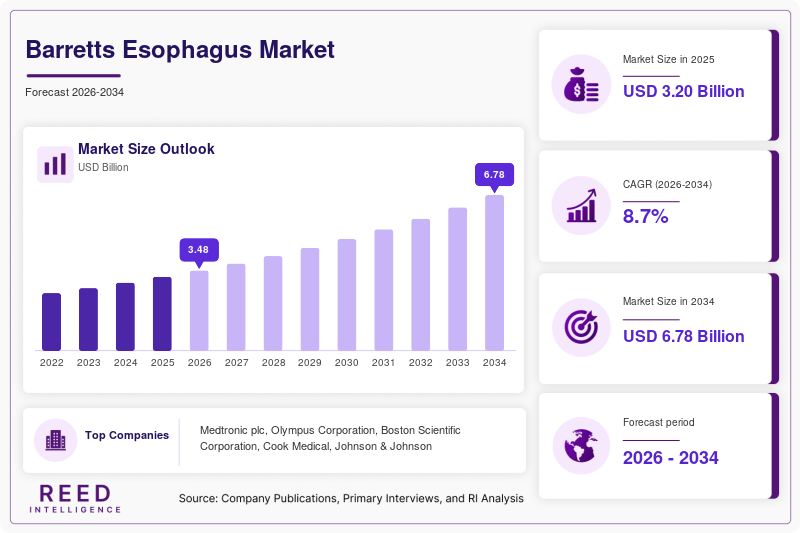
The Barretts Esophagus Market size was valued at approximately USD 3.2 billion in 2025 and is projected to reach USD 6.8 billion by 2034, expanding at a CAGR of 8.7% during 2025–2034. The market growth is primarily supported by the increasing global prevalence of gastroesophageal reflux disease (GERD), which is a major risk factor for Barrett’s esophagus. As lifestyle-related conditions such as obesity, smoking, and poor dietary habits rise worldwide, the incidence of Barrett’s esophagus has shown consistent growth, fueling demand for diagnostic and therapeutic interventions.
Another global factor contributing to the expansion of the Barretts Esophagus Market is the growing emphasis on early cancer detection programs. Since Barrett’s esophagus is a precursor to esophageal adenocarcinoma, healthcare systems are increasingly adopting screening and surveillance protocols, particularly in developed economies. Technological advancements in endoscopic imaging and minimally invasive treatment methods are also enhancing patient outcomes and driving market adoption.
Key Highlights
- North America dominated the market with 38.5% share in 2025, while Asia Pacific is projected to register the fastest CAGR of 10.2%.
- Among segments, diagnostic endoscopy led with a share of 42.3%, while radiofrequency ablation (RFA) is expected to grow at a CAGR of 9.8%.
- The United States remained the dominant country with a market value of USD 1.1 billion in 2025, projected to reach USD 1.18 billion in 2026.
Market Trends
Increasing Adoption of Advanced Endoscopic Imaging
The Barretts Esophagus Market is witnessing a strong shift toward advanced endoscopic imaging technologies such as narrow-band imaging (NBI), confocal laser endomicroscopy, and volumetric laser endomicroscopy. These innovations improve the accuracy of detecting dysplasia and early neoplastic changes. Healthcare providers are increasingly integrating these tools into routine screening procedures to enhance diagnostic precision. This trend is reducing the reliance on random biopsies and enabling targeted interventions, thereby improving patient outcomes and optimizing healthcare resources.
Rising Preference for Minimally Invasive Therapies
There is a growing preference for minimally invasive treatment approaches, particularly endoscopic therapies such as radiofrequency ablation, cryotherapy, and endoscopic mucosal resection (EMR). These procedures offer shorter recovery times, lower complication risks, and improved patient compliance compared to traditional surgical interventions. As a result, the Barretts Esophagus Market is experiencing increased demand for outpatient-based treatment solutions, supported by favorable reimbursement policies and technological advancements.
Market Drivers
Rising Prevalence of GERD and Lifestyle Disorders
The increasing global burden of GERD is a primary driver of the Barretts Esophagus Market. Sedentary lifestyles, unhealthy diets, and rising obesity rates are contributing to higher GERD incidence, which significantly elevates the risk of developing Barrett’s esophagus. As awareness regarding the complications associated with untreated GERD grows, more patients are undergoing diagnostic procedures, thereby driving market demand.
Growing Awareness and Screening Programs
Government initiatives and healthcare campaigns aimed at early detection of esophageal cancer are significantly boosting the Barretts Esophagus Market. Screening programs targeting high-risk populations, including individuals with chronic GERD symptoms, are becoming more widespread. Increased patient awareness regarding the importance of early diagnosis and regular monitoring is also contributing to higher adoption of diagnostic and treatment services.
Market Restraint
High Cost of Advanced Diagnostic and Treatment Procedures
Despite technological advancements, the high cost associated with advanced diagnostic tools and minimally invasive treatments remains a significant restraint in the Barretts Esophagus Market. Procedures such as endoscopic imaging and ablation therapies require specialized equipment and skilled professionals, which increases overall healthcare costs. In developing regions, limited reimbursement coverage and constrained healthcare budgets further restrict patient access to these treatments. Additionally, the cost burden may discourage routine screening among asymptomatic individuals, thereby limiting early diagnosis and market growth potential.
Market Opportunities
Expansion in Emerging Healthcare Markets
Emerging economies present a significant growth opportunity for the Barretts Esophagus Market. Improving healthcare infrastructure, increasing healthcare expenditure, and rising awareness about gastrointestinal disorders are driving demand in regions such as Asia Pacific and Latin America. Market players can capitalize on these opportunities by introducing cost-effective diagnostic solutions and expanding their presence through strategic partnerships.
Development of Non-Invasive Diagnostic Techniques
The development of non-invasive and less invasive diagnostic methods, such as capsule endoscopy and biomarker-based screening, offers promising opportunities for market expansion. These innovations have the potential to increase patient compliance and enable large-scale screening programs. As research in this area progresses, the Barretts Esophagus Market is expected to benefit from improved accessibility and early detection rates.
Segmental Analysis
By Diagnosis Method
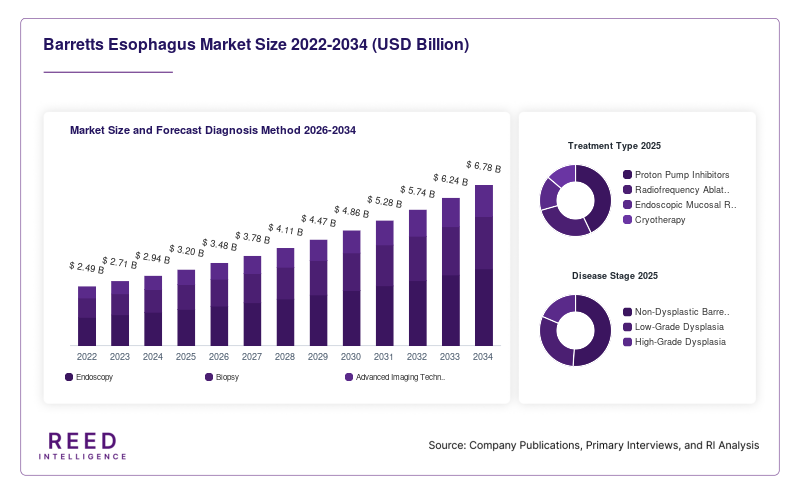
The diagnostic segment in the Barretts Esophagus Market was dominated by endoscopy, which accounted for 42.3% of the market share in 2025. This dominance was attributed to its high accuracy in detecting mucosal changes and its widespread use in clinical practice.
The fastest-growing subsegment is advanced imaging techniques, expected to grow at a CAGR of 9.5%. These technologies will gain traction due to their ability to enhance visualization and enable early detection of dysplasia.
By Treatment Type
The treatment segment was led by proton pump inhibitors (PPIs), holding 35.8% of the market share in 2025. These medications were widely used to manage GERD symptoms and prevent disease progression.
Radiofrequency ablation (RFA) is projected to be the fastest-growing subsegment, with a CAGR of 9.8%, driven by its effectiveness in eradicating dysplastic tissue and reducing cancer risk.
By End-User
Hospitals dominated the end-user segment with a 48.6% share in 2025, owing to the availability of advanced equipment and skilled professionals.
Ambulatory surgical centers are expected to grow at a CAGR of 8.9%, supported by the increasing preference for outpatient procedures and cost efficiency.
By Disease Stage
Non-dysplastic Barrett’s esophagus accounted for 51.2% of the market share in 2025, as it represents the most common stage diagnosed during routine screenings.
High-grade dysplasia is anticipated to grow at a CAGR of 9.2%, driven by increased detection rates and the need for immediate intervention.
Regional Analysis
North America
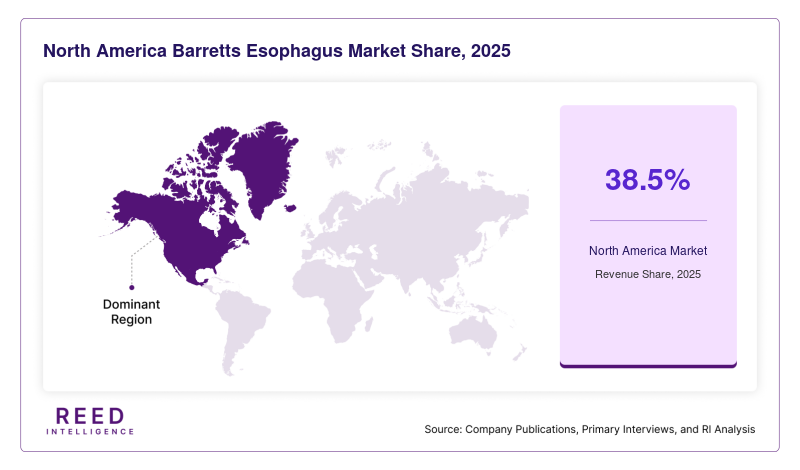
North America accounted for 38.5% of the Barretts Esophagus Market share in 2025 and is expected to grow at a CAGR of 8.1% during the forecast period. The region benefited from well-established healthcare infrastructure, high awareness levels, and widespread adoption of advanced diagnostic technologies.
The United States dominated the regional market due to the high prevalence of GERD and strong reimbursement frameworks. The presence of leading healthcare providers and continuous technological advancements further supported market growth in this region.
Europe
Europe held a 27.2% market share in 2025 and is projected to grow at a CAGR of 7.9%. The region experienced steady growth due to increasing healthcare expenditure and rising awareness regarding early cancer detection.
Germany emerged as the dominant country, driven by its advanced healthcare system and strong focus on research and development. The adoption of innovative endoscopic techniques contributed significantly to market expansion.
Asia Pacific
Asia Pacific represented 18.6% of the market share in 2025 and is anticipated to grow at the fastest CAGR of 10.2%. Rapid urbanization and changing lifestyles have led to a rise in GERD cases, supporting market growth.
China dominated the region, supported by a large patient population and increasing government initiatives to improve healthcare access. Expanding healthcare infrastructure and growing investments in medical technologies further enhanced regional growth.
Middle East & Africa
The Middle East & Africa accounted for 8.1% of the market share in 2025 and is expected to grow at a CAGR of 7.4%. The region witnessed gradual growth due to improving healthcare facilities and increasing awareness.
Saudi Arabia led the regional market, driven by government investments in healthcare infrastructure and rising adoption of advanced medical technologies.
Latin America
Latin America held 7.6% of the market share in 2025 and is projected to grow at a CAGR of 7.6%. The region experienced moderate growth due to improving access to healthcare services.
Brazil dominated the regional market, supported by a growing healthcare sector and increasing prevalence of gastrointestinal disorders. Rising investments in healthcare infrastructure further contributed to market development.
Competitive Landscape
The Barretts Esophagus Market is moderately competitive, with several global and regional players focusing on innovation and strategic collaborations. The market leader is Medtronic plc, which has maintained its position through continuous product development and a strong distribution network. The company recently introduced an advanced radiofrequency ablation system to enhance treatment outcomes.
Other key players are investing in research and development to expand their product portfolios and strengthen their market presence. Partnerships with healthcare providers and expansion into emerging markets are common strategies adopted by these companies. The competitive landscape is expected to evolve further as new technologies and treatment methods emerge.
Key Players
- Medtronic plc
- Olympus Corporation
- Boston Scientific Corporation
- Cook Medical
- Johnson & Johnson
- Fujifilm Holdings Corporation
- Hoya Corporation
- Conmed Corporation
- Erbe Elektromedizin GmbH
- Cantel Medical Corp.
- KARL STORZ SE & Co. KG
- Stryker Corporation
- Smith & Nephew plc
- Pentax Medical
- Apollo Endosurgery, Inc.
Recent Developments
- Medtronic plc launched an upgraded ablation platform to improve precision in Barrett’s esophagus treatment.
- Olympus Corporation introduced advanced imaging solutions for enhanced endoscopic diagnosis.
- Boston Scientific Corporation expanded its gastrointestinal product portfolio through strategic acquisitions.
- Cook Medical focused on developing minimally invasive devices for esophageal disorders.
- Fujifilm Holdings Corporation invested in AI-based diagnostic tools to improve early detection accuracy.
Barretts Esophagus Market Segments
Diagnosis Method
- Endoscopy
- Biopsy
- Advanced Imaging Techniques
Treatment Type
- Proton Pump Inhibitors
- Radiofrequency Ablation
- Endoscopic Mucosal Resection
- Cryotherapy
Disease Stage
- Non-Dysplastic Barrett’s Esophagus
- Low-Grade Dysplasia
- High-Grade Dysplasia
End-User
- Hospitals
- Ambulatory Surgical Centers
- Specialty Clinics
By Region
- North America
- Europe
- APAC
- Middle East and Africa
- LATAM