Bartholins Cyst Market Size, Share & Demand Report By Treatment Type (Word Catheter, Marsupialization, Laser Therapy, Surgical Excision), By Diagnosis Method (Physical Examination, Imaging), By End-Use (Hospitals, Ambulatory Surgical Centers, Specialty Clinics), By Distribution Channel & Segment Forecasts, 2025–2034
USD 3950
Market Overview
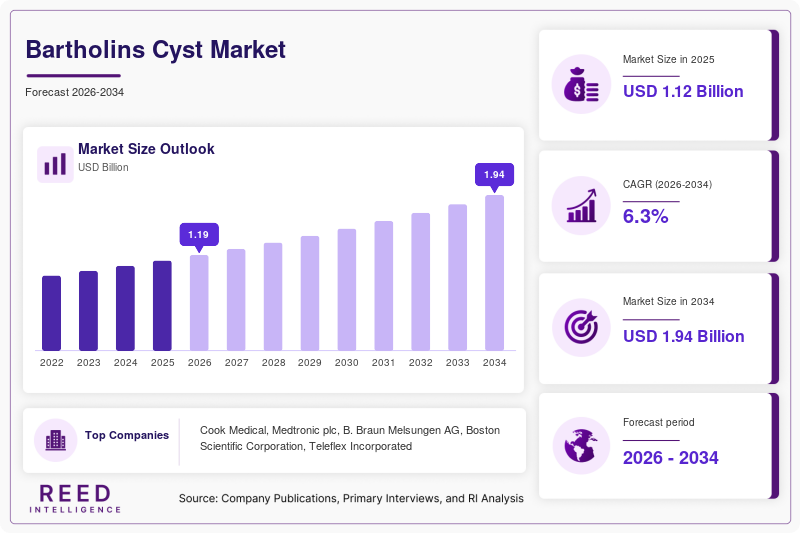
The global Bartholins Cyst Market was valued at approximately USD 1.12 billion in 2025 and is projected to reach USD 1.94 billion by 2034, expanding at a CAGR of 6.3%during the forecast period (2025–2034). The market growth is primarily supported by the increasing prevalence of gynecological conditions and rising awareness regarding women’s health issues worldwide. Improved access to healthcare services and early diagnosis has further accelerated treatment adoption, contributing to sustained market expansion.
The growing availability of minimally invasive treatment options, such as catheter-based drainage and laser procedures, has improved patient outcomes and reduced recovery time. Additionally, advancements in diagnostic imaging and outpatient care settings have enabled timely identification and management of Bartholin’s cysts, enhancing overall treatment rates.
Key Highlights:
- North America dominated the market with a 38.6% share in 2025, while Asia Pacific is projected to grow at the fastest CAGR of 7.4%.
- Treatment segment led by Word catheter procedures (41.2% share in 2024), while laser-based therapies are expected to grow at a CAGR of 7.8%.
- Hospitals dominated end-use with 52.5% share, whereas ambulatory surgical centers are the fastest-growing segment with 7.1% CAGR.
- The U.S. remained the dominant country, with market values of USD 372 million in 2024 and USD 395 million in 2025.
Market Trends
Shift Toward Minimally Invasive Procedures
A key trend shaping the Bartholins Cyst Market is the increasing preference for minimally invasive procedures. Techniques such as Word catheter insertion and marsupialization performed in outpatient settings are gaining traction due to reduced hospital stays and lower complication rates. These approaches offer faster recovery and improved patient comfort, which has driven their adoption among both patients and healthcare providers. The trend aligns with the broader healthcare shift toward cost-efficient and patient-centered care models.
Integration of Digital Health and Teleconsultation
Another notable trend is the growing integration of telemedicine platforms in gynecological care. Patients are increasingly seeking remote consultations for initial diagnosis and follow-up care, especially in regions with limited specialist availability. Digital tools are facilitating early detection and treatment planning, thereby improving clinical outcomes. This trend is particularly significant in emerging markets, where healthcare infrastructure constraints are being mitigated through technology-enabled services.
Market Drivers
Rising Awareness of Women’s Health
Increased awareness regarding women’s reproductive health has significantly contributed to the growth of the Bartholins Cyst Market. Public health campaigns, educational programs, and improved access to healthcare information have encouraged women to seek timely medical attention. Early diagnosis and treatment reduce complications, thereby increasing the overall demand for therapeutic interventions.
Advancements in Treatment Technologies
Technological advancements in gynecological procedures have enhanced the effectiveness and safety of Bartholin’s cyst treatments. Innovations such as laser therapy and improved catheter designs have streamlined procedures and reduced recurrence rates. These advancements have increased physician confidence and patient acceptance, leading to higher procedure volumes across healthcare facilities.
Market Restraint
Social Stigma and Delayed Diagnosis
A major restraint affecting the Bartholins Cyst Market is the persistent social stigma associated with gynecological conditions. In many regions, cultural barriers discourage women from discussing or seeking treatment for intimate health issues. This often leads to delayed diagnosis and underreporting of cases, limiting market growth potential.
Additionally, lack of awareness in rural and underserved areas further exacerbates the issue. Patients may ignore symptoms until complications arise, reducing the effectiveness of early-stage treatments. Healthcare providers also face challenges in reaching these populations due to limited infrastructure and resources.
Despite advancements in medical technology, these socio-cultural barriers continue to hinder widespread adoption of treatment solutions. Addressing this restraint requires targeted awareness campaigns, improved healthcare accessibility, and community-based education initiatives to encourage early intervention and reduce disease burden.
Market Opportunities
Expansion in Emerging Markets
Emerging economies present significant growth opportunities for the Bartholins Cyst Market. Increasing healthcare investments, rising disposable incomes, and improving medical infrastructure are driving demand for gynecological treatments. Governments and private organizations are focusing on expanding access to women’s healthcare services, which is expected to boost market penetration in these regions.
Development of Advanced Outpatient Solutions
The development of advanced outpatient treatment solutions offers another promising opportunity. Innovations aimed at reducing procedure time and improving patient comfort are gaining traction. Portable medical devices and simplified treatment kits are enabling healthcare providers to deliver effective care in non-hospital settings. This shift is expected to enhance accessibility and reduce healthcare costs, further supporting market growth.
Segmental Analysis
By Treatment Type
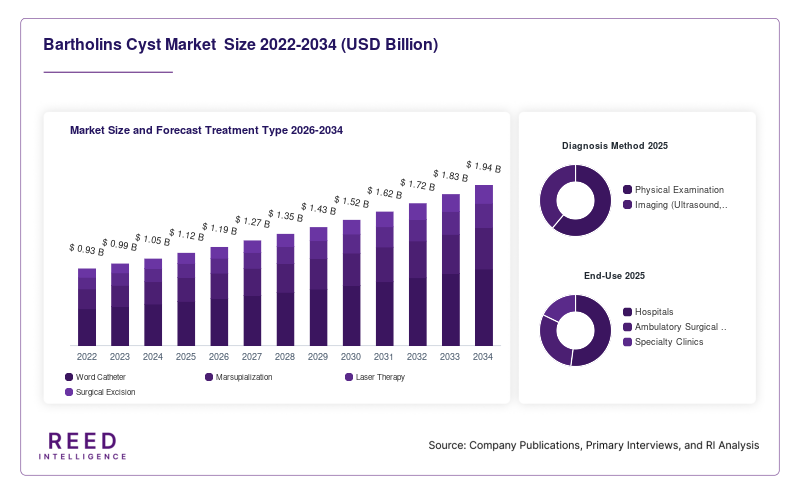
The treatment segment was dominated by Word catheter procedures, which accounted for 41.2% of the market share in 2024. These procedures were widely adopted due to their effectiveness, simplicity, and cost-efficiency. Healthcare providers preferred this method for its minimally invasive nature and low recurrence rates.
Laser-based therapies are expected to emerge as the fastest-growing subsegment, with a projected CAGR of 7.8% during the forecast period. The growth will be driven by advancements in laser technology, offering precise treatment with minimal tissue damage. Increasing patient preference for quick recovery and reduced discomfort will further support the adoption of this subsegment.
By Diagnosis Method
Physical examination remained the dominant diagnostic method, holding a significant share in 2024. Its widespread use can be attributed to its simplicity and cost-effectiveness. Physicians rely on clinical evaluation for initial diagnosis, especially in primary healthcare settings.
Imaging techniques, including ultrasound, are projected to grow at a CAGR of 6.9%. The increasing use of advanced diagnostic tools for accurate assessment and treatment planning will drive this growth. Improved imaging capabilities are expected to enhance diagnostic accuracy and patient outcomes.
By End-Use
Hospitals accounted for the largest share of the Bartholins Cyst Market in 2024, with 52.5% market share. The availability of specialized equipment and skilled healthcare professionals contributed to their dominance. Hospitals also handle complex cases requiring surgical intervention.
Ambulatory surgical centers are expected to be the fastest-growing segment, with a CAGR of 7.1%. The shift toward outpatient care and cost-effective treatment options will drive growth in this segment. These centers offer convenience and reduced hospitalization costs, making them increasingly popular among patients.
By Distribution Channel
Direct sales to healthcare facilities dominated the market in 2024 due to established supplier relationships and bulk purchasing practices. This channel ensured consistent availability of medical devices and treatment supplies.
Online distribution channels are anticipated to grow at a CAGR of 7.3%. The increasing adoption of e-commerce platforms for medical supplies and the convenience of online purchasing will drive this growth. Digital platforms are expected to improve accessibility and streamline procurement processes.
Regional Analysis
North America
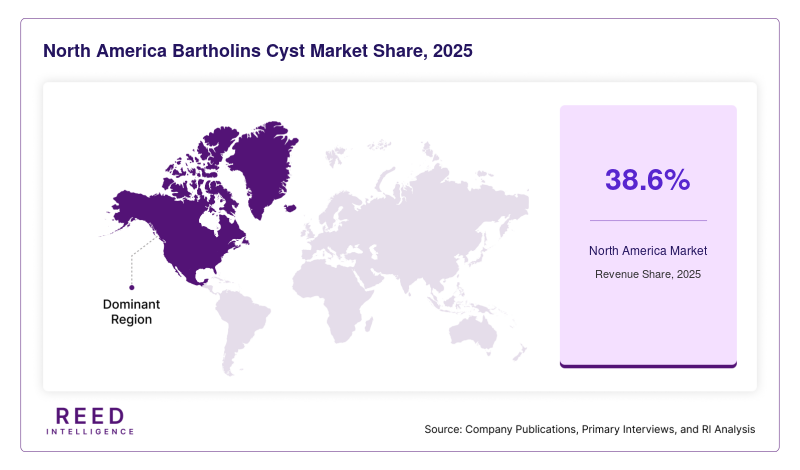
North America accounted for 38.6% of the Bartholins Cyst Market share in 2025 and is expected to grow at a CAGR of 5.8% through 2034. The region had a well-established healthcare infrastructure and high awareness levels regarding women’s health conditions. Advanced diagnostic capabilities and widespread availability of treatment options contributed to its dominant position.
The United States emerged as the leading country due to strong healthcare spending and the presence of skilled gynecologists. The increasing adoption of outpatient procedures and favorable reimbursement policies further supported market growth. Continuous innovation in treatment technologies has also played a key role in maintaining the country’s leadership position.
Europe
Europe held a significant share of the Bartholins Cyst Market in 2025 and is projected to grow at a CAGR of 5.9% during the forecast period. The region benefited from comprehensive healthcare systems and increasing focus on preventive care. Government initiatives aimed at improving women’s health services contributed to steady market growth.
Germany led the regional market due to its advanced medical infrastructure and high adoption of minimally invasive procedures. The country’s emphasis on research and development has facilitated the introduction of innovative treatment methods, supporting market expansion.
Asia Pacific
Asia Pacific represented a substantial portion of the Bartholins Cyst Market in 2025 and is anticipated to grow at the fastest CAGR of 7.4% through 2034. Rapid urbanization, increasing healthcare awareness, and expanding medical facilities have driven market growth in the region.
China dominated the regional market due to its large population base and improving healthcare access. Government initiatives to enhance women’s health services and rising investments in healthcare infrastructure have significantly contributed to market expansion. The growing adoption of modern treatment techniques is expected to further accelerate growth.
Middle East & Africa
The Middle East & Africa region held a moderate share of the Bartholins Cyst Market in 2025 and is expected to grow at a CAGR of 6.1% over the forecast period. Increasing healthcare investments and improving access to medical services have supported market growth.
Saudi Arabia emerged as the leading country in the region, driven by government efforts to modernize healthcare infrastructure. The expansion of specialized healthcare facilities and rising awareness of women’s health issues have contributed to increased treatment adoption.
Latin America
Latin America accounted for a notable share of the Bartholins Cyst Market in 2025 and is projected to grow at a CAGR of 6.0% through 2034. The region has witnessed improvements in healthcare access and growing awareness regarding gynecological conditions.
Brazil dominated the regional market due to its large population and expanding healthcare system. Increased government initiatives and private sector investments in healthcare have facilitated the adoption of advanced treatment options, supporting market growth.
Competitive Landscape
The Bartholins Cyst Market is characterized by the presence of several established and emerging players focusing on product innovation and strategic collaborations. Companies are investing in research and development to introduce advanced treatment solutions and expand their market presence.
The market leader, Cook Medical, has maintained a strong position through its comprehensive portfolio of minimally invasive devices. The company recently introduced an upgraded catheter system designed to improve patient comfort and reduce recurrence rates, strengthening its competitive edge.
Other key players are focusing on expanding their geographic reach and enhancing product offerings. Partnerships with healthcare providers and investments in training programs are common strategies adopted to increase market penetration and improve patient outcomes.
Key Players List
- Cook Medical
- Medtronic plc
- B. Braun Melsungen AG
- Boston Scientific Corporation
- Teleflex Incorporated
- Cardinal Health
- Smith & Nephew plc
- Olympus Corporation
- Conmed Corporation
- Hologic, Inc.
- CooperSurgical, Inc.
- Sklar Surgical Instruments
- Integra LifeSciences
- Karl Storz SE & Co. KG
- Richard Wolf GmbH
Recent Developments
- 2024: Cook Medical launched an advanced Word catheter with improved biocompatibility.
- 2024: Medtronic expanded its minimally invasive gynecology portfolio.
- 2023: B. Braun introduced new surgical instruments for cyst management.
- 2023: Boston Scientific enhanced its outpatient treatment solutions.
- 2023: Teleflex focused on expanding distribution networks in Asia Pacific.
Bartholins Cyst Market Segments
Treatment Type
- Word Catheter
- Marsupialization
- Laser Therapy
- Surgical Excision
Diagnosis Method
- Physical Examination
- Imaging (Ultrasound, MRI)
End-Use
- Hospitals
- Ambulatory Surgical Centers
- Specialty Clinics
Distribution Channel
- Direct Sales
- Distributors
- Online Platforms
By Region
- North America
- Europe
- APAC
- Middle East and Africa
- LATAM