Battery Energy Storage Systems Market Size, Share & Demand Report By Battery Type (Lithium-Ion Batteries, Lead-Acid Batteries, Flow Batteries, Sodium-Ion Batteries, Solid-State Batteries), By Application (Grid-Scale Storage, Commercial & Industrial Storage, Residential Storage), By End-Use (Utilities, Commercial & Industrial, Residential), By Region and Segment Forecasts, 2026–2034
USD 3950
Market Overview
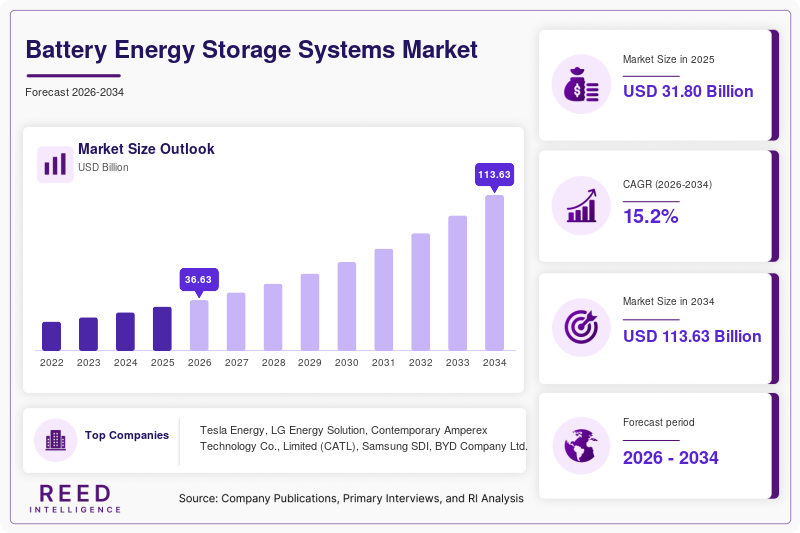
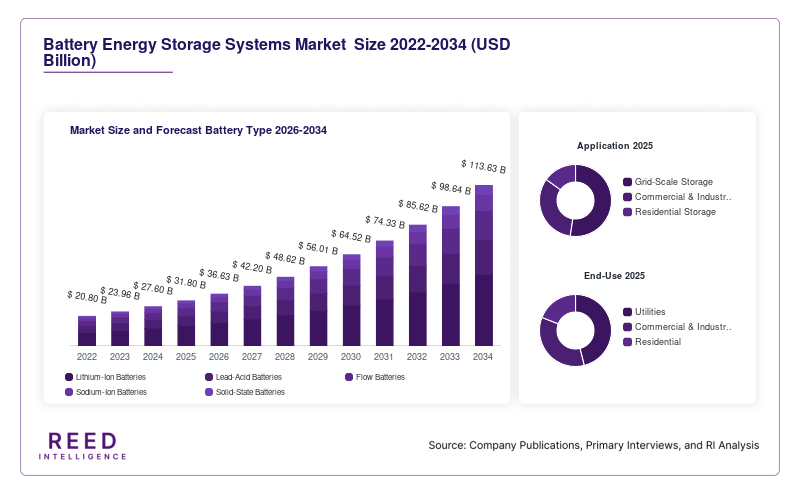
The global Battery Energy Storage Systems Market size was valued at approximately USD 31.8 billion in 2026 and is projected to reach USD 98.6 billion by 2034, expanding at a compound annual growth rate (CAGR) of 15.2% during 2026–2034. The market continues to gain momentum as utilities, commercial facilities, and residential consumers increasingly deploy energy storage technologies to improve grid reliability, support renewable energy integration, and optimize electricity consumption. Battery energy storage systems have become a critical component of modern power infrastructure due to their ability to store excess electricity and release it during peak demand periods.
A major global factor supporting market growth is the rapid expansion of renewable energy generation. The increasing deployment of solar and wind power has created a greater need for flexible energy storage solutions capable of balancing intermittent electricity supply. Governments and private sector stakeholders are investing in advanced battery technologies to strengthen grid stability and improve energy resilience. In addition, declining battery costs, technological improvements in lithium-ion systems, and supportive policy frameworks are accelerating adoption across developed and emerging economies.
Key Highlights
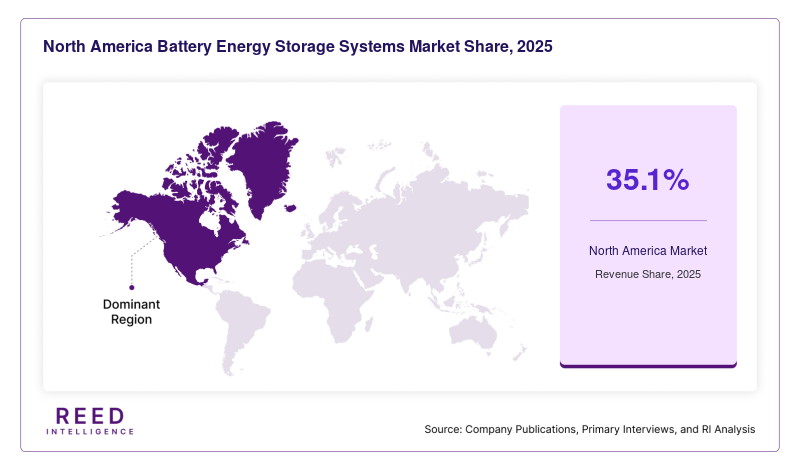
- North America dominated the market with a 35.1% share in 2025, while Asia Pacific is expected to grow at the fastest CAGR of 17.4% during 2026–2034.
- By battery type, Lithium-Ion Batteries accounted for the largest share of 67.8%, while Solid-State Batteries are projected to grow at a CAGR of 21.6%.
- By application, Grid-Scale Storage led with a 46.9% share, whereas Commercial & Industrial Storage is expected to expand at a CAGR of 18.3%.
- By end-use, Utilities held the largest share of 51.4%, while the Residential sector is anticipated to grow at a CAGR of 18.9%.
- The United States remained the dominant country, with market values of USD 9.4 billion in 2024 and USD 10.7 billion in 2025.
Market Trends
Integration of Artificial Intelligence in Energy Storage Management
The deployment of artificial intelligence and advanced analytics is becoming a significant trend across the Battery Energy Storage Systems Market. Operators are increasingly utilizing AI-powered software platforms to optimize charging and discharging cycles, predict maintenance requirements, and maximize battery efficiency. These technologies help improve asset performance while reducing operational costs. Utilities and commercial operators are integrating machine learning algorithms that analyze energy demand patterns and renewable energy generation forecasts. As battery installations become larger and more complex, intelligent energy management systems are expected to become standard components of storage infrastructure, creating additional value and improving overall system economics.
Expansion of Hybrid Renewable Energy and Storage Projects
Hybrid energy projects that combine renewable generation with battery storage are gaining widespread acceptance across global energy markets. Solar-plus-storage and wind-plus-storage projects are being developed to improve renewable energy reliability and enhance electricity dispatch capabilities. Project developers are increasingly integrating storage solutions during the planning stage rather than adding them later. This trend is driven by declining battery costs, improved project economics, and increasing demand for clean energy solutions. Hybrid installations enable energy producers to deliver electricity during periods of peak demand, strengthen grid resilience, and improve renewable energy utilization rates, making them an important trend shaping future market development.
Market Drivers
Growing Investments in Renewable Energy Infrastructure
The expansion of renewable energy infrastructure continues to drive demand within the Battery Energy Storage Systems Market. Countries around the world are increasing investments in solar and wind generation projects to reduce carbon emissions and strengthen energy security. However, the intermittent nature of renewable energy sources creates challenges for grid operators. Battery storage systems address these challenges by storing excess energy generated during favorable conditions and supplying electricity when generation declines. As governments establish ambitious clean energy targets and utilities seek reliable balancing solutions, demand for battery storage technologies continues to increase. Large-scale renewable projects increasingly include storage components to improve project efficiency and long-term profitability.
Rising Need for Grid Stability and Energy Reliability
The growing complexity of power grids is creating strong demand for advanced energy storage systems. Electricity networks face increasing pressure from electrification, population growth, industrial expansion, and the integration of distributed energy resources. Battery storage systems provide rapid response capabilities that help maintain frequency regulation, voltage support, and grid stability. Utilities are deploying storage assets to reduce transmission congestion and improve reliability during peak demand periods. Extreme weather events and power disruptions have also increased interest in resilient energy infrastructure. As grid modernization programs expand globally, battery energy storage systems are becoming essential assets for maintaining secure and reliable electricity supply.
Market Restraint
High Initial Capital Requirements and Supply Chain Challenges
Despite strong growth prospects, high upfront investment costs remain a notable challenge for the Battery Energy Storage Systems Market. Large-scale storage installations require significant expenditures related to batteries, power conversion equipment, system integration, and project development. Although battery prices have declined considerably over the past decade, investment requirements remain substantial for many utilities and commercial users. Financing challenges can delay project implementation, particularly in developing regions where access to capital may be limited.
Supply chain disruptions also affect market expansion. The production of advanced batteries depends on raw materials such as lithium, nickel, cobalt, and graphite. Price volatility and supply constraints can influence project economics and manufacturing capacity. For example, fluctuations in critical mineral availability can increase procurement costs and extend project timelines. These challenges may temporarily limit deployment rates in certain regions. Industry participants are responding through diversification of supply sources, recycling initiatives, and investments in alternative battery chemistries, but supply chain risks continue to influence market dynamics.
Market Opportunities
Emergence of Next-Generation Battery Technologies
The development of next-generation battery technologies presents significant opportunities for market participants. While lithium-ion batteries currently dominate deployments, research efforts are accelerating in areas such as solid-state batteries, sodium-ion batteries, and advanced flow batteries. These technologies offer the potential for improved safety, longer operational life, higher energy density, and lower costs. Manufacturers investing in innovation may gain competitive advantages as customers seek more efficient storage solutions. As pilot projects transition into commercial deployment, advanced battery technologies are expected to create new revenue streams and expand the application range of energy storage systems across multiple sectors.
Expansion of Distributed Energy Resources and Residential Storage
The increasing adoption of distributed energy resources is creating substantial growth opportunities for battery storage providers. Residential consumers and small businesses are investing in rooftop solar systems combined with battery storage to improve energy independence and reduce electricity expenses. Growing awareness of energy resilience and backup power capabilities is further encouraging adoption. Utilities are also exploring virtual power plant models that aggregate distributed storage assets into coordinated energy networks. These developments create opportunities for technology providers, software developers, and system integrators. As distributed energy ecosystems continue to evolve, residential and community-scale battery storage deployments are expected to increase significantly.
Segmental Analysis
By Battery Type
Lithium-Ion Batteries represented the dominant subsegment and accounted for approximately 67.8% market share in 2024. Their leadership position is supported by high energy density, declining manufacturing costs, and broad commercial availability. Lithium-ion technology is widely deployed across utility-scale, commercial, and residential applications due to its strong performance characteristics and operational flexibility. Continuous advancements in battery chemistry, thermal management systems, and manufacturing processes have improved efficiency and safety. The extensive global supply chain supporting lithium-ion battery production has also contributed to widespread adoption, making this technology the preferred choice for most energy storage projects.
Solid-State Batteries represent the fastest-growing subsegment and are projected to expand at a CAGR of 21.6% through 2034. These batteries offer enhanced safety, higher energy density, and improved lifespan compared with conventional technologies. Growing investments in research and development are accelerating commercialization efforts across multiple regions. Manufacturers are focusing on overcoming production challenges while scaling manufacturing capacity. The increasing need for advanced energy storage solutions in grid applications, electric mobility, and distributed energy systems is expected to support strong adoption. As technology maturity improves, solid-state batteries are likely to gain a larger share of future market deployments.
By Application
Grid-Scale Storage accounted for the largest market share of approximately 46.9% in 2024. Utilities are increasingly deploying large battery systems to improve grid stability, manage renewable energy variability, and reduce reliance on conventional peaking plants. Grid-scale projects support frequency regulation, voltage management, and energy arbitrage functions that improve electricity system efficiency. Government incentives and utility investment programs continue to encourage large-scale installations. As renewable energy penetration increases globally, grid-scale storage remains a critical solution for balancing supply and demand while supporting reliable electricity delivery.
Commercial & Industrial Storage is expected to be the fastest-growing application segment, registering a CAGR of 18.3% during the forecast period. Businesses are adopting battery systems to reduce electricity costs, manage peak demand charges, and improve operational resilience. Energy-intensive industries increasingly utilize storage technologies to optimize energy consumption and enhance sustainability performance. Growing concerns regarding power quality and reliability are further encouraging adoption. The integration of storage with onsite renewable energy systems also provides additional financial benefits, supporting accelerated growth across commercial and industrial facilities worldwide.
By End-Use
Utilities emerged as the dominant end-use segment, accounting for approximately 51.4% market share in 2024. Utility operators continue to invest heavily in battery energy storage systems to support grid modernization initiatives and renewable energy integration. These systems help utilities maintain system reliability, improve operational flexibility, and reduce infrastructure expansion requirements. Large-scale projects are increasingly incorporated into long-term energy planning strategies. Investments in transmission and distribution upgrades, coupled with supportive policy frameworks, continue to strengthen demand from utility customers and reinforce their leading market position.
Residential end-users are projected to register the fastest CAGR of 18.9% through 2034. Growing adoption of rooftop solar installations, rising electricity prices, and increasing awareness of energy independence are supporting residential battery deployment. Homeowners are investing in storage systems to maximize renewable energy utilization and maintain backup power during outages. Technological advancements have improved system affordability and ease of installation. Expanding government incentive programs and financing options are further encouraging adoption, making residential energy storage one of the most dynamic segments within the overall market.
Regional Analysis
North America
North America accounted for approximately 35.1% of the Battery Energy Storage Systems Market in 2025 and continues to represent the largest regional market. The region is projected to expand at a CAGR of 14.2% through 2034. Strong policy support, utility-scale renewable energy deployment, and ongoing grid modernization initiatives continue to drive demand. Large investments in transmission infrastructure and energy resilience programs further strengthen regional market growth. The widespread adoption of advanced battery technologies has positioned North America as a major contributor to global storage capacity additions.
The United States remains the dominant country within the region. Extensive renewable energy development and favorable investment incentives have encouraged large-scale storage deployments across multiple states. A unique growth factor is the increasing use of battery systems for grid resilience and disaster preparedness. Utilities are investing in storage assets to improve electricity reliability and reduce risks associated with severe weather events and power disruptions.
Europe
Europe represented approximately 26.8% of the global market in 2025 and is expected to register a CAGR of 14.8% during the forecast period. The region's commitment to carbon reduction goals and renewable energy expansion continues to support battery storage adoption. Grid operators are increasingly deploying storage technologies to manage renewable energy variability and support electricity market flexibility. Government incentives and energy transition programs are also encouraging investments across both utility-scale and distributed storage applications.
Germany remains the leading national market in Europe. The country's strong renewable energy sector and advanced manufacturing capabilities support widespread storage deployment. A unique growth factor is the increasing integration of residential solar-plus-storage systems. Homeowners are adopting battery solutions to maximize self-consumption of renewable electricity and reduce dependence on conventional grid power, creating sustained demand across the residential segment.
Asia Pacific
Asia Pacific held approximately 24.4% market share in 2025 and is anticipated to achieve the fastest regional CAGR of 17.4% through 2034. Rapid urbanization, industrial development, and rising electricity demand are driving investments in energy storage infrastructure. Governments throughout the region are implementing renewable energy targets and grid modernization initiatives that encourage large-scale battery deployments. Expanding manufacturing capacity for battery technologies also strengthens regional competitiveness and supports long-term growth.
China dominates the regional market due to its large-scale renewable energy investments and extensive battery manufacturing ecosystem. A unique growth factor is the country's focus on integrating energy storage with renewable generation projects. Significant investments in solar and wind infrastructure have created strong demand for storage solutions capable of balancing electricity supply and improving overall grid performance.
Middle East & Africa
The Middle East & Africa accounted for approximately 7.1% of the market in 2025 and is projected to grow at a CAGR of 15.6% during the forecast period. Increasing investments in renewable energy projects and efforts to diversify energy portfolios are supporting storage adoption. Governments are recognizing the importance of battery systems for improving grid reliability and supporting remote electrification initiatives. Utility-scale projects are becoming increasingly common across several countries within the region.
Saudi Arabia leads regional market development due to its ongoing investments in clean energy infrastructure. A unique growth factor is the deployment of battery systems alongside large-scale solar projects in remote locations. These installations help improve energy access, optimize renewable power utilization, and reduce dependence on conventional generation sources, contributing to long-term market growth.
Latin America
Latin America captured approximately 6.6% of the global market in 2025 and is expected to expand at a CAGR of 15.1% through 2034. Renewable energy development and rising electricity demand continue to create opportunities for battery storage deployment. Utilities are increasingly exploring storage technologies to improve grid flexibility and support renewable integration. Several countries are implementing regulatory frameworks that encourage private sector investments in energy storage infrastructure.
Brazil remains the dominant country within the region. The country's expanding renewable energy sector and growing electricity requirements support increasing demand for storage solutions. A unique growth factor is the use of battery systems to improve power quality and reliability in areas with grid constraints. These applications are helping utilities enhance operational efficiency while supporting broader energy transition objectives.
Competitive Landscape
The Battery Energy Storage Systems Market is characterized by strong competition among global battery manufacturers, energy technology providers, and system integrators. Companies focus on technological innovation, manufacturing expansion, strategic partnerships, and project development to strengthen their market positions. The competitive environment continues to evolve as demand for energy storage solutions expands across utility, commercial, and residential applications.
Tesla Energy remains a leading participant due to its extensive deployment of utility-scale battery systems and integrated energy solutions portfolio. A recent development involved the expansion of its large-scale energy storage manufacturing capacity to address growing global demand. Other major participants are actively investing in advanced battery technologies, digital energy management platforms, and localized production facilities. Strategic collaborations between battery manufacturers and renewable energy developers are becoming increasingly common as companies seek to enhance project economics and accelerate market penetration. Competitive differentiation increasingly depends on system efficiency, lifecycle performance, software capabilities, and supply chain resilience.
Key Players
- Tesla Energy
- LG Energy Solution
- Contemporary Amperex Technology Co. Limited (CATL)
- Samsung SDI
- BYD Company Ltd.
- Fluence Energy
- Panasonic Energy
- Hitachi Energy
- ABB Ltd.
- Siemens Energy
- Wärtsilä
- Sungrow Power Supply Co. Ltd.
- Powin LLC
- NextEra Energy Resources
- Enphase Energy
Recent Developments
- In 2025, Tesla Energy commissioned a new utility-scale battery energy storage project featuring advanced grid-balancing capabilities to support renewable energy integration across multiple power networks.
- In 2025, Fluence Energy introduced an AI-enabled energy management platform designed to optimize battery performance, predictive maintenance, and operational efficiency for large-scale storage installations.
- In 2024, CATL launched a next-generation energy storage battery solution incorporating enhanced safety architecture and higher energy density for grid-scale and commercial applications.
- In 2024, LG Energy Solution expanded its battery energy storage manufacturing operations with new production lines aimed at increasing supply capacity for utility and industrial customers.
- In 2025, BYD expanded its global energy storage portfolio by deploying integrated battery storage systems with advanced power conversion technologies for renewable energy projects and microgrid applications.
Battery Energy Storage Systems Market Segments
Battery Type
- Lithium-Ion Batteries
- Lead-Acid Batteries
- Flow Batteries
- Sodium-Ion Batteries
- Solid-State Batteries
Application
- Grid-Scale Storage
- Commercial & Industrial Storage
- Residential Storage
End-Use
- Utilities
- Commercial & Industrial
- Residential
By Region
- North America
- Europe
- APAC
- Middle East and Africa
- LATAM