Battery Felts Market Size, Share & Demand Report By Material Type (Carbon Felt, Synthetic Fiber Felt, Natural Fiber Felt), By Product Type (Nonwoven Felt, Woven Felt, Needle-Punched Felt), By Application (Lead-Acid Batteries, Lithium-Ion Batteries, Flow Batteries), By End-Use Industry (Automotive, Energy & Utilities, Industrial) & Segment Forecasts, 2025–2034
USD 3950
Market Overview
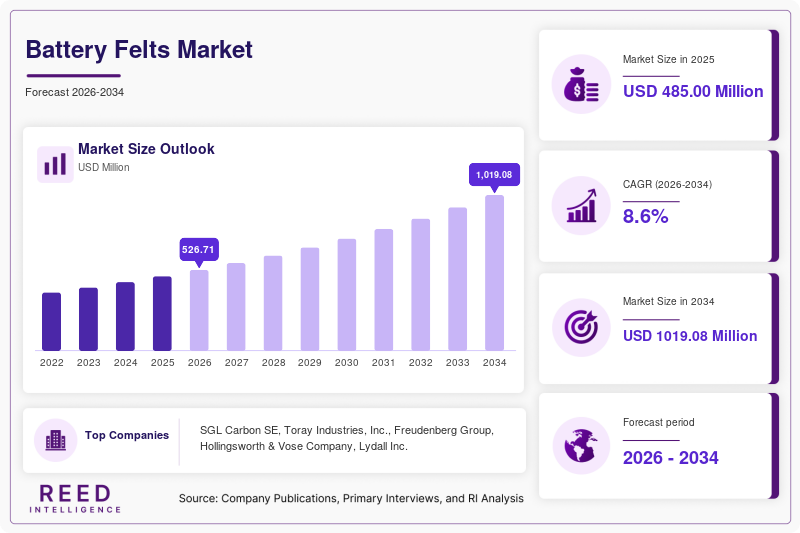
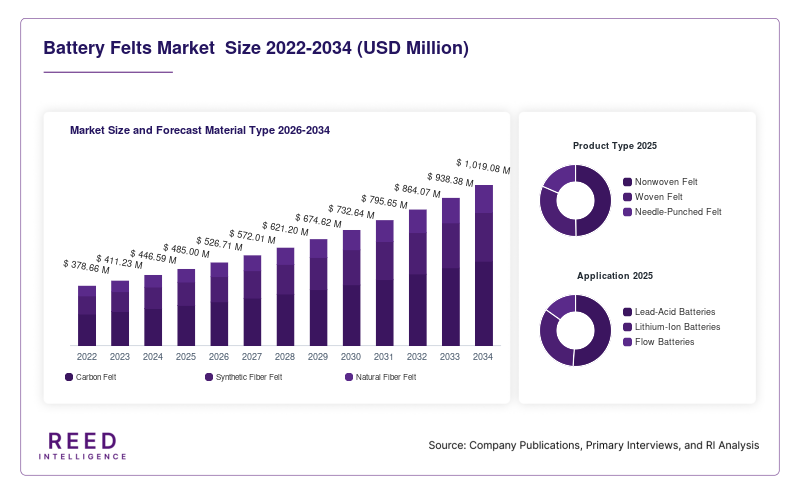
The global Battery Felts Market size was valued at USD 485 million in 2025 and is projected to reach approximately USD 1,020 million by 2034, expanding at a CAGR of 8.6% during the forecast period (2025–2034). Battery felts, primarily used in lead-acid batteries and emerging energy storage systems, play a critical role in enhancing electrolyte absorption, improving conductivity, and extending battery lifespan.
A key global factor supporting the growth of the Battery Felts Market is the increasing deployment of energy storage systems alongside renewable energy integration. As solar and wind installations expand, demand for efficient and durable battery components has risen significantly, thereby accelerating the adoption of advanced felts in battery manufacturing.
Key Highlights:
- Asia Pacific dominated the market with a 41% share in 2025 and will register the fastest CAGR of 9.4% through 2034.
- Carbon felt was the leading material segment, accounting for 48% share, while synthetic fiber felts will grow fastest at a CAGR of 9.1%.
- Lead-acid battery applications dominated with 52% share, while flow batteries will be the fastest-growing segment at a CAGR of 10.2%.
- China remained the dominant country, with market values of USD 112 million in 2024 and USD 121 million in 2025.
Market Trends
Rising Adoption of Carbon-Based Felts in Advanced Batteries
The Battery Felts Market is witnessing increasing adoption of carbon and graphite felts, particularly in advanced energy storage systems such as redox flow batteries. These materials offer superior conductivity, thermal stability, and chemical resistance, making them suitable for next-generation battery technologies. Manufacturers are investing in enhanced processing techniques to improve pore structure and surface area, thereby boosting battery performance.
Shift Toward Sustainable and Recyclable Materials
Sustainability has emerged as a key trend in the Battery Felts Market. Producers are focusing on eco-friendly raw materials and recyclable felts to align with environmental regulations and corporate sustainability goals. The development of biodegradable or low-emission production processes is gaining traction, particularly in regions with strict environmental compliance requirements. This shift is expected to redefine material selection and production strategies over the forecast period.
Market Drivers
Growth in Energy Storage Infrastructure
The rapid expansion of grid-scale and decentralized energy storage systems is driving demand in the Battery Felts Market. Battery felts are essential for maintaining electrolyte balance and improving efficiency in storage batteries. As countries invest in stabilizing power grids and integrating renewable energy, the need for high-performance battery components continues to rise.
Increasing Demand from Automotive Battery Applications
The automotive sector, particularly conventional and hybrid vehicles, relies heavily on lead-acid batteries, where felts are used as separators and absorbent materials. Growing vehicle production and replacement battery demand are contributing to the steady consumption of battery felts. Additionally, advancements in battery design are encouraging the use of higher-quality felts to enhance performance and longevity.
Market Restraint
Volatility in Raw Material Prices
Fluctuations in the prices of raw materials such as polyester fibers, carbon fibers, and synthetic polymers pose a challenge to the Battery Felts Market. These variations can affect production costs and profit margins for manufacturers. Since battery felts require specific material properties, switching to alternative inputs is often limited, making the market sensitive to supply chain disruptions.
Additionally, dependence on petrochemical-based materials exposes the industry to external economic and geopolitical factors. Price instability may also impact long-term supply contracts and pricing strategies, creating uncertainty for both manufacturers and end-users. This restraint could hinder consistent market growth, particularly for small and medium-scale producers.
Market Opportunities
Expansion of Flow Battery Technologies
The growing interest in flow batteries for large-scale energy storage presents a strong opportunity for the Battery Felts Market. These systems require high-performance felts with excellent conductivity and chemical resistance. As governments and industries invest in long-duration energy storage solutions, the demand for specialized felts is expected to increase significantly.
Technological Advancements in Nonwoven Manufacturing
Innovations in nonwoven fabrication techniques are opening new avenues for product development in the Battery Felts Market. Advanced manufacturing processes enable precise control over fiber structure, thickness, and porosity, enhancing product performance. Companies that invest in these technologies can differentiate their offerings and cater to specialized applications, including high-efficiency batteries and emerging storage systems.
Segmental Analysis
By Material Type
Carbon felt dominated the Battery Felts Market in 2024, accounting for approximately 48% of the total share. This dominance was attributed to its superior conductivity, chemical stability, and suitability for various battery applications. The material’s ability to enhance performance in both conventional and advanced batteries has made it a preferred choice among manufacturers.
Synthetic fiber felts are projected to be the fastest-growing subsegment, with a CAGR of 9.1% during the forecast period. Their lightweight properties, cost efficiency, and adaptability will drive growth. Increased usage in emerging battery technologies will further support this segment.
By Application
Lead-acid batteries represented the largest application segment, capturing 52% of the Battery Felts Market share in 2024. The widespread use of these batteries in automotive and backup power applications has contributed to their dominance. Battery felts are essential in maintaining electrolyte distribution and improving battery efficiency.
Flow batteries will be the fastest-growing application segment, expanding at a CAGR of 10.2% through 2034. Their growing adoption in large-scale energy storage systems will create demand for advanced felts with enhanced properties.
By End-Use Industry
The automotive sector dominated the Battery Felts Market in 2024, accounting for 46% share. High demand for lead-acid batteries in vehicles and replacement markets has supported this segment’s growth.
The energy and utilities sector is expected to be the fastest-growing segment, with a CAGR of 9.8%. Increasing investments in renewable energy storage will drive demand for battery felts in this segment.
By Product Type
Nonwoven felts held the largest share of the Battery Felts Market in 2024, accounting for 55%. Their flexibility, durability, and efficient absorption properties have made them widely used in battery manufacturing.
Needle-punched felts will grow at the fastest CAGR of 9.0% during the forecast period. Their improved structural integrity and performance characteristics will support adoption in advanced battery systems.
Regional Analysis
North America
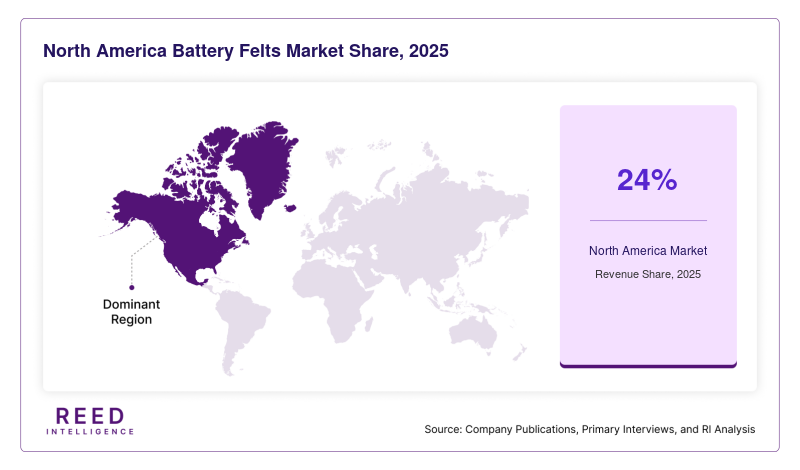
North America accounted for approximately 24% of the Battery Felts Market share in 2025 and will grow at a CAGR of 7.8% through 2034. The region’s growth is supported by increasing investments in energy storage projects and grid modernization initiatives. Demand for advanced battery components has risen steadily, particularly in the U.S., where infrastructure upgrades are driving adoption.
The United States dominated the regional market due to strong industrial demand and technological advancements in battery manufacturing. The presence of established battery producers and increasing focus on energy resilience are key growth factors supporting the market.
Europe
Europe held around 21% share of the Battery Felts Market in 2025 and is projected to expand at a CAGR of 8.1% during the forecast period. The region has experienced growth due to stringent environmental regulations and increasing adoption of sustainable battery solutions.
Germany led the European market, supported by its strong automotive industry and focus on energy transition initiatives. The country’s emphasis on efficient energy storage systems has driven demand for high-quality battery felts.
Asia Pacific
Asia Pacific dominated the Battery Felts Market with a 41% share in 2025 and will register the fastest CAGR of 9.4% through 2034. The region has benefited from large-scale battery manufacturing, rapid industrialization, and increasing energy demand.
China emerged as the leading country due to its extensive battery production capacity and growing investments in renewable energy projects. The country’s manufacturing ecosystem and cost advantages have significantly contributed to market expansion.
Middle East & Africa
The Middle East & Africa accounted for 7% of the Battery Felts Market in 2025 and will grow at a CAGR of 7.2% during the forecast period. The region has shown gradual adoption of energy storage technologies, particularly in off-grid and remote applications.
Saudi Arabia dominated the regional market, driven by investments in renewable energy projects and infrastructure development. The country’s initiatives to diversify its energy mix have supported demand for battery components.
Latin America
Latin America held an 7% share of the Battery Felts Market in 2025 and is expected to grow at a CAGR of 7.5% through 2034. The region has seen increasing adoption of energy storage systems to support renewable energy integration.
Brazil led the regional market, supported by expanding industrial activities and growing energy needs. The country’s focus on improving energy reliability has driven demand for battery-related components.
Competitive Landscape
The Battery Felts Market is moderately fragmented, with several global and regional players competing based on product quality, innovation, and pricing strategies. Companies are focusing on expanding their production capacities and investing in research and development to enhance material performance.
The market leader, SGL Carbon SE, has maintained a strong position through its advanced carbon-based felt solutions and continuous product innovation. The company recently introduced enhanced graphite felt products designed for improved efficiency in flow battery systems.
Other players are emphasizing strategic partnerships and technological advancements to strengthen their market presence. The competitive environment is characterized by ongoing innovation and a focus on meeting evolving customer requirements.
Key Players List
- SGL Carbon SE
- Toray Industries, Inc.
- Freudenberg Group
- Hollingsworth & Vose Company
- Lydall Inc.
- AstenJohnson Inc.
- Nippon Felt Co., Ltd.
- Albany International Corp.
- Technical Fibre Products Ltd.
- Sinoma Science & Technology Co., Ltd.
- Jiangsu Tianniao High Technology Co., Ltd.
- Beijing Great Wall Co., Ltd.
- Shandong Huayang New Materials Technology Co., Ltd.
- Zhejiang Xinhua Chemical Fiber Group
- AvCarb Material Solutions
Recent Developments
- SGL Carbon SE launched a new generation of graphite felts tailored for high-performance energy storage systems.
- Toray Industries expanded its production capacity for advanced fiber materials used in battery applications.
- Freudenberg Group introduced eco-friendly nonwoven felts to support sustainable battery manufacturing.
- Hollingsworth & Vose developed enhanced separator materials for improved battery efficiency.
- Technical Fibre Products invested in new manufacturing technologies to improve product consistency and performance.
Battery Felts Market Segments
Material Type
- Carbon Felt
- Synthetic Fiber Felt
- Natural Fiber Felt
Product Type
- Nonwoven Felt
- Woven Felt
- Needle-Punched Felt
Application
- Lead-Acid Batteries
- Lithium-Ion Batteries
- Flow Batteries
End-Use Industry
- Automotive
- Energy & Utilities
- Industrial
By Region
- North America
- Europe
- APAC
- Middle East and Africa
- LATAM