Battery Plate Market Size, Share & Demand Report By Type (Flat Plates, Tubular Plates), By Material (Lead-Based Plates, Lithium-Based Plates, Other Advanced Materials), By Application (Automotive Batteries, Industrial Batteries, Energy Storage Systems, Consumer Electronics), By End-Use Industry (Automotive, Renewable Energy, Industrial Sector, Telecommunications), By Region & Segment Forecasts, 2025–2034
USD 3950
Market Overview
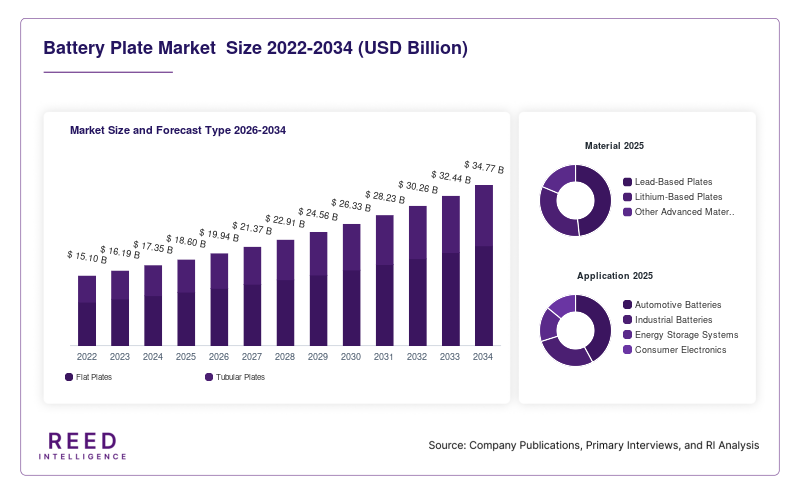
The global Battery Plate Market size was valued at approximately USD 18.6 billion in 2025 and is projected to reach USD 34.9 billion by 2034, expanding at a CAGR of 7.2% during the forecast period (2025–2034). Battery plates, which serve as critical components in energy storage systems, are witnessing consistent demand across automotive, industrial, and renewable energy applications. Their role in improving charge efficiency, durability, and energy density has made them essential in both conventional and advanced battery technologies.
One of the primary global factors supporting market growth is the rapid electrification of transportation and the scaling of energy storage infrastructure. Governments and private sectors worldwide are investing heavily in electric vehicles (EVs), grid-scale energy storage systems, and backup power solutions, all of which rely on efficient battery plate designs. This trend has encouraged innovation in materials such as lead alloys, lithium-based composites, and advanced coatings, enhancing product performance and lifecycle.
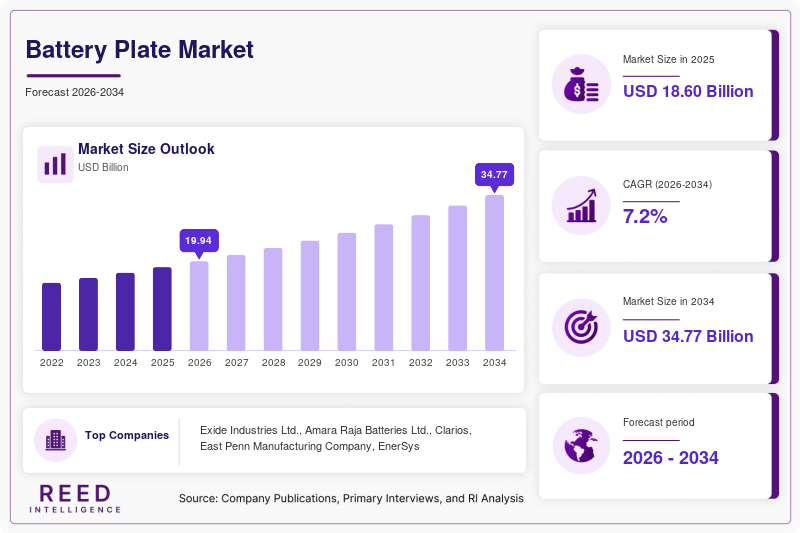
Key Highlights:
- Asia Pacific dominated the market with a 42.3% share in 2025, while the region is also expected to be the fastest-growing at a CAGR of 8.1%.
- By type, flat plates accounted for the largest share at 48.7% in 2024, whereas tubular plates are projected to grow fastest at a CAGR of 7.9%.
- By material, lead-based plates held dominance with 61.5% share, while lithium-based materials are expected to expand at a CAGR of 8.6%.
- China remained the dominant country, with market values of USD 4.9 billion in 2024 and USD 5.3 billion in 2025.
Market Trends
Transition Toward Advanced Battery Chemistries
The Battery Plate Market is experiencing a shift toward advanced battery chemistries, particularly lithium-ion and hybrid systems. Manufacturers are focusing on improving plate conductivity, corrosion resistance, and energy efficiency through the use of nanomaterials and composite structures. This trend is driven by the need for lightweight and high-performance batteries, especially in electric mobility and portable energy storage. As a result, traditional lead-acid plate designs are being enhanced with innovative coatings and alloy formulations.
Integration of Sustainable Manufacturing Practices
Sustainability has become a central theme across the Battery Plate Market. Companies are increasingly adopting recycling technologies and eco-friendly production processes to reduce environmental impact. The use of recycled lead and low-emission manufacturing techniques is gaining traction, particularly in regions with strict environmental regulations. Additionally, circular economy models are encouraging the reuse of battery components, including plates, which is influencing product design and lifecycle management strategies.
Market Drivers
Expansion of Electric Vehicle Ecosystem
The rapid adoption of electric vehicles is significantly driving demand in the Battery Plate Market. EV batteries require high-performance plates that ensure efficient energy transfer and longer lifespan. As automotive manufacturers scale up EV production, the demand for durable and lightweight battery plates continues to rise, fostering innovation and capacity expansion.
Increasing Deployment of Energy Storage Systems
The growing need for reliable energy storage solutions is another key driver. Battery plates are integral to stationary storage systems used in renewable energy integration, backup power, and grid stabilization. As solar and wind installations expand globally, the demand for efficient battery components is increasing, supporting sustained growth in the market.
Market Restraint
Volatility in Raw Material Prices
Fluctuations in the prices of key raw materials such as lead, lithium, and other metals present a significant challenge for the Battery Plate Market. These materials constitute a substantial portion of production costs, and their price volatility can impact profit margins and pricing strategies. Additionally, supply chain disruptions and geopolitical factors can further exacerbate cost uncertainties, limiting market growth and investment planning.
Market Opportunities
Growth in Renewable Energy Storage Applications
The increasing adoption of renewable energy sources presents a significant opportunity for the Battery Plate Market. As solar and wind energy installations expand, there is a growing need for efficient storage systems to manage energy intermittency. Battery plates designed for high-cycle stability and long service life are expected to witness increased demand in this segment.
Technological Advancements in Plate Design
Innovations in battery plate design, including the use of advanced alloys, coatings, and nanotechnology, are creating new growth avenues. These advancements enhance performance characteristics such as conductivity, durability, and energy density. Manufacturers investing in research and development are likely to gain a competitive advantage by offering differentiated products tailored to emerging applications.
Segmental Analysis
By Type
Flat plates dominated the Battery Plate Market, accounting for 48.7% of the share in 2024. Their widespread use in automotive and industrial batteries contributed to their leading position.
Tubular plates are expected to be the fastest-growing segment, with a projected CAGR of 7.9%. Their superior durability and performance in deep-cycle applications will drive adoption, particularly in energy storage systems.
By Material
Lead-based plates held the largest share of 61.5% in 2024 due to their cost-effectiveness and established usage in traditional batteries.
Lithium-based materials are anticipated to grow at a CAGR of 8.6%, driven by increasing adoption of lithium-ion batteries in EVs and portable devices. Their higher energy density and efficiency will support growth.
By Application
Automotive applications dominated the market with a 45.2% share in 2024, supported by widespread use in vehicles.
Energy storage systems are projected to grow at a CAGR of 8.3%, driven by increasing renewable energy integration and demand for backup power solutions.
By End-Use Industry
The automotive sector accounted for the largest share of 41.8% in 2024 due to consistent demand for vehicle batteries.
The renewable energy sector is expected to grow at a CAGR of 8.5%, supported by increasing investments in solar and wind energy storage solutions.
Regional Analysis
North America
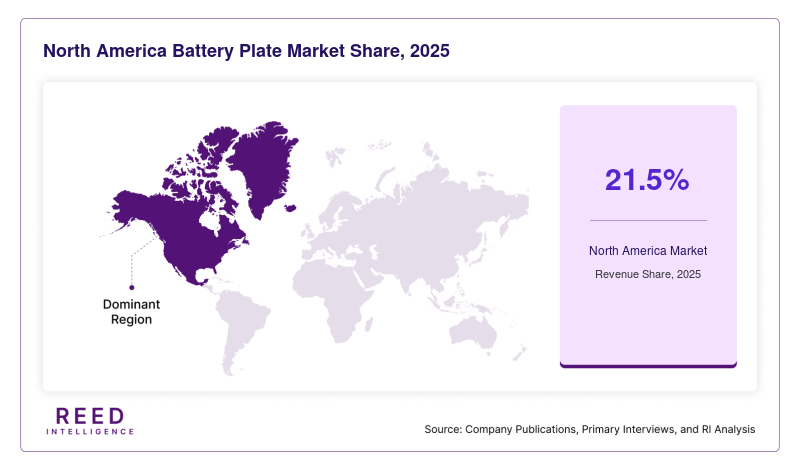
North America accounted for approximately 21.5% of the Battery Plate Market share in 2025 and is expected to grow at a CAGR of 6.8% during the forecast period. The region’s mature automotive and industrial sectors contributed to steady demand for battery plates.
The United States dominated the regional market due to its strong focus on energy storage and EV infrastructure. Increased investments in grid modernization and backup power systems supported consistent growth.
Europe
Europe held around 19.8% of the global market share in 2025 and is projected to expand at a CAGR of 6.9%. Regulatory emphasis on sustainability and emissions reduction supported the adoption of advanced battery technologies.
Germany led the region, driven by its automotive manufacturing base and transition toward electric mobility. The country’s focus on energy efficiency and innovation strengthened demand for high-performance battery plates.
Asia Pacific
Asia Pacific captured the largest share of 42.3% in 2025 and is anticipated to grow at the fastest CAGR of 8.1%. Rapid industrialization, urbanization, and strong manufacturing capabilities contributed to regional dominance.
China remained the leading country due to its extensive battery production ecosystem and large-scale EV adoption. Government support and domestic manufacturing capacity played a key role in market expansion.
Middle East & Africa
The Middle East & Africa region accounted for 8.2% of the market in 2025 and is expected to grow at a CAGR of 7.0%. Increasing demand for backup power and off-grid energy solutions supported growth.
Saudi Arabia emerged as a key country, driven by investments in renewable energy projects and infrastructure development. The need for reliable energy storage systems contributed to rising demand.
Latin America
Latin America held a 8.2% share in 2025 and is projected to grow at a CAGR of 6.7%. Economic development and increasing electrification supported market growth.
Brazil dominated the region due to its expanding automotive sector and energy storage needs. Growing investments in renewable energy projects further supported demand for battery plates.
Competitive Landscape
The Battery Plate Market is moderately fragmented, with several global and regional players competing on product quality, innovation, and cost efficiency. Leading companies are focusing on research and development to enhance plate performance and durability.
The market leader, Exide Industries Ltd., has strengthened its position through continuous product innovation and expansion of manufacturing capacity. The company recently introduced advanced tubular plate technologies aimed at improving battery lifespan and efficiency.
Other key players are investing in strategic partnerships, mergers, and technological advancements to expand their market presence and address evolving customer requirements.
Key Players List
- Exide Industries Ltd.
- Amara Raja Batteries Ltd.
- Clarios
- East Penn Manufacturing Company
- EnerSys
- GS Yuasa Corporation
- Johnson Controls
- Hoppecke Batteries
- Crown Battery Manufacturing Company
- Narada Power Source Co., Ltd.
- Leoch International Technology Ltd.
- Trojan Battery Company
- Banner Batteries
- C&D Technologies
- FIAMM Energy Technology
Recent Developments
- In 2024, major manufacturers expanded production capacity to meet rising demand for EV batteries.
- Several companies introduced advanced plate coatings to improve corrosion resistance and efficiency.
- Strategic collaborations between battery manufacturers and renewable energy firms increased to support energy storage projects.
- Investments in recycling technologies for battery materials gained momentum across developed regions.
Battery Plate Market Segments
Type
- Flat Plates
- Tubular Plates
Material
- Lead-Based Plates
- Lithium-Based Plates
- Other Advanced Materials
Application
- Automotive Batteries
- Industrial Batteries
- Energy Storage Systems
- Consumer Electronics
End-Use Industry
- Automotive
- Renewable Energy
- Industrial Sector
- Telecommunications
Distribution Channel
- OEM Supply
- Aftermarket Sales
- Online Distribution
- Specialty Distributors
By Region
- North America
- Europe
- APAC
- Middle East and Africa
- LATAM