Bean Bag Market Size, Share, Demand Report By Product Type (Classic Bean Bags, Gaming Bean Bags, Lounger Bean Bags, Kids Bean Bags, Outdoor Bean Bags), By Material (Leather & Faux Leather, Cotton Fabric, Polyester, Velvet, Others), By End Use (Residential, Commercial, Hospitality, Corporate Offices, Educational Institutions, Entertainment Centers), By Distribution Channel (Online Retail, Specialty Furniture Stores, Hypermarkets & Supermarkets, Others), By Region & Segment Forecasts, 2026–2034
USD 3950
Market Overview
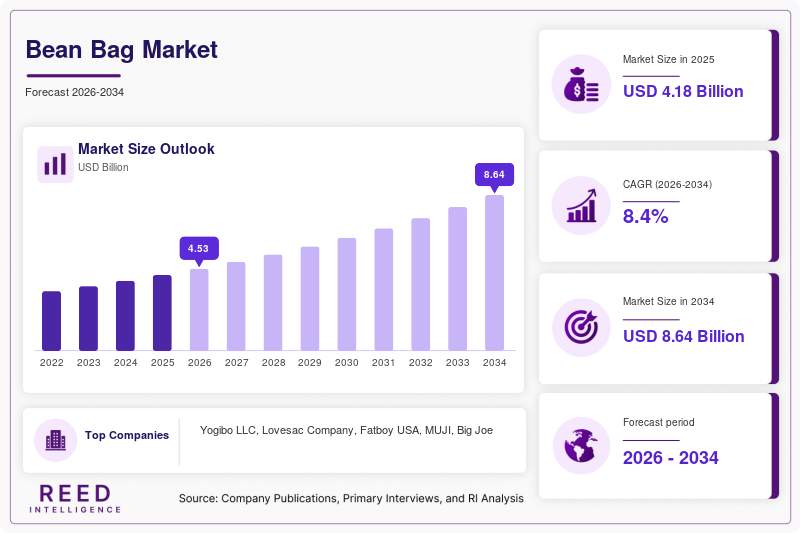
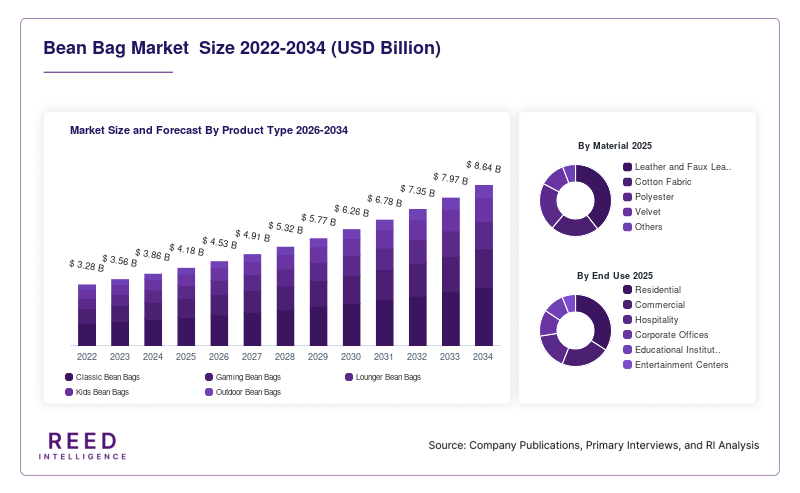
The global Bean Bag Market size was valued at USD 4.18 billion in 2026 and is projected to reach USD 7.96 billion by 2034, expanding at a CAGR of 8.4% during the forecast period from 2026 to 2034. The market continues to benefit from evolving consumer preferences toward flexible and space-efficient furniture products designed for residential, commercial, and recreational environments. Bean bags have shifted from being casual seating accessories to multifunctional furniture solutions used in apartments, gaming rooms, educational institutions, cafés, hotels, and coworking spaces. Manufacturers are increasingly introducing ergonomic designs, premium filling materials, and washable fabric covers to attract a broader consumer base.
Growing urbanization and smaller residential living spaces across major economies have encouraged the adoption of lightweight and portable furniture. Consumers are prioritizing convenience, affordability, and adaptable interior designs, which has supported demand for bean bags among millennials and younger households. In addition, the growth of online furniture retailing has improved product visibility and accessibility across emerging economies. E-commerce platforms now provide extensive customization options related to color, size, fabric, and shape, strengthening purchasing behavior among digitally connected consumers.
Key Highlights
- North America dominated the market with a 35.1% share in 2025, while Asia Pacific is expected to grow at the fastest CAGR of 10.9% during 2026–2034.
- By product type, classic bean bags accounted for the largest share of 39.4%, while gaming bean bags are projected to grow at a CAGR of 11.8%.
- By material, leather and faux leather products led with a 33.8% share, whereas cotton fabric bean bags are expected to expand at a CAGR of 10.6%.
- By end use, residential applications dominated with a 61.7% share, while commercial applications are projected to grow at a CAGR of 10.3%.
- The United States remained the dominant country, with market values of USD 780 million in 2024 and USD 842 million in 2025.
Market Trends
Expansion of Gaming and Entertainment-Oriented Furniture
The increasing popularity of gaming culture and home entertainment setups has created strong momentum for gaming-focused bean bags. Consumers are investing in comfortable and ergonomic seating products that support long hours of entertainment activities, including gaming, streaming, and virtual reality experiences. Manufacturers are responding by introducing bean bags with memory foam filling, back support systems, cup holders, and integrated device storage compartments. Gaming bean bags are becoming particularly popular among younger consumers living in urban apartments where multifunctional furniture solutions are preferred over traditional seating products.
The trend is also supported by the rising number of esports tournaments, gaming cafés, and streaming studios worldwide. Commercial entertainment spaces are adopting oversized and customizable bean bag seating arrangements to create informal and immersive environments. Product launches featuring premium fabrics, LED accents, and branded collaborations with gaming companies are increasing customer engagement. The growing integration of comfort and aesthetic appeal within gaming furniture categories is expected to maintain steady demand for premium bean bag products during the forecast period.
Rising Preference for Sustainable and Personalized Furniture
Consumers are increasingly seeking environmentally responsible furniture products that align with sustainable lifestyle preferences. This trend has encouraged manufacturers to adopt recycled polystyrene filling, organic cotton covers, biodegradable packaging, and low-emission production methods. Sustainable bean bags are gaining traction among environmentally conscious households, educational institutions, and hospitality businesses that aim to reduce environmental impact. The growing awareness of circular economy principles has encouraged companies to promote refillable and repairable bean bag models that extend product life cycles.
Customization is also influencing purchasing decisions across online and offline retail channels. Consumers prefer personalized products with options related to fabric texture, shape, print design, and color combinations. Digital retail platforms now offer interactive customization tools that allow buyers to visualize products before purchase. This trend has increased customer satisfaction while helping brands differentiate themselves in a competitive market. The combination of sustainability and personalization is reshaping product development strategies and encouraging long-term consumer engagement across the global bean bag industry.
Market Drivers
Growth of Urban Living and Compact Residential Spaces
Rapid urbanization and the growing popularity of compact residential spaces are supporting demand for flexible furniture solutions worldwide. Urban consumers increasingly prefer lightweight and movable seating products that maximize available space while maintaining modern interior aesthetics. Bean bags are widely adopted in studio apartments, shared housing units, and small family homes because they can be repositioned easily and stored conveniently. Their affordability compared to traditional sofas and lounge chairs also makes them attractive for younger consumers and first-time homeowners.
The expansion of the rental housing market has further strengthened demand for practical furniture products requiring minimal maintenance and transportation effort. Students and working professionals frequently relocate between cities and prefer furniture that is portable and cost-effective. Bean bags fit these requirements while offering versatility across living rooms, bedrooms, balconies, and recreational spaces. Manufacturers are introducing foldable and modular designs to address changing lifestyle patterns, which is expected to sustain market growth throughout the forecast period.
Increasing Penetration of Online Furniture Retail Platforms
The rapid growth of e-commerce platforms has transformed the purchasing behavior of furniture consumers, significantly benefiting the Bean Bag Market. Online retail channels provide consumers with access to extensive product catalogs, competitive pricing, customer reviews, and home delivery services. Digital platforms enable manufacturers to reach customers in regions where physical furniture stores have limited presence. This expanded accessibility has accelerated market penetration in developing economies across Asia Pacific, Latin America, and the Middle East.
Social media marketing and influencer-based promotional campaigns are also driving online sales growth. Lifestyle influencers and interior design creators frequently showcase bean bags as stylish and practical additions to modern homes, encouraging impulse purchases among younger audiences. Augmented reality applications and virtual room visualization tools have improved consumer confidence in online furniture purchases. Furthermore, online-exclusive discounts and seasonal promotional campaigns continue to attract price-sensitive consumers. The strong expansion of digital retail infrastructure is expected to remain a major driver for global bean bag sales over the coming years.
Market Restraint
Concerns Related to Product Durability and Low-Cost Competition
Despite growing demand, the Bean Bag Market faces challenges associated with product durability and intense competition from low-cost manufacturers. Consumers often perceive bean bags as less durable compared to traditional furniture because filling materials can flatten over time and fabric covers may experience wear with continuous use. Low-quality products sold through unorganized retail channels have contributed to negative consumer experiences in several price-sensitive markets. Inferior stitching, poor filling retention, and reduced structural support can lead to shorter product life spans, affecting brand reputation and repeat purchasing behavior.
The presence of numerous regional manufacturers offering inexpensive alternatives has intensified price competition across the market. Smaller companies frequently compete through aggressive pricing strategies rather than product innovation, reducing profit margins for established brands. This pricing pressure can limit investments in premium materials, sustainable production methods, and advanced ergonomic features. In commercial applications such as hotels and gaming lounges, businesses may hesitate to adopt bean bags extensively due to concerns regarding maintenance frequency and long-term durability. As a result, manufacturers must continuously balance affordability with quality enhancement to maintain customer trust and market competitiveness.
Market Opportunities
Expansion of Commercial and Institutional Applications
The increasing use of informal seating arrangements in commercial and institutional environments presents significant opportunities for the Bean Bag Market. Educational institutions, coworking spaces, cafés, libraries, and corporate offices are adopting flexible seating concepts to encourage collaboration and comfort. Bean bags are being integrated into creative workspaces and student lounges where traditional furniture may appear rigid or space-consuming. Their portability and aesthetic versatility allow organizations to redesign interiors quickly without major infrastructure investments.
Hospitality businesses are also using bean bags in resorts, rooftop lounges, and recreational areas to create relaxed customer experiences. Outdoor waterproof bean bags designed for poolsides and beach resorts are gaining popularity among premium hospitality operators. The demand for customizable branding on commercial bean bags is further supporting business opportunities for manufacturers. As organizations continue prioritizing employee wellness and customer comfort, the commercial segment is expected to generate strong long-term revenue potential across developed and emerging markets.
Product Innovation Through Smart and Ergonomic Designs
Technological advancements and ergonomic innovation are creating new growth opportunities within the global Bean Bag Market. Manufacturers are introducing products with enhanced lumbar support, memory foam integration, temperature-regulating fabrics, and modular structures that improve comfort and usability. Smart bean bags equipped with built-in speakers, charging ports, and Bluetooth connectivity are attracting tech-oriented consumers seeking multifunctional furniture solutions for modern homes.
The growing emphasis on health-conscious seating products is encouraging investment in ergonomic research and development. Parents are increasingly purchasing supportive bean bags for children’s study areas and reading spaces, while elderly consumers prefer products that provide easy mobility and comfort. In addition, premium luxury bean bags made from designer fabrics and handcrafted materials are attracting high-income consumers interested in decorative furniture. Continuous innovation in design, materials, and functionality is expected to create differentiated product categories and expand the overall consumer base during the forecast period.
Segmental Analysis
By Product Type
Classic bean bags accounted for the largest share of the global Bean Bag Market in 2024, representing 39.4% of total revenue. These products continue to dominate because of their affordability, lightweight structure, and broad availability across residential and commercial channels. Consumers frequently choose classic round and pear-shaped designs for living rooms, bedrooms, libraries, and children’s spaces. Manufacturers have expanded fabric options, including velvet, leather, microfiber, and polyester, to attract diverse customer preferences. The segment also benefits from strong sales through e-commerce platforms that offer multiple size and color variations suitable for different interior themes.
By Material
Leather and faux leather bean bags dominated the material segment in 2024 with a market share of 33.8%. These products are widely preferred because of their premium appearance, durability, and ease of maintenance. Commercial establishments such as hotels, cafés, offices, and entertainment lounges frequently select leather-based bean bags due to their long-lasting performance and aesthetic compatibility with modern interiors. Consumers also favor faux leather variants because they provide a similar appearance to genuine leather at comparatively lower prices. Manufacturers are increasingly introducing stain-resistant and waterproof coatings to improve product longevity and expand outdoor usage applications.
By End Use
Residential applications held the dominant share of the Bean Bag Market in 2024, accounting for 61.7% of total revenue. The segment benefits from growing consumer demand for casual and multifunctional furniture suitable for compact living spaces. Households increasingly use bean bags in bedrooms, living rooms, balconies, reading corners, and entertainment areas. The affordability and portability of these products make them attractive for students, young professionals, and first-time homeowners. Online retail channels have further strengthened residential demand by providing convenient customization options and competitive pricing across various product categories.
Regional Analysis
North America
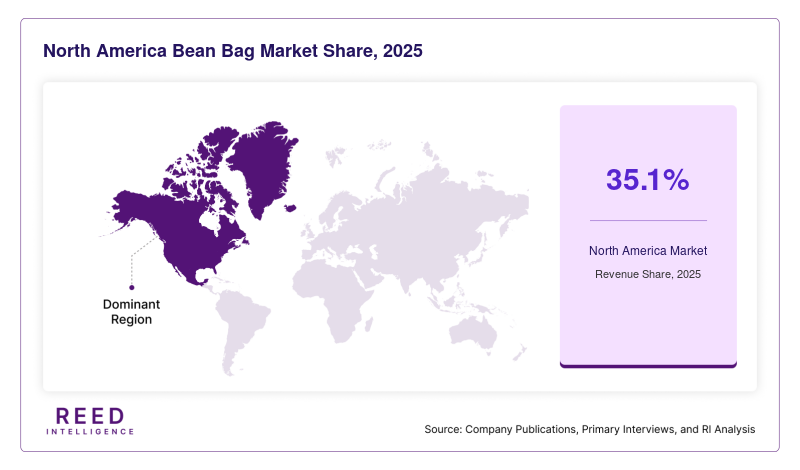
North America accounted for 35.1% of the global Bean Bag Market share in 2025 and is projected to maintain stable growth at a CAGR of 7.8% through 2034. The region benefits from high consumer spending on home décor and lifestyle-oriented furniture products. The popularity of gaming culture, streaming entertainment, and multifunctional living spaces has contributed significantly to bean bag demand across the United States and Canada. Consumers increasingly prefer premium seating products that combine comfort with modern aesthetics, encouraging manufacturers to launch innovative designs and sustainable materials.
Europe
Europe represented 24.6% of the global Bean Bag Market in 2025 and is expected to grow at a CAGR of 7.5% during the forecast period. The region demonstrates steady demand due to growing interest in minimalist interior designs and sustainable furniture consumption. Consumers across Western Europe prefer eco-friendly products manufactured using recyclable fabrics and low-emission production processes. Bean bags are increasingly used in urban apartments, student housing, and creative workspaces where flexible furniture solutions support changing lifestyle preferences.
Asia Pacific
Asia Pacific held 21.8% of the global market share in 2025 and is anticipated to expand at the fastest CAGR of 10.9% through 2034. Rapid urbanization, rising disposable incomes, and increasing digital retail penetration are driving substantial growth across the region. Consumers in countries such as China, India, Japan, and South Korea are increasingly adopting compact and affordable furniture products suited for urban lifestyles. The expansion of online furniture marketplaces has significantly improved accessibility to customized bean bag products in metropolitan and semi-urban areas.
Middle East & Africa
The Middle East & Africa region accounted for 9.2% of the global Bean Bag Market in 2025 and is forecast to grow at a CAGR of 8.1% during the study period. Market expansion is supported by rising investments in hospitality infrastructure, premium residential projects, and entertainment venues. Luxury resorts, cafés, and outdoor recreational facilities are increasingly adopting bean bag seating arrangements to create relaxed customer environments. Demand for waterproof and weather-resistant products is particularly strong in tourism-oriented destinations across the Gulf region.
Latin America
Latin America captured 9.3% of the global Bean Bag Market share in 2025 and is projected to grow at a CAGR of 8.3% through 2034. Rising middle-class income levels and increasing interest in affordable home furnishing products are supporting market development across the region. Bean bags are becoming popular among younger consumers who prefer informal and versatile furniture solutions for apartments and shared living spaces. Regional manufacturers are expanding product availability through both online platforms and retail furniture chains.
Competitive Landscape
The global Bean Bag Market is moderately fragmented, with both international and regional manufacturers competing through pricing strategies, product innovation, and online retail expansion. Leading companies are focusing on sustainable materials, ergonomic product development, and customized design offerings to strengthen brand positioning. E-commerce partnerships and direct-to-consumer sales channels are becoming increasingly important for expanding customer reach and improving profit margins.
Yogibo LLC remains one of the leading companies in the market due to its broad product portfolio and strong presence across North America and Asia. The company has continued investing in premium comfort technology and modular seating concepts designed for residential and commercial customers. Fatboy, MUJI, Comfy Sacks, and Lovesac are also prominent players emphasizing multifunctional furniture and lifestyle branding.
Key Players
- Yogibo LLC
- Fatboy USA
- Lovesac Company
- MUJI
- Comfy Sacks
- Big Joe
- Sumo Lounge
- Ace Bayou Corp.
- CordaRoy’s
- Jaxx Bean Bags
- Gilda Industries
- Ultimate Sack
- Sofa Sack
- Lumaland
- Chill Sack
Recent Developments
- In February 2026, Yogibo LLC introduced a new eco-friendly bean bag collection manufactured using recycled foam filling and washable organic cotton covers for residential consumers.
- In July 2025, Lovesac Company expanded its online customization platform, enabling customers to personalize bean bag size, texture, color, and modular seating configurations.
- In October 2025, Fatboy USA partnered with hospitality chains in the Middle East to supply waterproof outdoor bean bags designed for luxury resorts and rooftop leisure spaces.
- In March 2026, MUJI launched compact multifunctional bean bag seating products targeting urban apartments and student housing markets across Asia Pacific.
Bean Bag Market Segments
By Product Type
- Classic Bean Bags
- Gaming Bean Bags
- Lounger Bean Bags
- Kids Bean Bags
- Outdoor Bean Bags
By Material
- Leather and Faux Leather
- Cotton Fabric
- Polyester
- Velvet
- Others
By End Use
- Residential
- Commercial
- Hospitality
- Corporate Offices
- Educational Institutions
- Entertainment Centers
By Distribution Channel
- Online Retail
- Specialty Furniture Stores
- Hypermarkets & Supermarkets
- Others
By Region
- North America
- Europe
- APAC
- Middle East and Africa
- LATAM