Bearing Isolators Market Size, Share, Demand Report By Type (Non-Contact Labyrinth Bearing Isolators, Magnetic Bearing Isolators, Hybrid Bearing Isolators), By Application (Oil & Gas, Power Generation, Mining Equipment, Marine Systems, Renewable Energy Systems), By End-Use Industry (Industrial Manufacturing, Energy & Utilities, Transportation, Chemical Processing, Construction Equipment), By Region & Segment Forecasts, 2026–2034
USD 3950
Market Overview
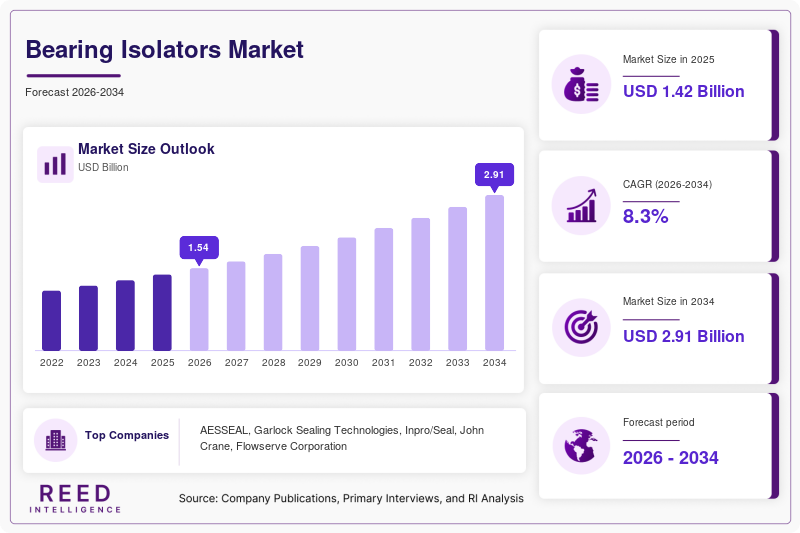
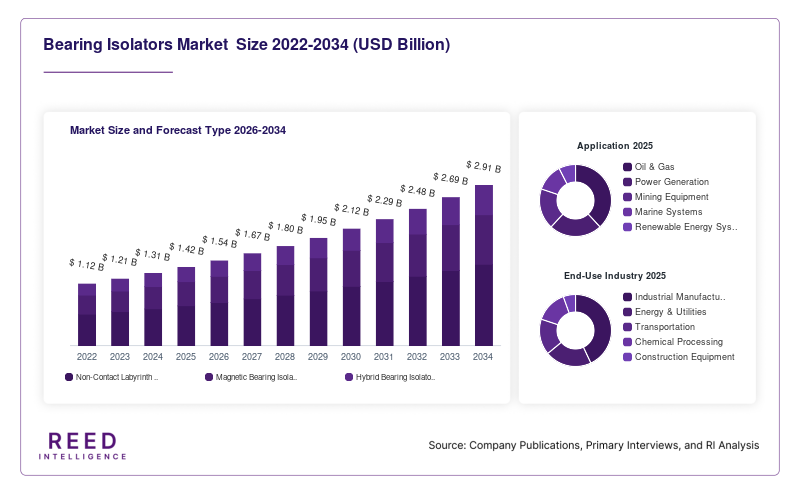
The Bearing Isolators Market size is projected to demonstrate steady expansion, with the global market size valued at approximately USD 1.42 billion in 2026 and expected to reach around USD 2.68 billion by 2034, registering a CAGR of 8.3% during 2026–2034. The growth trajectory is primarily supported by increasing demand for advanced machinery protection systems across heavy industries such as oil & gas, power generation, mining, marine, and manufacturing. Bearing isolators play a crucial role in preventing lubricant leakage and protecting bearings from contamination, which significantly enhances equipment lifespan and reduces maintenance costs.
A major global factor supporting market expansion is the rapid industrial automation trend combined with rising investments in predictive maintenance technologies. Industries are increasingly adopting high-efficiency rotating equipment, where bearing isolators are essential for minimizing downtime and improving operational reliability. Additionally, stricter environmental regulations regarding lubricant leakage and industrial emissions are pushing end users toward more sustainable sealing technologies.
Key Highlights
- North America dominated the market with a 34.2% share in 2025.
- Asia Pacific is expected to grow at the fastest CAGR of 11.1% during 2026–2034.
- By material type, non-contact labyrinth isolators accounted for the largest share of 39.4%, while magnetic bearing isolators are projected to grow at a CAGR of 12.6%.
- By end-use industry, oil & gas applications led with a 37.8% share, whereas renewable energy systems are expected to expand at a CAGR of 11.9%.
- The United States remained the dominant country, with market values of USD 610 million in 2024 and USD 660 million in 2025.
Market Trends
Increasing Adoption of Non-Contact Sealing Technologies
One of the most prominent trends shaping the Bearing Isolators Market is the increasing shift toward non-contact sealing technologies, particularly in high-speed rotating equipment. Unlike traditional contact seals, bearing isolators operate without frictional contact, which significantly reduces wear and enhances system efficiency. Industries such as power generation and petrochemicals are rapidly transitioning toward labyrinth and magnetic isolator designs to improve machine uptime. The demand is further supported by the need to reduce lubricant contamination and extend maintenance intervals. Manufacturers are also innovating with hybrid isolator designs that combine magnetic and labyrinth structures, offering improved resistance to harsh environmental conditions and temperature fluctuations.
Integration of Smart Monitoring and Predictive Maintenance
Another key trend is the integration of smart monitoring systems with bearing isolators, enabling predictive maintenance capabilities. Industrial operators are increasingly deploying sensor-enabled isolators that provide real-time data on vibration, temperature, and contamination levels. This digital transformation allows maintenance teams to anticipate failures before they occur, reducing unplanned downtime. The trend is particularly strong in industries such as mining, marine, and large-scale manufacturing, where equipment reliability is critical. In addition, advancements in Industrial Internet of Things (IIoT) platforms are further enhancing the adoption of intelligent bearing protection systems, enabling centralized monitoring and improved operational decision-making.
Market Drivers
Rising Demand for Industrial Equipment Reliability
A major driver of the Bearing Isolators Market is the increasing demand for enhanced reliability and operational efficiency in industrial machinery. Heavy-duty equipment used in sectors such as oil & gas, mining, and manufacturing operates under extreme conditions, where bearing failure can lead to significant production losses. Bearing isolators help mitigate these risks by preventing contamination from dust, moisture, and chemicals while retaining lubrication inside the system. As industries focus on minimizing downtime and maintenance costs, the adoption of high-performance isolators continues to rise. Furthermore, global industrial expansion and infrastructure development projects are accelerating demand for durable and efficient rotating machinery protection solutions.
Growth in Predictive Maintenance and Automation Systems
The growing adoption of predictive maintenance strategies is another key driver fueling market growth. Companies are increasingly investing in automation systems that rely on real-time equipment monitoring to optimize performance and reduce operational disruptions. Bearing isolators play a critical role in these systems by ensuring clean operating environments for bearings, which improves the accuracy and lifespan of predictive maintenance technologies. Additionally, industries are integrating advanced analytics and AI-driven monitoring platforms, which further increases reliance on high-quality sealing and isolation solutions. This shift toward smart manufacturing and Industry 4.0 practices is significantly boosting demand for advanced bearing isolators across multiple end-use sectors.
Market Restraint
High Initial Installation and Replacement Costs
One of the primary restraints affecting the Bearing Isolators Market is the relatively high initial installation and replacement costs associated with advanced isolator systems. While bearing isolators offer long-term cost savings through reduced maintenance and extended equipment life, their upfront cost remains a barrier for small and medium-sized enterprises. In cost-sensitive industries, operators often continue using conventional sealing solutions despite their lower efficiency. Additionally, retrofitting existing machinery with advanced isolators can require significant downtime and engineering adjustments, further increasing overall implementation costs. This financial constraint limits widespread adoption, particularly in developing regions where industrial budgets are more restricted.
Market Opportunities
Expansion in Renewable Energy Infrastructure
The expansion of renewable energy infrastructure presents a significant growth opportunity for the Bearing Isolators Market. Wind turbines, hydroelectric systems, and solar tracking equipment rely heavily on high-performance rotating components that require effective contamination protection. Bearing isolators are increasingly being adopted in wind turbine gearboxes and generators to improve operational reliability under harsh environmental conditions. As global investments in clean energy projects continue to rise, demand for durable and maintenance-free sealing technologies is expected to increase substantially. This creates new revenue streams for manufacturers specializing in corrosion-resistant and high-efficiency isolator designs.
Technological Advancements in Material Engineering
Another key opportunity lies in advancements in material engineering, particularly the development of high-performance composites and corrosion-resistant alloys. These materials enhance the durability and performance of bearing isolators in extreme environments such as offshore drilling platforms and chemical processing plants. Manufacturers are focusing on improving thermal resistance, chemical compatibility, and mechanical strength to meet evolving industrial requirements. The introduction of nano-coated and polymer-enhanced isolators is further expanding application potential. These innovations are expected to drive market penetration in high-risk industrial environments where traditional sealing solutions are insufficient.
Segmental Analysis
By Type of Bearing Isolators
The non-contact labyrinth isolators segment dominated the market with a 2024 share of approximately 39.4%, driven by their wide usage in heavy-duty industrial machinery. These isolators are preferred for their ability to prevent contamination without mechanical wear, making them suitable for high-speed applications in power generation and manufacturing industries.
The magnetic bearing isolators segment is projected to grow at a CAGR of 12.6% during the forecast period, supported by increasing adoption in advanced machinery and renewable energy systems. Their superior sealing efficiency, combined with reduced maintenance requirements, makes them highly suitable for modern industrial environments requiring high operational reliability.
By Application
Oil & gas applications accounted for the dominant share of 37.8% in 2024, primarily due to extensive use of rotating equipment in drilling, refining, and transportation systems. Bearing isolators are essential in preventing contamination and ensuring equipment reliability in harsh operating conditions.
Renewable energy applications are expected to grow at a CAGR of 11.9%, driven by expanding wind and hydroelectric power installations. The increasing need for durable and maintenance-free sealing solutions in turbine systems is significantly contributing to this growth.
By End-Use Industry
Industrial manufacturing held the largest share of 41.2% in 2024, supported by widespread use of rotating machinery in production facilities. Bearing isolators are critical in reducing downtime and improving operational efficiency in continuous manufacturing environments.
The renewable energy sector is projected to grow at a CAGR of 12.1%, driven by global clean energy initiatives and rising investment in wind and solar infrastructure. The need for high-performance bearing protection systems in extreme environmental conditions is accelerating adoption.
Regional Analysis
North America
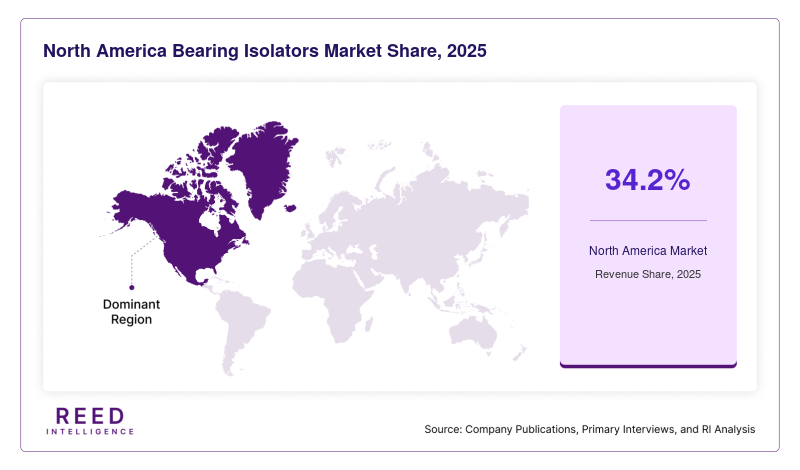
North America accounted for approximately 34.2% of the global market share in 2025, with a projected CAGR of 7.9% from 2026 to 2034. The region’s growth is supported by strong industrial automation adoption and high investment in maintenance optimization technologies.
The United States leads the regional market, driven by extensive oil & gas operations and advanced manufacturing infrastructure. Increasing focus on predictive maintenance systems and energy efficiency regulations is further supporting demand for bearing isolators across industrial applications.
Europe
Europe held nearly 27.5% market share in 2025, with an expected CAGR of 7.6% during the forecast period. The region benefits from stringent environmental regulations and a strong emphasis on sustainable industrial operations.
Germany dominates the European market due to its advanced engineering sector and strong automotive manufacturing base. The country’s focus on precision machinery and energy-efficient production systems is driving increased adoption of high-performance bearing isolators.
Asia Pacific
Asia Pacific represented around 25.8% market share in 2025, while recording the fastest CAGR of 11.1% through 2034. Rapid industrialization and infrastructure development are key growth contributors.
China leads the regional market, supported by large-scale manufacturing expansion and growing investments in renewable energy projects. Increasing demand for heavy machinery in construction and mining is also boosting isolator adoption.
Middle East & Africa
The Middle East & Africa region held approximately 7.2% market share in 2025, with a CAGR of 8.5% expected through 2034. Growth is driven by oil & gas exploration activities and industrial diversification initiatives.
Saudi Arabia is the dominant country, supported by large-scale refinery and petrochemical projects. Rising investments in industrial maintenance technologies are enhancing demand for durable bearing protection solutions.
Latin America
Latin America accounted for around 5.3% market share in 2025, with a projected CAGR of 7.8% during 2026–2034. Growth is supported by mining and energy sector expansion.
Brazil leads the regional market due to its strong mining industry and increasing industrial automation adoption. Infrastructure development projects are also contributing to rising demand for efficient bearing isolation systems.
Competitive Landscape
The Bearing Isolators Market is moderately consolidated, with key players focusing on product innovation, material advancements, and global expansion strategies. Leading companies are investing in R&D to develop advanced non-contact sealing technologies that improve efficiency and reduce maintenance costs. One of the market leaders, AESSEAL, has recently expanded its manufacturing capabilities to meet rising global demand for high-performance isolators. Other prominent players such as Garlock and Inpro/Seal are strengthening their product portfolios through technological upgrades and strategic partnerships with industrial equipment manufacturers.
Key Players
- AESSEAL
- Garlock Sealing Technologies
- Inpro/Seal
- John Crane
- Flowserve Corporation
- EagleBurgmann
- SKF Group
- Parker Hannifin
- Schaeffler Group
- Timken Company
- Chesterton Company
- Kalsi Engineering Inc.
- Technetics Group
- Chesterton Sealing Solutions
- Eagle Industry Co., Ltd.
Recent Developments
- A leading manufacturer introduced a next-generation magnetic bearing isolator designed for high-temperature industrial environments, improving operational lifespan by enhancing thermal resistance capabilities.
- Several global players expanded their production facilities in Asia Pacific to meet increasing demand from wind energy and heavy manufacturing industries, strengthening regional supply chains.
- Strategic collaborations between sealing technology companies and industrial OEMs have increased, focusing on integrating smart monitoring systems into bearing isolator designs for predictive maintenance applications.
Bearing Isolators Market Segments
Type
- Non-Contact Labyrinth Bearing Isolators
- Magnetic Bearing Isolators
- Hybrid Bearing Isolators
Application
- Oil & Gas
- Power Generation
- Mining Equipment
- Marine Systems
- Renewable Energy Systems
End-Use Industry
- Industrial Manufacturing
- Energy & Utilities
- Transportation
- Chemical Processing
- Construction Equipment
By Region
- North America
- Europe
- APAC
- Middle East and Africa
- LATAM