Bed Head Panel Market Size, Share Demand Report By Type (Horizontal Bed Head Panels, Vertical Bed Head Panels, Recessed Bed Head Panels), By Application (Intensive Care Units, General Wards, Emergency Care Units, Surgical Units), By End-User (Hospitals, Specialty Clinics, Ambulatory Surgical Centers), By Region & Segment Forecasts, 2025–2034
USD 3950
Market Overview
The Bed Head Panel Market size was valued at USD 2.14 billion in 2025 and is projected to reach USD 3.96 billion by 2033, expanding at a CAGR of 7.9% during 2025–2034. Bed head panels are integrated medical equipment units installed at the head of hospital beds to provide centralized access to electrical outlets, medical gas pipelines, communication systems, and lighting controls. These panels support efficient patient care by organizing medical utilities within easy reach of healthcare professionals.
A key global factor supporting the growth of the Bed Head Panel Marketis the expansion of healthcare infrastructure worldwide. Governments and healthcare organizations are investing in hospital construction, modernization of healthcare facilities, and expansion of intensive care units. As hospitals increase bed capacity and upgrade patient care systems, the demand for integrated bedside infrastructure such as bed head panels continues to grow. These panels improve workflow efficiency, reduce cable clutter, and support patient safety by organizing essential medical equipment connections.
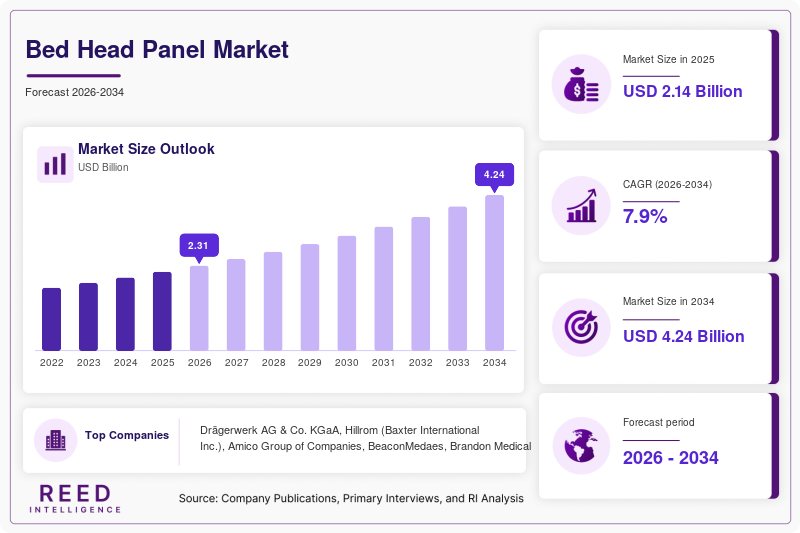
Key Highlights
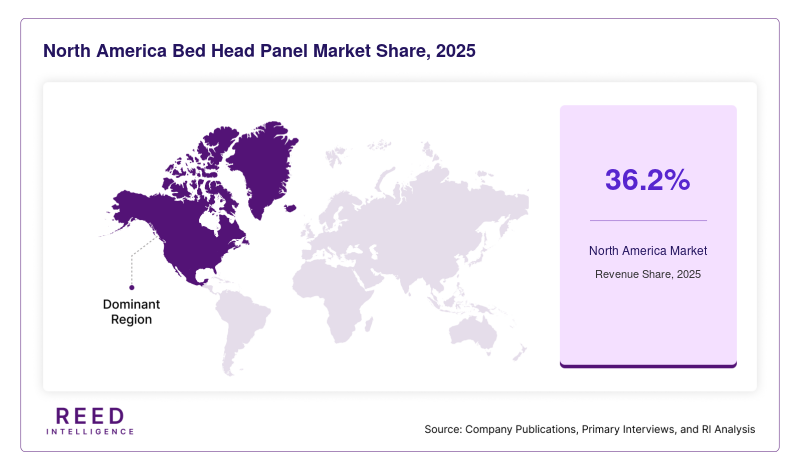
- North America held the dominant share of 36.2% in 2025, while Asia Pacific is expected to grow at the fastest CAGR of 9.3%.
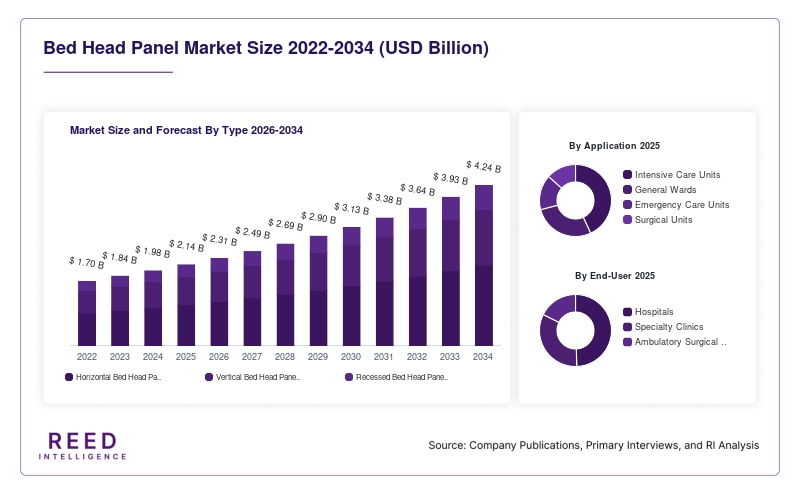
- Horizontal bed head panels dominated the type segment with 52.6% share, while vertical bed head panels are projected to grow at a 8.8% CAGR.
- Intensive care units (ICU) represented the leading application with 41.4% share, while emergency care units will expand at a 9.1% CAGR.
- The United States remained the leading country with a market value of USD 521.6 million in 2025, projected to reach USD 556.8 million in 2026.
Market Trends
Increasing Adoption of Modular Healthcare Infrastructure
The Bed Head Panel Marketis witnessing a growing shift toward modular healthcare infrastructure systems. Hospitals are adopting modular patient room designs that enable flexible configuration of medical equipment and utilities. Modular bed head panels allow healthcare providers to customize panel components, including electrical outlets, medical gas ports, and communication interfaces. This flexibility supports diverse clinical requirements across departments such as ICU, surgical wards, and emergency units. As healthcare facilities focus on improving operational efficiency and patient safety, modular panel systems are becoming increasingly preferred.
Integration of Smart Monitoring and Digital Connectivity
Another trend influencing the Bed Head Panel Marketis the integration of smart monitoring technologies and digital connectivity features. Modern bed head panels increasingly include data ports, nurse call systems, and integrated device management interfaces. These features allow healthcare professionals to connect monitoring devices and communicate with hospital information systems directly from bedside units. Hospitals implementing digital healthcare technologies are gradually adopting integrated bed head panels to support connected care environments.
Market Drivers
Growth in Hospital Construction and Expansion Projects
The expansion of hospital infrastructure is a major factor driving the Bed Head Panel Market. Healthcare systems across many countries are increasing hospital capacity to meet growing patient demand. Construction of new hospitals and expansion of existing healthcare facilities require installation of essential medical infrastructure such as bed head panels. These systems help organize medical equipment connections and improve accessibility for healthcare staff. Increasing investment in healthcare infrastructure therefore contributes to steady market growth.
Rising Demand for Efficient Patient Care Environments
The demand for efficient patient care environments is another driver supporting the Bed Head Panel Market. Hospitals are focusing on improving patient safety and clinical workflow efficiency. Bed head panels help reduce clutter by consolidating electrical outlets, gas supply points, and communication interfaces into a single unit. This organized layout allows healthcare professionals to access essential equipment quickly and improves overall patient management efficiency.
Market Restraint
High Installation and Infrastructure Costs
A significant restraint affecting the Bed Head Panel Marketis the high installation and infrastructure costs associated with advanced panel systems. Installing bed head panels requires integration with hospital electrical systems, medical gas pipelines, and communication networks. Healthcare facilities must invest in specialized installation procedures and infrastructure modifications during construction or renovation.
Small healthcare facilities and clinics may face financial limitations when adopting advanced bed head panel systems. In addition, upgrading older hospital infrastructure to accommodate modern panel designs may require significant capital investment. Maintenance and replacement costs also contribute to the overall expense of implementing these systems. These factors may slow adoption in healthcare facilities with limited budgets.
Market Opportunities
Expansion of Healthcare Infrastructure in Emerging Economies
An emerging opportunity in the Bed Head Panel Marketlies in the expansion of healthcare infrastructure in emerging economies. Governments in regions such as Asia Pacific, the Middle East, and Latin America are investing in hospital development and modernization initiatives. As healthcare systems expand capacity and improve medical facilities, the demand for integrated bedside infrastructure solutions is expected to increase.
Development of Ergonomic and Patient-Centered Panel Designs
Another opportunity involves the development of ergonomic and patient-centered bed head panel designs. Healthcare providers increasingly prioritize patient comfort and safety in hospital environments. Manufacturers are designing panels with improved accessibility, adjustable lighting systems, and integrated device management features. These innovations can enhance patient care experiences and support adoption across modern healthcare facilities.
Segmental Analysis
By Type
Horizontal bed head panels accounted for the largest share of 52.6% in 2025. These panels are commonly installed across hospital wards due to their compact design and ability to integrate multiple medical utilities in a single horizontal unit. Hospitals prefer horizontal panels because they provide convenient access to electrical outlets, gas pipelines, and communication ports while maintaining an organized bedside layout.
Vertical bed head panels will be the fastest-growing type with a CAGR of 8.8%. These panels offer flexible installation options and are particularly suitable for intensive care environments where multiple medical devices are required. Their vertical configuration allows easier management of cables and gas connections in high-acuity patient care settings.
By Application
Intensive care units represented the largest share of 41.4% in 2025. ICUs require advanced medical infrastructure to support critical patient monitoring and treatment equipment. Bed head panels installed in ICUs provide centralized access to medical gas outlets, electrical sockets, and communication systems required for life-support equipment.
Emergency care units will be the fastest-growing application segment with a CAGR of 9.1%. Emergency departments require flexible medical infrastructure capable of supporting rapid patient treatment and diagnostic procedures. Bed head panels in these environments help organize medical equipment connections and improve accessibility during urgent medical situations.
By End-User
Hospitals accounted for the largest share of 68.7% in 2025. Large hospitals require integrated medical infrastructure systems across patient wards, surgical units, and critical care departments. Bed head panels support efficient equipment organization and enable healthcare professionals to deliver patient care more effectively.
Specialty clinics will be the fastest-growing end-user segment with a CAGR of 8.6%. Clinics specializing in rehabilitation, maternity care, and outpatient treatments are gradually adopting compact bed head panel systems to improve patient care infrastructure.
Regional Analysis
North America
North America accounted for 36.2% of the Bed Head Panel Market in 2025and is expected to grow at a CAGR of 7.2% through 2034. The region maintained strong demand due to its well-developed healthcare infrastructure and ongoing hospital modernization projects. Healthcare providers frequently upgrade patient care environments to incorporate modern medical infrastructure, including integrated bed head panel systems. Hospitals across the region increasingly install advanced bedside units to improve clinical efficiency and patient safety.
The United Statesremained the dominant country in the regional market. The country has a large network of hospitals and healthcare facilities that continuously invest in upgrading patient care infrastructure. Healthcare institutions in the United States prioritize efficient hospital room layouts and integrated medical equipment management systems. As a result, bed head panels have become a standard component of modern hospital room design.
Europe
Europe represented 27.8% share of the Bed Head Panel Market in 2025and will expand at a CAGR of 7.0% during the forecast period. The region has a well-established healthcare system and a strong focus on improving hospital infrastructure. Many hospitals in Europe are upgrading patient care facilities to meet modern healthcare standards. Bed head panels are widely installed in intensive care units and general wards to provide organized access to medical utilities.
Germanyemerged as the dominant country in the European market. The country has a large healthcare system supported by advanced hospital infrastructure. Hospitals in Germany frequently invest in modern medical equipment and infrastructure solutions that enhance patient care efficiency. This has contributed to steady demand for integrated bed head panel systems.
Asia Pacific
Asia Pacific held 24.6% share of the Bed Head Panel Market in 2025and is projected to grow at the fastest CAGR of 9.3% through 2034. Rapid urbanization and expanding healthcare infrastructure have supported the growth of hospital facilities across the region. Governments are investing in healthcare modernization programs to improve medical services and expand hospital capacity.
Chinaremained the dominant country in the regional market. The country has been expanding hospital infrastructure significantly to meet increasing healthcare demand. New hospital construction projects and modernization of existing healthcare facilities have created demand for advanced medical infrastructure equipment, including bed head panels.
Middle East & Africa
The Middle East & Africaaccounted for 6.8% of the Bed Head Panel Market in 2025and is expected to grow at a CAGR of 8.1% through 2034. Healthcare systems in the region are gradually expanding and investing in modern hospital facilities. Governments are prioritizing healthcare infrastructure development as part of broader economic development strategies.
Saudi Arabiaemerged as the leading country in the region due to its increasing investments in healthcare infrastructure development. The country has been constructing new hospitals and expanding medical facilities to improve healthcare accessibility. These developments have supported demand for bed head panel systems.
Latin America
Latin America represented 4.6% of the Bed Head Panel Market in 2025and will grow at a CAGR of 7.8% through 2034. Healthcare infrastructure improvements and hospital modernization initiatives are gradually supporting market growth across the region.
Brazilremained the dominant country in the regional market due to its relatively large healthcare system. Hospitals and healthcare institutions in Brazil are upgrading patient care environments and installing modern medical infrastructure solutions. This trend has supported demand for bed head panel systems in the country.
Competitive Landscape
The Bed Head Panel Marketconsists of several medical equipment manufacturers specializing in hospital infrastructure solutions. Companies focus on developing ergonomic panel designs, improving material durability, and integrating digital connectivity features to support modern healthcare environments.
Drägerwerk AG & Co. KGaAis considered a major participant in the market due to its extensive portfolio of medical infrastructure equipment. The company recently introduced advanced bed head panel systems designed to integrate medical gas outlets, lighting systems, and digital connectivity features into a single unit.
Other manufacturers are also investing in product development to create modular panel systems that allow hospitals to customize configurations according to clinical requirements. Strategic collaborations between medical equipment suppliers and hospital construction companies are supporting the development of integrated healthcare infrastructure solutions.
Key Players
- Drägerwerk AG & Co. KGaA
- Hillrom (Baxter International Inc.)
- Amico Group of Companies
- Sostel Medical
- BeaconMedaes
- Brandon Medical
- Tedisel Medical
- Schönn Medizintechnik GmbH
- Silbermann Technologies
- INMED-Karczewscy
- Precision UK Ltd.
- Modular Services Company
- Megasan Medical Gas Systems
- Starkstrom Equipment Ltd.
- Shanghai Zhenghua Medical Equipment Co., Ltd.
Recent Developments
- Medical equipment manufacturers introduced modular bed head panel systems with customizable medical gas and electrical outlet configurations.
- Hospitals implemented integrated bedside infrastructure systems to improve patient care workflow efficiency.
- Several companies launched smart bed head panels with digital connectivity features for integration with hospital information systems.
- Healthcare infrastructure providers expanded hospital construction partnerships to support installation of modern medical utility systems.
Bed Head Panel Market Segments
By Type
- Horizontal Bed Head Panels
- Vertical Bed Head Panels
- Recessed Bed Head Panels
By Application
- Intensive Care Units
- General Wards
- Emergency Care Units
- Surgical Units
By End-User
- Hospitals
- Specialty Clinics
- Ambulatory Surgical Centers
By Region
- North America
- Europe
- APAC
- Middle East and Africa
- LATAM