Bee Pollen Market Size, Share & Demand Report By Product Type (Raw Bee Pollen, Granules, Capsules, Tablets), By Application (Dietary Supplements, Food & Beverages, Cosmetics, Pharmaceuticals), By Distribution Channel (Online Retail, Supermarkets/Hypermarkets, Health & Specialty Stores, Pharmacies), By End-Use (Individual Consumers, Commercial/Industrial Use) & Segment Forecasts, 2025–2034
USD 3950
Market Overview
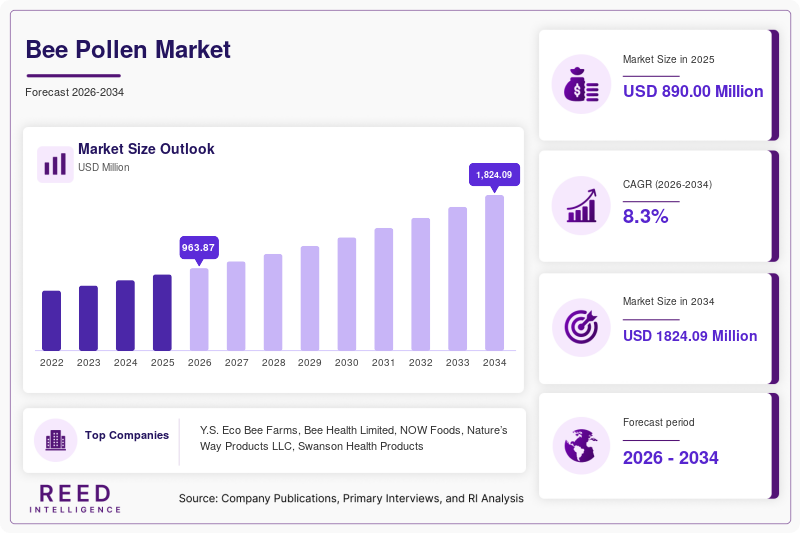
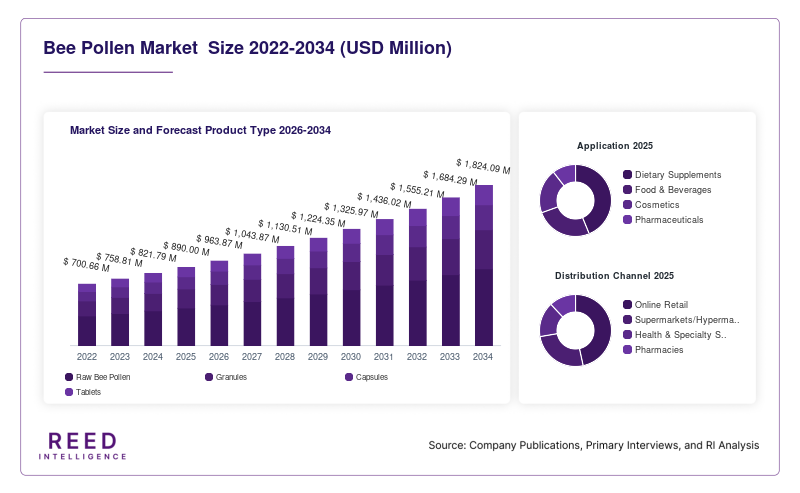
The Bee Pollen Market size was valued at approximately USD 890 million in 2025 and is projected to reach USD 1.82 billion by 2034, expanding at a CAGR of 8.3% during the forecast period (2025–2034). The market growth has been supported by the increasing global demand for natural and functional food ingredients, particularly those associated with enhanced immunity and nutritional benefits. Bee pollen, known for its high protein content, essential amino acids, vitamins, and antioxidants, has gained traction across dietary supplements, cosmetics, and pharmaceutical formulations.
A key global factor driving the Bee Pollen Market is the growing consumer preference for plant-based and natural health products. As awareness around preventive healthcare rises, consumers are shifting away from synthetic supplements toward organic alternatives. Bee pollen, being minimally processed and naturally sourced, aligns well with clean-label trends and sustainable consumption patterns, thus accelerating its demand across developed and emerging markets.
Key Highlights
- North America dominated the market with a 36.4% share in 2025, while Asia Pacific is expected to grow at the fastest CAGR of 9.6%.
- By product type, raw bee pollen accounted for 42.8% share, whereas capsules are projected to grow at a CAGR of 9.1%.
- In applications, dietary supplements led with 48.2% share, while cosmetics are expected to expand at a CAGR of 8.9%.
- The United States remained the dominant country, valued at USD 310 million in 2025 and estimated to reach USD 335 million in 2026.
Market Trends
Rising Demand for Functional Foods and Nutraceuticals
The Bee Pollen Market is witnessing increasing integration into functional food products such as smoothies, protein bars, and fortified beverages. Consumers are seeking nutrient-dense foods that offer additional health benefits beyond basic nutrition. Bee pollen’s profile as a superfood rich in antioxidants and micronutrients is driving its inclusion in premium food formulations. This trend is particularly visible in urban markets where health-conscious consumers prioritize natural supplements.
Expansion of Organic and Clean-Label Product Lines
Another notable trend shaping the Bee Pollen Market is the rapid expansion of organic-certified and clean-label product offerings. Manufacturers are focusing on transparency, traceability, and minimal processing to appeal to environmentally conscious consumers. Organic bee pollen products are gaining shelf space in specialty stores and online platforms. This trend is also encouraging beekeepers and suppliers to adopt sustainable harvesting practices, which further strengthens product authenticity and market appeal.
Market Drivers
Increasing Awareness of Nutritional Benefits
Growing awareness regarding the nutritional composition of bee pollen is a major driver of the Bee Pollen Market. Rich in proteins, vitamins, minerals, and enzymes, bee pollen is widely recognized for supporting immunity, energy levels, and overall wellness. Consumers are increasingly incorporating it into daily diets as a natural supplement, thereby boosting market demand.
Growth in Natural Cosmetics Industry
The expanding natural and organic cosmetics sector is another key driver for the Bee Pollen Market. Bee pollen is used in skincare products due to its anti-inflammatory and antioxidant properties. It is commonly found in creams, lotions, and serums aimed at improving skin health. The shift toward chemical-free beauty products has encouraged manufacturers to include bee pollen as an active ingredient, contributing to sustained market growth.
Market Restraint
Risk of Allergic Reactions and Regulatory Limitations
One of the primary restraints in the Bee Pollen Market is the potential for allergic reactions among certain consumer groups. Bee pollen can trigger sensitivities, particularly in individuals allergic to pollen or bee products. This limits its widespread adoption and requires manufacturers to include cautionary labeling. Additionally, varying regulatory frameworks across regions regarding the use of bee-derived ingredients in food and supplements create compliance challenges. These factors collectively hinder market penetration and may slow down growth in certain regions.
Market Opportunities
Expansion in Emerging Markets
Emerging economies present significant growth opportunities for the Bee Pollen Market. Rising disposable incomes and increasing awareness of natural health products are driving demand in countries across Asia, Latin America, and the Middle East. Market players are focusing on expanding distribution networks and introducing affordable product variants to tap into these regions.
Product Innovation and Value-Added Formulations
Innovation in product formats such as flavored bee pollen, ready-to-consume sachets, and fortified blends offers strong growth potential. Companies are developing value-added products that enhance taste and convenience, making bee pollen more accessible to a broader consumer base. This innovation is expected to attract new customers and drive market expansion over the forecast period.
Segmental Analysis
By Product Type
Raw bee pollen dominated the Bee Pollen Market with a 42.8% share in 2025. This dominance was attributed to its natural form and minimal processing, which preserved its nutritional content. Consumers preferred raw bee pollen for direct consumption and use in homemade health preparations.
Capsules are expected to grow at the fastest CAGR of 9.1% during the forecast period. The convenience of consumption and precise dosage are key factors driving this segment. Capsules are increasingly favored by urban consumers seeking easy-to-use dietary supplements.
By Application
Dietary supplements accounted for the largest share of 48.2% in 2025. The widespread use of bee pollen in health supplements was driven by its rich nutritional profile and increasing consumer awareness.
The cosmetics segment is projected to grow at a CAGR of 8.9%. The demand for natural skincare products is driving the inclusion of bee pollen in cosmetic formulations. Its antioxidant properties are expected to support growth in this segment.
By Distribution Channel
Offline channels dominated the Bee Pollen Market with a 63.5% share in 2025. Supermarkets, health stores, and pharmacies remained key distribution points for bee pollen products.
Online channels are expected to grow at a CAGR of 10.2%. The increasing penetration of e-commerce platforms and the convenience of online shopping are driving growth in this segment.
By End-Use
Individual consumers accounted for the largest share of 54.6% in 2025. The rising adoption of bee pollen as a daily supplement contributed to this dominance.
The commercial segment is projected to grow at a CAGR of 8.7%. Increasing use of bee pollen in food processing and cosmetics manufacturing is expected to drive growth.
Regional Analysis
North America
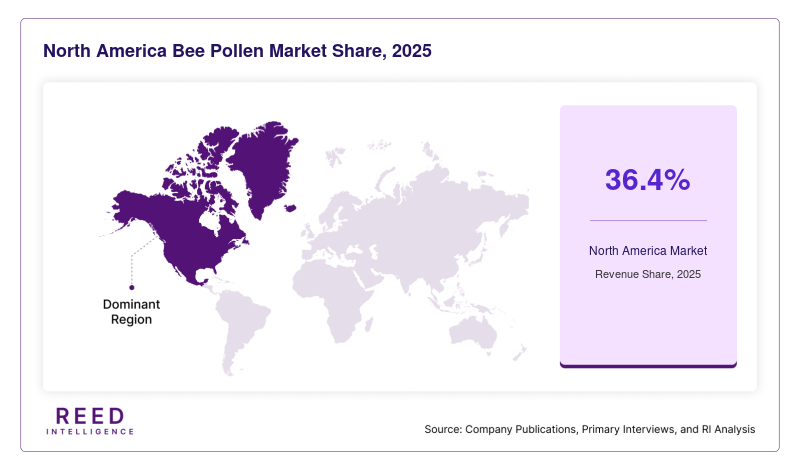
North America accounted for 36.4% of the Bee Pollen Market share in 2025 and will grow at a CAGR of 7.9% through 2034. The region has a well-established dietary supplement industry and a strong consumer base for natural health products. High awareness of superfoods and functional ingredients supported market growth.
The United States dominated the regional market due to the widespread availability of bee pollen products and a robust distribution network. The increasing adoption of organic food products and a strong presence of health-conscious consumers contributed significantly to market expansion in the country.
Europe
Europe held approximately 27.1% of the Bee Pollen Market share in 2025 and is projected to grow at a CAGR of 8.1%. The region’s growth is supported by stringent regulations promoting natural and organic products, along with increasing consumer awareness regarding sustainable sourcing.
Germany emerged as the dominant country in Europe due to its strong organic food market and increasing consumption of nutraceuticals. The presence of established manufacturers and a preference for clean-label products drove demand for bee pollen across the country.
Asia Pacific
Asia Pacific represented 21.3% of the Bee Pollen Market share in 2025 and is expected to register the fastest CAGR of 9.6%. The region is experiencing rapid growth due to rising health awareness and increasing disposable incomes.
China led the regional market, supported by its long-standing tradition of using bee products in traditional medicine. The country’s large population base and expanding middle class contributed to increased demand for bee pollen in supplements and functional foods.
Middle East & Africa
The Middle East & Africa accounted for 8.2% of the Bee Pollen Market share in 2025 and will grow at a CAGR of 7.5%. The market growth in this region is driven by rising demand for natural health products and increasing urbanization.
The United Arab Emirates dominated the regional market due to growing health awareness and a rising number of specialty health stores. The country’s focus on wellness and premium products supported the adoption of bee pollen.
Latin America
Latin America held 7.0% of the Bee Pollen Market share in 2025 and is expected to grow at a CAGR of 8.4%. The region is witnessing increased demand for natural supplements and organic food products.
Brazil emerged as the leading country due to its strong agricultural base and increasing production of bee-related products. Growing consumer awareness and expanding retail channels supported market growth in the country.
Competitive Landscape
The Bee Pollen Market is moderately fragmented, with several regional and global players competing based on product quality, pricing, and distribution reach. Leading companies are focusing on expanding their product portfolios and strengthening supply chains.
A key market leader is Y.S. Eco Bee Farms, known for its wide range of bee pollen products and strong distribution network. The company has recently introduced organic-certified bee pollen variants to cater to growing consumer demand for clean-label products.
Other players are investing in research and development to enhance product quality and explore new applications. Strategic partnerships and expansions into emerging markets are common strategies adopted by market participants.
Key Players
- Y.S. Eco Bee Farms
- Bee Health Limited
- NOW Foods
- Nature’s Way Products LLC
- Swanson Health Products
- GloryBee Inc.
- Bee Alive Inc.
- Livemoor
- Dutch Gold Honey Inc.
- Stakich Inc.
- Sattvic Foods
- Durham’s Bee Farm
- Honey Pacifica
- Comvita Limited
- Mellona
Recent Developments
- In 2024, Y.S. Eco Bee Farms launched a new line of organic bee pollen products targeting premium consumers.
- In 2023, NOW Foods expanded its distribution network in Asia Pacific to strengthen market presence.
- In 2024, Comvita Limited introduced innovative bee pollen blends for functional food applications.
- In 2023, GloryBee Inc. partnered with local beekeepers to enhance sustainable sourcing practices.
- In 2024, Nature’s Way Products LLC launched new capsule-based bee pollen supplements for improved convenience.
Bee Pollen Market Segments
Product Type
- Raw Bee Pollen
- Granules
- Capsules
- Tablets
Application
- Dietary Supplements
- Food & Beverages
- Cosmetics
- Pharmaceuticals
Distribution Channel
- Online Retail
- Supermarkets/Hypermarkets
- Health & Specialty Stores
- Pharmacies
End-Use
- Individual Consumers
- Commercial/Industrial Use
By Region
- North America
- Europe
- APAC
- Middle East and Africa
- LATAM