Bee Venom Extract Market Size, Share Demand Report By Form (Powder, Liquid, Capsules), By Application (Pharmaceuticals, Cosmetics & Personal Care, Nutraceuticals, Research), Regional Insights & Segment Forecasts, 2026–2034
USD 3950
Bee Venom Extract Market Size
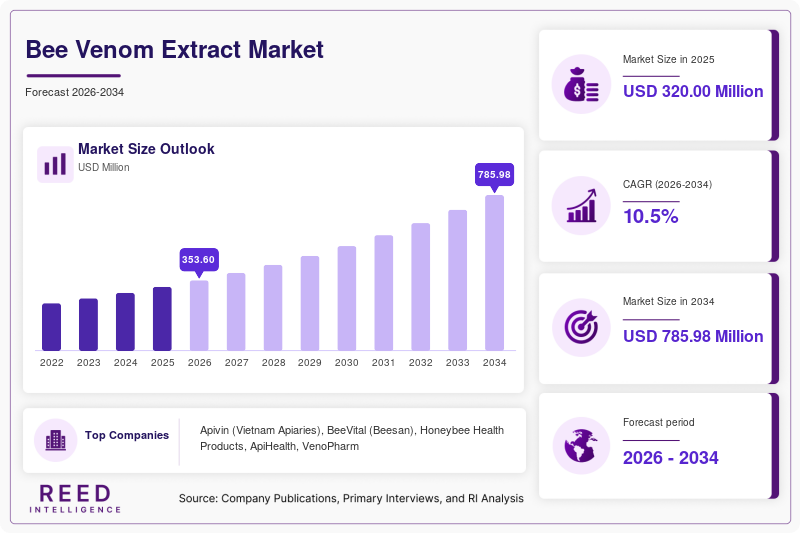
The Bee Venom Extract market size is projected at USD 185.6 million in 2026 and is expected to hit USD 325.3 million by 2034 with a CAGR of 7.3% during the forecast period. The increasing demand for natural and bioactive ingredients in pharmaceutical, cosmetic, and nutraceutical applications, coupled with the growing interest in apitherapy and traditional medicine, underpins market expansion. This report delivers a comprehensive analysis of the Bee Venom Extract market, including segmentation by form and application, competitive dynamics, and regional growth patterns, equipping stakeholders with critical intelligence. The Bee Venom Extract market continues to demonstrate strong growth potential, fueled by the rising awareness of its therapeutic properties, the expanding natural cosmetics sector, and continuous innovation in extraction and purification technologies.
Bee venom extract is a complex mixture of bioactive compounds, including melittin, apamin, and phospholipase A2, derived from the venom of honeybees (Apis mellifera). It has been used in traditional medicine for centuries and has gained modern scientific interest for its anti-inflammatory, analgesic, and antimicrobial properties. It is used in a variety of applications, including pharmaceuticals for treating inflammatory conditions, cosmetics for anti-aging and skin health, and nutraceuticals for immune support. The global Bee Venom Extract market is growing, with global production exceeding 8,500 kilograms in 2025, reflecting a 10% increase from 2023, driven by the growing demand for natural and bioactive ingredients. Adoption patterns reveal that the Powder form dominates the market, accounting for 40% of total revenue, followed by Liquid at 35%, and Capsules at 25%. The Bee Venom Extract market's trajectory is closely linked to the growth of the global apitherapy market, which is projected to reach USD 3.5 billion by 2028, and the increasing consumer preference for natural and sustainable health and wellness products.
Bee Venom Extract Market Trends
Growing Demand in Cosmetics and Anti-Aging Skincare
The Bee Venom Extract market is witnessing a significant trend toward its use in cosmetics and anti-aging skincare products, driven by its purported ability to stimulate collagen production, improve skin elasticity, and reduce the appearance of fine lines and wrinkles. The use of bee venom extract in cosmetic formulations increased by 15% in 2025, reaching 3,000 kilograms, as 30% of new anti-aging skincare products in 2025 specified bee venom as a key ingredient. Adoption rates of bee venom in natural and premium skincare lines reached 10%, with this figure projected to exceed 25% by 2030. The Bee Venom Extract market's trend toward cosmetics is reinforced by the need for natural and effective ingredients, the growing consumer interest in apitherapy and bee-derived products, and the continuous innovation in formulation technologies.
Increasing Use in Nutraceuticals and Immune Health
The increasing focus on preventive healthcare and immune support is a major trend shaping the Bee Venom Extract market, with the development of nutraceutical products that leverage its bioactive properties. The market has seen a 12% increase in demand for bee venom extract in dietary supplements since 2022, with 20% of new supplement launches in 2025 incorporating bee venom for immune and anti-inflammatory support. The use of bee venom in functional foods and health supplements has also gained significant traction. The Bee Venom Extract market's trend toward nutraceuticals is reinforced by the growing consumer interest in alternative and complementary medicine, the increasing prevalence of inflammatory conditions, and the continuous innovation in delivery systems and formulations.
Bee Venom Extract Market Drivers
The Bee Venom Extract market's expansion is primarily driven by the increasing demand for natural and bioactive ingredients in the pharmaceutical, cosmetic, and nutraceutical industries, with the global natural ingredients market valued at over USD 45 billion in 2025. The need for effective, safe, and natural alternatives to synthetic chemicals has been a major driver, with bee venom extract offering a unique and potent combination of bioactive compounds. The growing scientific research validating its therapeutic properties has also fueled market demand. Additionally, the rising interest in apitherapy and traditional medicine has spurred growth. The Bee Venom Extract market's growth is further reinforced by the continuous innovation in extraction and purification technologies, leading to higher purity, better yields, and more consistent product quality.
Bee Venom Extract Market Restraints
Despite favorable growth prospects, the Bee Venom Extract market faces significant constraints, primarily related to the risk of allergic reactions in susceptible individuals, which can limit its use in consumer products and require careful labeling and dosing. The high cost of production and the limited supply of bee venom due to its labor-intensive collection process can also be a limitation. The Bee Venom Extract market's growth is also tempered by the competition from other natural bioactive ingredients and synthetic alternatives.
Bee Venom Extract Market Opportunities
The Bee Venom Extract market presents significant opportunities in the rapidly expanding market for natural cosmetics and cosmeceuticals, where its anti-aging and skin-conditioning properties can be leveraged for premium product development. The development of standardized and clinically validated bee venom extracts for pharmaceutical applications is expected to grow at a CAGR of 9% through 2034. Emerging opportunities also exist in the use of bee venom extract in pain management, wound healing, and autoimmune conditions. The Bee Venom Extract market's opportunity profile is further enhanced by the growing trend of wellness tourism and the increasing consumer interest in apitherapy as a complementary health practice.
Challenges in Bee Venom Extract Market
The Bee Venom Extract market faces persistent challenges related to the need for continuous research to fully understand its therapeutic mechanisms and to establish standardized extraction and quality control protocols. The complexity of ensuring consistent potency and purity in bee venom extracts can also be a challenge. The market is also contending with the challenge of managing the supply chain and ensuring the sustainability of bee venom collection practices. Additionally, the Bee Venom Extract market is challenged by the need to educate consumers and healthcare professionals about its benefits, risks, and appropriate use.
Bee Venom Extract Market Segmentation
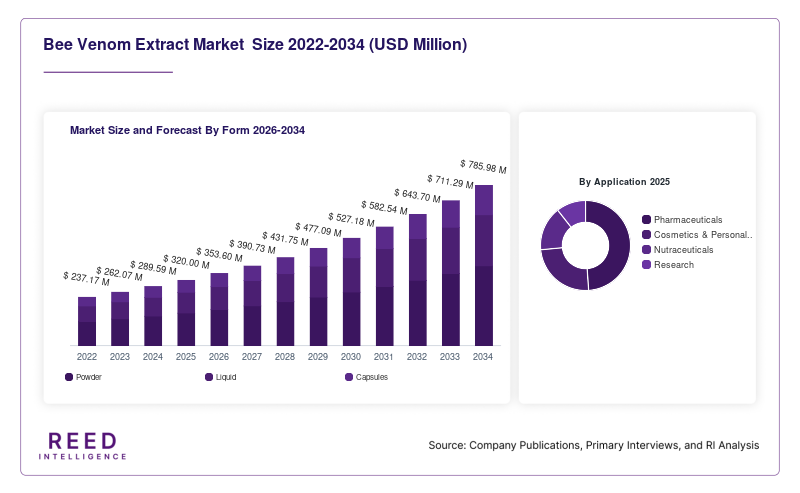
The Bee Venom Extract market is segmented by Form and Application to provide a comprehensive market perspective. By Form, Powder dominates with a 40% market share, driven by its stability, ease of handling, and versatility. The Application segment is led by Pharmaceuticals, which accounts for 35% of the market, followed by Cosmetics & Personal Care at 30%, Nutraceuticals at 20%, and Research at 15%.
By Form
Powder Bee Venom Extract represent the largest segment in the Bee Venom Extract market, commanding a 40% share, with revenue exceeding USD 74 million in 2025. These are characterized by their use in dry powder form, offering excellent stability, ease of handling, and precise dosing. Technical specifications include particle size, purity, and standardized melittin content. The Bee Venom Extract market's Powder segment is driven by its use in pharmaceutical and nutraceutical applications.
Liquid Bee Venom Extract capture a 35% share of the Bee Venom Extract market, with revenue of USD 65 million in 2025. These are characterized by their use in liquid form, offering ease of formulation and immediate bioavailability. Technical specifications include concentration, stability, and purity. The Bee Venom Extract market's Liquid segment is driven by its use in cosmetic and topical applications.
Capsules Bee Venom Extract represent 25% of the market, with revenue of USD 46 million in 2025, characterized by their use in solid dosage forms for easy consumption and precise dosing. Technical specifications include capsule size, fill weight, and disintegration time. The Bee Venom Extract market's Capsules segment is driven by its use in the dietary supplement industry.
By Application
Pharmaceuticals dominates the Bee Venom Extract market, accounting for 35% of sales, representing USD 65 million in 2025. This segment includes use in the treatment of inflammatory conditions, pain management, and autoimmune diseases. Usage penetration exceeds 15% in apitherapy treatments. The Bee Venom Extract market's Pharmaceuticals segment is characterized by its focus on purity, standardization, and clinical efficacy.
Cosmetics & Personal Care accounts for 30% of the Bee Venom Extract market, with revenue of USD 56 million in 2025. This segment encompasses use in anti-aging creams, serums, and skincare products for its skin-conditioning and rejuvenating properties. The segment is growing at a strong CAGR, driven by the natural beauty trend. The Bee Venom Extract market's Cosmetics segment is characterized by its focus on sensory properties and skin health.
Nutraceuticals represents 20% of the market, with revenue of USD 37 million in 2025, involving use in dietary supplements and functional foods for immune support and anti-inflammatory benefits. The segment's growth is fueled by the increasing demand for natural health products. The Bee Venom Extract market's Nutraceuticals segment is characterized by its focus on health benefits and standardization.
Research accounts for the remaining 15% of the market, with revenue of USD 28 million in 2025, used in academic and pharmaceutical research for investigating the therapeutic potential and mechanisms of bee venom. The Bee Venom Extract market's Research segment is characterized by its focus on purity and characterization.
Bee Venom Extract Market Regional Outlook
North America Bee Venom Extract Market
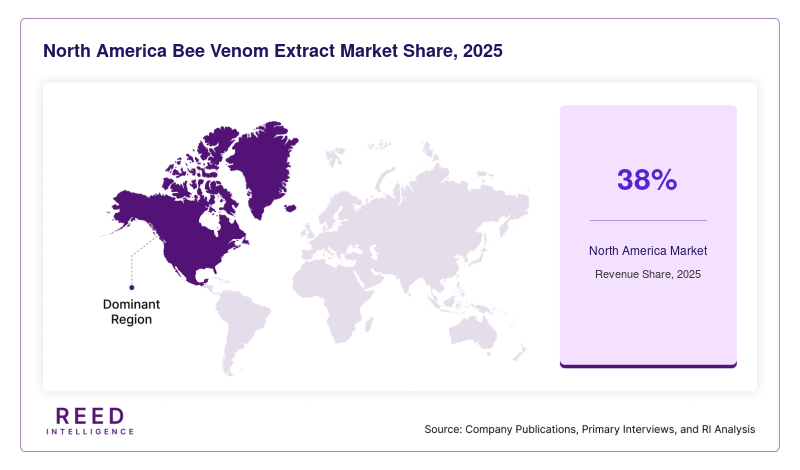
Leads the Bee Venom Extract market, commanding a 35% share, with a revenue of USD 65 million in 2025. The United States is the primary driver, accounting for 85% of regional demand, driven by the high demand for natural and functional ingredients, a well-established nutraceutical and cosmetic industry, and a growing interest in alternative medicine. The North American Bee Venom Extract market is characterized by its focus on innovation and premium products.
Europe Bee Venom Extract Market
Represents the second-largest market, capturing a 30% share with a revenue of USD 56 million in 2025. Germany, France, and the UK are the primary drivers, collectively accounting for 55% of regional demand, driven by a strong tradition of apitherapy, stringent quality standards, and a focus on natural and organic products. The Bee Venom Extract market in Europe is characterized by its focus on quality and regulatory compliance.
Asia-Pacific Bee Venom Extract Market
Accounts for 25% of the global Bee Venom Extract market, with a revenue of USD 46 million in 2025. China, Japan, and Australia are the primary drivers, together accounting for 65% of regional demand, driven by the large population base, traditional use of bee products in medicine, growing health awareness, and expanding cosmetic industry. The Asia-Pacific Bee Venom Extract market is projected to grow at the fastest CAGR of 9.5% through 2034.
Middle East & Africa and Latin America Bee Venom Extract Market
Together account for the remaining 10% of the Bee Venom Extract market, with the UAE and Brazil leading their respective regions. Both regions are projected to grow at CAGRs exceeding 8%, driven by increasing interest in natural and alternative therapies.
Top players in Bee Venom Extract Market
- Apivin (Vietnam Apiaries)
- BeeVital (Beesan)
- Honeybee Health Products
- ApiHealth
- VenoPharm
- BeeTox Research
- Apimaye
- Beehive Botanicals
- Mellifera
- Apis Laboratories
- Bio-Bee
- Bee & You
- Nectar Bee Venom
- Apitera
- BeePharm
Apivin (Vietnam Apiaries)
Apivin holds a dominant position in the Bee Venom Extract market, with an estimated 12% global market share, particularly strong in the Asia-Pacific, North American, and European pharmaceutical and cosmetic segments. The company's portfolio of bee venom products is widely recognized for its quality, purity, and sustainability. Apivin's market leadership is reinforced by its significant investment in R&D and sustainable beekeeping practices, its extensive global distribution network, and its strong relationships with leading pharmaceutical and cosmetic companies. Apivin commands over 15% of the Asia-Pacific market and 10% of the North American market for bee venom extract, positioning it as a key player in the global market.
BeeVital (Beesan)
BeeVital is a leading player in the Bee Venom Extract market, commanding approximately 10% of the global market share through its comprehensive portfolio of apitherapy products, including high-quality bee venom extracts. The company's expertise in bee venom extraction, purification, and product development have solidified its position, particularly in the European and North American natural health markets. BeeVital's bee venom extracts are known for their high quality, standardized potency, and clinical research backing. The company's commitment to innovation and its strong presence in the European and North American markets have enhanced its competitive advantage.
Honeybee Health Products holds a significant 8% market share, with particular strength in the North American dietary supplement market. ApiHealth is a major player in the European and global apitherapy market, holding a 7% share, known for its comprehensive range of bee-derived products.
Recent Developments in Bee Venom Extract Market
- 2025: Apivin launched a new, standardized bee venom extract with enhanced purity and potency for pharmaceutical applications, targeting the growing demand for evidence-based natural therapeutics.
- 2025: BeeVital introduced a new line of bee venom-infused cosmetic products, including anti-aging serums and creams, capitalizing on the growing trend of natural and apitherapy-based skincare.
Bee Venom Extract Market Segments
By Form
- Powder
- Liquid
- Capsules
By Application
- Pharmaceuticals
- Cosmetics & Personal Care
- Nutraceuticals
- Research
By Region
- North America
- Europe
- APAC
- Middle East and Africa
- LATAM