Beekeeping Equipment Market Size, Share & Demand Report By Equipment Type (Hive Equipment, Protective Equipment, Honey Extraction Equipment, Hive Monitoring Systems, Feeders and Accessories), By Application (Commercial Beekeeping, Pollination Services, Honey Production, Research and Educational Activities), By End Use (Professional Beekeepers, Hobbyist Beekeepers, Agricultural Institutions, Research Organizations), By Region & Segment Forecasts, 2026–2034
USD 3950
Market Overview
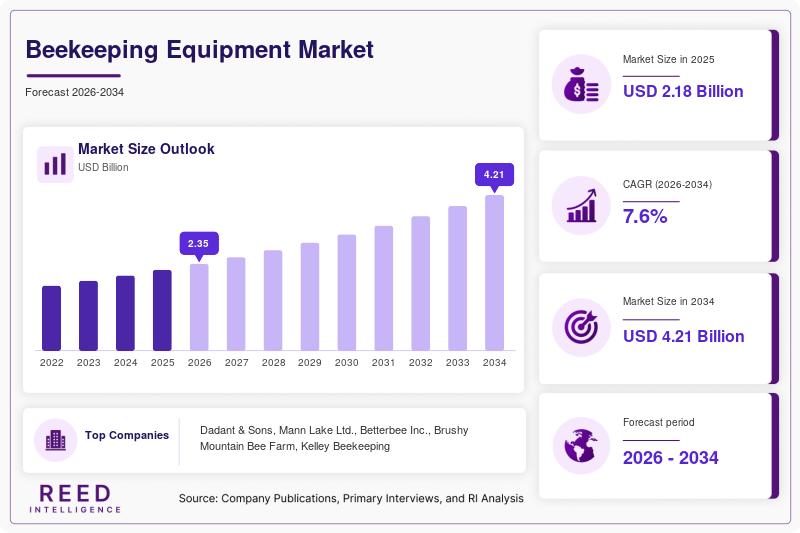
The global Beekeeping Equipment Market size was valued at approximately USD 2.18 billion in 2026 and is projected to reach nearly USD 3.91 billion by 2034, expanding at a CAGR of 7.6% during the forecast period from 2026 to 2034. The market continues to gain momentum due to rising awareness regarding sustainable honey production, increasing commercial beekeeping operations, and expanding pollination services across agricultural economies. Demand for modern hive management systems, automated honey extraction tools, protective gear, and monitoring technologies has accelerated as professional apiaries seek higher productivity and improved colony health management.
Growing concerns about declining bee populations and pollinator health have also encouraged governments and agricultural organizations to support commercial beekeeping practices through subsidies, training programs, and research initiatives. The expansion of organic food consumption globally has further contributed to rising honey demand, creating favorable conditions for beekeeping equipment manufacturers. In addition, technological integration in hive monitoring, including IoT-enabled sensors and remote tracking systems, is reshaping operational efficiency across both small-scale and industrial beekeeping farms.
Key Highlights
- North America dominated the market with a 35.1% share in 2025, while Asia Pacific is expected to grow at the fastest CAGR of 9.4% during 2026–2034.
- By equipment type, hive equipment accounted for the largest share of 39.6%, while hive monitoring systems are projected to grow at a CAGR of 10.8%.
- By application, commercial beekeeping led with a 46.8% share, whereas pollination services are expected to expand at a CAGR of 9.9%.
- The United States remained the dominant country, with market values of USD 520 million in 2024 and USD 568 million in 2025.
Market Trends
Integration of Smart Hive Monitoring Technologies
The Beekeeping Equipment Market is witnessing a notable shift toward digital hive monitoring solutions that enable real-time colony management. Commercial apiaries are increasingly adopting smart sensors, temperature monitoring devices, humidity trackers, and mobile-connected hive systems to improve operational efficiency and reduce colony losses. These technologies help beekeepers identify disease outbreaks, queen bee issues, and environmental stress factors before they significantly affect production. The integration of data analytics platforms with hive monitoring systems is supporting predictive maintenance and improving honey yield forecasting across commercial operations.
Technology adoption is particularly strong in North America and Europe, where labor shortages and large-scale commercial beekeeping operations are encouraging automation. Manufacturers are introducing solar-powered hive monitoring devices and cloud-based colony management applications to meet rising demand for precision beekeeping. The trend is also supported by increasing investments in agricultural technology startups focused on pollinator health and sustainable food production systems.
Rising Demand for Sustainable and Organic Honey Production
Consumer preference for organic honey and naturally sourced bee products continues to influence purchasing decisions across global food markets. This trend is encouraging commercial beekeepers to invest in advanced beekeeping equipment that supports hygienic honey extraction, sustainable hive management, and chemical-free production processes. Stainless steel extraction systems, eco-friendly hive materials, and reusable protective clothing are gaining wider adoption among professional and hobbyist beekeepers.
Retail growth in organic food products across Europe, Asia Pacific, and North America has strengthened demand for certified honey production systems. Additionally, the expansion of direct-to-consumer honey brands and artisanal honey producers has increased sales of small-scale extraction and packaging equipment. Governments and agricultural organizations are also promoting sustainable beekeeping practices to improve biodiversity and pollination efficiency, further supporting long-term market expansion.
Market Drivers
Expansion of Commercial Pollination Services in Agriculture
The growing dependence of global agriculture on pollination services is a major factor supporting the Beekeeping Equipment Market. Crops such as almonds, apples, berries, sunflower, and canola require efficient pollination for higher yield and crop quality. Commercial farmers are increasingly partnering with professional beekeeping operators to improve agricultural productivity, leading to greater demand for durable hive systems, transport equipment, and colony management tools.
Large-scale migratory beekeeping operations are particularly expanding across the United States, Canada, China, and parts of Europe. These operations require advanced transportation systems, portable hive structures, and automated honey extraction technologies to maintain operational efficiency. The rising commercialization of pollination services has also encouraged equipment manufacturers to develop lightweight and climate-resistant hive designs suitable for long-distance movement and varying environmental conditions.
Government Support for Bee Conservation and Rural Livelihoods
Many national governments and agricultural agencies are implementing programs that encourage beekeeping activities as part of biodiversity protection and rural income development strategies. Financial incentives, beekeeper training initiatives, and agricultural grants have improved access to modern beekeeping equipment among small and medium-scale operators. These initiatives are particularly influential in developing economies where beekeeping serves as an additional source of household income.
Environmental concerns related to pollinator decline have also accelerated public and private investments in bee conservation projects. Research institutions and nonprofit organizations are collaborating with equipment manufacturers to promote safe hive management practices and disease prevention methods. The availability of subsidized equipment packages and educational programs has increased market penetration in rural regions, creating broader demand for protective clothing, hive frames, smokers, feeders, and honey processing systems.
Market Restraint
High Initial Investment and Colony Health Challenges
The Beekeeping Equipment Market faces challenges associated with high setup costs and increasing colony health risks. Commercial beekeeping operations require substantial investment in hive systems, extraction machinery, protective gear, transportation equipment, and monitoring technologies. Small-scale beekeepers in developing economies often struggle to afford advanced equipment, limiting the pace of modernization across regional markets. Additionally, fluctuating honey prices and uncertain climatic conditions can affect profitability and delay equipment replacement cycles.
Colony collapse disorder, pesticide exposure, parasitic mites, and changing environmental conditions continue to impact bee populations globally. Frequent colony losses reduce beekeeper confidence and create financial pressure on commercial operators. For example, severe winter colony losses in parts of North America and Europe have forced several commercial apiaries to reduce operational scale, affecting equipment procurement volumes. Manufacturers are responding by developing disease-monitoring technologies and insulated hive systems, but adoption remains uneven due to pricing limitations among smaller operators.
Market Opportunities
Growth of Urban and Hobbyist Beekeeping Activities
Urban beekeeping has emerged as a promising opportunity within the Beekeeping Equipment Market, particularly across developed economies. Consumers are increasingly participating in hobbyist beekeeping to support environmental sustainability, produce local honey, and contribute to pollinator conservation. This trend is driving demand for compact hive kits, beginner-friendly protective gear, and educational beekeeping tools designed for residential environments.
Municipal governments and environmental organizations are supporting rooftop beekeeping initiatives and urban biodiversity programs, especially in cities across Europe and North America. Equipment manufacturers are introducing aesthetically designed hive systems and lightweight maintenance tools tailored for non-commercial users. Online retail platforms and digital learning resources are also simplifying market access for first-time beekeepers, creating new revenue opportunities for suppliers targeting hobbyist consumers.
Emerging Demand for Automated Honey Processing Equipment
Automation in honey extraction and processing presents strong growth potential for equipment manufacturers. Commercial honey producers are increasingly investing in automated uncapping machines, centrifugal extractors, filtration systems, and bottling equipment to improve efficiency and maintain hygiene standards. Automation helps reduce labor dependency while enabling higher production volumes during peak harvesting seasons.
Rapid growth in packaged honey exports from Asia Pacific and Latin America is encouraging modernization of processing facilities. Food safety regulations in export-oriented economies are also driving investment in stainless steel extraction systems and contamination-free processing equipment. Manufacturers are focusing on energy-efficient machinery and modular automation systems suitable for medium-sized apiaries. As commercial honey demand continues to rise globally, automated processing technologies are expected to create long-term expansion opportunities across both developed and emerging markets.
Segmental Analysis
By Equipment Type
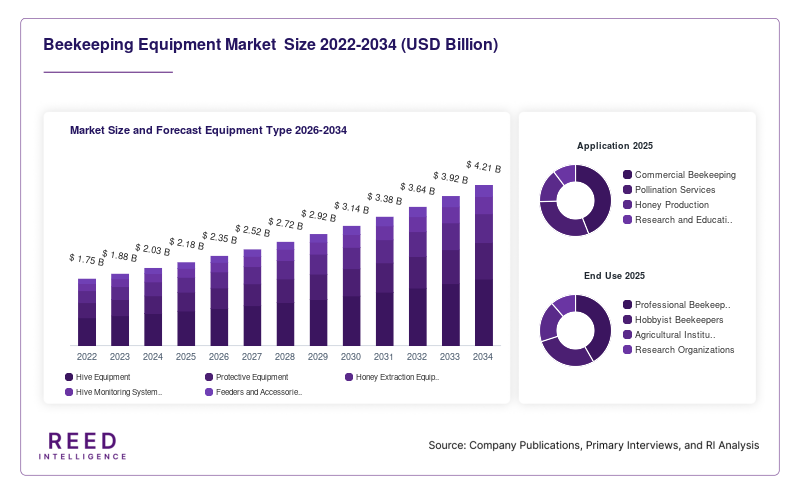
Hive equipment represented the dominant subsegment within the Beekeeping Equipment Market, accounting for nearly 39.6% of total market share in 2024. Demand for hive boxes, frames, foundations, and feeders remains consistently strong due to their essential role in colony management and honey production. Commercial beekeepers continue to invest in durable wooden and plastic hive systems that improve ventilation, insulation, and operational efficiency. The growing expansion of commercial pollination services has further strengthened sales of modular hive systems suitable for transportation and migratory beekeeping operations. Manufacturers are also introducing lightweight hive materials and customizable designs to improve handling convenience and colony protection in varying climatic conditions.
Protective equipment and honey extraction systems also contribute significantly to market revenue growth across professional and hobbyist beekeeping communities. Rising awareness regarding beekeeper safety and improved hygiene standards in honey processing has encouraged widespread adoption of advanced protective suits, gloves, smokers, and stainless steel extractors. Online retail channels and specialized agricultural supply stores are improving accessibility to modern equipment kits, particularly among first-time beekeepers. Growing participation in educational beekeeping programs is additionally supporting consistent sales of beginner-oriented equipment packages across developed and emerging economies.
By Application
Commercial beekeeping dominated the application segment of the Beekeeping Equipment Market and accounted for approximately 46.8% of global revenue share in 2024. The growth of large-scale honey production operations and commercial pollination services continues to drive demand for advanced hive systems, extraction machinery, and colony management tools. Commercial apiaries prioritize durable and scalable equipment capable of supporting high-volume honey harvesting and migratory beekeeping activities. Increasing global consumption of organic honey and natural sweeteners has further strengthened investment in commercial honey production infrastructure across developed and emerging economies.
The segment also benefits from expanding agricultural dependence on managed pollination services for fruit, nut, and vegetable crops. Commercial operators are investing in portable hive systems and transportation equipment to support seasonal pollination contracts across multiple farming regions. Technological advancements in automated extraction and monitoring systems are improving operational efficiency and reducing labor costs within large-scale beekeeping enterprises. As global agricultural productivity requirements continue to increase, commercial beekeeping applications are expected to maintain strong equipment demand throughout the forecast period.
By End Use
Professional beekeepers accounted for the largest share of the Beekeeping Equipment Market in 2024, contributing nearly 58.3% of total revenue. Commercial honey producers and pollination service providers continue to represent the primary customer base for advanced beekeeping equipment. Professional operators require high-capacity extraction systems, durable hive infrastructure, transportation equipment, and monitoring technologies to manage large bee colonies efficiently. Rising global honey consumption and increasing pollination requirements across agricultural industries continue to strengthen equipment procurement among large-scale apiary businesses.
The segment is also benefiting from the growing adoption of automated processing systems and smart hive technologies designed to improve productivity and colony management efficiency. Professional beekeepers increasingly prioritize operational scalability, disease prevention, and labor optimization, encouraging continuous investment in technologically advanced equipment solutions. Manufacturers are responding by introducing integrated beekeeping systems that combine monitoring, extraction, and colony management capabilities within streamlined operational platforms suitable for commercial-scale use.
Regional Analysis
North America
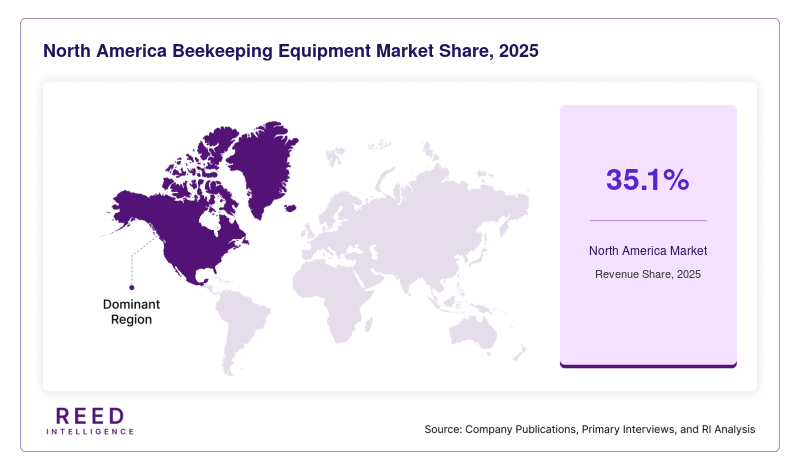
North America accounted for approximately 35.1% of the global Beekeeping Equipment Market in 2025 and is projected to maintain stable growth at a CAGR of 7.1% through 2034. The region benefits from a well-established commercial beekeeping industry supported by strong demand for pollination services across large agricultural sectors. Advanced hive monitoring technologies, automated extraction systems, and modern protective equipment continue to experience high adoption rates among commercial apiaries throughout the region.
The United States remains the dominant country in North America due to extensive almond pollination activities and rising organic honey consumption. Large-scale migratory beekeeping operations across California and other agricultural states generate consistent demand for portable hive systems and transportation equipment. Increasing investments in pollinator health research and sustainable agriculture programs are also supporting long-term equipment modernization across commercial beekeeping operations.
Europe
Europe represented nearly 27.4% of the global Beekeeping Equipment Market in 2025 and is expected to expand at a CAGR of 7.3% during the forecast period. Strong consumer preference for organic honey products and sustainable agricultural practices continues to support regional market development. Countries across the region are actively promoting biodiversity conservation and pollinator protection, leading to greater adoption of advanced hive management systems and eco-friendly equipment materials.
Germany remains the leading country within the European market due to its organized beekeeping associations and strong organic food industry. The country has witnessed increasing demand for smart hive monitoring systems and premium extraction equipment among both professional and hobbyist beekeepers. Government-backed environmental initiatives encouraging bee-friendly ecosystems have further strengthened demand for sustainable beekeeping technologies across the country.
Asia Pacific
Asia Pacific held around 22.8% of the global Beekeeping Equipment Market in 2025 and is anticipated to register the fastest CAGR of 9.4% through 2034. Rapid expansion of commercial honey production in China, India, Vietnam, and Australia is creating strong demand for modern hive systems and honey extraction equipment. Rising agricultural dependence on pollination services and increasing exports of natural honey products are contributing to regional market growth.
China dominates the Asia Pacific market due to its large honey production industry and growing investment in commercial apiary operations. Expanding domestic consumption of natural health products and increasing government support for rural beekeeping programs are supporting equipment adoption. Additionally, growing awareness regarding bee conservation and technological improvements in hive monitoring are accelerating modernization among commercial producers throughout the country.
Middle East & Africa
The Middle East & Africa region accounted for nearly 7.2% of the global Beekeeping Equipment Market in 2025 and is expected to grow at a CAGR of 6.8% over the forecast period. Increasing focus on agricultural diversification and rural economic development is encouraging beekeeping activities across several countries in the region. Demand for durable hive systems and climate-resistant protective equipment is rising due to harsh environmental conditions in many local markets.
South Africa remains the dominant country within the regional market because of its established honey production sector and growing commercial farming activities. Expansion of pollination services for fruit cultivation and rising awareness regarding biodiversity protection are supporting equipment demand. Government initiatives promoting sustainable farming and small-scale entrepreneurship have also encouraged greater participation in commercial beekeeping operations across rural communities.
Latin America
Latin America captured approximately 7.5% of the global Beekeeping Equipment Market in 2025 and is projected to grow at a CAGR of 7.5% through 2034. Rising honey exports and expanding commercial agriculture sectors are supporting equipment demand throughout the region. Increasing investment in professional apiary management and growing interest in organic honey production are encouraging adoption of modern hive systems and automated extraction equipment.
Brazil leads the Latin American market due to its strong agricultural economy and expanding honey export industry. Commercial beekeeping activities associated with coffee, soybean, and fruit cultivation continue to generate demand for pollination-related equipment. Local manufacturers are increasingly developing affordable hive systems and protective clothing tailored for tropical climates, contributing to broader market accessibility across small and medium-scale beekeeping operations.
Competitive Landscape
The Beekeeping Equipment Market is moderately fragmented, with a combination of international manufacturers, regional suppliers, and specialized agricultural equipment companies competing across commercial and hobbyist segments. Companies are focusing on product innovation, automation technologies, and sustainable equipment materials to strengthen market positioning. Strategic partnerships with agricultural organizations and beekeeping associations are also becoming increasingly important for market expansion and customer engagement.
Dadant & Sons remains one of the leading companies in the global market due to its extensive product portfolio, established distribution network, and strong presence within commercial beekeeping communities. The company recently introduced an upgraded modular hive system designed to improve ventilation and simplify migratory transport operations. Other major players are investing in smart hive monitoring technologies, lightweight extraction systems, and eco-friendly hive materials to address evolving beekeeper requirements.
Key Players
- Dadant & Sons
- Mann Lake Ltd.
- Betterbee Inc.
- Brushy Mountain Bee Farm
- Kelley Beekeeping
- Thorne Beehives Ltd.
- Bee Equipment Australia
- Ross Rounds Inc.
- Miller Bee Supply
- Lyson Beekeeping Equipment
- Paradise Honey Ltd.
- Bee Castle
- Swienty A/S
- Vibeehive
- ApiHex
Recent Developments
- Dadant & Sons launched a modular insulated hive series in 2025 aimed at improving colony survival rates during extreme winter conditions.
- Mann Lake Ltd. expanded its automated honey extraction equipment portfolio in 2024 to support medium-scale commercial apiaries across North America.
- Swienty A/S introduced a cloud-connected hive monitoring platform in 2025 featuring real-time temperature and humidity analytics for professional beekeepers.
- Betterbee Inc. expanded its online distribution network in 2024 to improve accessibility for hobbyist beekeepers across Europe and Asia Pacific.
- Paradise Honey Ltd. announced the development of energy-efficient extraction systems in 2025 designed to reduce operational costs in commercial honey processing facilities.
Beekeeping Equipment Market Segments
Equipment Type
- Hive Equipment
- Protective Equipment
- Honey Extraction Equipment
- Hive Monitoring Systems
- Feeders and Accessories
Application
- Commercial Beekeeping
- Pollination Services
- Honey Production
- Research and Educational Activities
End Use
- Professional Beekeepers
- Hobbyist Beekeepers
- Agricultural Institutions
- Research Organizations
By Region
- North America
- Europe
- APAC
- Middle East and Africa
- LATAM