Beer Adjuncts Market Size, Share & Demand Report By Type (Grain Adjuncts, Sugar Adjuncts, Specialty Adjuncts, Syrups and Extracts), By Form (Dry Adjuncts, Liquid Adjuncts), By Application (Commercial Breweries, Craft Breweries, Home Brewing), By Region & Segment Forecasts, 2026–2034
USD 3950
Market Overview
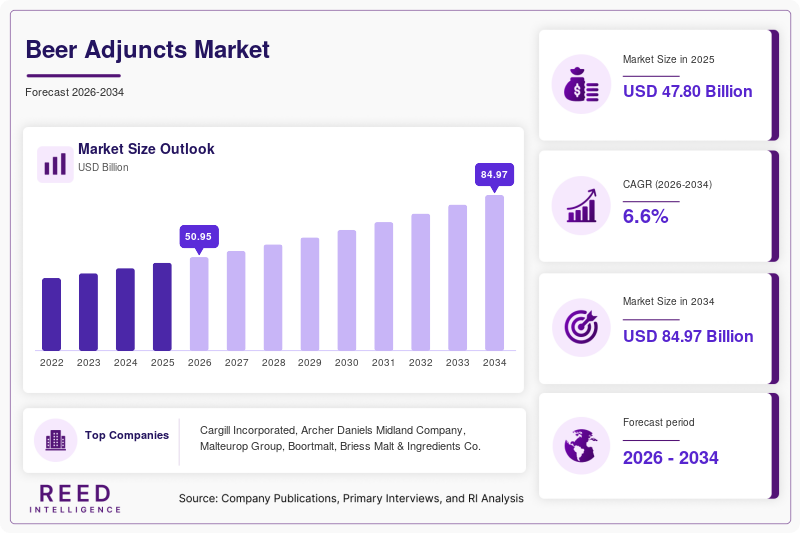
The global Beer Adjuncts Market size was valued at USD 47.8 billion in 2026 and is projected to reach USD 79.6 billion by 2034, expanding at a CAGR of 6.6% during the forecast period from 2026 to 2034. Beer adjuncts are fermentable or non-fermentable ingredients used alongside malted barley during beer production to improve flavor, aroma, texture, shelf life, color, and production efficiency. Common adjuncts include corn, rice, wheat, sugar, syrups, oats, rye, and specialty grains. Rising consumer demand for flavored beers, low-calorie beer products, premium craft beverages, and innovative brewing methods continues to support the expansion of the market across developed and emerging economies.
One of the major global factors supporting market growth is the rapid expansion of craft brewing operations and flavored alcoholic beverage consumption. Breweries are increasingly adopting specialty adjuncts to create differentiated products that align with changing consumer taste preferences. Adjunct ingredients help brewers reduce production costs, improve fermentation consistency, and introduce new sensory characteristics into beer products. Growing urbanization, rising disposable income, and increasing social consumption patterns have further strengthened beer demand across Asia Pacific, Europe, and Latin America. In addition, the development of gluten-reduced beer varieties and functional beer beverages has increased the use of alternative grains and specialty adjunct ingredients.
Key Highlights
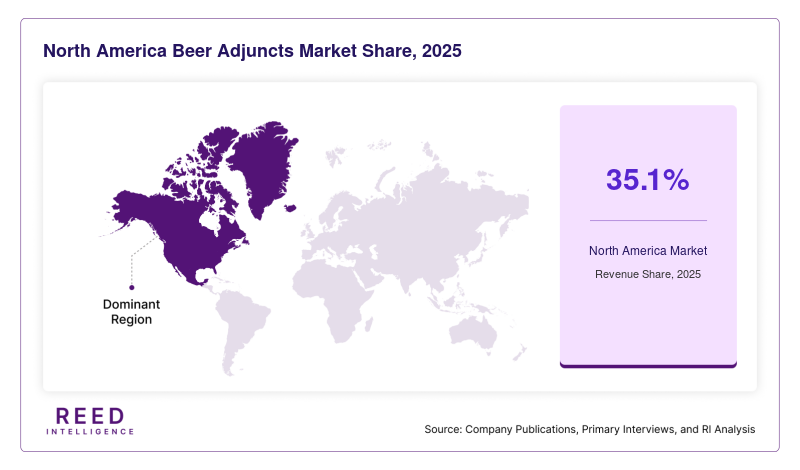
- North America dominated the market with a 35.1% share in 2025.
- Asia Pacific is expected to grow at the fastest CAGR of 8.9% during 2026–2034.
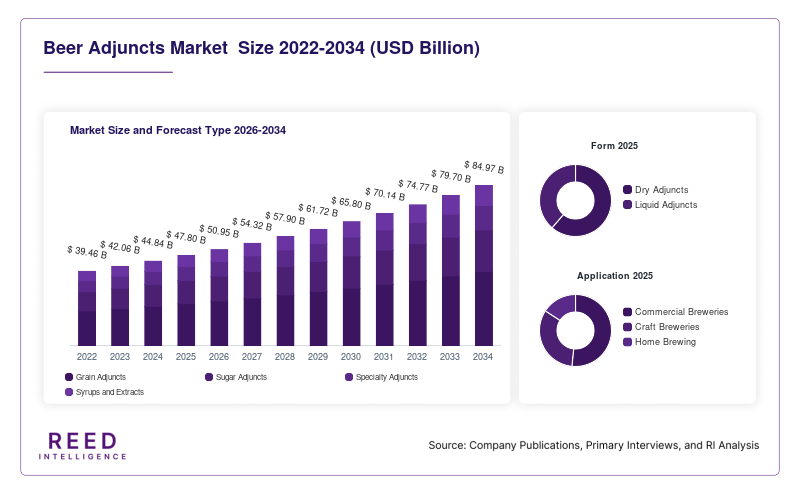
- By type, grain adjuncts accounted for the largest share of 44.6%, while specialty adjuncts are projected to grow at a CAGR of 9.3%. By form, dry adjuncts led with a 58.4% share, whereas liquid adjuncts are expected to expand at a CAGR of 8.1%.
- By application, commercial breweries held the highest share of 63.8%, while craft breweries are projected to grow at a CAGR of 9.7%.
- The United States remained the dominant country, with market values of USD 9.4 billion in 2024 and USD 10.1 billion in 2025.
Market Trends
Rising Adoption of Specialty and Functional Adjunct Ingredients
The Beer Adjuncts Market is witnessing increased adoption of specialty ingredients designed to enhance beer flavor profiles and nutritional positioning. Breweries are incorporating oats, rye, honey, fruits, spices, herbs, and botanical extracts into beer formulations to attract younger consumers seeking differentiated drinking experiences. Demand for low-alcohol and low-calorie beers has also encouraged the use of adjuncts that improve mouthfeel and taste without significantly increasing alcohol content. Craft brewers in North America and Europe are investing in limited-edition products using unconventional adjuncts to strengthen brand positioning and consumer engagement. This trend has expanded the premium beer category and encouraged suppliers to introduce customized adjunct blends suitable for regional flavor preferences and seasonal beer production.
Growing Demand for Cost-Efficient Brewing Solutions
Commercial breweries are increasingly using adjunct ingredients to optimize production efficiency and manage raw material costs. Fluctuations in barley supply and pricing have encouraged brewers to partially replace malted barley with alternative grains such as corn and rice. Adjuncts also help improve fermentation stability, extend shelf life, and maintain product consistency across large-scale production facilities. Emerging markets in Asia Pacific and Latin America are experiencing rising beer consumption, prompting breweries to invest in economical brewing inputs that support volume expansion. Technological improvements in adjunct processing and ingredient standardization have further improved product quality and reduced operational waste. As breweries continue to focus on scalable production and margin improvement, demand for versatile adjunct solutions is expected to remain strong throughout the forecast period.
Market Drivers
Expansion of Global Craft Brewing Industry
The rapid expansion of the craft beer industry continues to drive growth in the Beer Adjuncts Market. Independent breweries are increasingly experimenting with unique adjunct ingredients to create distinctive flavor combinations and strengthen product differentiation. Consumer preference for seasonal beers, fruit-infused beverages, barrel-aged varieties, and premium artisanal products has encouraged breweries to adopt specialty adjuncts on a larger scale. Craft beer producers also use adjuncts to deliver region-specific flavors and create innovative product narratives that resonate with younger consumers. The increasing number of microbreweries across the United States, Germany, the United Kingdom, Japan, and Australia has significantly increased demand for high-quality adjunct ingredients. This growth pattern is expected to continue as premiumization trends remain strong in the global alcoholic beverage industry.
Increasing Consumer Preference for Low-Calorie and Gluten-Reduced Beer
Consumer health awareness has increased demand for low-calorie, low-carbohydrate, and gluten-reduced alcoholic beverages, creating new opportunities for beer adjunct manufacturers. Alternative grains such as rice, corn, sorghum, and oats are being used to develop lighter beer products with improved digestibility and reduced gluten content. Adjuncts also help breweries maintain flavor complexity while lowering calorie content, supporting demand among health-conscious consumers. The rising popularity of wellness-oriented beverages among millennials and urban consumers has encouraged breweries to diversify their portfolios with functional and low-alcohol products. Regulatory support for ingredient transparency and clean-label alcoholic beverages has further strengthened market demand. As breweries continue to prioritize innovation and healthier product formulations, adjunct ingredient adoption is expected to increase steadily.
Market Restraint
Volatility in Agricultural Raw Material Supply and Pricing
The Beer Adjuncts Market faces challenges associated with fluctuating prices and inconsistent availability of agricultural raw materials. Climate variability, changing rainfall patterns, transportation disruptions, and geopolitical uncertainties continue to impact the production of grains, sugars, and specialty crops used in adjunct manufacturing. Price instability in corn, rice, wheat, and barley markets can affect brewery profitability and limit procurement flexibility for smaller brewers. In addition, supply chain disruptions may delay production schedules and increase operational costs for ingredient suppliers and breweries alike. Specialty adjunct ingredients such as fruits, spices, and botanicals are particularly vulnerable to seasonal shortages and export restrictions. Smaller craft breweries often face difficulties securing long-term supply contracts, making them more exposed to sudden cost increases. These factors can create pricing pressure across the beer production value chain and reduce investment capacity for product innovation.
Market Opportunities
Rising Demand for Premium and Flavored Beer Products
Growing consumer interest in premium alcoholic beverages presents a major opportunity for the Beer Adjuncts Market. Beer manufacturers are increasingly developing flavored products that include fruit extracts, cocoa, coffee, vanilla, caramel, maple syrup, and exotic spices to attract consumers seeking unique drinking experiences. Premium beer categories are gaining popularity among urban consumers with higher disposable income and changing lifestyle preferences. Adjunct suppliers are responding by introducing customized ingredient blends tailored for seasonal and experimental beer launches. Breweries are also leveraging regional ingredients to create localized products with authentic flavor profiles. The expansion of premium retail channels, online alcohol delivery platforms, and specialty bars has further increased visibility for innovative beer products, supporting long-term market growth.
Expansion of Brewing Operations Across Emerging Economies
Emerging economies in Asia Pacific, Latin America, and Africa are creating substantial growth opportunities for adjunct ingredient suppliers. Rising urbanization, increasing tourism activity, expanding middle-class populations, and growing social drinking culture are contributing to higher beer consumption in these regions. International brewing companies are investing in local production facilities to reduce distribution costs and improve market penetration. Adjunct ingredients help breweries optimize production efficiency while adapting products to regional taste preferences and raw material availability. Governments in several developing countries are also encouraging food and beverage manufacturing investments through industrial development programs and tax incentives. As domestic brewing capacity expands, demand for affordable and versatile adjunct ingredients is expected to increase significantly over the coming years.
Segmental Analysis
By Type
Grain adjuncts represented the dominant subsegment in the Beer Adjuncts Market, accounting for 44.6% of the market share in 2024. Corn, rice, wheat, and barley substitutes are widely used across commercial brewing operations due to their cost efficiency, fermentation performance, and ability to modify flavor characteristics. Large breweries rely heavily on grain adjuncts to maintain production scalability and product consistency across high-volume operations. Rice and corn adjuncts are particularly popular in light lager production because they contribute to a cleaner flavor profile and lighter body. Demand for grain adjuncts has also increased in emerging economies where breweries prioritize affordable production methods and localized raw material sourcing strategies. Growing global beer consumption continues to support large-scale procurement of grain-based brewing ingredients.
Specialty adjuncts are projected to register the fastest CAGR of 9.3% during the forecast period due to rising demand for premium and experimental beer varieties. This category includes fruits, spices, herbs, honey, cocoa, coffee, and botanical ingredients that help breweries develop differentiated flavor profiles. Craft breweries are increasingly investing in specialty adjunct formulations to create seasonal products and strengthen customer engagement. Consumer preference for artisanal beverages with unique sensory experiences has encouraged ingredient manufacturers to introduce customized specialty blends suitable for various beer styles. Rising social media influence and consumer interest in limited-edition products are also supporting demand for specialty adjunct ingredients across North America, Europe, and Asia Pacific.
By Form
Dry adjuncts held the largest share of 58.4% in the Beer Adjuncts Market in 2024 due to their longer shelf life, ease of storage, and compatibility with industrial brewing systems. Powdered grains, flakes, pellets, and dehydrated specialty ingredients are widely preferred by breweries seeking efficient transportation and inventory management solutions. Dry adjuncts also reduce contamination risks during brewing and simplify handling procedures in large-scale production facilities. Commercial breweries often use dry corn and rice products because they support consistent fermentation performance and stable product quality. Increasing demand for packaged and shelf-stable brewing ingredients among small and medium-sized breweries has further strengthened adoption of dry adjunct solutions.
Liquid adjuncts are expected to expand at the fastest CAGR of 8.1% during the forecast period due to their convenience in automated brewing systems and growing use in flavored beer production. Liquid sugars, syrups, fruit concentrates, and flavor extracts are increasingly used by breweries to improve brewing efficiency and reduce preparation time. These products help brewers achieve consistent flavor integration and improve batch uniformity across production cycles. Demand for liquid adjuncts is particularly strong among craft breweries introducing fruit-flavored and low-alcohol beer products. Advancements in ingredient processing technologies and aseptic packaging solutions have also improved the shelf stability and transportation efficiency of liquid adjunct ingredients.
By Application
Commercial breweries accounted for the largest share of 63.8% in the Beer Adjuncts Market in 2024 due to high production volumes and strong global beer demand. Large brewing companies use adjunct ingredients extensively to optimize operational efficiency, reduce raw material costs, and maintain consistent product quality across multiple manufacturing facilities. Commercial breweries often incorporate corn, rice, and sugar-based adjuncts into mainstream lager production to improve brewing scalability and enhance profitability. Growing consumer demand for affordable beer products in emerging markets has further encouraged breweries to increase adjunct utilization. Expansion of multinational brewing operations across Asia Pacific and Latin America continues to strengthen demand for industrial-scale adjunct ingredient supply.
Craft breweries are projected to register the fastest CAGR of 9.7% during the forecast period as consumer interest in premium and experimental beer products continues to rise. Independent brewers are increasingly using specialty adjunct ingredients to create distinctive flavor combinations and attract niche consumer groups. Fruit extracts, spices, oats, rye, and botanicals are widely incorporated into craft beer recipes to support product differentiation and seasonal launches. Rising popularity of brewpubs, taprooms, and local artisanal beer brands has encouraged continued investment in craft brewing infrastructure. Social media marketing and direct consumer engagement strategies have also accelerated demand for innovative adjunct-driven beer formulations among younger demographic groups.
Regional Analysis
North America
North America accounted for 35.1% of the global Beer Adjuncts Market share in 2025 and is expected to maintain a stable growth trajectory with a CAGR of 6.1% during the forecast period. The region benefits from a highly developed brewing industry, extensive craft brewery networks, and strong consumer demand for premium and flavored beer products. Breweries across the United States and Canada continue to adopt specialty adjuncts such as oats, fruit extracts, spices, and flavored syrups to differentiate their offerings in a competitive market. Increasing investment in low-calorie beer products and non-traditional brewing techniques has further strengthened adjunct ingredient demand.
The United States remains the dominant country within the regional market due to its large craft beer ecosystem and high beer consumption levels. Breweries are increasingly experimenting with regionally sourced adjunct ingredients to create unique flavor identities and improve product authenticity. The rising popularity of seasonal and limited-edition beer releases has encouraged ingredient suppliers to develop customized adjunct solutions for microbreweries and independent beer producers. In addition, growing consumer interest in premium alcoholic beverages and taproom experiences continues to support innovation across the brewing industry.
Europe
Europe represented 28.4% of the global Beer Adjuncts Market in 2025 and is projected to expand at a CAGR of 5.8% between 2026 and 2034. The region has a long-established beer culture supported by advanced brewing technologies and strong consumer preference for premium beverages. Germany, the United Kingdom, Belgium, and the Netherlands remain major contributors to regional market growth. Breweries across Europe are increasingly incorporating specialty grains, botanicals, and fruit-based adjuncts into beer formulations to address rising demand for artisanal and experimental beer products. The increasing popularity of low-alcohol and alcohol-free beer varieties has also supported adjunct ingredient adoption.
Germany continues to dominate the European market owing to its large-scale beer production industry and strong export activity. The country has witnessed increasing demand for specialty beer categories that combine traditional brewing techniques with innovative adjunct ingredients. Breweries are investing in research and development to improve product diversity while maintaining brewing efficiency and product consistency. Sustainability initiatives in the food and beverage sector have also encouraged the use of locally sourced adjunct ingredients, reducing transportation costs and supporting regional agricultural supply chains.
Asia Pacific
Asia Pacific held 22.6% of the global Beer Adjuncts Market share in 2025 and is expected to register the fastest CAGR of 8.9% through 2034. Rising urbanization, increasing disposable income, and expanding middle-class populations are supporting rapid beer consumption growth across China, India, Vietnam, Japan, and South Korea. International and domestic breweries are increasing production capacity to meet rising demand for affordable and premium beer products. Adjunct ingredients such as rice, corn, and sugar syrups are widely used across the region to improve brewing efficiency and adapt products to local consumer taste preferences.
China remains the dominant country in the regional market due to its large beer production volume and extensive brewery network. The country has experienced growing demand for premium craft beer products among younger urban consumers seeking differentiated flavor experiences. Breweries are increasingly introducing fruit-infused and flavored beer varieties using specialty adjunct ingredients to strengthen market competitiveness. In India and Southeast Asia, rising tourism activity and expansion of hospitality infrastructure are also contributing to increasing beer consumption, creating favorable conditions for adjunct ingredient suppliers.
Middle East & Africa
The Middle East & Africa region accounted for 7.2% of the global Beer Adjuncts Market share in 2025 and is projected to grow at a CAGR of 5.4% during the forecast period. Market growth is supported by gradual expansion of brewing operations in select African countries and increasing demand for affordable alcoholic beverages in urban areas. Breweries across South Africa, Nigeria, and Kenya are adopting adjunct ingredients to reduce production costs and improve product scalability. The growing availability of locally sourced grains and sugar-based adjuncts has also strengthened regional manufacturing capabilities.
South Africa remains the dominant country within the regional market due to its relatively advanced brewing infrastructure and established alcoholic beverage industry. Breweries in the country are increasingly introducing flavored beer variants and lighter alcoholic beverages to attract younger consumers. Investment in local grain processing and agricultural development has improved raw material availability for adjunct manufacturers. In addition, multinational brewing companies are expanding distribution networks across African economies to strengthen long-term growth opportunities and improve regional market penetration.
Latin America
Latin America captured 6.7% of the global Beer Adjuncts Market share in 2025 and is anticipated to grow at a CAGR of 6.3% between 2026 and 2034. The region benefits from strong beer consumption culture and increasing investment in domestic brewing operations. Brazil, Mexico, and Argentina continue to lead regional beer production and export activities. Breweries are increasingly using corn, rice, and sugar-based adjuncts to improve production efficiency and maintain competitive pricing. Growing consumer preference for flavored beer products and premium beverage categories has further supported adjunct demand.
Brazil remains the leading country in the Latin American market owing to its large consumer base and strong brewery presence. The country has experienced increasing demand for craft beer and flavored alcoholic beverages, particularly among younger urban consumers. Breweries are adopting tropical fruit adjuncts and region-specific ingredients to create localized beer products with distinctive flavor profiles. Expanding retail distribution networks and rising investments in tourism and hospitality infrastructure are also contributing to long-term beer industry expansion across the region.
Competitive Landscape
The Beer Adjuncts Market remains moderately fragmented with the presence of multinational ingredient suppliers, agricultural processing companies, and specialized brewing ingredient manufacturers. Companies are focusing on product innovation, strategic partnerships, regional expansion, and sustainable sourcing initiatives to strengthen market competitiveness. The increasing popularity of craft beer and flavored alcoholic beverages has encouraged suppliers to introduce customized adjunct solutions tailored to specific brewing requirements.
Cargill Incorporated remains one of the leading companies in the market due to its extensive ingredient portfolio, strong agricultural supply network, and global distribution capabilities. The company continues to expand its specialty brewing ingredient offerings to support premium beer manufacturers and craft breweries. Archer Daniels Midland Company has also increased investment in grain processing technologies to improve adjunct quality and supply efficiency.
Key Players
- Cargill Incorporated
- Archer Daniels Midland Company
- Malteurop Group
- Boortmalt
- Briess Malt & Ingredients Co.
- Muntons Plc
- BSG CraftBrewing
- GrainCorp Limited
- Simpsons Malt
- Viking Malt
- Soufflet Group
- Rahr Corporation
- Crisp Malt
- Agrana Beteiligungs AG
- Associated British Foods Plc
Recent Developments
- Cargill Incorporated expanded its specialty brewing ingredient production facility in North America in 2025 to support increasing demand from craft breweries.
- Archer Daniels Midland Company introduced a new portfolio of clean-label liquid adjunct solutions for flavored beer applications in 2024.
- Muntons Plc partnered with regional breweries across Europe in 2025 to develop customized specialty grain blends for premium beer production.
- Döhler GmbH launched fruit-based adjunct concentrates designed for low-alcohol beer products in 2024.
- Boortmalt increased investment in sustainable barley sourcing programs to improve traceability and reduce environmental impact across brewing supply chains in 2025.
Beer Adjuncts Market Segments
Type
- Grain Adjuncts
- Sugar Adjuncts
- Specialty Adjuncts
- Syrups and Extracts
Form
- Dry Adjuncts
- Liquid Adjuncts
Application
- Commercial Breweries
- Craft Breweries
- Home Brewing
By Region
- North America
- Europe
- APAC
- Middle East and Africa
- LATAM