Benzaldehyde Derivatives Market Size, Share & Demand Report By Type (Benzoic Acid Derivatives, Cinnamic Acid Derivatives, Other Benzaldehyde Derivatives), By Application (Pharmaceuticals, Agrochemicals, Food & Beverages, Fragrances), By End-Use Industry (Chemical Manufacturing, Pharmaceutical Industry, Agriculture, Personal Care & Cosmetics), By Region & Segment Forecasts, 2026–2034
USD 3950
Market Overview
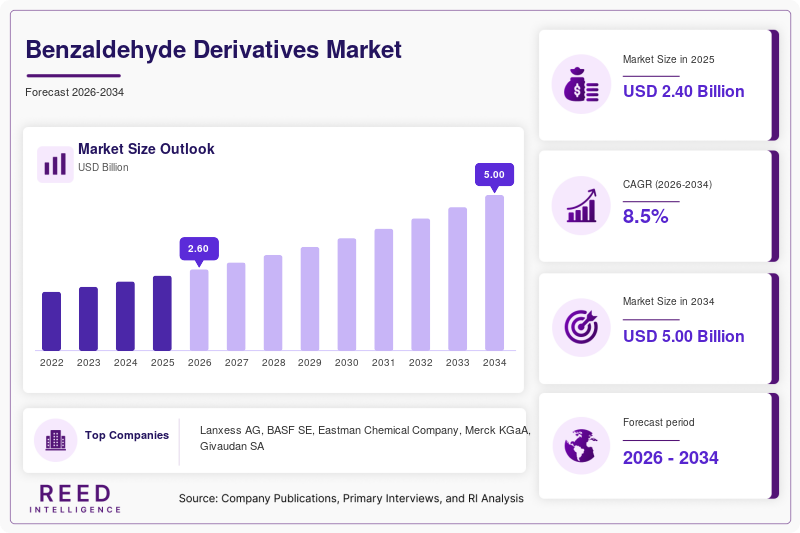
The global Benzaldehyde Derivatives Market size was valued at approximately USD 2.4 billion in 2026 and is projected to reach USD 4.6 billion by 2034, expanding at a compound annual growth rate (CAGR) of 8.5% during the forecast period. The market growth is primarily driven by the increasing demand for benzaldehyde-based intermediates across pharmaceuticals, agrochemicals, and flavor & fragrance industries. These derivatives play a critical role in synthesizing active pharmaceutical ingredients (APIs), pesticides, and aromatic compounds, making them essential across multiple industrial value chains.
One major global factor supporting market growth is the expansion of the pharmaceutical manufacturing sector, particularly in emerging economies. The growing burden of chronic diseases and the increasing focus on cost-effective drug production have significantly elevated the demand for chemical intermediates such as benzaldehyde derivatives. Additionally, rising investments in specialty chemicals and sustainable synthesis methods are further contributing to steady market expansion.
Key Highlights
- North America dominated the market with a 33.8% share in 2025.
- Asia Pacific is expected to grow at the fastest CAGR of 9.6% during 2026–2034.
- By type, benzoic acid derivatives accounted for the largest share of 36.4%, while cinnamic acid derivatives are projected to grow at a CAGR of 9.8%.
- By application, pharmaceuticals led with a 42.1% share, whereas agrochemicals are expected to expand at a CAGR of 9.3%.
- The United States remained the dominant country, with market values of USD 520 million in 2024 and USD 565 million in 2025.
Market Trends
Rising adoption of bio-based and sustainable chemical synthesis
A key trend shaping the Benzaldehyde Derivatives Market is the increasing shift toward bio-based and sustainable chemical synthesis processes. Manufacturers are adopting green chemistry principles to reduce environmental impact and meet regulatory requirements. This includes using renewable feedstocks and minimizing hazardous by-products during benzaldehyde derivative production. The demand for eco-friendly chemicals is rising, particularly in Europe and North America, where environmental regulations are becoming more stringent. This transition is also supported by consumer preference for sustainable products in personal care and food applications, further driving the adoption of bio-based derivatives.
Additionally, companies are investing in research and development to create innovative production techniques that enhance yield efficiency while reducing carbon emissions. These advancements are not only improving cost structures but also strengthening supply chain sustainability. As industries continue to focus on environmental compliance and circular economy models, the demand for sustainable benzaldehyde derivatives is expected to witness steady growth.
Expansion of applications in specialty chemicals and fragrances
Another notable trend is the expanding use of benzaldehyde derivatives in specialty chemicals and fragrance formulations. These derivatives serve as essential aromatic compounds in perfumes, cosmetics, and food flavoring agents. The rising disposable income and changing consumer preferences for premium and customized products are boosting demand for high-quality fragrances and flavors. This trend is particularly evident in emerging markets, where urbanization and lifestyle changes are influencing consumption patterns.
Moreover, the growth of the personal care and cosmetics industry is driving the use of benzaldehyde derivatives in innovative formulations. Manufacturers are focusing on creating unique scent profiles and enhancing product differentiation. The integration of advanced blending technologies and the rising popularity of natural and organic fragrances are further contributing to this trend. As consumer demand evolves, the market is likely to see continuous innovation in fragrance applications.
Market Drivers
Increasing demand from pharmaceutical manufacturing
The growing demand from the pharmaceutical sector is a major driver of the Benzaldehyde Derivatives Market. These compounds are widely used as intermediates in the synthesis of various drugs, including antibiotics, anti-inflammatory agents, and cardiovascular medications. The rising prevalence of chronic diseases and the expanding global population are increasing the need for efficient drug production, thereby boosting demand for benzaldehyde derivatives.
Furthermore, the shift toward generic drug manufacturing in emerging economies is accelerating the consumption of cost-effective chemical intermediates. Pharmaceutical companies are focusing on optimizing production processes and reducing costs, which is increasing reliance on benzaldehyde derivatives. The growing investment in research and development and the expansion of pharmaceutical production facilities are expected to sustain this demand over the forecast period.
Growth of agrochemical industry and crop protection needs
The expansion of the agrochemical industry is another significant driver of market growth. Benzaldehyde derivatives are used in the production of pesticides, herbicides, and fungicides, which are essential for improving crop yield and quality. The increasing global demand for food, driven by population growth, is encouraging the adoption of advanced crop protection solutions.
In addition, climate change and the need for sustainable agriculture are driving innovation in agrochemical formulations. Farmers are increasingly relying on effective and efficient crop protection products, which is boosting the demand for chemical intermediates such as benzaldehyde derivatives. Governments and agricultural organizations are also supporting the use of advanced agrochemicals to enhance productivity, further contributing to market growth.
Market Restraint
Volatility in raw material prices and regulatory challenges
One of the key restraints affecting the Benzaldehyde Derivatives Market is the volatility in raw material prices, particularly for toluene and related petrochemical feedstocks. Fluctuations in crude oil prices directly impact the cost structure of benzaldehyde production, leading to pricing instability and reduced profit margins for manufacturers. This creates challenges in maintaining consistent supply and competitive pricing, especially for small and medium-sized enterprises.
Additionally, stringent environmental and safety regulations related to chemical manufacturing pose significant hurdles for market players. Regulatory authorities in regions such as Europe and North America have implemented strict guidelines for emissions, waste disposal, and chemical handling. Compliance with these regulations requires substantial investment in infrastructure and technology, increasing operational costs. These factors collectively limit market growth, particularly for companies with limited financial resources.
Market Opportunities
Emerging demand in developing economies
The growing industrialization in developing economies presents a significant opportunity for the Benzaldehyde Derivatives Market. Countries in Asia Pacific, Latin America, and Africa are witnessing rapid growth in pharmaceutical, agrochemical, and food processing industries. This is creating a strong demand for chemical intermediates, including benzaldehyde derivatives.
Moreover, favorable government policies and increasing foreign direct investment are supporting industrial expansion in these regions. The availability of low-cost labor and raw materials is attracting global manufacturers to establish production facilities. As infrastructure improves and domestic consumption rises, these markets are expected to offer substantial growth opportunities for industry players.
Innovation in high-value specialty applications
Another promising opportunity lies in the development of high-value specialty applications for benzaldehyde derivatives. Advances in chemical engineering and material science are enabling the creation of novel compounds with enhanced properties. These derivatives are finding increasing applications in areas such as advanced polymers, coatings, and electronic chemicals.
Furthermore, the rising demand for customized and premium products in industries such as cosmetics and food & beverages is driving innovation. Companies are focusing on developing unique formulations that cater to specific consumer preferences. This trend is encouraging investment in research and development, leading to the introduction of new and improved benzaldehyde derivatives. As technological capabilities continue to evolve, the market is likely to witness significant growth in specialty applications.
Segmental Analysis
By Type
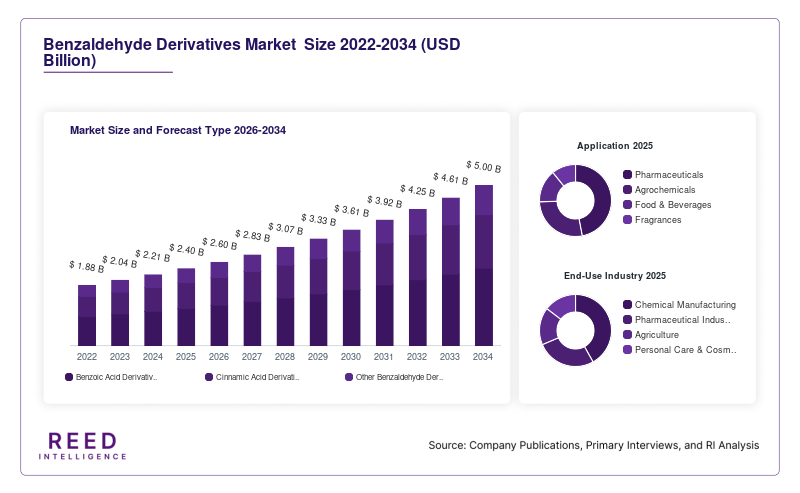
Benzoic acid derivatives dominated the Benzaldehyde Derivatives Market, accounting for a 36.4% share in 2024. These derivatives are widely used in pharmaceuticals, food preservatives, and chemical synthesis processes. Their versatility and cost-effectiveness make them a preferred choice across multiple industries. The increasing demand for preservatives in food and beverage products and the growing use of benzoic acid derivatives in drug formulations are key factors supporting their dominance. Additionally, advancements in production technologies have improved the efficiency and scalability of these derivatives, further strengthening their market position.
Cinnamic acid derivatives are the fastest-growing subsegment, expected to expand at a CAGR of 9.8% during the forecast period. These derivatives are gaining popularity due to their applications in cosmetics, fragrances, and pharmaceuticals. Their antioxidant and antimicrobial properties make them suitable for high-value applications. The increasing demand for natural and bio-based ingredients is driving the growth of cinnamic acid derivatives. Furthermore, ongoing research into their therapeutic properties is expected to open new avenues for market expansion.
By Application
The pharmaceutical segment held the largest share of 42.1% in 2024, driven by the extensive use of benzaldehyde derivatives in drug synthesis. These compounds serve as essential intermediates in the production of various medications, making them indispensable in the pharmaceutical industry. The growing prevalence of chronic diseases and the increasing demand for affordable medicines are key factors supporting this segment’s growth. Additionally, the expansion of pharmaceutical manufacturing in emerging markets is further boosting demand.
The agrochemical segment is projected to grow at a CAGR of 9.3%, making it the fastest-growing application. The increasing need for crop protection solutions and the rising demand for food are driving the use of benzaldehyde derivatives in pesticide and herbicide formulations. Technological advancements in agrochemical production and the development of more effective and environmentally friendly products are also contributing to this segment’s growth.
By End-Use Industry
The chemical manufacturing industry dominated the market with a 39.6% share in 2024. Benzaldehyde derivatives are widely used in the production of specialty chemicals, resins, and coatings. The growth of the chemical industry, particularly in emerging economies, is driving demand for these derivatives. Additionally, the increasing focus on innovation and product differentiation is encouraging the use of benzaldehyde derivatives in advanced applications.
The personal care and cosmetics industry is the fastest-growing segment, with a projected CAGR of 9.1%. The rising demand for premium and natural products is driving the use of benzaldehyde derivatives in fragrances and skincare formulations. Consumer preferences for high-quality and customized products are encouraging manufacturers to invest in innovative formulations, supporting the growth of this segment.
Regional Analysis
North America
North America held a significant share of approximately 33.8% in the Benzaldehyde Derivatives Market in 2025 and is expected to grow at a CAGR of 7.9% during the forecast period. The region benefits from a well-established pharmaceutical and specialty chemicals industry, which drives demand for benzaldehyde derivatives. Strong research and development capabilities and the presence of major industry players further support market growth.
The United States dominates the regional market due to its advanced manufacturing infrastructure and high demand for pharmaceutical intermediates. A unique growth factor in this region is the increasing adoption of sustainable chemical production practices, supported by strict environmental regulations and government initiatives promoting green chemistry.
Europe
Europe accounted for around 27.5% of the market share in 2025 and is projected to grow at a CAGR of 8.1%. The region’s growth is driven by strong demand from the fragrance and cosmetics industries, particularly in countries known for luxury goods production. Regulatory compliance and sustainability initiatives are also shaping market dynamics.
Germany leads the European market due to its robust chemical manufacturing sector. A key growth factor is the region’s emphasis on eco-friendly and bio-based chemicals, which is encouraging innovation and increasing the adoption of sustainable benzaldehyde derivatives.
Asia Pacific
Asia Pacific is expected to witness the fastest growth, with a CAGR of 9.6% during the forecast period, and held a 24.3% share in 2025. Rapid industrialization, urbanization, and increasing demand for pharmaceuticals and agrochemicals are driving market expansion in this region.
China dominates the market due to its large-scale chemical production capacity. A unique growth factor is the region’s cost-effective manufacturing environment, which attracts global companies to establish production facilities and expand their supply chains.
Middle East & Africa
The Middle East & Africa region accounted for 7.2% of the market share in 2025 and is expected to grow at a CAGR of 7.4%. The market is driven by increasing investments in chemical manufacturing and the expansion of downstream industries.
Saudi Arabia is a key contributor to regional growth, supported by its strong petrochemical base. A notable growth factor is the region’s focus on diversifying its economy beyond oil, leading to increased investments in specialty chemicals and related industries.
Latin America
Latin America held a market share of 7.2% in 2025 and is projected to grow at a CAGR of 8.0%. The region is experiencing steady growth due to increasing demand from the agrochemical and food processing industries.
Brazil leads the regional market, driven by its large agricultural sector. A unique growth factor is the rising adoption of advanced crop protection solutions, which is increasing the demand for benzaldehyde derivatives used in agrochemical formulations.

Competitive Landscape
The Benzaldehyde Derivatives Market is characterized by the presence of several established players and emerging companies focusing on innovation and expansion. Key companies are investing in research and development to enhance product quality and diversify their offerings. Strategic collaborations, mergers, and acquisitions are common strategies adopted to strengthen market presence.
Lanxess AG is considered a leading player in the market due to its strong product portfolio and global presence. The company recently expanded its specialty chemicals production capacity to meet growing demand. Other major players are focusing on sustainable production methods and expanding their geographical reach to capture emerging opportunities.
Key Players
- Lanxess AG
- Emerald Performance Materials
- Kadillac Chemicals Pvt. Ltd.
- Axxence Aromatic GmbH
- Shimmer Chemicals Pvt. Ltd.
- Valtris Specialty Chemicals
- Tokyo Chemical Industry Co. Ltd.
- Alfa Aesar
- Merck KGaA
- Haihang Industry Co. Ltd.
- Central Drug House Pvt. Ltd.
- Givaudan SA
- Symrise AG
- BASF SE
- Eastman Chemical Company
Recent Developments
- Several companies have increased investments in sustainable production technologies to reduce environmental impact and improve efficiency.
- A leading chemical manufacturer announced the expansion of its benzaldehyde derivatives production facility in Asia to meet growing regional demand.
- A major player introduced a new range of bio-based benzaldehyde derivatives aimed at the personal care and fragrance industries.
Benzaldehyde Derivatives Market Segments
Type
- Benzoic Acid Derivatives
- Cinnamic Acid Derivatives
- Other Benzaldehyde Derivatives
Application
- Pharmaceuticals
- Agrochemicals
- Food & Beverages
- Fragrances
End-Use Industry
- Chemical Manufacturing
- Pharmaceutical Industry
- Agriculture
- Personal Care & Cosmetics
By Region
- North America
- Europe
- APAC
- Middle East and Africa
- LATAM