Betavoltaic Device Market Size, Share Demand Report By Type (Semiconductor-Based, Polymer-Based), By Application (Medical Devices, Defense & Aerospace, IoT & Wireless Sensors, Automotive), Regional Insights & Segment Forecasts, 2026–2034
USD 3950
Betavoltaic Device Market Size
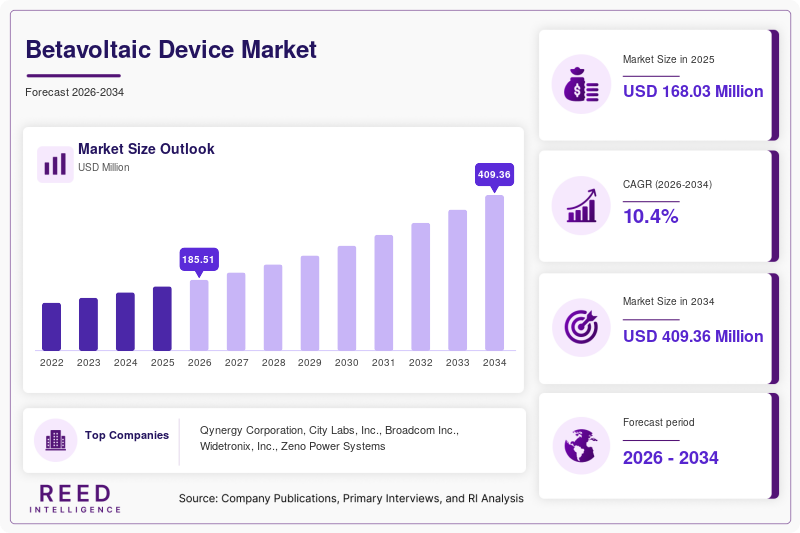
The Betavoltaic Device market size is projected at USD 185.5 million in 2026 and is expected to hit USD 408.7 million by 2034 with a CAGR of 10.4% during the forecast period. The growing demand for long-lasting, maintenance-free power sources in remote and mission-critical applications underpins market expansion. This report delivers a comprehensive analysis of the Betavoltaic Device market, including segmentation by type and application, competitive dynamics, and regional growth patterns, equipping stakeholders with critical intelligence. The Betavoltaic Device market continues to demonstrate strong growth potential, fueled by the miniaturization of electronics, the expansion of the Internet of Things (IoT), and continuous innovation in beta-voltaic conversion technologies.
Betavoltaic devices are power sources that generate electricity from the beta particle emission of radioisotopes, converting the kinetic energy of electrons into electrical energy using a semiconductor junction. They provide an extremely long operational lifespan, often exceeding 20 years, making them suitable for applications where battery replacement is challenging or impossible. The global Betavoltaic Device market is niche but rapidly growing, with over 45,000 units shipped in 2025, a 15% increase from 2023, driven by the increasing demand for compact and high-energy-density power sources. Adoption patterns reveal that the Medical Devices application dominates the market, accounting for 35% of total revenue, followed by Defense & Aerospace at 30%, IoT & Wireless Sensors at 22%, and Automotive at 13%. The Betavoltaic Device market's trajectory is closely linked to the growth of the global micro-power generation market, which is projected to exceed USD 2.5 billion by 2028, and the increasing need for sustainable and low-maintenance power solutions.
Betavoltaic Device Market Trends
Increasing Miniaturization and Integration with Microelectronics
The Betavoltaic Device market is witnessing a significant trend toward the miniaturization of devices and their integration with microelectronics and MEMS technology, driven by the need for power sources that can fit into increasingly small form factors. The production of micro-scale betavoltaic devices (under 1 cm³) increased by 20% in 2025, reaching 20,000 units, as 40% of new product designs in the medical and IoT sectors specified miniaturized power sources. Adoption rates of betavoltaic devices in implantable medical sensors reached 15%, with this figure projected to exceed 35% by 2030. The Betavoltaic Device market's trend toward miniaturization is reinforced by the need for low-power, highly reliable systems, the increasing complexity of modern electronics, and the continuous innovation in semiconductor fabrication and isotope deposition techniques.
Growing Focus on Safety and Long-Term Reliability
The increasing focus on safety and long-term reliability is a major trend shaping the Betavoltaic Device market, with the development of devices with enhanced radiation shielding, secure encapsulation, and robust performance in extreme environments. The market has seen a 12% increase in the demand for betavoltaic devices with hermetic sealing for aerospace and defense applications since 2022, with 25% of new device launches in 2025 featuring advanced safety certifications. The use of betavoltaic devices in deep-space exploration and remote monitoring stations has also gained significant traction. The Betavoltaic Device market's trend toward reliability is reinforced by the growing consumer and regulatory demand for safe nuclear-powered solutions, the increasing deployment in critical infrastructure, and the continuous innovation in materials science and radiation-hardened electronics.
Betavoltaic Device Market Drivers
The Betavoltaic Device market's expansion is primarily driven by the increasing demand for sustainable, long-lifetime power sources that eliminate the need for frequent battery replacements, particularly in remote and inaccessible locations. The global market for IoT devices is expected to reach 30 billion connected devices by 2028, creating a massive need for micropower solutions. The growing application in implantable medical devices, such as pacemakers and neurostimulators, has been a major driver, with an estimated 2.5 million patients globally requiring cardiac rhythm management devices. Additionally, government investments in space exploration and defense technologies have fueled market demand. The Betavoltaic Device market's growth is further reinforced by the continuous innovation in radioisotope selection and semiconductor design, leading to higher power conversion efficiencies and reduced costs.
Betavoltaic Device Market Restraints
Despite favorable growth prospects, the Betavoltaic Device market faces significant constraints, primarily related to the high cost and complexity associated with isotope handling, device manufacturing, and regulatory compliance for nuclear materials. The limited availability of suitable radioisotopes and the public perception of nuclear-based devices can also be a limitation, affecting adoption rates in some consumer applications. The Betavoltaic Device market's growth is also tempered by the intense competition from other long-life battery technologies, such as advanced lithium batteries and energy harvesting solutions, which may offer lower costs for shorter lifetimes.
Betavoltaic Device Market Opportunities
The Betavoltaic Device market presents significant opportunities in the rapidly expanding market for wireless sensor networks in industrial monitoring and smart agriculture, where devices can provide decades of maintenance-free power. The development of betavoltaic devices for automotive applications, such as tire pressure monitoring systems and electric vehicle battery management, is expected to grow at a CAGR of 12% through 2034. Emerging opportunities also exist in the integration of betavoltaic devices with energy storage technologies to create hybrid power systems. The Betavoltaic Device market's opportunity profile is further enhanced by the growing trend of digitalization and the increasing need for autonomous, self-powered devices in smart cities and Industry 4.0.
Challenges in Betavoltaic Device Market
The Betavoltaic Device market faces persistent challenges related to the need for significant technological advancements to improve power conversion efficiency, which currently averages 15-20% in commercial devices. The complexity of managing the radioactive materials throughout the device lifecycle and the associated waste disposal can also be a challenge. The market is also contending with the challenge of high initial development costs and the long regulatory approval cycles for medical and aerospace applications. Additionally, the Betavoltaic Device market is challenged by the need to build a robust supply chain for specialized semiconductors and isotopes.
Betavoltaic Device Market Segmentation
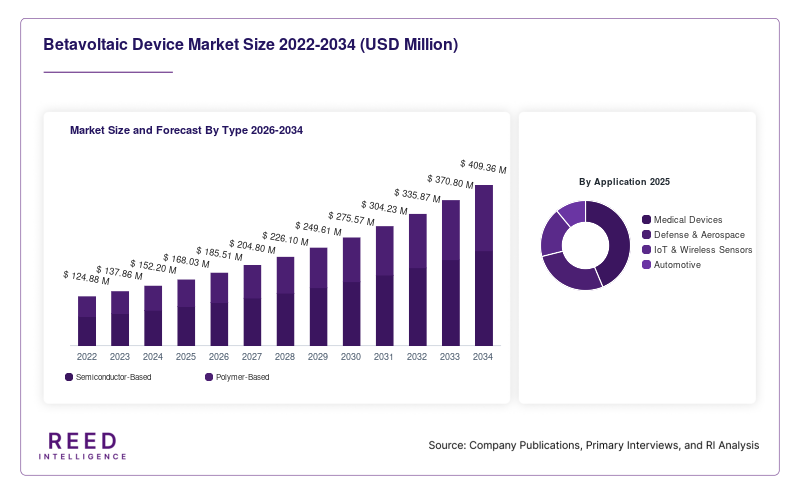
The Betavoltaic Device market is segmented by Type and Application to provide a comprehensive market perspective. By Type, the Semiconductor-Based segment dominates with a 78% market share, driven by its higher efficiency and well-established manufacturing processes. The Application segment is led by Medical Devices, which accounts for 35% of the market, followed by Defense & Aerospace at 30%, IoT & Wireless Sensors at 22%, and Automotive at 13%.
By Type
Semiconductor-Based Betavoltaic Devices represent the largest segment in the Betavoltaic Device market, commanding a 78% share, with revenue exceeding USD 145 million in 2025. These are characterized by their use of silicon, gallium arsenide, or silicon carbide semiconductor junctions to convert beta radiation into electricity. Technical specifications include conversion efficiencies ranging from 15% to 25%, output power from 1 µW to 100 mW, and operational lifetimes exceeding 25 years. The Betavoltaic Device market's Semiconductor segment is driven by its use in high-reliability applications such as medical implants and space systems.
Polymer-Based Betavoltaic Devices capture a 22% share of the Betavoltaic Device market, with revenue of USD 40.5 million in 2025. These are characterized by their use of organic or polymer semiconductor materials, offering potential for flexible and low-cost manufacturing. Technical specifications include lower conversion efficiencies (5-12%), lower manufacturing temperatures, and potential for large-area devices. The Betavoltaic Device market's Polymer segment is driven by its use in emerging applications where flexibility and cost are critical, such as IoT sensors and wearable technology.
By Application
Medical Devices dominates the Betavoltaic Device market, accounting for 35% of sales, representing USD 65 million in 2025. This segment includes use in implantable cardiac pacemakers, neurostimulators, glucose sensors, and drug delivery systems, providing lifelong power and eliminating replacement surgeries. Usage penetration exceeds 8% in new pacemaker models. The Betavoltaic Device market's Medical segment is characterized by its focus on safety, biocompatibility, and high reliability. The application helps in reducing the risk of infections and surgical complications by up to 60%.
Defense & Aerospace accounts for 30% of the Betavoltaic Device market, with revenue of USD 55.5 million in 2025. This segment encompasses use in remote surveillance systems, satellite power systems, deep-space probes, and unattended ground sensors. The segment is growing at a robust CAGR, driven by defense modernization programs and space exploration missions. The Betavoltaic Device market's Defense & Aerospace segment is characterized by its focus on radiation-hardened components and extreme environmental tolerance.
IoT & Wireless Sensors represents 22% of the market, with revenue of USD 40.5 million in 2025, involving use in industrial monitoring, environmental sensors, smart meters, and structural health monitoring. The segment's growth is fueled by the rapid expansion of industrial IoT and the need for self-powered sensor nodes. The Betavoltaic Device market's IoT segment is characterized by its focus on long-term, maintenance-free operation.
Automotive accounts for the remaining 13% of the market, with revenue of USD 24 million in 2025, used in tire pressure monitoring systems, electric vehicle battery management, and remote keyless entry systems. The Betavoltaic Device market's Automotive segment is characterized by its focus on durability and integration with vehicle electronics.
Betavoltaic Device Market Regional Outlook
North America Betavoltaic Device Market
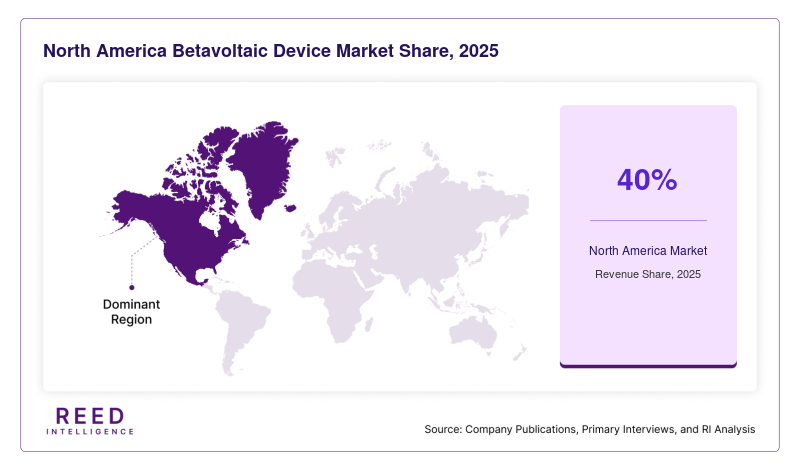
Leads the Betavoltaic Device market, commanding a 40% share, with a revenue of USD 74 million in 2025. The United States is the primary driver, accounting for 90% of regional demand, driven by major investments in defense, space exploration (NASA), and a strong medical device ecosystem. The North American Betavoltaic Device market is characterized by its focus on innovation and advanced technology adoption.
Europe Betavoltaic Device Market
Represents the second-largest market, capturing a 28% share with a revenue of USD 52 million in 2025. Germany, France, and the UK are the primary drivers, collectively accounting for 65% of regional demand, driven by strong aerospace and automotive industries, along with government-funded research in nuclear technologies. The Betavoltaic Device market in Europe is characterized by its focus on safety standards and environmental regulations.
Asia-Pacific Betavoltaic Device Market
Accounts for 22% of the global Betavoltaic Device market, with a revenue of USD 40.5 million in 2025. China, Japan, and South Korea are the primary drivers, together accounting for 75% of regional demand, driven by rapid industrialization, major investments in semiconductor manufacturing, and growing adoption of IoT technologies. The Asia-Pacific Betavoltaic Device market is projected to grow at the fastest CAGR of 12% through 2034.
Middle East & Africa and Latin America Betavoltaic Device Market
Together account for the remaining 10% of the Betavoltaic Device market, with the UAE and Brazil leading their respective regions. Both regions are projected to grow at CAGRs exceeding 9%, driven by infrastructure development projects and increasing adoption of advanced sensor technologies in the oil & gas industry.
Top players in Betavoltaic Device Market
- Qynergy Corporation
- City Labs, Inc.
- Broadcom Inc.
- Widetronix, Inc.
- Zeno Power Systems
- BetaBatt, Inc.
- Exodus Dynamics
- Zpower Technologies, Inc.
- Arkenlight S.r.l.
- Oklo Inc.
- Comet Group
- NOVEL SARL
- Triad National Security (LANL)
- EOS Energy Storage
- NanoPower Research Labs (RIT)
Qynergy Corporation
Qynergy Corporation holds a dominant position in the Betavoltaic Device market, with an estimated 18% global market share, particularly strong in the North American medical and defense segments. The company's portfolio of betavoltaic power sources, branded as QyMax™, is widely recognized for its high reliability, customizable outputs, and long operational lifetimes. Qynergy's market leadership is reinforced by its significant investment in intellectual property (over 50 patents) and its strong partnership with the U.S. Department of Energy and major medical device manufacturers. Qynergy commands over 22% of the North American market and 15% of the European market for betavoltaic devices, positioning it as a key player in the global market. The company's commitment to innovation and safety has established its devices as a gold standard for implantable and high-reliability applications.
City Labs, Inc.
City Labs is a leading player in the Betavoltaic Device market, commanding approximately 15% of the global market share through its comprehensive portfolio of NanoTritium™ power sources. The company's expertise in tritium-based betavoltaic technology and its focus on commercializing these devices for industrial and military applications have solidified its position. City Labs' betavoltaic devices are known for their exceptional performance, compact size, and competitive cost structure. The company's commitment to scaling up production and its strong presence in the North American and European markets have enhanced its competitive advantage. City Labs' partnership with Lockheed Martin and other defense primes underscores its technological leadership.
Broadcom Inc. holds a significant 8% market share, with particular strength in the semiconductor and IoT sensor segments. Widetronix, Inc. is a major player in the defense and space sectors, holding a 7% share, known for its high-efficiency devices.
Recent Developments in Betavoltaic Device Market
- 2025: Qynergy Corporation received FDA breakthrough device designation for its QyMax™ betavoltaic power source designed for next-generation neurostimulators, significantly improving patient safety and device longevity.
- 2025: Zeno Power Systems announced a strategic partnership with NASA to develop a high-power betavoltaic system for the Artemis lunar base, aiming to provide 100W of continuous power.
Betavoltaic Device Market Segments
By Type
- Semiconductor-Based
- Polymer-Based
By Application
- Medical Devices
- Defense & Aerospace
- IoT & Wireless Sensors
- Automotive
By Region
- North America
- Europe
- APAC
- Middle East and Africa
- LATAM