Betulinic Acid Market Size, Share & Demand Report By Source (Plant-Derived, Semi-Synthetic), By Form (Powder, Liquid), By Application (Pharmaceutical, Nutraceutical, Cosmetics & Personal Care, Research & Laboratory Use), By End-Use Industry (Pharmaceutical & Biotechnology Companies, Nutraceutical Manufacturers, Cosmetics & Personal Care Companies, Academic & Research Institutions), By Region & Segment Forecasts, 2025–2034
USD 3950
Market Overview
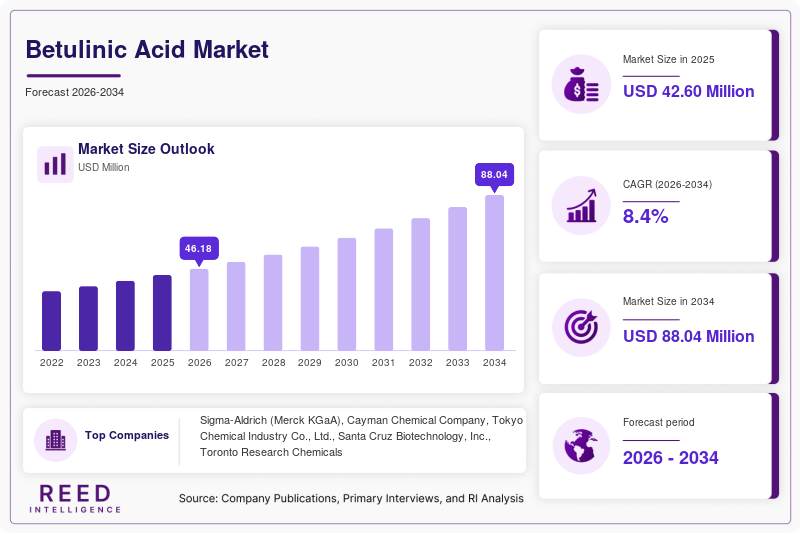
The Betulinic Acid Market Size was valued at approximately USD 42.6 million in 2025 and is projected to reach USD 86.3 million by 2033, expanding at a compound annual growth rate (CAGR) of 8.4% during the forecast period (2025–2034). Growth of the market is associated with increasing interest in plant-derived bioactive compounds across the pharmaceutical and nutraceutical sectors. Betulinic acid, a naturally occurring pentacyclic triterpenoid extracted mainly from birch bark and other plant sources, has gained attention due to its antiviral, anti-inflammatory, and anticancer properties.
One global factor supporting the expansion of the Betulinic Acid Market is the growing shift toward plant-based bioactive compounds in pharmaceutical research and development. Biotechnology companies and academic laboratories are increasingly exploring natural molecules as potential therapeutic agents. Betulinic acid has shown promising activity against melanoma cells and viral infections in early-stage studies, which has encouraged investment in extraction technologies and formulation development. The rise in botanical ingredients in nutraceutical products has further expanded commercial applications.
Key Highlights
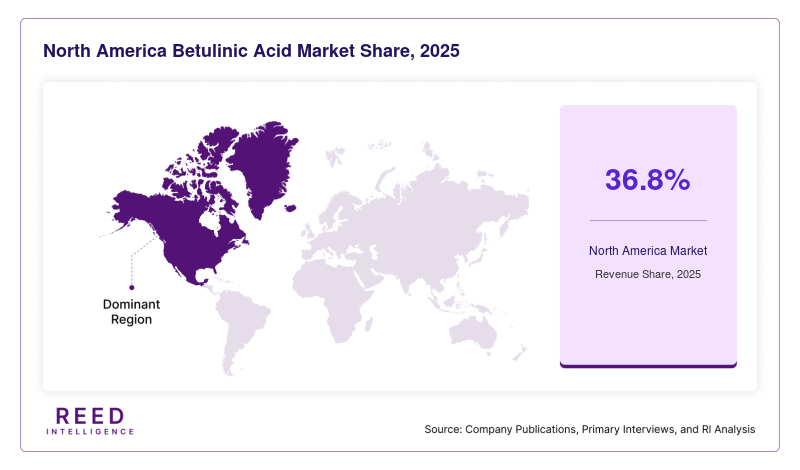
- Dominant Region: North America accounted for 36.8% market share in 2025, while Asia Pacific will grow at a CAGR of 9.7% during the forecast period.
- Leading Subsegments: Pharmaceutical application represented 41.2% share in 2025, while the nutraceutical segment is expected to grow fastest at 9.2% CAGR.
- Dominant Country: The United States recorded USD 12.4 million in 2025 and is estimated to reach USD 13.5 million in 2026.
Market Trends
Increasing Use of Natural Triterpenoids in Therapeutic Research
A key trend influencing the Betulinic Acid Market is the increasing focus on triterpenoid compounds in biomedical research. Betulinic acid is being studied for its potential role in antiviral, anticancer, and anti-inflammatory treatments. Research institutions and biotechnology firms are exploring structural modifications of betulinic acid to enhance therapeutic efficacy. These efforts are contributing to a steady rise in laboratory-scale demand and contract manufacturing of the compound. The trend reflects a broader shift in pharmaceutical innovation toward bioactive natural molecules that may offer novel mechanisms of action.
Expansion of Botanical Ingredients in Functional Products
Another trend shaping the Betulinic Acid Market involves the growing integration of botanical ingredients into functional foods and dietary supplements. Nutraceutical manufacturers are incorporating triterpenoid compounds into formulations targeting immune health and metabolic wellness. Betulinic acid is being evaluated as an ingredient in botanical extracts used in capsules, powders, and functional beverages. This trend is driven by consumer preference for plant-based ingredients and the expansion of global herbal supplement markets.
Market Drivers
Growing Investment in Natural Compound Research
Increasing investment in natural product research is a major driver of the Betulinic Acid Market. Pharmaceutical companies and biotechnology startups are expanding research pipelines focused on plant-derived compounds. Betulinic acid has attracted interest due to its diverse pharmacological activities and availability in several plant species. As funding for natural compound screening programs increases, laboratories and research institutions are purchasing purified betulinic acid for experimentation and drug discovery programs.
Rising Demand for Botanical Extracts in Cosmetic Formulations
The global cosmetics industry is gradually incorporating plant-derived ingredients into skincare formulations. Betulinic acid has demonstrated antioxidant and anti-inflammatory properties that support its use in dermatological and cosmetic products. Cosmetic manufacturers are experimenting with triterpenoid-based formulations aimed at skin protection and anti-aging applications. As the demand for botanical skincare ingredients increases, suppliers of purified betulinic acid are expanding their production capacity.
Market Restraint
Limited Large-Scale Commercial Production
A significant restraint affecting the Betulinic Acid Market is the limited availability of cost-efficient large-scale extraction methods. Although betulinic acid occurs naturally in several plants, particularly birch bark, the extraction process often requires multiple purification stages. These processes increase production costs and limit supply availability for industrial applications.
Furthermore, variability in plant raw materials can influence the concentration of betulinic acid obtained during extraction. This variability can lead to inconsistent product quality, posing challenges for pharmaceutical-grade manufacturing. As a result, some manufacturers face difficulties scaling production while maintaining purity standards required by research institutions and pharmaceutical companies.
Market Opportunities
Development of Semi-Synthetic Betulinic Acid Derivatives
The development of semi-synthetic derivatives represents a significant opportunity for the Betulinic Acid Market. Researchers are exploring chemical modifications that can improve the bioavailability and therapeutic performance of betulinic acid. Pharmaceutical companies may develop novel drug candidates based on these derivatives, creating new demand for the base compound used in synthesis processes.
Expansion of Contract Manufacturing for Natural Compounds
Contract manufacturing organizations are increasingly offering specialized extraction and purification services for natural compounds. This trend presents opportunities for the Betulinic Acid Market, as research institutions and pharmaceutical companies often outsource production of high-purity bioactive molecules. As demand for specialized natural compounds increases, contract manufacturers may expand production capacity for betulinic acid.
Segmental Analysis
By Source
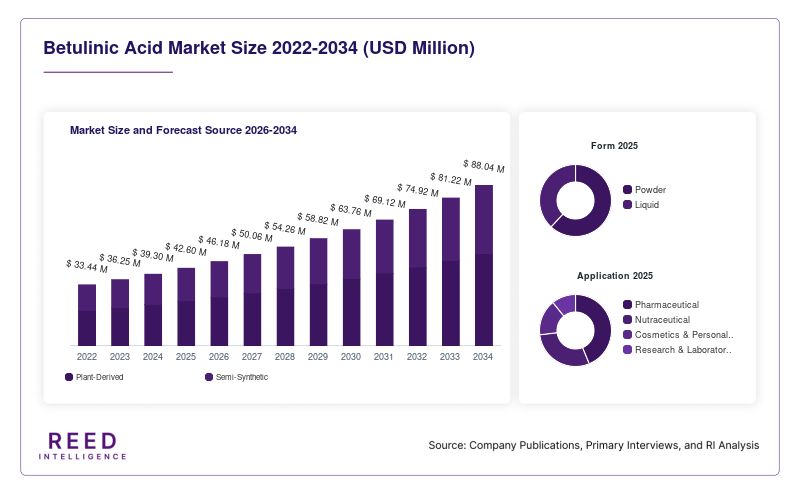
Plant-derived betulinic acid represented the dominant subsegment, accounting for 78.4% share in 2025. The majority of commercial betulinic acid is extracted from natural sources such as birch bark, which contains high concentrations of triterpenoid compounds. Extraction from botanical materials has historically been the primary method used by manufacturers due to the availability of plant biomass and established extraction processes.
The semi-synthetic source segment will grow at a CAGR of 9.1% through 2034. Semi-synthetic production methods involve chemical modification of betulin obtained from plant sources to produce betulinic acid with improved purity levels. Increasing research interest in standardized compounds for pharmaceutical applications will support the expansion of this segment.
By Application
The pharmaceutical application segment accounted for 41.2% share of the Betulinic Acid Market in 2025. Pharmaceutical companies and research institutions use betulinic acid as a reference compound for studying triterpenoid pharmacology. Laboratory demand for the compound remains strong due to its relevance in early-stage drug discovery programs.
The nutraceutical application segment will grow at a CAGR of 9.2% during the forecast period. Nutraceutical manufacturers are evaluating botanical extracts containing triterpenoids for use in dietary supplements targeting immune support and metabolic health. As consumer interest in plant-based health products expands, nutraceutical companies may increase the use of such compounds in product formulations.
By Form
The powder form segment held 63.5% share in 2025. Powdered betulinic acid is commonly supplied to laboratories and manufacturing facilities because it is easier to transport, measure, and incorporate into experimental or formulation processes. Powder form also supports longer shelf stability compared to liquid solutions.
The liquid form segment will grow at a CAGR of 8.8% through 2034. Liquid solutions of betulinic acid are used in specific research applications and formulation processes where solubility is required. Laboratories conducting biochemical assays often prefer liquid solutions to simplify experimental preparation procedures.
By End-Use Industry
The pharmaceutical and biotechnology companies segment dominated the Betulinic Acid Market with 46.7% share in 2025. These organizations frequently purchase purified betulinic acid for drug discovery and preclinical studies. Research laboratories within these companies evaluate the compound for its biological activity and potential therapeutic applications.
The cosmetics and personal care segment will expand at a CAGR of 8.6% during the forecast period. Cosmetic manufacturers are investigating plant-derived triterpenoids for their antioxidant and skin-protective properties. Incorporation of botanical compounds into skincare formulations is expected to support the expansion of this segment.
Regional Analysis
North America
North America accounted for 36.8% of the global Betulinic Acid Market share in 2025. The region will expand at an estimated CAGR of 8.1% between 2025 and 2034. Market demand in this region has historically been associated with the presence of biotechnology firms, academic research institutions, and pharmaceutical development programs focused on plant-derived molecules.
The United States represented the dominant country within the regional market. Growth in the country has been associated with research funding for natural product chemistry and molecular pharmacology. Universities and biotechnology startups have increasingly explored triterpenoid compounds as part of drug discovery programs. Research laboratories frequently procure purified betulinic acid for experimental studies related to oncology and virology, supporting steady regional demand.
Europe
Europe held approximately 25.7% share of the Betulinic Acid Market in 2025. The region will grow at a CAGR of 7.9% during the forecast period. Demand within the region has historically been associated with the strong presence of botanical extract manufacturers and natural ingredient suppliers. European regulatory frameworks have also supported research into plant-derived molecules.
Germany emerged as the dominant country in the region. The country has a well-established pharmaceutical research ecosystem and a strong presence of botanical ingredient manufacturers. Laboratories and chemical suppliers based in Germany have developed specialized extraction processes for triterpenoids obtained from birch bark, enabling commercial-scale production of betulinic acid for research and industrial applications.
Asia Pacific
Asia Pacific accounted for 21.9% of the Betulinic Acid Market in 2025 and will expand at a CAGR of 9.7% through 2034, making it the fastest-growing region. The region has witnessed increasing activity in botanical compound research and nutraceutical product development.
China represented the dominant country in the region. The country has extensive plant biodiversity and established industries for herbal extracts and natural ingredients. Chinese manufacturers are involved in large-scale extraction of plant-based compounds for export markets. Expansion of herbal ingredient processing facilities has supported increased availability of betulinic acid derived from natural plant sources.
Middle East & Africa
The Middle East & Africa accounted for 8.3% share of the Betulinic Acid Market in 2025. The region will grow at a CAGR of 7.2% during the forecast period. Demand within this region has been associated with the gradual development of pharmaceutical research facilities and botanical ingredient trade.
South Africa emerged as the dominant country in the region. The country has a growing pharmaceutical manufacturing sector and an active botanical research community. Local universities and laboratories have been involved in studying plant-derived compounds for medicinal applications, which has contributed to demand for purified betulinic acid in research projects.
Latin America
Latin America represented 7.3% share of the Betulinic Acid Market in 2025 and will expand at a CAGR of 7.6% through 2034. The region has seen growing interest in plant-derived bioactive compounds due to its biodiversity and expanding botanical extraction industries.
Brazil was the dominant country within the region. The country possesses extensive forest resources and a growing natural products research ecosystem. Research institutes in Brazil have been studying bioactive molecules obtained from plant species, supporting the demand for triterpenoid compounds including betulinic acid.
Competitive Landscape
The Betulinic Acid Market is moderately fragmented, with the presence of chemical suppliers, botanical extract manufacturers, and biotechnology firms involved in natural compound production. Market participants focus on improving extraction techniques, expanding purification capabilities, and supplying high-purity compounds for research and pharmaceutical applications.
Sigma-Aldrich (Merck KGaA) emerged as a key market leader due to its extensive portfolio of laboratory chemicals and natural compounds. The company supplies high-purity betulinic acid for research applications worldwide. A recent development includes the expansion of its specialty chemical catalog, enabling research laboratories to access standardized triterpenoid compounds with certified purity levels.
Other companies in the market are involved in botanical extraction, contract manufacturing, and supply of research-grade compounds to pharmaceutical and academic institutions.
Key Players in the Betulinic Acid Market
- Sigma-Aldrich (Merck KGaA)
- Cayman Chemical Company
- Tokyo Chemical Industry Co., Ltd.
- Santa Cruz Biotechnology Inc.
- Toronto Research Chemicals
- Abcam plc
- LKT Laboratories Inc.
- Carbosynth Limited
- Extrasynthese
- Biosynth Carbosynth
- Selleck Chemicals
- PhytoLab GmbH & Co. KG
- Chengdu Biopurify Phytochemicals Ltd.
- Xi’an Natural Field Bio-Technique Co., Ltd.
- Hunan Nutramax Inc.
Recent Developments
- Several botanical extraction companies expanded purification facilities to improve the yield of triterpenoid compounds including betulinic acid.
- Chemical suppliers introduced higher-purity betulinic acid grades intended for pharmaceutical research applications.
- Biotechnology laboratories initiated research programs exploring semi-synthetic derivatives of betulinic acid for experimental therapeutics.
- Contract manufacturing organizations expanded capabilities for natural compound extraction to serve pharmaceutical research clients.
- Nutraceutical companies began evaluating triterpenoid-containing plant extracts for use in functional supplement formulations.
Betulinic Acid Market Segments
Source
- Plant-Derived
- Semi-Synthetic
Form
- Powder
- Liquid
Application
- Pharmaceutical
- Nutraceutical
- Cosmetics & Personal Care
- Research & Laboratory Use
End-Use Industry
- Pharmaceutical & Biotechnology Companies
- Nutraceutical Manufacturers
- Cosmetics & Personal Care Companies
- Academic & Research Institutions
By Region
- North America
- Europe
- APAC
- Middle East and Africa
- LATAM