Bicycle Subscription Market Size, Share & Demand Report By Bicycle Type (Standard Bicycles, E-Bikes, Cargo Bikes, Premium Performance Bikes), By Subscription Model (Monthly Plans, Annual Plans, Corporate Leasing, Family Plans), By End User (Individual Consumers, Corporate Users, Delivery & Logistics, Tourism & Hospitality), By Region & Segment Forecasts, 2026–2034
USD 3950
Market Overview
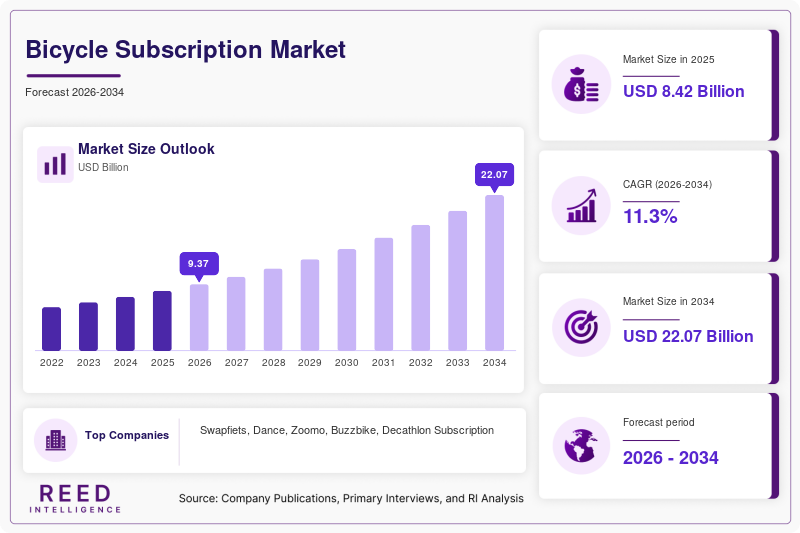
The global Bicycle Subscription Market size was valued at USD 8.42 billion in 2026 and is projected to reach USD 19.86 billion by 2034, expanding at a CAGR of 11.3% during the forecast period. Bicycle subscription services are reshaping urban mobility by offering flexible access to bicycles, e-bikes, and premium cycling equipment through monthly or annual payment models. This market is gaining momentum as consumers increasingly prefer access-based transportation over ownership, particularly in dense urban centers where congestion, environmental concerns, and maintenance costs influence purchasing behavior. Subscription platforms combine product access with repair, insurance, and upgrade benefits, creating a convenient ecosystem that appeals to commuters, recreational riders, and corporate mobility programs.
A major global factor supporting market growth is the sustained transition toward sustainable transportation policies. Governments across developed and emerging economies are promoting low-emission mobility solutions through cycling infrastructure investments, tax benefits, and smart city initiatives. This policy environment has accelerated bicycle adoption while creating a favorable framework for subscription-based mobility providers. Rising fuel prices and changing consumer attitudes toward cost-efficient transportation are also encouraging users to choose predictable recurring payment models over large upfront bicycle purchases.
Key Highlights
- North America dominated the Bicycle Subscription Market with a 36.4% share in 2025.
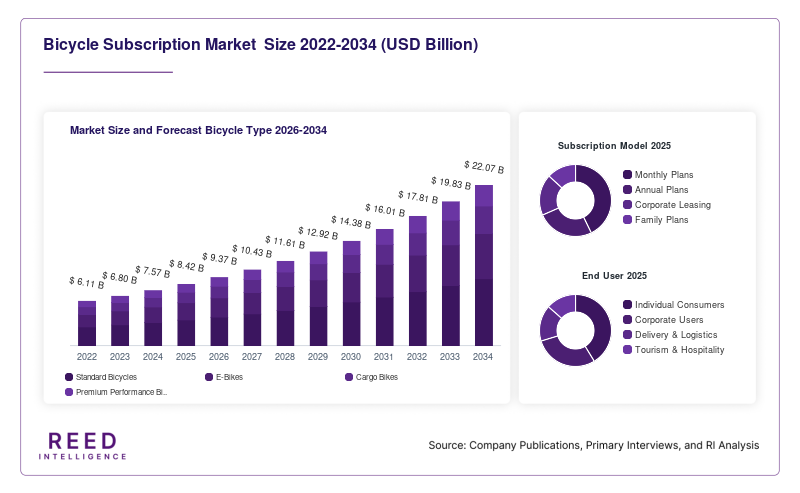
- Asia Pacific is expected to grow at the fastest CAGR of 13.1% during 2026–2034. By bicycle type, e-bikes accounted for the largest share of 42.8%, while cargo bikes are projected to grow at a CAGR of 14.2%. By subscription model, monthly plans led with a 47.3% share, whereas corporate leasing programs are expected to expand at a CAGR of 12.8%.
- By end user, individual consumers held the dominant share of 61.5%, while business users are forecast to grow at a CAGR of 13.4%.
- The United States remained the dominant country, with market values of USD 2.31 billion in 2024 and USD 2.58 billion in 2025.
Market Trends
Expansion of e-bike-focused subscription ecosystems
The Bicycle Subscription Market is witnessing significant growth in e-bike-centered subscription platforms as urban commuters increasingly prioritize speed, convenience, and low-carbon transportation. E-bikes provide greater commuting flexibility, especially in metropolitan regions with longer travel distances or challenging terrain. Subscription providers are integrating maintenance, battery replacement, theft protection, and app-based fleet management into bundled packages, making e-bike subscriptions more practical than direct ownership for many users. Premium manufacturers are also partnering with subscription startups to improve recurring revenue streams. This shift is particularly visible in cities with advanced cycling lanes and electrification incentives, where consumers seek affordable alternatives to public transport and personal vehicles.
Integration of digital mobility platforms with flexible subscription plans
Digital transformation is reshaping the Bicycle Subscription Market through AI-powered fleet management, predictive maintenance systems, and app-driven customer interfaces. Subscription providers now offer customizable plans based on duration, bike category, and user behavior, improving retention rates and customer satisfaction. Smartphone integration enables route optimization, usage tracking, and seamless upgrades, while data analytics allows operators to optimize inventory placement. This trend is attracting younger consumers who value convenience and digital accessibility. The rise of integrated mobility-as-a-service platforms is also positioning bicycle subscriptions as part of broader urban transportation ecosystems, combining cycling with public transit and micro-mobility solutions.
Market Drivers
Rising urban congestion and cost-conscious commuting preferences
Increasing urban traffic congestion is driving consumers toward flexible bicycle subscription models as cities struggle with transportation inefficiencies. Daily commuting costs associated with fuel, parking, and public transport are encouraging consumers to adopt bicycles as a practical mobility solution. Subscription models eliminate ownership barriers such as maintenance, repairs, and depreciation while offering lower monthly costs compared to car ownership. Urban professionals and students are key contributors to this demand pattern. As more consumers prioritize affordable and predictable mobility expenses, subscription providers are expanding service portfolios to address both short-distance commuting and lifestyle-oriented cycling preferences.
Government investment in cycling infrastructure and sustainability goals
Public sector investment in bicycle lanes, green mobility zones, and carbon reduction initiatives is significantly supporting Bicycle Subscription Market growth. Cities in North America, Europe, and Asia Pacific are actively encouraging cycling adoption to reduce traffic congestion and improve environmental outcomes. Bicycle-friendly urban planning increases rider confidence and usage frequency, making subscription programs more viable. Corporate sustainability initiatives are also driving employee bicycle leasing schemes. These developments create a supportive environment for providers to scale operations, attract new customer groups, and improve service density in high-demand urban clusters.
Market Restraint
High operational costs and fleet maintenance complexity
Despite robust growth potential, the Bicycle Subscription Market faces operational challenges due to high maintenance costs, theft risks, and asset depreciation. Providers must continuously invest in bicycle servicing, logistics, redistribution systems, insurance, and technology infrastructure to maintain service quality. E-bike subscriptions involve additional battery servicing and charging network expenses, which can pressure profit margins. In emerging markets, limited cycling infrastructure and lower payment predictability further complicate expansion strategies. Smaller operators often struggle to balance affordability with operational sustainability, especially when scaling across multiple cities. For example, fleet damage and replacement rates in densely populated urban zones can significantly increase monthly service expenses, limiting profitability despite rising subscriber volumes.
Market Opportunities
Corporate mobility programs and employee wellness partnerships
Corporate leasing and workplace mobility initiatives present a major opportunity for Bicycle Subscription Market expansion. Businesses increasingly seek employee transportation benefits that align with environmental goals, reduce parking costs, and support workforce wellness. Subscription providers can partner with corporations to offer subsidized commuter packages, creating stable recurring revenue streams. This model is especially attractive in technology hubs and business districts where sustainability commitments are strong. Companies benefit from healthier employees and lower commuting emissions, while subscription providers gain access to large user bases with predictable long-term contracts.
Growth potential in emerging urban centers
Rapid urbanization in developing economies creates strong opportunities for bicycle subscription platforms. Cities across Asia Pacific, Latin America, and parts of the Middle East are facing mobility challenges linked to congestion and infrastructure expansion. Subscription providers can address affordability barriers by offering accessible transportation without high ownership costs. As smartphone penetration and digital payment systems improve, app-based bicycle subscriptions become increasingly scalable. Local governments promoting clean mobility can further accelerate adoption. These markets may also support hybrid models that combine standard bicycles, e-bikes, and shared fleet access tailored to diverse income groups.
Segmental Analysis
By Bicycle Type
E-bikes dominated the Bicycle Subscription Market in 2024, accounting for 42.8% of total revenue share. Their leading position is largely driven by urban commuters seeking faster and less physically demanding transportation for daily travel. E-bike subscriptions are especially attractive in cities with extended commuting distances or hilly terrain, where traditional bicycles may be less practical. Subscription providers benefit from higher average revenue per user through premium pricing structures, while consumers value bundled maintenance, insurance, and battery support. The segment also benefits from increasing electrification incentives, making it the preferred category for both premium consumers and practical daily commuters.
Cargo bikes are expected to register the fastest CAGR of 14.2% through 2034 due to expanding commercial delivery and family transport applications. Businesses increasingly adopt cargo bike subscriptions for last-mile delivery as urban logistics strategies shift toward low-emission transportation. Families are also using cargo bicycles for school commutes and errands. Subscription models reduce high ownership costs associated with specialized bicycles, enabling broader accessibility. As urban logistics and sustainability targets align, cargo bike subscriptions are likely to become a strong niche growth engine.
By Subscription Model
Monthly subscription plans held the dominant 47.3% market share in 2024 due to their flexibility and accessibility. Consumers favor monthly subscriptions because they require lower commitment levels while offering access to maintenance, repairs, and bike swaps. This model is particularly effective among younger urban populations, temporary residents, and first-time subscribers testing cycling as a commuting solution. Providers also use monthly plans to attract wider user groups through promotional pricing and digital onboarding systems.
Corporate leasing programs are projected to grow at the fastest CAGR of 12.8% during the forecast period. Employers increasingly use bicycle subscriptions as sustainability benefits and employee wellness incentives. These programs create stable long-term contracts for providers while reducing customer acquisition costs. Tax incentives and environmental compliance strategies further strengthen adoption. As organizations prioritize ESG frameworks, corporate leasing is becoming a scalable growth channel.
By End User
Individual consumers represented the largest market share at 61.5% in 2024, driven by direct-to-consumer urban commuting and recreational demand. Personal users value flexibility, lower maintenance responsibilities, and upgrade access. Subscription services cater to diverse income groups through tiered pricing models, making bicycles accessible without high capital costs. The growth of app-based mobility ecosystems has further simplified onboarding for individual users.
Business users are anticipated to grow at the fastest CAGR of 13.4% through 2034 due to delivery services, employee mobility programs, and tourism applications. Logistics firms increasingly use subscription bicycles for cost-efficient delivery, while hospitality sectors adopt them for guest mobility. The segment’s expansion is supported by operational efficiency and sustainability benefits.
Regional Analysis
North America
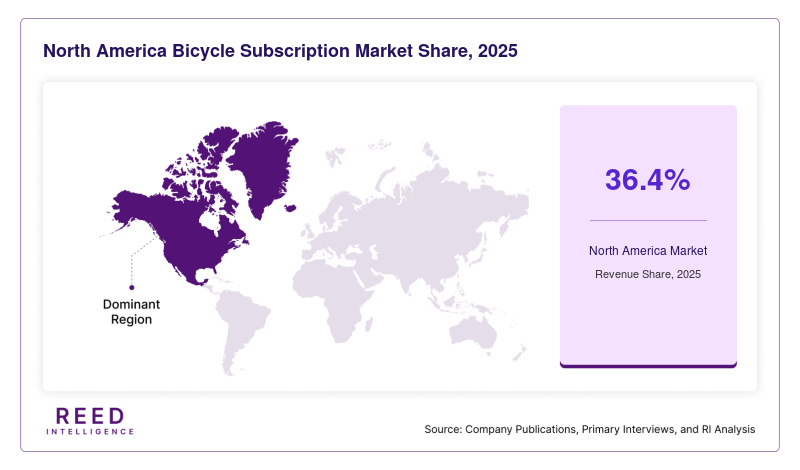
North America held 36.4% of the global Bicycle Subscription Market share in 2025, supported by mature urban mobility ecosystems and growing e-bike adoption. The region is forecast to expand at a CAGR of 10.2% through 2034 as subscription providers diversify into premium bicycles, family mobility plans, and employer-backed programs. High consumer purchasing power and digital platform penetration continue to strengthen recurring subscription demand.
The United States leads the regional market due to advanced cycling infrastructure in major metropolitan areas and strong venture capital investment in mobility startups. A key growth factor is corporate commuter benefit integration, where businesses increasingly subsidize bicycle subscriptions as part of sustainability programs. This trend is particularly prominent in technology-driven urban centers.
Europe
Europe accounted for 29.8% of the Bicycle Subscription Market in 2025 and remains a highly influential region due to cycling-friendly regulations and environmental awareness. The market is projected to grow at a CAGR of 10.8% during the forecast period. Strong public investment in protected bike lanes and emissions reduction frameworks continues to support subscription service adoption.
Germany dominates the European market because of its established cycling culture and broad acceptance of mobility subscriptions. A unique growth factor is the popularity of salary sacrifice bicycle leasing programs, where employees gain tax-efficient bicycle access through employers. This model has significantly expanded long-term subscriber retention.
Asia Pacific
Asia Pacific represented 21.7% of the market in 2025 and is expected to record the fastest CAGR of 13.1% through 2034. Urbanization, traffic congestion, and increasing environmental awareness are accelerating bicycle subscription demand across major cities. Expanding digital ecosystems and app-based service platforms also support scalable market penetration.
China leads the regional market due to its large urban population and strong adoption of shared and electric mobility systems. A unique growth factor is government-backed smart mobility infrastructure, which integrates cycling with public transportation and digital payment systems. This combination creates favorable conditions for subscription platform scalability.
Middle East & Africa
The Middle East & Africa held 6.3% of the Bicycle Subscription Market in 2025 and is forecast to grow at a CAGR of 11.5% through 2034. Market development is supported by smart city projects, tourism-linked cycling demand, and increasing awareness of alternative transportation options. Premium bicycle subscriptions are particularly relevant in affluent urban clusters.
The United Arab Emirates dominates this region due to smart urban development and lifestyle-oriented cycling initiatives. A key growth factor is tourism and recreational cycling infrastructure, especially in premium urban developments where subscription bicycles are marketed for both commuters and leisure users.
Latin America
Latin America captured 5.8% of the market in 2025 and is anticipated to grow at a CAGR of 12.2% during the forecast period. Rising fuel prices and public transit limitations are creating favorable demand for low-cost mobility alternatives. Subscription providers are targeting densely populated urban centers with affordable monthly packages.
Brazil leads the Latin American market because of expanding urban mobility innovation and growing consumer awareness of sustainable commuting. A unique growth factor is the development of public-private cycling partnerships that support subscription deployment in underserved transport corridors, improving accessibility and market reach.
Competitive Landscape
The Bicycle Subscription Market is moderately fragmented, with established bicycle manufacturers, mobility startups, and digital subscription platforms competing through pricing flexibility, fleet quality, and service ecosystems. Swapfiets remains a market leader due to its strong European presence and integrated maintenance-first subscription model. Its expansion into new urban markets and strategic e-bike fleet upgrades strengthened market positioning in 2025. Dance, Zoomo, Buzzbike, and Decathlon Subscription are also significant players. Companies are increasingly focused on strategic partnerships with employers, municipal governments, and mobility apps to improve customer retention and geographic reach.
Key Players List
- Swapfiets
- Dance
- Zoomo
- Buzzbike
- Decathlon Subscription
- Lime Micromobility
- JUMP Bikes
- VANMOOF Subscription
- Bike Club
- Cycle2Work
- MyByk
- Yulu
- Brompton Subscription
- Wheels Mobility
- TIER Mobility
Recent Developments
- Swapfiets expanded its e-bike subscription portfolio across North America in 2025 to address urban commuter demand.
- Zoomo introduced AI-enabled fleet diagnostics to reduce maintenance downtime and improve operational efficiency in 2025.
- Dance partnered with corporate employers in Germany and France to scale salary-linked bicycle subscription programs in 2024.
Bicycle Subscription Market Segments
Bicycle Type
- Standard Bicycles
- E-Bikes
- Cargo Bikes
- Premium Performance Bikes
Subscription Model
- Monthly Plans
- Annual Plans
- Corporate Leasing
- Family Plans
End User
- Individual Consumers
- Corporate Users
- Delivery & Logistics
- Tourism & Hospitality
By Region
- North America
- Europe
- APAC
- Middle East and Africa
- LATAM