Billiards Tables Market Size, Share, Demand Report by Product Type (Standard Pool Tables, Snooker Tables, Convertible Billiards Tables), By End-Use (Commercial Entertainment Venues, Residential Use, Hospitality & Hotels, Recreational Clubs), By Distribution Channel (Offline Retail Stores, Online E-commerce Platforms, Specialty Sports Equipment Dealers), By Region & Segment Forecasts, 2026–2034
USD 3950
Market Overview
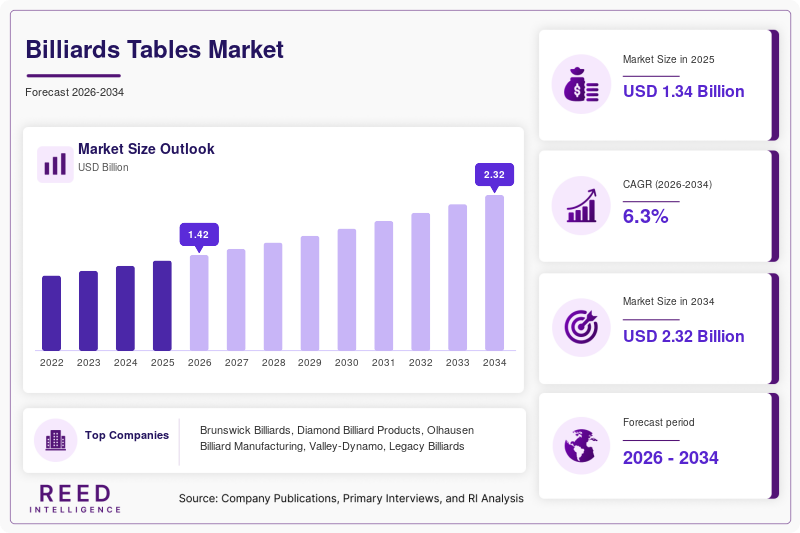
The Billiards Tables Market size is witnessing steady expansion, supported by rising recreational spending, growth in indoor entertainment venues, and increasing adoption of leisure sports across commercial and residential settings. In 2026, the global market size is estimated at approximately USD 1.42 billion, and it is projected to reach nearly USD 2.31 billion by 2034, growing at a CAGR of 6.3% during 2026–2034. This growth trajectory reflects consistent demand from sports clubs, hospitality establishments, gaming lounges, and home entertainment buyers.
One of the primary global factors supporting market growth is the expansion of hospitality and recreational infrastructure. Hotels, resorts, and entertainment complexes are increasingly integrating billiards tables as part of their indoor leisure offerings to enhance guest experience. Additionally, rising urbanization and shrinking outdoor recreational spaces have contributed to greater consumer preference for indoor games, further boosting demand for billiards tables across both developed and emerging economies. Technological improvements in table manufacturing, including enhanced slate leveling systems, durable synthetic materials, and modular designs, are also influencing market adoption. Manufacturers are focusing on customization options such as LED lighting integration, foldable structures, and smart scoring systems, which are attracting younger demographics. The growing popularity of esports lounges and social gaming cafes is further expanding the application scope of billiards tables.
Key Highlights
- North America dominated the market with a 34.8% share in 2025.
- Asia Pacific is expected to grow at the fastest CAGR of 10.9% during 2026–2034.
- By product type, standard pool tables accounted for the largest share of 42.6%, while convertible billiards tables are projected to grow at a CAGR of 11.3%.
- By end-use, commercial entertainment venues led with a 46.1% share, whereas residential usage is expected to expand at a CAGR of 9.7%.
- The United States remained the dominant country, with market values of USD 610 million in 2024 and USD 645 million in 2025.
Market Trends
Integration of Smart Gaming Features
The Billiards Tables Market is experiencing a shift toward smart-enabled gaming solutions, particularly in commercial entertainment spaces. Manufacturers are incorporating digital scoring systems, sensor-based ball tracking, and interactive LED interfaces to enhance user engagement. These innovations are increasingly popular in gaming lounges and esports cafés where experience differentiation is essential. Smart tables also allow operators to collect usage data, optimize space utilization, and offer competitive gameplay modes. This trend is gradually extending into premium residential segments where consumers are willing to invest in connected entertainment systems. The integration of technology is expected to redefine traditional billiards experiences over the forecast period.
Growth of Modular and Space-Saving Designs
Another notable trend in the Billiards Tables Market is the rising demand for modular and space-efficient designs. Urban living spaces are becoming smaller, prompting manufacturers to develop foldable, convertible, and multi-functional billiards tables that can double as dining or workspace units. These designs are gaining traction among residential buyers who seek recreational value without compromising space efficiency. Additionally, commercial venues such as coworking lounges and boutique hotels are adopting modular tables to maximize floor utilization. The use of lightweight composite materials and easy-assembly structures is further enhancing product flexibility and driving adoption across space-constrained environments.
Market Drivers
Expansion of Recreational and Hospitality Infrastructure
One of the key drivers of the Billiards Tables Market is the rapid expansion of recreational and hospitality infrastructure worldwide. Hotels, resorts, cruise ships, and entertainment complexes are increasingly investing in indoor leisure amenities, including billiards tables, to improve customer satisfaction and retention. This trend is particularly strong in urban tourism hubs where experiential offerings are a major competitive factor. Additionally, commercial gaming lounges and sports bars are incorporating multiple billiards setups to attract group-based entertainment consumers. Rising disposable incomes and lifestyle changes have further encouraged spending on recreational experiences, strengthening demand across both premium and mid-range product categories.
Rising Popularity of Indoor Social Gaming
The growing preference for indoor social gaming is another major factor driving market growth. Consumers are increasingly seeking interactive and group-based recreational activities that can be enjoyed in controlled indoor environments. Billiards, being a skill-based and socially engaging game, fits well into this demand pattern. The rise of gaming cafés, community clubs, and social entertainment hubs has significantly contributed to increased table installations. Additionally, the influence of digital content creators and streaming platforms showcasing billiards gameplay has enhanced its visibility among younger demographics. This cultural shift toward indoor entertainment is expected to sustain long-term demand growth.
Market Restraint
High Initial Investment and Maintenance Costs
A key restraint affecting the Billiards Tables Market is the relatively high initial investment required for premium-quality tables, especially those used in commercial environments. Professional-grade tables involve precision engineering, high-quality slate surfaces, and durable cushioning systems, which significantly increase overall costs. Additionally, maintenance expenses such as leveling, felt replacement, and structural upkeep add to the long-term ownership burden. Small businesses and residential buyers in price-sensitive markets often find these costs restrictive, limiting widespread adoption. In emerging economies, where disposable income levels remain moderate, affordability continues to be a barrier to market penetration despite growing interest in recreational gaming.
Market Opportunities
Expansion in Emerging Economies
Emerging economies present significant opportunities for the Billiards Tables Market, driven by urbanization, rising middle-class income, and expanding leisure infrastructure. Countries in Asia Pacific, Latin America, and parts of the Middle East are witnessing increased investments in entertainment centers, shopping malls, and hospitality venues, all of which contribute to rising demand for billiards tables. Additionally, the growing youth population in these regions is actively engaging in indoor recreational activities. Local manufacturers are also entering the market with cost-effective product offerings, making billiards more accessible. This combination of demand growth and affordability is expected to unlock substantial market potential.
Growth of Home Entertainment Segment
The increasing focus on home-based entertainment systems represents another strong opportunity for market expansion. Consumers are investing in dedicated recreational spaces within homes, particularly in urban high-income households. Billiards tables are becoming a preferred choice for home game rooms due to their social and interactive nature. Manufacturers are responding with compact, stylish, and customizable designs tailored for residential interiors. Integration with smart home ecosystems and aesthetic customization options is further enhancing appeal. As remote lifestyles continue to influence leisure behavior, the home entertainment segment is expected to contribute significantly to future market growth.
Segmental Analysis
Product Type Segment
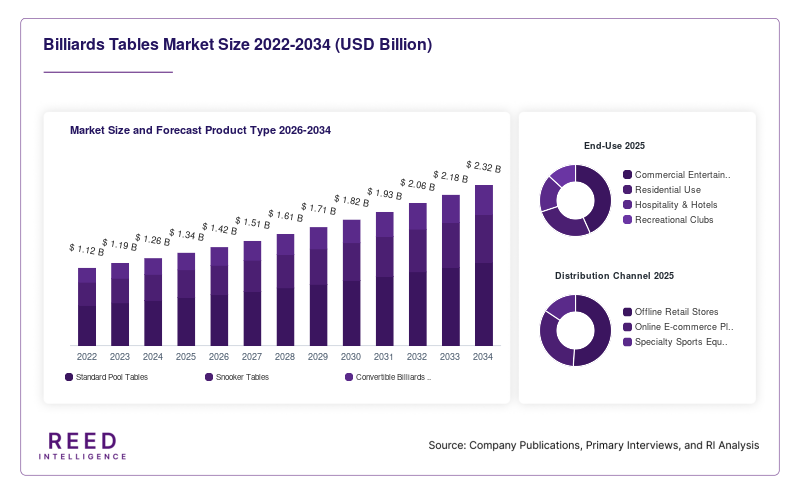
Standard pool tables continue to dominate the Product Type segment of the Billiards Tables Market, accounting for approximately 42.6% share in 2024. Their strong position is supported by widespread usage across commercial entertainment venues such as sports bars, pubs, and gaming lounges, as well as steady adoption in residential game rooms. These tables are preferred due to their standardized dimensions, long operational life, and relatively lower maintenance complexity compared to specialized or convertible variants. Manufacturers are also focusing on improving durability by integrating high-density slate beds, reinforced wooden frames, and premium felt surfaces, which further strengthens their demand in high-traffic commercial environments. Additionally, standard pool tables benefit from strong brand recognition and availability across both offline retail and specialty sports equipment dealers, ensuring consistent global penetration.
Convertible billiards tables are emerging as the fastest-growing subsegment within the Product Type category, projected to expand at a CAGR of 11.3% during 2026–2034. This rapid growth is driven by increasing demand for space-efficient and multifunctional furniture, particularly in urban residential settings where space optimization is essential. These tables can be transformed into dining tables, workstations, or recreational surfaces, making them highly attractive for modern apartments and compact living environments. Manufacturers are increasingly integrating modular engineering, lightweight composite materials, and aesthetic customization options such as wood-grain finishes and minimalist designs. The rising influence of interior design trends that prioritize multifunctionality is further accelerating adoption. Additionally, hospitality venues such as boutique hotels and coworking lounges are increasingly adopting convertible tables to maximize utility without compromising design aesthetics.
End-Use Segment
Commercial entertainment venues represent the dominant End-Use segment in the Billiards Tables Market, holding a significant 46.1% share in 2024. This dominance is attributed to the high installation rate of billiards tables in sports bars, gaming lounges, arcades, nightclubs, and recreational clubs. These establishments prioritize durable, tournament-quality tables that can withstand continuous usage and deliver consistent performance. The growing popularity of social entertainment hubs has further reinforced demand, particularly in urban areas where group-based recreational activities are preferred. Additionally, commercial operators increasingly view billiards tables as revenue-generating assets, using them as pay-per-play installations or integrated entertainment offerings. This revenue-driven model ensures consistent replacement and upgrade cycles, contributing to sustained market demand across developed regions.
The residential segment is expected to be the fastest-growing category, projected to register a CAGR of 9.7% during the forecast period. Rising disposable incomes, expanding urban housing projects, and increasing interest in home-based leisure activities are key drivers supporting this growth. Consumers are increasingly allocating dedicated spaces within homes for recreational purposes, and billiards tables are becoming a central feature of these entertainment zones. The availability of compact, stylish, and customizable table designs has significantly enhanced residential adoption. Additionally, social media influence and lifestyle content showcasing home game rooms have encouraged younger demographics to invest in premium recreational furniture. The integration of billiards tables into luxury home interiors and smart home environments is further expected to expand this segment over the forecast period.
Distribution Channel Segment
Offline retail channels continue to dominate the Distribution Channel segment of the Billiards Tables Market, accounting for approximately 58.4% share in 2024. This dominance is primarily due to the nature of the product, which often requires physical inspection before purchase. Buyers prefer to assess table build quality, surface smoothness, cushioning response, and overall craftsmanship in person, especially when investing in high-value or professional-grade tables. Specialty sports equipment stores and dedicated showrooms play a critical role in guiding customer decisions through demonstrations and customization consultations. Additionally, offline channels benefit from strong relationships with commercial buyers such as hospitality chains and recreational clubs, which often require bulk purchases and installation services.
Online distribution channels are witnessing rapid expansion and are projected to grow at a CAGR of 12.1% during 2026–2034, making them the fastest-growing segment. The growth of e-commerce platforms, improved logistics networks, and increasing digital adoption among consumers are key contributing factors. Online platforms now offer detailed product visualization tools, virtual customization options, and customer reviews, which help reduce purchase uncertainty. Manufacturers are also leveraging direct-to-consumer models to reduce distribution costs and expand global reach. Furthermore, the availability of easy financing options, doorstep delivery, and installation services has significantly improved customer confidence in online purchases. This trend is particularly strong among younger consumers and small commercial buyers seeking cost-effective procurement solutions.
Regional Analysis
North America
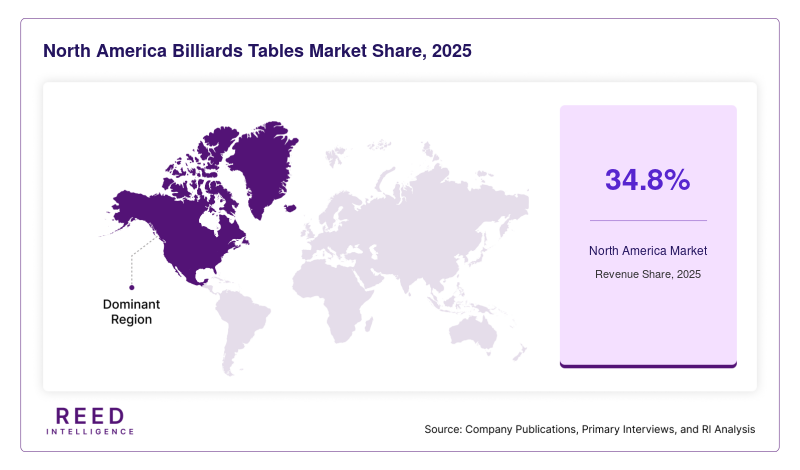
North America accounted for approximately 34.8% share of the Billiards Tables Market in 2025, with a projected CAGR of 6.1% from 2026 to 2034. The region’s strong market position is supported by a deeply rooted recreational gaming culture and widespread availability of billiards tables across commercial and residential settings. The United States represents the largest contributor to regional demand, followed by Canada and Mexico. High penetration of sports bars, entertainment lounges, and gaming clubs continues to drive consistent installations of premium-quality billiards tables. Additionally, rising consumer spending on home entertainment systems has further strengthened residential adoption across suburban households.
The United States remains the most dominant country within North America due to its extensive hospitality infrastructure and strong tradition of cue sports. One key growth factor is the increasing integration of billiards tables into mixed-use entertainment spaces such as coworking lounges, boutique hotels, and recreational complexes. These venues aim to enhance customer engagement by offering interactive indoor leisure options. Additionally, the presence of established manufacturers and strong distribution networks ensures product availability across various price segments, supporting sustained market expansion.
Europe
Europe held approximately 27.5% market share in 2025, with a projected CAGR of 5.8% during 2026–2034. The region demonstrates steady demand driven by strong cultural association with cue sports and widespread usage in pubs, recreational clubs, and hospitality establishments. Countries such as the United Kingdom, Germany, France, and Italy contribute significantly to regional consumption. The presence of well-established social entertainment venues ensures consistent demand for durable and mid-range billiards tables. Furthermore, tourism-driven hospitality investments across major European cities continue to support installations in hotels and leisure centers.
The United Kingdom leads the European market, primarily due to its long-standing pub culture where billiards and snooker are popular recreational activities. A key growth factor in the country is the modernization of traditional pubs into multifunctional entertainment spaces. Many establishments are upgrading interiors to attract younger customers, incorporating high-quality billiards setups as part of broader experiential offerings. Additionally, rising interest in home gaming rooms across urban households is contributing to steady residential demand growth.
Asia Pacific
Asia Pacific accounted for approximately 22.3% share in 2025, and is projected to grow at the fastest CAGR of 10.9% during 2026–2034. Rapid urbanization, expanding middle-class population, and increasing disposable income levels are key drivers of market growth in the region. Countries such as China, Japan, India, and South Korea are witnessing strong expansion of gaming cafés, entertainment centers, and shopping mall-based leisure zones. The region’s young population is also increasingly engaging in indoor recreational activities, further boosting demand for billiards tables across commercial and residential applications.
China dominates the Asia Pacific market due to its large urban population and rapid expansion of entertainment infrastructure. A major growth factor is the proliferation of gaming cafés and social entertainment hubs in tier-1 and tier-2 cities. These venues are increasingly incorporating billiards tables as part of multi-activity entertainment offerings. Additionally, rising investments in hospitality and tourism infrastructure are creating new installation opportunities across hotels and resorts, further strengthening market penetration.
Middle East & Africa
The Middle East & Africa region held approximately 7.2% share in 2025, with a projected CAGR of 7.4% during 2026–2034. Growth in this region is primarily driven by expanding hospitality sectors, increasing tourism inflows, and rising investments in luxury entertainment infrastructure. Countries such as the United Arab Emirates, Saudi Arabia, and South Africa are key contributors to regional demand. High-end hotels, resorts, and entertainment complexes are increasingly incorporating billiards tables as part of premium indoor leisure offerings to enhance guest experience.
The United Arab Emirates leads the regional market due to its strong tourism-driven economy and luxury hospitality infrastructure. A key growth factor is the development of large-scale entertainment destinations and integrated resort complexes that prioritize indoor recreational amenities. Additionally, increasing expatriate population and demand for premium leisure experiences continue to support installations of high-end billiards tables across commercial venues.
Latin America
Latin America accounted for approximately 6.2% share in 2025, with a projected CAGR of 6.8% during 2026–2034. Market growth in this region is supported by increasing urbanization, rising disposable incomes, and expanding recreational club infrastructure. Countries such as Brazil, Mexico, and Argentina are key contributors, with growing adoption in bars, social clubs, and entertainment centers. The region is also witnessing gradual growth in residential adoption as home entertainment trends gain traction.
Brazil dominates the Latin American market due to its large urban population and expanding nightlife and entertainment culture. A key growth factor is the increasing establishment of recreational clubs and sports bars in metropolitan areas. These venues are investing in durable billiards tables to attract group-based social gaming customers. Additionally, rising interest in indoor leisure activities among younger consumers is expected to further support long-term market expansion.
Competitive Landscape
The Billiards Tables Market is moderately consolidated, with leading manufacturers focusing on product innovation, material enhancement, and global distribution expansion. Key players include Brunswick Billiards, Diamond Billiard Products, Olhausen Billiard Manufacturing, Valley-Dynamo, and Legacy Billiards. Brunswick Billiards holds a strong position due to its extensive product portfolio and commercial installations across hospitality venues. Recent developments include increased investment in smart table integration and premium customization features to target high-end residential buyers and commercial entertainment chains.
Key Players
- Brunswick Billiards
- Diamond Billiard Products
- Olhausen Billiard Manufacturing
- Valley-Dynamo
- Legacy Billiards
- Imperial International
- Rasson Billiards
- Connelly Billiards
- Billard Toulet
- Gabriels Billiards
- Plank & Hide Co.
- Chevillotte
- Riley England
- Hathaway Games
- Xingpai Billiards
Recent Developments
- In 2025, Brunswick Billiards enhanced its manufacturing capabilities by integrating precision CNC machining and automated calibration systems to improve table leveling accuracy and production consistency across its premium product line.
- In 2025, Diamond Billiard Products introduced a new tournament-grade billiards table series featuring upgraded slate alignment technology and high-durability cushion systems designed for professional and commercial gaming environments.
- In 2024, Olhausen Billiard Manufacturing expanded its customization program by launching a digital design platform that allows customers to configure table finishes, cloth colors, and frame materials for residential and hospitality applications.
- In 2024, Rasson Billiards strengthened its international distribution network through new partnerships in Asia Pacific and Europe, aiming to increase penetration in fast-growing entertainment and gaming café markets.
Billiards Tables Market Segments
Product Type
- Standard Pool Tables
- Snooker Tables
- Convertible Billiards Tables
End-Use
- Commercial Entertainment Venues
- Residential Use
- Hospitality & Hotels
- Recreational Clubs
Distribution Channel
- Offline Retail Stores
- Online E-commerce Platforms
- Specialty Sports Equipment Dealers
By Region
- North America
- Europe
- APAC
- Middle East and Africa
- LATAM