Bio Based Paraxylene Market Size, Share & Demand Report By Feedstock Type (Biomass, Algae, Agricultural Waste), By Application (Packaging, Textiles, Consumer Goods), By End-Use Industry (Food & Beverage, Automotive, Electronics), By Production Technology (Catalytic Conversion, Fermentation), By Region & Segment Forecasts, 2025–2034
USD 3950
Market Overview
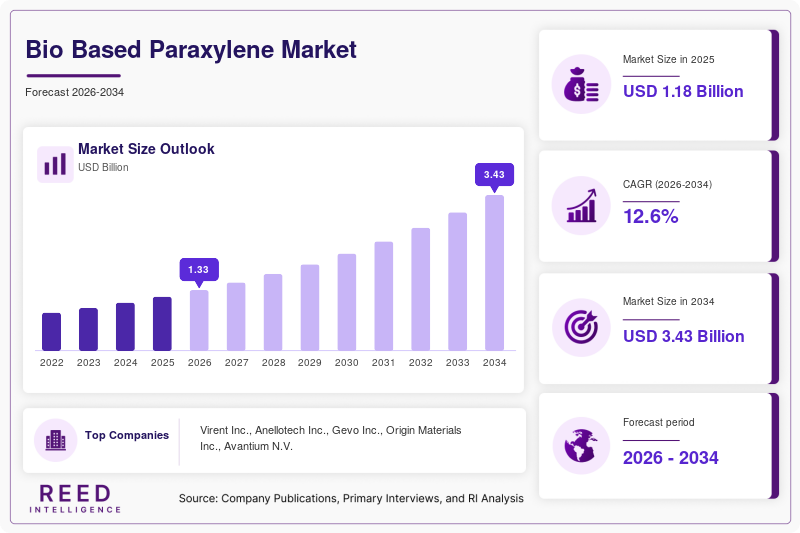
The Bio Based Paraxylene Market size was valued at approximately USD 1.18 billion in 2025 and is projected to reach USD 3.42 billion by 2034, expanding at a CAGR of 12.6% during the forecast period (2025–2034). The market has gained traction due to the increasing demand for sustainable alternatives in the petrochemical industry, particularly in the production of bio-based polyethylene terephthalate (PET). Bio-based paraxylene, derived from renewable feedstocks such as biomass and agricultural residues, is emerging as a viable substitute for petroleum-based paraxylene in packaging and textile applications.
A major global factor supporting market growth is the rising regulatory push toward carbon neutrality and reduced dependence on fossil fuels. Governments across developed and emerging economies have introduced policies promoting bio-based chemicals, thereby encouraging manufacturers to invest in renewable feedstock technologies.
Key Highlights:
- Asia Pacific dominated the market with a 42.8% share in 2025, while it is expected to remain the fastest-growing region with a CAGR of 13.4% through 2034.
- The biomass-based feedstock segment led the market in 2024, whereas the algae-based feedstock segment is projected to grow at the fastest CAGR of 14.1%.
- The packaging application segment held the largest share, while textiles are anticipated to witness the fastest growth at a CAGR of 13.2%.
- The United States remained the dominant country, with market values of USD 310 million in 2024 and USD 345 million in 2025.
Market Trends
Integration of Bio-Based PET Value Chains
The Bio Based Paraxylene Market is experiencing a shift toward vertically integrated value chains, particularly in bio-based PET production. Companies are increasingly aligning feedstock sourcing, bio-refining, and polymer manufacturing processes to optimize efficiency and reduce costs. This integration is enabling manufacturers to improve supply reliability and scale production of renewable plastics, especially for beverage packaging and consumer goods.
Advancements in Catalytic Conversion Technologies
Technological innovation in catalytic processes is shaping the market landscape. New conversion technologies are improving yield efficiency from renewable sources such as isobutanol and biomass-derived sugars. These advancements are reducing production costs and enhancing product quality, making bio-based paraxylene more competitive with conventional alternatives. As a result, commercial-scale production is becoming more feasible, attracting investments from chemical producers and research institutions.
Market Drivers
Rising Demand for Sustainable Packaging Materials
The growing need for eco-friendly packaging solutions is a primary driver of the Bio Based Paraxylene Market. With increasing consumer awareness and regulatory pressure to reduce plastic waste, companies are transitioning toward bio-based PET bottles and containers. Bio-based paraxylene serves as a key building block in these applications, supporting the shift toward circular economy practices.
Government Regulations Promoting Bio-Based Chemicals
Supportive government policies and environmental regulations are accelerating market growth. Incentives such as tax benefits, subsidies, and carbon reduction targets are encouraging manufacturers to adopt renewable chemical production. These regulatory frameworks are particularly strong in North America and Europe, fostering innovation and commercialization of bio-based paraxylene technologies.
Market Restraints
High Production Costs Compared to Petrochemical Alternatives
Despite its environmental advantages, the Bio Based Paraxylene Market faces a major challenge in the form of high production costs. The conversion of renewable feedstocks into paraxylene involves complex processes and advanced technologies, which increase capital and operational expenditures. Additionally, limited availability of cost-effective feedstock and lower economies of scale further contribute to pricing disparities.
These cost challenges restrict widespread adoption, especially in price-sensitive markets where conventional petrochemical-based paraxylene remains more affordable. While technological advancements are expected to reduce costs over time, the current pricing gap continues to hinder market penetration, particularly among small and medium-scale manufacturers.
Market Opportunities
Expansion in Emerging Economies
Emerging markets in Asia Pacific and Latin America present significant growth opportunities for the Bio Based Paraxylene Market. Rapid industrialization, increasing urbanization, and rising demand for sustainable consumer products are driving the adoption of bio-based materials. Governments in these regions are also implementing policies to promote green manufacturing, creating a favorable environment for market expansion.
Development of Advanced Feedstock Technologies
The exploration of alternative feedstocks such as algae, agricultural waste, and lignocellulosic biomass offers new avenues for growth. These feedstocks are abundant and can reduce dependence on traditional biomass sources. Innovations in feedstock processing and conversion technologies are expected to enhance yield efficiency and lower production costs, thereby unlocking new market potential and improving competitiveness.
Segmental Analysis
By Feedstock Type
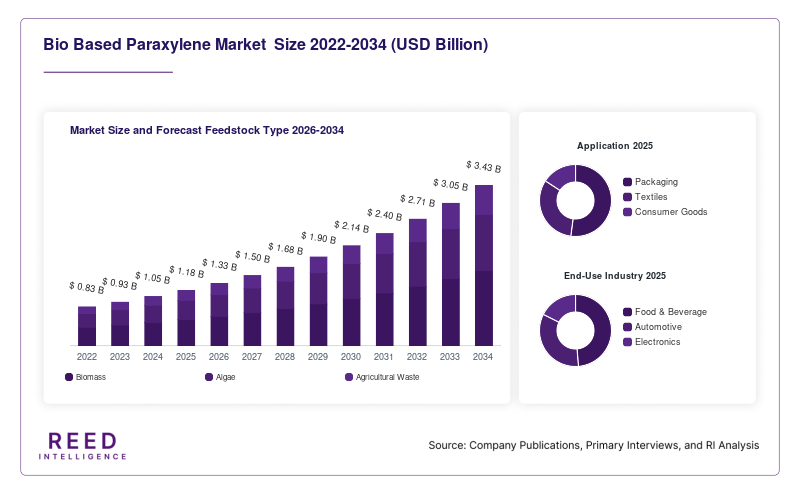
The biomass-based feedstock segment dominated the Bio Based Paraxylene Market, accounting for 61.4% of the share in 2024. This dominance was attributed to the widespread availability of agricultural residues and established conversion technologies. Biomass feedstocks such as corn, sugarcane, and wood derivatives have been extensively used in bio-refining processes, enabling large-scale production of bio-based paraxylene.
The algae-based feedstock segment is expected to grow at the fastest CAGR of 14.1% during the forecast period. This growth will be driven by the high yield potential and sustainability of algae as a renewable resource. Algae cultivation requires less land and water compared to traditional crops, making it an attractive alternative for future production.
By Application
The packaging segment held the largest share of 54.7% in 2024, driven by the increasing use of bio-based PET in bottles, containers, and films. The demand for sustainable packaging solutions has significantly contributed to the dominance of this segment, particularly in the food and beverage industry.
The textiles segment is projected to grow at a CAGR of 13.2% through 2034. The rising demand for eco-friendly fabrics and sustainable fashion is expected to drive growth in this segment. Bio-based paraxylene is increasingly being used in the production of polyester fibers, supporting the shift toward greener textile manufacturing.
By End-Use Industry
The food and beverage industry dominated the market with a 48.9% share in 2024, owing to the extensive use of bio-based PET packaging for beverages and packaged foods. The industry’s focus on reducing environmental impact and improving recyclability has supported the adoption of bio-based paraxylene.
The automotive industry is expected to witness the fastest growth, with a CAGR of 12.8%. The increasing use of lightweight and sustainable materials in vehicle manufacturing is driving demand for bio-based polymers, which incorporate bio-based paraxylene as a key component.
By Production Technology
The catalytic conversion technology segment held the largest share of 57.2% in 2024, driven by its efficiency and scalability. This technology enables the conversion of renewable feedstocks into high-purity paraxylene, making it suitable for commercial applications.
The fermentation-based technology segment is projected to grow at a CAGR of 13.6% during the forecast period. Advances in biotechnology and microbial engineering are expected to enhance the efficiency of fermentation processes, enabling cost-effective production of bio-based paraxylene.
Regional Analysis
North America
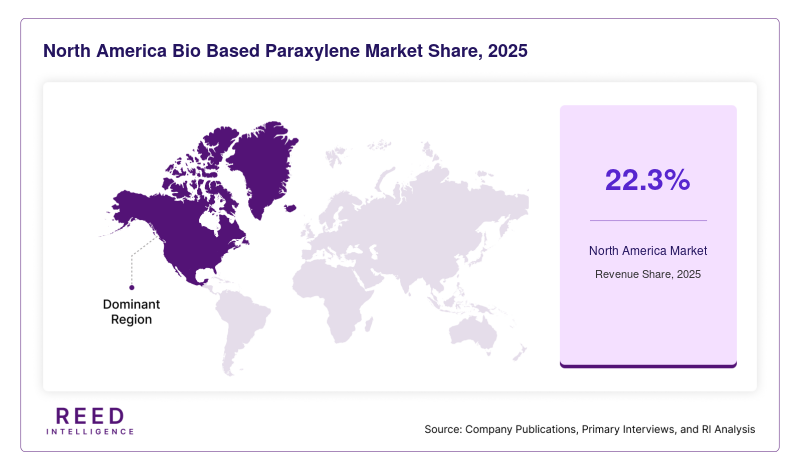
North America accounted for approximately 26.5% of the Bio Based Paraxylene Market share in 2025 and is projected to grow at a CAGR of 12.1% through 2034. The region’s established chemical industry infrastructure and focus on sustainable materials have supported steady adoption of bio-based paraxylene. Increasing investments in renewable chemical production facilities and strong demand from packaging industries have further contributed to market growth.
The United States dominated the regional market due to its advanced research ecosystem and presence of key industry players. The country’s emphasis on reducing carbon emissions and promoting bio-based alternatives has driven adoption across various applications, particularly in food and beverage packaging.
Europe
Europe held a 22.3% market share in 2025 and is expected to grow at a CAGR of 11.8% during the forecast period. The region’s stringent environmental regulations and commitment to sustainability have played a significant role in market expansion. Demand for eco-friendly packaging solutions has been particularly strong across Western Europe.
Germany emerged as the dominant country, driven by its strong chemical manufacturing base and focus on innovation. The country’s investment in green technologies and circular economy initiatives has supported the development and commercialization of bio-based paraxylene.
Asia Pacific
Asia Pacific led the Bio Based Paraxylene Market with a 42.8% share in 2025 and is projected to grow at a CAGR of 13.4% through 2034. The region’s rapid industrialization, expanding consumer base, and growing demand for sustainable products have fueled market growth. Increasing investments in bio-refineries and renewable chemical production facilities are further supporting expansion.
China dominated the regional market due to its large-scale manufacturing capabilities and strong demand for packaging materials. Government initiatives promoting sustainable development and reduced carbon emissions have accelerated the adoption of bio-based chemicals in the country.
Middle East & Africa
The Middle East & Africa accounted for a 4.6% share in 2025 and is expected to grow at a CAGR of 10.9% during the forecast period. The region is gradually adopting bio-based chemicals as part of its diversification strategies away from traditional oil-based industries.
The United Arab Emirates emerged as the dominant country, driven by its focus on sustainable development and investments in renewable technologies. Efforts to reduce reliance on fossil fuels are supporting the adoption of bio-based paraxylene.
Latin America
Latin America held a 3.8% share in 2025 and is projected to grow at a CAGR of 11.2% through 2034. The region’s abundant biomass resources and increasing focus on sustainable manufacturing are driving market growth.
Brazil led the regional market due to its strong agricultural base and availability of renewable feedstocks. The country’s emphasis on bio-based industries and favorable government policies have supported the development of bio-based paraxylene production.
Competitive Landscape
The Bio Based Paraxylene Market is characterized by the presence of several global and regional players focusing on innovation and strategic partnerships. Key companies are investing in research and development to improve production efficiency and reduce costs.
A leading player in the market is Virent Inc., known for its proprietary BioForming technology. The company has recently expanded its production capabilities to support commercial-scale manufacturing of bio-based paraxylene, strengthening its market position.
Other prominent players are actively collaborating with packaging and chemical companies to develop integrated value chains. These collaborations are aimed at enhancing supply chain efficiency and meeting the growing demand for sustainable materials across industries.
Key Players
- Virent Inc.
- Anellotech Inc.
- Gevo Inc.
- Origin Materials Inc.
- Avantium N.V.
- Toray Industries Inc.
- Coca-Cola Company
- PepsiCo Inc.
- SABIC
- Braskem S.A.
Recent Developments
- 2024: Virent Inc. announced expansion of its bio-based paraxylene production facility to support commercial demand.
- 2024: Avantium N.V. partnered with packaging manufacturers to develop fully bio-based PET bottles.
- 2025: Gevo Inc. launched a new renewable feedstock processing technology to improve yield efficiency.
- 2025: Origin Materials Inc. secured funding to scale up bio-based chemical production.
- 2025: Anellotech Inc. introduced an advanced catalytic process for converting biomass into aromatic chemicals.
Bio Based Paraxylene Market Segments
Feedstock Type
- Biomass
- Algae
- Agricultural Waste
Application
- Packaging
- Textiles
- Consumer Goods
End-Use Industry
- Food & Beverage
- Automotive
- Electronics
Production Technology
- Catalytic Conversion
- Fermentation
By Region
- North America
- Europe
- APAC
- Middle East and Africa
- LATAM