Bio Butanol Market Size, Share & Demand Report By Type (n-Butanol, Isobutanol), By Feedstock (Sugar-Based Feedstock, Starch-Based Feedstock, Lignocellulosic Biomass), By Application (Biofuel Blending, Industrial Solvents, Chemical Intermediates), By End-Use Industry (Transportation, Paints & Coatings, Chemicals Industry, Others), By Region & Segment Forecasts, 2026–2034
USD 3950
Market Overview
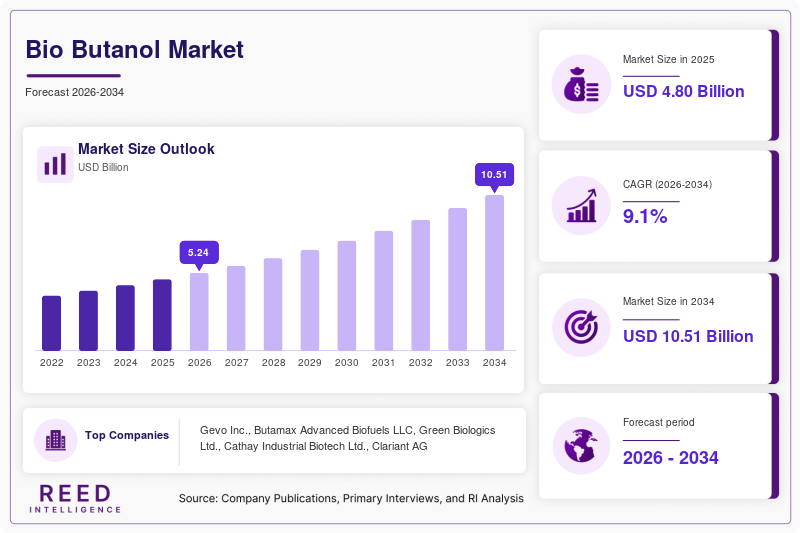
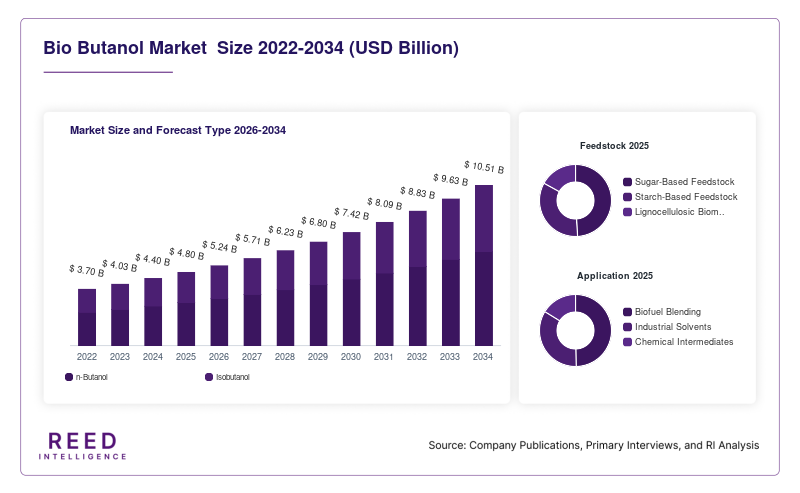
The global Bio Butanol Market size was valued at USD 4.8 billion in 2026 and is projected to reach USD 9.6 billion by 2034, expanding at a CAGR of 9.1% during the forecast period (2026–2034). The market has been gaining steady traction due to the increasing emphasis on sustainable fuel alternatives and bio-based chemicals. Bio-butanol, produced through fermentation processes using biomass feedstocks, is increasingly being recognized as a viable substitute for petroleum-based butanol due to its superior energy content and compatibility with existing fuel infrastructure.
A major global factor supporting market growth has been the shift toward decarbonization policies and renewable energy mandates across developed and emerging economies. Governments and regulatory bodies are actively promoting the use of advanced biofuels to reduce greenhouse gas emissions, thereby encouraging investments in bio-butanol production technologies. Additionally, rising crude oil price volatility has strengthened the economic viability of bio-based fuels, further contributing to market expansion.
Key Highlights:
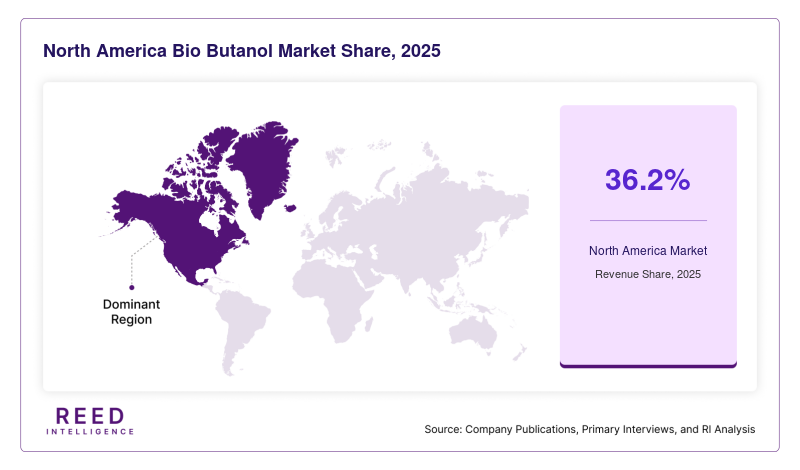
- North America dominated the market with a 36.2% share in 2025, while Asia Pacific is projected to be the fastest-growing region with a CAGR of 10.4%.
- By type, n-butanol held the largest share of 58.5%, whereas isobutanol is expected to grow at the fastest CAGR of 9.8%.
- In application, biofuel blending dominated with a 41.3% share, while industrial solvents are anticipated to grow at a CAGR of 9.6%.
- The U.S. market was valued at USD 1.42 billion in 2024 and USD 1.53 billion in 2025.
Market Trends
Increasing Adoption of Advanced Fermentation Technologies
The Bio Butanol Market is witnessing a growing shift toward advanced fermentation technologies, including genetically engineered microorganisms and continuous fermentation systems. These innovations are enhancing yield efficiency, reducing production costs, and improving scalability. Companies are focusing on optimizing feedstock utilization, including agricultural residues and industrial waste, to create cost-effective and sustainable production cycles. This trend is expected to redefine the competitive landscape by enabling commercial-scale production and improving profit margins.
Integration of Bio-Butanol in Aviation and Marine Fuels
Another notable trend is the increasing integration of bio-butanol into aviation and marine fuel applications. As industries seek low-emission fuel alternatives, bio-butanol is being explored as a blending component due to its higher energy density compared to ethanol and its compatibility with existing engines. This trend is particularly prominent in regions with stringent emission regulations. Collaborations between biofuel producers and transportation companies are further accelerating adoption, making bio-butanol a promising solution for hard-to-abate sectors.
Market Drivers
Rising Demand for Sustainable Biofuels
The growing demand for renewable and low-carbon fuels is a key driver of the Bio Butanol Market. Increasing awareness of environmental sustainability and the need to reduce dependence on fossil fuels are encouraging the adoption of bio-based alternatives. Bio-butanol offers advantages such as higher energy content, lower volatility, and compatibility with existing fuel infrastructure, making it an attractive option for fuel blending.
Favorable Government Policies and Incentives
Supportive regulatory frameworks and financial incentives are significantly boosting market growth. Governments across North America, Europe, and Asia Pacific are implementing policies to promote biofuel production and consumption. Subsidies, tax benefits, and renewable fuel standards are encouraging investments in bio-butanol production facilities. These initiatives are not only driving demand but also fostering technological advancements and capacity expansion.
Market Restraint
High Production Costs and Feedstock Variability
One of the primary challenges facing the Bio Butanol Market is the high cost of production compared to conventional petrochemical alternatives. The fermentation process requires significant capital investment and operational expenses, particularly in maintaining optimal conditions for microbial activity. Additionally, the availability and cost of feedstocks such as corn, sugarcane, and lignocellulosic biomass can fluctuate due to seasonal variations and competing uses.
These factors create pricing pressures and limit the widespread adoption of bio-butanol, especially in price-sensitive markets. Furthermore, technological limitations in scaling up production while maintaining efficiency continue to pose challenges for industry participants.
Market Opportunities
Expansion into Emerging Economies
Emerging economies present significant growth opportunities for the Bio Butanol Market. Rapid industrialization, increasing energy demand, and growing environmental concerns are driving the adoption of bio-based fuels and chemicals. Countries in Asia Pacific and Latin America are investing in biofuel infrastructure and encouraging local production, creating new avenues for market expansion.
Development of Integrated Biorefineries
The development of integrated biorefineries is another promising opportunity. These facilities enable the production of multiple bio-based products, including bio-butanol, from a single feedstock, improving overall process efficiency and profitability. By leveraging advanced technologies and optimizing resource utilization, companies can achieve economies of scale and reduce production costs, enhancing market competitiveness.
Segmental Analysis
By Type
n-Butanol dominated the Bio Butanol Market in 2025, accounting for 58.5% of the total share. Its widespread use in solvents, coatings, and chemical intermediates has driven demand.
Isobutanol is expected to be the fastest-growing segment, with a projected CAGR of 9.8%. Its application in advanced biofuels and potential use in aviation fuel blending are expected to support growth.
By Feedstock
Sugar-based feedstocks held the largest share of 46.7% in 2025, supported by their high fermentation efficiency and availability.
Lignocellulosic biomass is anticipated to grow at the fastest CAGR of 10.2%, driven by advancements in conversion technologies and the availability of agricultural residues.
By Application
Biofuel blending dominated the market with a 41.3% share in 2025 due to increasing demand for renewable fuels.
Industrial solvents are expected to grow at a CAGR of 9.6%, supported by rising demand from the chemical and manufacturing sectors.
By End-Use Industry
The transportation sector held the largest share of 39.8% in 2025, driven by the adoption of biofuels to reduce emissions.
The paints and coatings industry is projected to grow at a CAGR of 9.4%, supported by increasing construction activities and demand for eco-friendly products.
Regional Analysis
North America
North America accounted for a 36.2% share of the Bio Butanol Market in 2025 and is expected to grow at a CAGR of 8.7% during the forecast period. The region’s established biofuel infrastructure and strong focus on renewable energy adoption have supported market expansion.
The United States dominated the regional market due to its advanced research capabilities and significant investments in biofuel technologies. The presence of leading industry players and ongoing innovations in fermentation processes have strengthened the country’s position.
Europe
Europe held a 27.5% share of the market in 2025 and is projected to grow at a CAGR of 8.9% from 2026 to 2034. The region’s stringent environmental regulations and commitment to reducing carbon emissions have driven demand for bio-based fuels.
Germany emerged as the dominant country, supported by its strong industrial base and focus on sustainable chemical production. Government initiatives promoting bio-based alternatives have further enhanced market growth.
Asia Pacific
Asia Pacific accounted for 22.8% of the Bio Butanol Market in 2025 and is expected to register the fastest CAGR of 10.4% during the forecast period. Rapid industrialization and increasing energy consumption are key factors driving market growth.
China dominated the region due to its large-scale production capabilities and growing investments in renewable energy. The country’s focus on reducing pollution and enhancing energy security has accelerated the adoption of bio-butanol.
Middle East & Africa
The Middle East & Africa region held a 7.1% share in 2025 and is anticipated to grow at a CAGR of 8.2%. The market is gradually expanding as countries explore renewable energy sources to diversify their economies.
South Africa led the region, driven by initiatives to develop biofuel industries and reduce reliance on fossil fuels. Increasing awareness of sustainable energy solutions is contributing to market growth.
Latin America
Latin America captured a 6.4% share of the Bio Butanol Market in 2025 and is projected to grow at a CAGR of 9.3%. The region’s abundant biomass resources and favorable climatic conditions support biofuel production.
Brazil dominated the market due to its well-established biofuel industry and extensive use of agricultural feedstocks. Government support for renewable energy projects has further strengthened the country’s position.
Competitive Landscape
The Bio Butanol Market is moderately consolidated, with several key players focusing on technological advancements and strategic partnerships. Leading companies are investing in research and development to improve production efficiency and expand their product portfolios.
Gevo Inc. is a prominent market leader, known for its innovations in isobutanol production. The company recently announced the expansion of its biofuel production capacity to meet growing demand. Other major players are also focusing on collaborations and joint ventures to strengthen their market presence and enhance distribution networks.
Key Players List
- Gevo Inc.
- Butamax Advanced Biofuels LLC
- Green Biologics Ltd.
- Cathay Industrial Biotech Ltd.
- Cobalt Technologies Inc.
- GranBio Technologies
- METabolic EXplorer
- Global Bioenergies
- Clariant AG
- DuPont Industrial Biosciences
- BASF SE
- Eastman Chemical Company
- Mitsubishi Chemical Corporation
- Toray Industries Inc.
- LanzaTech Inc.
Recent Developments
- In 2025, Gevo Inc. expanded its production facility to increase isobutanol output capacity.
- In 2024, Clariant AG introduced a new lignocellulosic conversion technology for biofuel production.
- In 2025, Butamax Advanced Biofuels LLC partnered with a major airline to develop sustainable aviation fuels.
- In 2024, LanzaTech Inc. launched a pilot project for carbon capture-based bio-butanol production.
- In 2025, BASF SE invested in a joint venture to enhance bio-based chemical production capabilities.
Bio Butanol Market Segments
Type
- n-Butanol
- Isobutanol
Feedstock
- Sugar-Based Feedstock
- Starch-Based Feedstock
- Lignocellulosic Biomass
Application
- Biofuel Blending
- Industrial Solvents
- Chemical Intermediates
End-Use Industry
- Transportation
- Paints & Coatings
- Chemicals Industry
- Others
By Region
- North America
- Europe
- APAC
- Middle East and Africa
- LATAM