Bio degradable Polymer Coated NPK Market Size, Share & Demand Report By Coating Type (Starch-Based Polymers, PLA-Based Polymers, Other Biodegradable Polymers), By Crop Type (Cereals & Grains, Horticulture Crops, Oilseeds & Pulses), By Application Method (Soil Application, Foliar Application), By End-Use (Agricultural Farms, Commercial Plantations) By Region & Segment Forecasts, 2025–2034
USD 3950
Market Overview
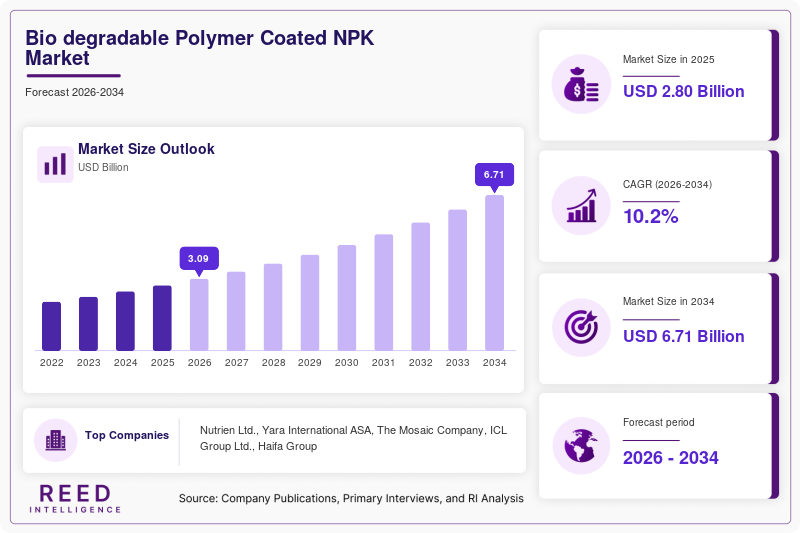
The global Bio degradable Polymer Coated NPK Market size was valued at USD 2.8 billion in 2025 and is projected to reach USD 6.7 billion by 2034, expanding at a CAGR of 10.2% during the forecast period (2025–2034). The market is gaining traction due to the rising demand for sustainable agricultural inputs that enhance nutrient efficiency while minimizing environmental impact. Bio degradable polymer coated NPK fertilizers provide controlled nutrient release, reducing leaching and volatilization losses, which improves crop yield and soil health.
A key global factor supporting the growth of the Bio degradable Polymer Coated NPK Market is the increasing shift toward sustainable farming practices. Governments and agricultural bodies are encouraging the adoption of eco-friendly fertilizers to reduce soil degradation and water contamination. This has led to the growing adoption of controlled-release fertilizers coated with biodegradable polymers across both developed and emerging agricultural economies.
Key Highlights
- Asia Pacific dominated the market with a share of 38.6% in 2025, while Latin America is projected to grow at the fastest CAGR of 11.8%.
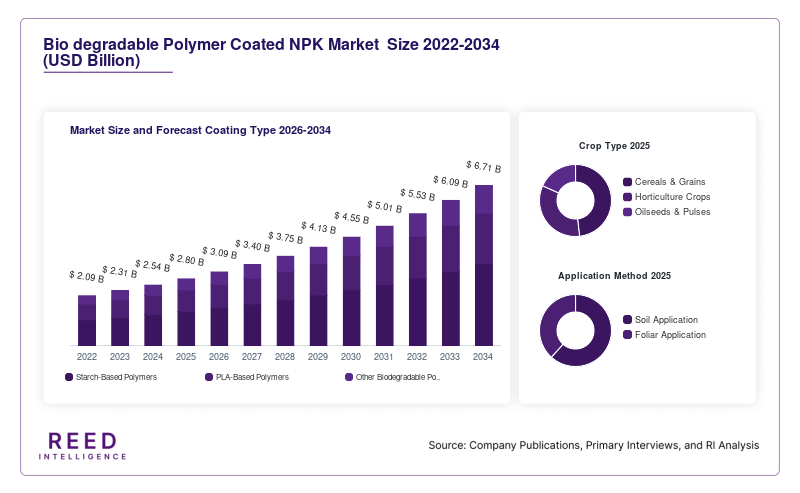
- By coating type, starch-based polymers held the largest share at 41.2%, while PLA-based coatings are expected to grow at the fastest CAGR of 12.6%.
- By crop type, cereals & grains accounted for 44.7% share, while horticulture crops are projected to grow at a CAGR of 11.5%.
- China Bio degradable Polymer Coated NPK Market was valued at USD 0.92 billion in 2025 and is estimated to reach USD 1.01 billion in 2026
Market Trends
Shift Toward Controlled-Release Sustainable Fertilizers
The Bio degradable Polymer Coated NPK Market is witnessing a strong shift toward controlled-release fertilizer technologies. Farmers are increasingly adopting biodegradable coatings that regulate nutrient release based on soil conditions and crop needs. This trend is helping improve nutrient use efficiency and reduce environmental pollution, particularly in regions facing soil degradation.
Increasing Adoption of Bio-Based Polymer Coatings
Another key trend in the Bio degradable Polymer Coated NPK Market is the growing use of bio-based polymer coatings such as polylactic acid (PLA) and starch blends. These materials decompose naturally in soil, reducing long-term residue accumulation. Manufacturers are focusing on developing cost-effective and high-performance biodegradable coatings to meet regulatory and environmental standards.
Market Drivers
Rising Demand for Sustainable Agriculture Practices
The increasing emphasis on sustainable agriculture is a major driver of the Bio degradable Polymer Coated NPK Market. Farmers are adopting eco-friendly fertilizers to improve soil health and reduce environmental impact. Regulatory frameworks promoting sustainable farming practices are further supporting market growth.
Improvement in Nutrient Efficiency and Crop Yield
Bio degradable polymer coated NPK fertilizers enhance nutrient efficiency by providing a steady release of nutrients over time. This reduces wastage and improves crop productivity. The ability to optimize fertilizer usage is encouraging adoption among farmers, particularly in high-value crop segments.
Market Restraint
Higher Production Costs Compared to Conventional Fertilizers
A significant restraint in the Bio degradable Polymer Coated NPK Market is the higher cost associated with biodegradable coatings. The production of bio-based polymers and the coating process increase overall manufacturing expenses.
These higher costs are often passed on to end users, making such fertilizers less accessible for small-scale farmers in price-sensitive regions. Additionally, limited awareness and lack of technical knowledge about controlled-release fertilizers can hinder adoption. Addressing cost challenges and improving farmer education will be critical for market expansion.
Market Opportunities
Expansion in Precision Agriculture Practices
The integration of biodegradable polymer coated NPK fertilizers with precision agriculture technologies presents significant opportunities. Farmers can optimize fertilizer application based on soil and crop data, improving efficiency and reducing input costs. This alignment with digital farming practices is expected to drive market growth.
Increasing Demand in High-Value Crop Cultivation
The growing cultivation of high-value crops such as fruits, vegetables, and specialty crops is creating new opportunities in the Bio degradable Polymer Coated NPK Market. These crops require precise nutrient management, making controlled-release fertilizers an ideal solution. The trend toward intensive farming is expected to boost demand.
Segmental Analysis
By Coating Type
Starch-based polymer coatings dominated the Bio degradable Polymer Coated NPK Market with a share of 41.2% in 2025 due to their cost-effectiveness and biodegradability. These coatings are widely used across various crops and regions.
PLA-based coatings are expected to grow at the fastest CAGR of 12.6% during the forecast period. Their superior performance and environmental compatibility are driving adoption, particularly in regulated markets.
By Crop Type
Cereals & grains accounted for the largest share of 44.7% in 2025, as they represent a major portion of global agricultural production. Controlled-release fertilizers help improve yield and nutrient efficiency in these crops.
Horticulture crops are projected to grow at a CAGR of 11.5%, driven by increasing demand for high-quality produce. The need for precise nutrient management supports the adoption of coated fertilizers.
By Application Method
Soil application dominated the market with a share of 62.8% in 2025 due to its widespread use and effectiveness. This method ensures direct nutrient availability to plant roots.
Foliar application is expected to grow at a CAGR of 10.9%, supported by its ability to provide quick nutrient absorption. This method is gaining popularity in intensive farming practices.
By End-Use
Agricultural farms held the largest share of 71.3% in 2025, reflecting the primary use of coated fertilizers in crop production.
Commercial plantations are expected to grow at a CAGR of 11.2%, driven by the need for efficient nutrient management in large-scale farming operations.
Regional Analysis
North America
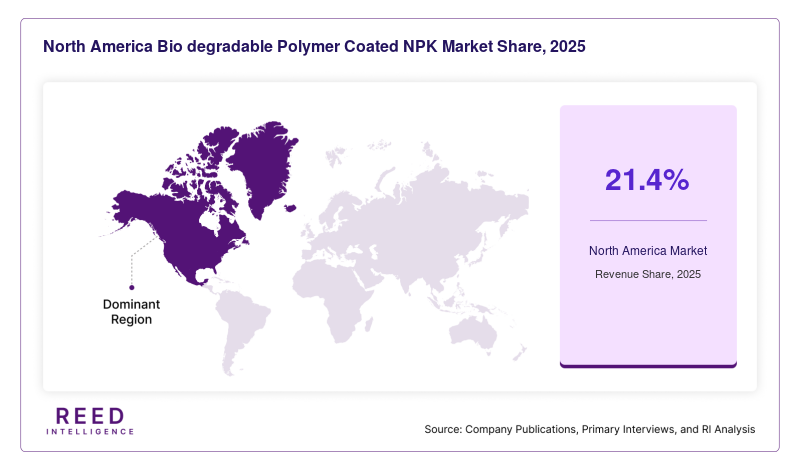
North America accounted for 21.4% of the Bio degradable Polymer Coated NPK Market share in 2025 and will grow at a CAGR of 9.6% during the forecast period. The region has a well-established agricultural sector with increasing adoption of advanced farming inputs.
The United States dominated the regional market due to its focus on sustainable farming practices. The adoption of eco-friendly fertilizers and advanced agricultural technologies has supported market growth.
Europe
Europe held a market share of 24.2% in 2025 and is expected to grow at a CAGR of 9.9% through 2034. Strict environmental regulations and policies promoting sustainable agriculture are influencing market adoption.
Germany emerged as the dominant country, driven by its strong emphasis on environmental protection. The use of biodegradable fertilizers aligns with regulatory requirements and supports market expansion.
Asia Pacific
Asia Pacific represented 38.6% of the Bio degradable Polymer Coated NPK Market in 2025 and is projected to grow at a CAGR of 10.8%. The region has a large agricultural base and increasing demand for improved crop productivity.
China led the region due to its extensive agricultural activities and focus on improving fertilizer efficiency. Government initiatives promoting sustainable farming practices have driven adoption.
Middle East & Africa
The Middle East & Africa accounted for 7.3% of the market share in 2025 and is expected to grow at a CAGR of 10.1%. The region is focusing on improving agricultural productivity in challenging climatic conditions.
Saudi Arabia dominated the region, supported by investments in modern agriculture. The use of advanced fertilizers is helping improve crop yields in arid environments.
Latin America
Latin America held a market share of 8.5% in 2025 and is projected to grow at the fastest CAGR of 11.8%. The region has a strong agricultural export base and increasing adoption of modern farming techniques.
Brazil emerged as the leading country due to its large-scale agricultural operations. The demand for efficient fertilizers to support high crop yields is driving market growth.
Competitive Landscape
The Bio degradable Polymer Coated NPK Market is moderately competitive, with key players focusing on product innovation and sustainable solutions. Companies are investing in research and development to enhance coating technologies and improve product performance.
Nutrien Ltd. is a leading player in the market, known for its advanced fertilizer solutions. The company recently introduced a new line of biodegradable coated fertilizers aimed at improving nutrient efficiency and reducing environmental impact.
Other players are adopting strategies such as partnerships, capacity expansion, and product diversification to strengthen their market presence. The focus on sustainability and compliance with environmental regulations is shaping competitive dynamics in the Bio degradable Polymer Coated NPK Market.
Key Players
- Nutrien Ltd.
- Yara International ASA
- The Mosaic Company
- ICL Group Ltd.
- Haifa Group
- EuroChem Group
- CF Industries Holdings, Inc.
- OCI N.V.
- Koch Industries, Inc.
- Coromandel International Ltd.
- Zuari Agro Chemicals Ltd.
- Indian Farmers Fertiliser Cooperative Limited (IFFCO)
- SQM S.A.
- Sinofert Holdings Limited
- Kingenta Ecological Engineering Group
Recent Developments
- 2024: Nutrien Ltd. launched biodegradable coated NPK fertilizers.
- 2024: Yara International expanded its sustainable fertilizer portfolio.
- 2023: ICL Group introduced advanced polymer coating technologies.
- 2023: Kingenta developed eco-friendly controlled-release fertilizers.
- 2023: EuroChem invested in sustainable fertilizer production facilities.
Bio degradable Polymer Coated NPK Market Segments
Coating Type
- Starch-Based Polymers
- PLA-Based Polymers
- Other Biodegradable Polymers
Crop Type
- Cereals & Grains
- Horticulture Crops
- Oilseeds & Pulses
Application Method
- Soil Application
- Foliar Application
End-Use
- Agricultural Farms
- Commercial Plantations
Distribution Channel
- Direct Sales
- Agricultural Cooperatives
- Online Platforms
- Retail Agro Stores
By Region
- North America
- Europe
- APAC
- Middle East and Africa
- LATAM