Bio Pharma Buffer Market Size, Share & Demand Report By Product Type (Phosphate Buffers, Acetate Buffers, Tris Buffers, Citrate Buffers, Custom Buffer Solutions), By Application (Upstream Processing, Downstream Processing, Cell Culture Applications, Formulation and Fill-Finish, Analytical and Research Applications), By End Use (Biopharmaceutical Companies, Contract Manufacturing Organizations, Research Institutes, Biotechnology Companies, Academic Laboratories) By Region & Segment Forecasts, 202
USD 3950
Market Overview
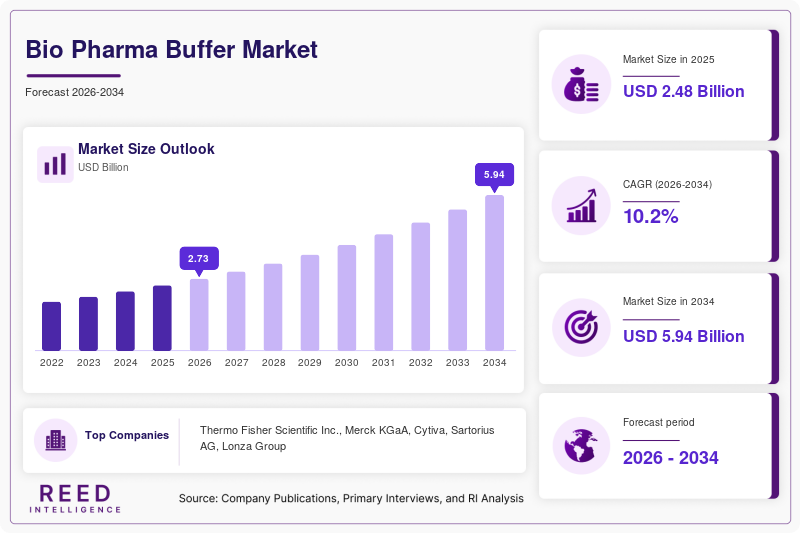
The global Bio Pharma Buffer Market size was valued at USD 2.48 billion in 2026 and is projected to reach USD 5.41 billion by 2034, expanding at a CAGR of 10.2% during the forecast period from 2026 to 2034. The market continues to gain momentum due to the rapid expansion of biologics manufacturing, increasing monoclonal antibody production, and rising investments in vaccine development across both developed and emerging economies. Bio pharma buffers play a critical role in maintaining pH stability, improving protein purification efficiency, and supporting cell culture processes during pharmaceutical manufacturing operations. As biopharmaceutical companies continue to scale production capacity, the requirement for high-purity and application-specific buffer solutions is increasing steadily.
The growing adoption of single-use bioprocessing systems has also strengthened demand for ready-to-use and customized buffer formulations. Pharmaceutical manufacturers are increasingly prioritizing operational efficiency and contamination control, which has accelerated the shift toward pre-formulated buffers and automated buffer preparation systems. In addition, regulatory focus on product consistency and manufacturing precision has encouraged companies to invest in advanced bioprocess solutions that optimize downstream purification and formulation activities.
Key Highlights
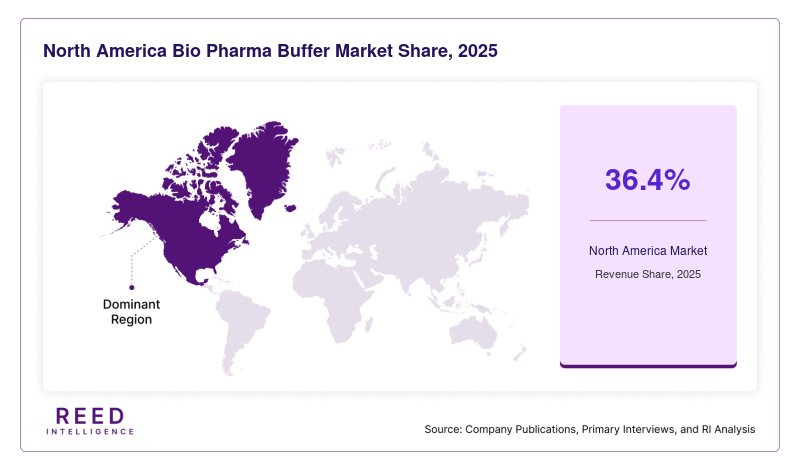
- North America dominated the market with a 36.4% share in 2025, while Asia Pacific is expected to grow at the fastest CAGR of 11.8% during 2026–2034.
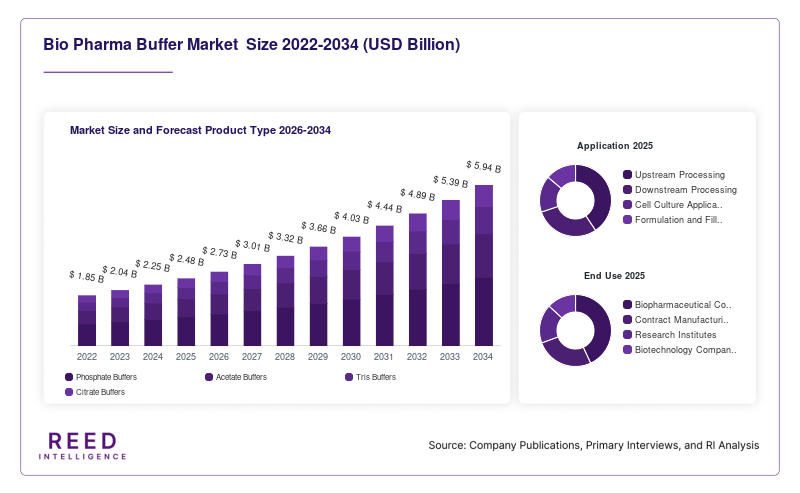
- By product type, phosphate buffers accounted for the largest share of 39.1%, while custom buffer solutions are projected to grow at a CAGR of 12.3%.
- By application, downstream processing led with a 42.6% share, whereas cell culture applications are expected to expand at a CAGR of 11.9%.
- By end use, biopharmaceutical companies held the leading share of 48.7%, while contract manufacturing organizations are projected to grow at a CAGR of 12.1%.
- The United States remained the dominant country, with market values of USD 620 million in 2024 and USD 690 million in 2025.
Market Trends
Increasing Adoption of Single-Use Bioprocessing Technologies
The transition toward single-use bioprocessing systems is becoming one of the most influential trends shaping the Bio Pharma Buffer Market. Biopharmaceutical manufacturers are increasingly adopting disposable technologies to reduce operational complexity, lower contamination risks, and improve production flexibility. Single-use mixing systems and disposable buffer containers simplify cleaning validation procedures and reduce downtime between production batches. This trend is particularly significant among biologics manufacturers that operate multiple production lines for monoclonal antibodies, recombinant proteins, and biosimilars. Buffer suppliers are responding by introducing ready-to-use solutions that integrate efficiently with disposable bioprocessing equipment.
The trend is also supported by the expansion of small-scale and modular manufacturing facilities. Biotechnology startups and contract manufacturers are investing in flexible production environments that rely heavily on pre-formulated buffers and compact preparation systems. The demand for scalable and rapid manufacturing processes has encouraged suppliers to develop concentrated buffer formulations with extended shelf life and high compatibility across various purification platforms. As companies seek faster commercialization timelines, the adoption of single-use technologies is expected to continue influencing purchasing decisions across the industry.
Growing Focus on Personalized Medicine and Advanced Therapies
The increasing commercialization of personalized medicine, gene therapy, and cell therapy products is creating new requirements for specialized buffer systems. Advanced therapies often require highly controlled manufacturing environments and customized formulations to maintain molecular stability throughout production and storage processes. As the number of clinical trials for personalized biologics continues to increase, buffer manufacturers are investing in research capabilities to deliver tailored solutions for niche therapeutic applications.
Biopharmaceutical companies are also focusing on precision manufacturing techniques that require highly purified and low-endotoxin buffers. The expansion of messenger RNA therapeutics and viral vector production has created additional demand for buffers that support sensitive biological materials. In addition, regulatory agencies are emphasizing process consistency and reproducibility, encouraging manufacturers to adopt high-performance buffer systems with validated quality standards. The increasing complexity of modern biologic drugs is expected to sustain long-term demand for innovative buffer technologies that improve formulation stability and downstream purification efficiency.
Market Drivers
Expansion of Biologics and Biosimilar Manufacturing Capacity
The rapid expansion of biologics and biosimilar manufacturing facilities across major pharmaceutical markets is driving consistent demand for bio pharma buffers. Pharmaceutical companies are increasing production capacity to address rising demand for monoclonal antibodies, vaccines, recombinant proteins, and immunotherapies. These manufacturing processes require large volumes of high-quality buffers during cell culture, purification, and formulation stages. As biologics become a larger component of the pharmaceutical industry, the requirement for efficient and scalable buffer systems continues to grow.
Large pharmaceutical companies and contract development organizations are also investing in continuous manufacturing systems that depend on precise pH management and process optimization. Buffers help maintain product stability and improve purification yields, making them essential for reducing production losses and ensuring regulatory compliance. The increasing number of biosimilar approvals in emerging economies has further accelerated demand for cost-effective and standardized buffer solutions. Companies operating in the market are therefore expanding production infrastructure and launching application-specific products to meet growing industry requirements.
Rising Investments in Biopharmaceutical Research and Development
Global investments in biopharmaceutical research and development activities are significantly contributing to market growth. Government funding, private equity investments, and strategic collaborations between pharmaceutical firms and biotechnology companies are accelerating innovation in drug discovery and biologics manufacturing. Research laboratories require specialized buffer solutions for analytical testing, protein stabilization, chromatography, and molecular biology applications. As the number of clinical-stage biologic candidates increases, the consumption of laboratory and manufacturing-grade buffers is also expanding.
Academic institutions and biotechnology startups are increasingly involved in advanced therapeutic research involving cell engineering, regenerative medicine, and gene editing technologies. These applications depend heavily on precise buffer formulations to maintain biological integrity during experimentation and scale-up activities. In addition, pharmaceutical companies are increasing expenditure on process optimization initiatives aimed at improving production efficiency and reducing manufacturing variability. The combination of expanding research pipelines and increased commercialization efforts continues to create strong long-term demand for bio pharma buffer products and services.
Market Restraint
High Production Costs and Stringent Regulatory Compliance Requirements
The Bio Pharma Buffer Market faces challenges associated with high production costs and complex regulatory compliance standards. Manufacturing pharmaceutical-grade buffers requires high-purity raw materials, controlled production environments, and advanced quality testing procedures. These requirements increase operational expenses for manufacturers and create pricing pressures, particularly for smaller biotechnology firms with limited budgets. In addition, fluctuations in the prices of specialty chemicals and pharmaceutical ingredients can impact overall production economics and supply chain stability.
Regulatory agencies across North America, Europe, and Asia impose strict quality standards related to contamination control, traceability, and process validation. Buffer manufacturers must comply with detailed documentation requirements and maintain consistency across production batches to meet pharmaceutical manufacturing guidelines. Failure to meet these standards can result in product recalls, delayed approvals, and operational disruptions. For example, manufacturers supplying buffers for injectable biologics often need to invest heavily in sterile production systems and advanced analytical testing technologies. These regulatory and cost-related challenges may limit market entry for new participants and slow adoption among cost-sensitive pharmaceutical manufacturers operating in emerging economies.
Market Opportunities
Growing Demand for Customized and Application-Specific Buffer Solutions
The increasing complexity of biologic drug development is creating strong opportunities for customized and application-specific buffer formulations. Pharmaceutical manufacturers are seeking buffer systems tailored to specific protein structures, purification requirements, and therapeutic applications. Customized buffers improve process efficiency by enhancing protein stability, reducing aggregation, and supporting optimized downstream purification. This demand is particularly significant in the production of gene therapies, monoclonal antibodies, and next-generation vaccines.
Buffer suppliers are increasingly collaborating with pharmaceutical companies to develop formulations that align with unique manufacturing conditions and regulatory expectations. The trend toward personalized therapeutics has also increased the need for flexible and small-batch buffer production capabilities. Companies offering formulation support, analytical testing, and rapid customization services are likely to gain competitive advantages in the market. As biologic pipelines continue to diversify, the need for specialized buffers designed for niche therapeutic applications is expected to generate substantial growth opportunities during the forecast period.
Expansion of Biopharmaceutical Manufacturing in Emerging Economies
Emerging economies across Asia Pacific, Latin America, and the Middle East are investing heavily in biotechnology infrastructure and pharmaceutical manufacturing capabilities. Governments in countries such as India, China, Brazil, and Saudi Arabia are introducing incentives to encourage domestic biologics production and reduce dependence on imported therapeutics. This industrial expansion is creating new opportunities for suppliers of bio pharma buffers, particularly those offering cost-effective and scalable manufacturing solutions.
Contract manufacturing organizations in emerging markets are also expanding their production capabilities to serve international pharmaceutical clients. These facilities require reliable buffer systems for large-scale purification and formulation activities. In addition, the increasing number of regional biotechnology startups is creating demand for research-grade and pilot-scale buffer solutions. Companies that establish local manufacturing facilities, distribution partnerships, and technical support networks in emerging economies are expected to benefit from expanding pharmaceutical production activities and rising healthcare investments.
Segmental Analysis
By Product Type
Phosphate buffers accounted for the largest share of the Bio Pharma Buffer Market in 2024, representing approximately 39.1% of total revenue. These buffers are widely used across pharmaceutical manufacturing processes because of their strong buffering capacity, compatibility with biological molecules, and cost efficiency. Phosphate-based formulations are extensively applied in protein purification, chromatography, and cell culture applications, making them essential for biologics manufacturing. Pharmaceutical companies prefer phosphate buffers because they maintain stable pH conditions during sensitive production processes and support high product consistency. Their broad availability and compatibility with multiple manufacturing platforms further strengthen their dominant position in the market.
Custom buffer solutions are expected to witness the fastest CAGR of 12.3% during the forecast period due to increasing demand for tailored bioprocessing systems. Biopharmaceutical manufacturers are seeking application-specific formulations designed to optimize protein stability, purification efficiency, and manufacturing performance. The growing complexity of gene therapies, monoclonal antibodies, and personalized medicines has increased the need for customized solutions that address unique process requirements. Buffer suppliers are expanding technical support services and formulation capabilities to meet these evolving needs. In addition, contract manufacturing organizations are increasingly requesting customized buffer systems that align with flexible production environments and small-batch manufacturing processes.
By Application
Downstream processing emerged as the dominant application segment in 2024 and accounted for 42.6% of the global market share. Buffer systems play a critical role in purification, filtration, chromatography, and formulation processes that occur during downstream bioprocessing operations. The increasing production of biologics and biosimilars has significantly increased the need for efficient purification technologies, which directly supports demand for high-performance buffers. Pharmaceutical companies are also focusing on improving purification yields and reducing production losses, further strengthening adoption within this segment. Advanced downstream processing systems require stable and high-purity buffer formulations to maintain product quality and regulatory compliance.
Cell culture applications are projected to grow at the fastest CAGR of 11.9% from 2026 to 2034 due to increasing research activities involving biologics, vaccines, and regenerative medicine. Buffers used in cell culture applications help maintain optimal pH levels and support stable growth environments for sensitive cell lines. The expansion of stem cell research, gene therapy development, and vaccine production is driving strong demand for specialized cell culture buffers. Biotechnology companies are also increasing investments in advanced cell-based manufacturing platforms that require consistent and contamination-free buffer solutions. Growing interest in personalized therapeutics is expected to further accelerate growth in this application segment.
By End Use
Biopharmaceutical companies held the largest share of the Bio Pharma Buffer Market in 2024, accounting for 48.7% of total revenue. These organizations require large volumes of buffer solutions throughout biologics manufacturing processes, including upstream fermentation, downstream purification, and final product formulation. The expansion of monoclonal antibody production, biosimilar development, and vaccine manufacturing has significantly increased demand for pharmaceutical-grade buffers. Large pharmaceutical companies are also investing in automated buffer preparation systems and integrated manufacturing technologies to improve production efficiency and process consistency. Their extensive manufacturing operations and strong research capabilities continue to support the dominance of this segment.
Contract manufacturing organizations are anticipated to register the fastest CAGR of 12.1% during the forecast period due to increasing outsourcing activities within the pharmaceutical industry. Biotechnology startups and mid-sized pharmaceutical firms are increasingly relying on external manufacturing partners to reduce infrastructure costs and accelerate commercialization timelines. Contract manufacturers require scalable and flexible buffer systems that can support multiple production programs across different therapeutic categories. The expansion of global outsourcing networks and increasing demand for biologics production services are creating favorable growth conditions for this segment. In addition, contract organizations are investing in modular manufacturing facilities that depend heavily on ready-to-use and customizable buffer solutions.
Regional Analysis
North America
North America accounted for 36.4% of the global Bio Pharma Buffer Market in 2025 and is expected to maintain a strong position throughout the forecast period. The region is projected to grow at a CAGR of 9.8% from 2026 to 2034 due to advanced biologics manufacturing infrastructure and consistent investments in pharmaceutical research. Major pharmaceutical companies in the United States and Canada continue to increase production of monoclonal antibodies, vaccines, and biosimilars, which supports steady demand for high-purity buffer solutions. The presence of established biotechnology clusters and strong regulatory oversight also contributes to market expansion.
The United States remains the dominant country in the regional market due to its extensive pharmaceutical manufacturing capacity and growing investment in advanced therapies. Increasing research activities involving cell and gene therapies are creating demand for specialized and customized buffer formulations. In addition, the expansion of contract development and manufacturing organizations across the country is supporting large-scale buffer consumption. Government support for biologics innovation and continuous improvements in bioprocess automation are further strengthening the regional market outlook.
Europe
Europe represented a significant share of the Bio Pharma Buffer Market in 2025 and is forecast to expand at a CAGR of 9.5% during the assessment period. The region benefits from a strong pharmaceutical manufacturing base, increasing biosimilar approvals, and rising investments in biotechnology research. Countries across Western Europe are focusing on advanced bioprocessing technologies that require high-quality buffer systems for purification and formulation activities. Pharmaceutical companies are also increasing spending on research programs involving personalized medicine and biologic therapies.
Germany remains the leading contributor to the European market due to its established pharmaceutical industry and strong biotechnology ecosystem. The country has witnessed increased investments in biomanufacturing facilities and process optimization technologies. German pharmaceutical manufacturers are also emphasizing sustainable and efficient production practices, which has increased demand for concentrated and reusable buffer systems. In addition, collaborations between academic research institutes and biotechnology companies are supporting innovation in advanced therapeutic development and expanding regional buffer consumption.
Asia Pacific
Asia Pacific is projected to record the fastest CAGR of 11.8% during the forecast period due to rapid pharmaceutical industrialization and growing biotechnology investments. The region accounted for a substantial share of global demand in 2025 as countries such as China, India, South Korea, and Japan expanded biologics manufacturing capabilities. Increasing healthcare expenditure, rising chronic disease prevalence, and growing government support for domestic pharmaceutical production are contributing to market growth. Regional contract manufacturing organizations are also increasing production capacity to meet international demand for biologics and biosimilars.
China continues to dominate the regional market due to strong government initiatives supporting biotechnology innovation and pharmaceutical self-sufficiency. The country has experienced rapid growth in monoclonal antibody production and vaccine manufacturing activities, increasing demand for industrial-scale buffer systems. Chinese biotechnology companies are also investing in advanced purification technologies that require high-performance buffers. In addition, expanding collaborations with global pharmaceutical firms are improving technology transfer and accelerating the adoption of modern bioprocessing solutions across the country.
Middle East & Africa
The Middle East & Africa region is witnessing gradual expansion in the Bio Pharma Buffer Market and is anticipated to grow at a CAGR of 8.4% from 2026 to 2034. Governments across the region are increasing healthcare investments and supporting local pharmaceutical production to improve medical supply chain resilience. Biopharmaceutical manufacturing activities remain limited compared to developed markets, but growing interest in biotechnology and vaccine production is creating opportunities for buffer suppliers. The adoption of modern laboratory infrastructure and bioprocessing technologies is also supporting regional market development.
Saudi Arabia remains a leading country within the regional market due to increasing investments in pharmaceutical manufacturing and healthcare diversification initiatives. The country is encouraging domestic biologics production through public-private partnerships and industrial development programs. Expanding research capabilities in biotechnology and vaccine development are contributing to increased demand for laboratory-grade and production-scale buffer systems. In addition, the establishment of new pharmaceutical manufacturing zones is expected to strengthen long-term market potential across the country.
Latin America
Latin America accounted for a moderate share of the Bio Pharma Buffer Market in 2025 and is expected to expand at a CAGR of 8.9% through 2034. The region is experiencing increased pharmaceutical production activities supported by rising healthcare expenditure and growing demand for biologic treatments. Governments in several countries are introducing policies to strengthen local pharmaceutical manufacturing and reduce reliance on imported drugs. Biotechnology startups and regional contract manufacturing organizations are also contributing to increased consumption of buffer systems for research and production applications.
Brazil dominates the Latin American market due to its large pharmaceutical sector and growing investment in biosimilar production. The country has expanded public healthcare programs and increased funding for biotechnology research, encouraging growth in biologics manufacturing. Brazilian pharmaceutical companies are also adopting modern purification and formulation technologies that require high-quality buffers. In addition, partnerships between domestic manufacturers and international pharmaceutical firms are supporting technology transfer and improving regional manufacturing capabilities.
Competitive Landscape
The Bio Pharma Buffer Market is characterized by strong competition among global pharmaceutical suppliers, biotechnology solution providers, and specialty chemical manufacturers. Companies are focusing on expanding production capacity, strengthening distribution networks, and developing customized buffer formulations to improve market positioning. Strategic collaborations with biopharmaceutical manufacturers and contract development organizations have become common as suppliers aim to provide integrated bioprocessing solutions.
Thermo Fisher Scientific remains one of the leading companies in the market due to its broad product portfolio, global manufacturing presence, and strong focus on bioprocess innovation. The company continues to expand its buffer preparation technologies and single-use bioprocessing solutions to support biologics manufacturing. Other major participants such as Merck KGaA, Cytiva, Sartorius AG, and Lonza Group are also investing in product development and regional expansion initiatives.
Recent competitive activity has focused heavily on expanding manufacturing infrastructure in Asia Pacific and North America. Several companies are introducing concentrated and ready-to-use buffer systems that improve production efficiency and reduce operational complexity. Market participants are also emphasizing sustainability initiatives, including reduced packaging waste and energy-efficient manufacturing processes, to align with evolving industry expectations.
Key Players
- Thermo Fisher Scientific Inc.
- Merck KGaA
- Cytiva
- Sartorius AG
- Lonza Group
- Avantor Inc.
- Danaher Corporation
- Repligen Corporation
- Fujifilm Irvine Scientific
- Corning Incorporated
- Bio-Rad Laboratories Inc.
- AGC Biologics
- Cambrex Corporation
- Eppendorf SE
- Parker Hannifin Corporation
Recent Developments
- In February 2026, Thermo Fisher Scientific expanded its bioprocessing manufacturing facility in the United States to increase production capacity for pharmaceutical-grade buffer solutions and single-use technologies.
- In August 2025, Merck KGaA introduced a new high-concentration buffer platform designed for large-scale biologics purification and advanced cell culture applications.
- In November 2025, Cytiva announced a strategic collaboration with a major contract manufacturing organization in Asia Pacific to develop customized buffer preparation systems for biosimilar production facilities.
- In March 2026, Sartorius AG launched an automated buffer management solution aimed at improving process efficiency and reducing contamination risks in biologics manufacturing environments.
Bio Pharma Buffer Market Segments
Product Type
- Phosphate Buffers
- Acetate Buffers
- Tris Buffers
- Citrate Buffers
Application
- Upstream Processing
- Downstream Processing
- Cell Culture Applications
- Formulation and Fill-Finish
End Use
- Biopharmaceutical Companies
- Contract Manufacturing Organizations
- Research Institutes
- Biotechnology Companies
By Region
- North America
- Europe
- APAC
- Middle East and Africa
- LATAM