Bio Vanillin Market Size, Share & Demand Report By Source (Fermentation-Based, Lignin-Based, Ferulic Acid-Based), By Application (Food & Beverages, Personal Care & Cosmetics, Pharmaceuticals), By End-Use Industry (Food Processing, Cosmetics & Personal Care, Pharmaceutical Industry), By Distribution Channel (Direct Sales, Distributors, Online Channels), By Region & Segment Forecasts, 2025–2034
USD 3950
Market Overview
The global Bio Vanillin Market size was valued at approximately USD 285 million in 2025 and is projected to reach USD 612 million by 2034, expanding at a compound annual growth rate (CAGR) of 8.9% during the forecast period. The market is gaining steady traction as industries shift toward natural and sustainable flavoring ingredients, particularly in food, beverages, and personal care products.
A key global factor supporting the growth of the Bio Vanillin Market is the increasing consumer preference for clean-label and plant-based ingredients. Rising awareness regarding synthetic additives and their potential health implications has led manufacturers to replace petrochemical-derived vanillin with bio-based alternatives. This shift is further supported by regulatory encouragement in several regions to promote sustainable sourcing and environmentally friendly production methods.
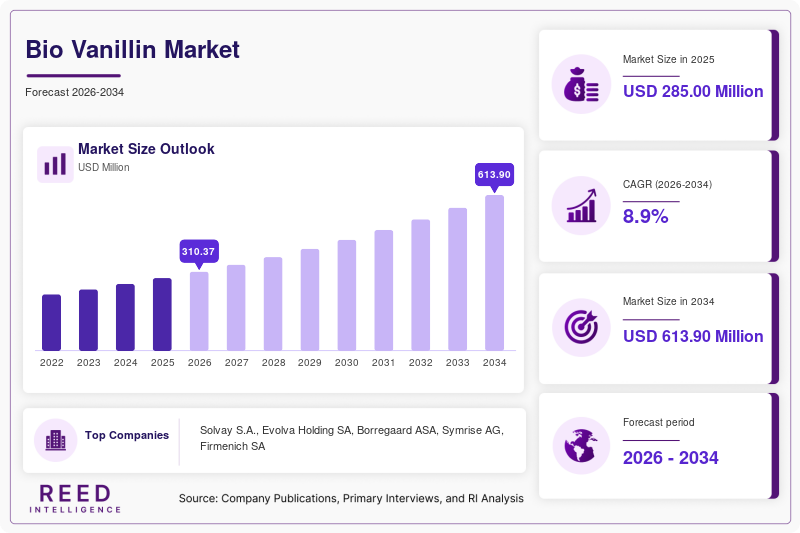
Key Highlights:
- Europe dominated the Bio Vanillin Market with a 38% share in 2025, while Asia Pacific is expected to register the fastest CAGR of 9.7%.
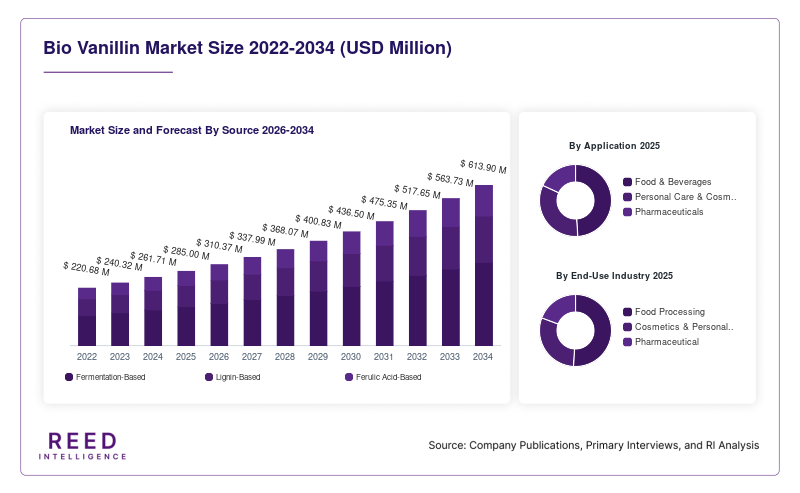
- By source, fermentation-based bio vanillin led with a 52% share, while lignin-based bio vanillin is projected to grow at the fastest CAGR of 9.9%.
- By application, food & beverages dominated with a 61% share, while personal care & cosmetics is expected to grow at a CAGR of 9.3%.
- Germany remained the dominant country with market values of USD 64 million in 2025 and USD 69 million in 2026.
Market Trends
Shift Toward Sustainable and Bio-Based Ingredients
The Bio Vanillin Market is experiencing a strong shift toward sustainability, with manufacturers prioritizing eco-friendly production processes. Bio vanillin derived from renewable sources such as ferulic acid and lignin is gaining traction as companies aim to reduce carbon footprints. This trend is particularly prominent in Europe, where regulatory frameworks encourage sustainable sourcing and transparency in ingredient labeling. The demand for natural flavors is driving investments in green chemistry and biotechnology innovations.
Expansion in Personal Care and Fragrance Applications
Another notable trend is the increasing use of bio vanillin in personal care and fragrance products. Consumers are seeking natural and skin-friendly ingredients in cosmetics, prompting manufacturers to incorporate bio vanillin as a fragrance component. Its mild aroma and compatibility with other natural ingredients make it suitable for a wide range of applications. This trend is expanding the market beyond traditional food and beverage uses.
Market Drivers
Rising Demand for Clean-Label Food Products
The growing demand for clean-label products is a major driver for the Bio Vanillin Market. Consumers are actively seeking products with natural ingredients and transparent labeling. Bio vanillin, being derived from natural sources, aligns well with these preferences, leading to its increased adoption in food and beverage formulations.
Advancements in Biotechnological Production Methods
Technological advancements in fermentation and enzymatic processes are significantly supporting market growth. These innovations are improving production efficiency and reducing costs, making bio vanillin more accessible. As a result, manufacturers are increasingly incorporating bio-based flavors into their product portfolios.
Market Restraint
High Production Costs Compared to Synthetic Vanillin
A key restraint in the Bio Vanillin Market is the relatively high cost of production compared to synthetic vanillin. Bio-based production processes require specialized raw materials and advanced technologies, which increase overall manufacturing costs. This price difference can limit adoption, particularly among cost-sensitive manufacturers.
Additionally, supply chain constraints for natural raw materials can impact production consistency. Variability in raw material availability and quality may affect product output, posing challenges for large-scale commercialization. These factors collectively hinder the widespread adoption of bio vanillin, especially in price-competitive markets.
Market Opportunities
Growing Demand in Emerging Economies
Emerging markets in Asia Pacific and Latin America present significant growth opportunities for the Bio Vanillin Market. Rising disposable incomes and increasing awareness of natural ingredients are driving demand for premium food and personal care products. Manufacturers can leverage these trends to expand their presence in these regions.
Innovation in Sustainable Packaging and Branding
The integration of sustainable packaging with bio-based products offers a unique opportunity for market players. Companies can enhance brand value by promoting eco-friendly packaging alongside natural ingredients. This approach can attract environmentally conscious consumers and strengthen market positioning.
Segmental Analysis
By Source
Fermentation-based bio vanillin dominated the Bio Vanillin Market with a 52% share in 2025, as it offers consistent quality and scalability in production. It is widely adopted due to its ability to meet regulatory standards for natural labeling. Additionally, advancements in fermentation technology have improved yield and cost efficiency.
Lignin-based bio vanillin is expected to grow at the fastest CAGR of 9.9%, driven by its sustainable sourcing from wood-based raw materials. Increasing focus on circular economy practices and utilization of industrial by-products will support its growth in the coming years.
By Application
Food & beverages accounted for 61% of the Bio Vanillin Market in 2025, as it is extensively used in bakery, confectionery, and dairy products. The demand is driven by consumer preference for natural flavors and clean-label formulations. Manufacturers are increasingly incorporating bio vanillin to enhance product appeal.
Personal care & cosmetics is anticipated to grow at a CAGR of 9.3%, supported by rising demand for natural fragrance ingredients. The use of bio vanillin in perfumes, skincare, and haircare products is increasing due to its compatibility with organic formulations.
By End-Use Industry
The food processing industry dominated with a 57% share in 2025, driven by large-scale usage of flavoring agents in packaged and processed foods. Increasing consumption of convenience foods and premium products is further boosting demand. The shift toward natural additives is also strengthening this segment.
The pharmaceutical industry is expected to grow at a CAGR of 8.7%, as bio vanillin is used in drug formulations for flavor masking. Growing demand for patient-friendly medicines and advancements in formulation technologies are contributing to segment growth.
By Distribution Channel
Direct sales accounted for 48% of the Bio Vanillin Market in 2025, as manufacturers prefer bulk procurement through long-term contracts. This channel ensures consistent supply and cost efficiency for large-scale buyers. It is widely used by food and beverage companies.
Online channels are projected to grow at a CAGR of 9.0%, driven by increasing digitalization and ease of access to specialty ingredients. Small and medium enterprises are increasingly relying on online platforms for sourcing, supporting segment expansion.
Regional Analysis
North America
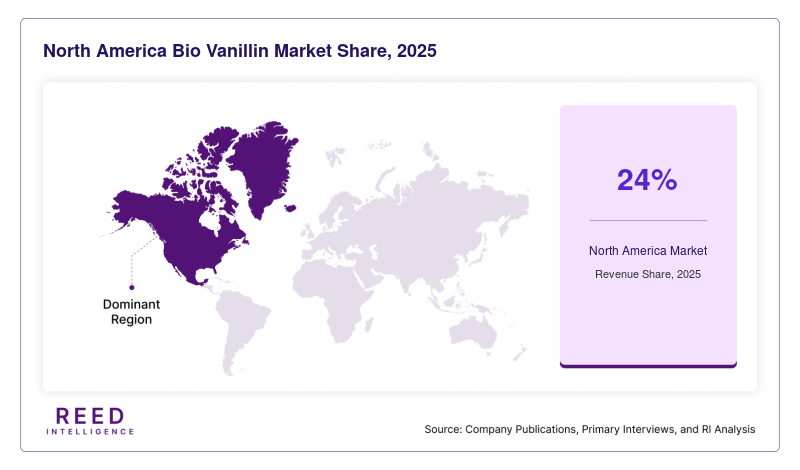
North America accounted for 24% of the Bio Vanillin Market share in 2025 and will grow at a CAGR of 8.5% through 2034. The region benefits from strong demand for clean-label food products and increasing consumer preference for natural flavoring agents. Regulatory support for sustainable ingredients and the presence of major food processing companies are further supporting steady growth.
The United States dominated the region due to ongoing product reformulation trends among food manufacturers. Companies are increasingly replacing synthetic additives with bio-based alternatives, supported by rising consumer awareness and premium product demand.
Europe
Europe held 38% market share in 2025 and is projected to grow at a CAGR of 8.1%. The region has a well-established market for natural ingredients, supported by strict regulatory frameworks promoting sustainability and transparency. Increasing demand for organic and eco-friendly food products is also contributing to growth.
Germany emerged as the dominant country due to its strong industrial base and emphasis on green chemistry. The country’s focus on sustainable production processes and innovation in biotechnology is accelerating the adoption of bio vanillin across industries.
Asia Pacific
Asia Pacific captured 22% of the Bio Vanillin Market in 2025 and is expected to register the fastest CAGR of 9.7%. Rapid urbanization, expanding food processing industries, and growing middle-class population are driving demand for natural flavoring ingredients. Increasing awareness of clean-label products is also supporting market expansion.
China led the region due to its large manufacturing base and rising demand for processed foods. Government initiatives promoting sustainable industrial practices and investments in biotechnology are further strengthening market growth.
Middle East & Africa
The Middle East & Africa held 8% share in 2025 and will grow at a CAGR of 8.8%. The market is gradually expanding due to increasing demand for premium and imported food products. Rising urbanization and improving retail infrastructure are enhancing product accessibility.
Saudi Arabia dominated the region due to growing consumption of packaged foods and beverages. The shift toward higher-quality ingredients and increasing adoption of natural additives are supporting demand for bio vanillin.
Latin America
Latin America accounted for 8% of the Bio Vanillin Market in 2025 and is projected to grow at a CAGR of 9.1%. The region is witnessing steady growth driven by expanding food and beverage industries and rising consumer awareness of natural ingredients. Economic development is also improving purchasing power.
Brazil led the region due to its strong food processing sector and increasing demand for flavored products. The growth of local manufacturing and distribution networks is improving market penetration.
Competitive Landscape
The Bio Vanillin Market is characterized by moderate competition, with key players focusing on innovation and sustainable production methods. Companies are investing in advanced fermentation technologies to enhance product quality and reduce costs.
A leading market player has recently expanded its production capacity for bio-based vanillin using renewable raw materials. This development reflects the growing demand for sustainable flavoring solutions and the company’s commitment to environmental responsibility.
Other players are focusing on strategic partnerships and product diversification to strengthen their market presence. The competitive landscape is shaped by continuous innovation and efforts to meet evolving consumer preferences.
Key Players List
- Solvay S.A.
- Evolva Holding SA
- Borregaard ASA
- Symrise AG
- Firmenich SA
- Givaudan SA
- International Flavors & Fragrances Inc.
- Archer Daniels Midland Company
- BASF SE
- Kerry Group plc
- Sensient Technologies Corporation
- Advanced Biotech
- Omega Ingredients Ltd.
- Axxence Aromatic GmbH
- Lesaffre Group
Recent Developments
- 2024: Expansion of bio vanillin production facilities using fermentation technology.
- 2024: Launch of new sustainable flavoring solutions by key manufacturers.
- 2025: Strategic collaborations between biotechnology firms and food companies.
- 2025: Increased investment in research for lignin-based vanillin production.
Bio Vanillin Market Segments
By Source
- Fermentation-Based
- Lignin-Based
- Ferulic Acid-Based
By Application
- Food & Beverages
- Personal Care & Cosmetics
- Pharmaceuticals
By End-Use Industry
- Food Processing
- Cosmetics & Personal Care
- Pharmaceutical
By Distribution Channel
- Direct Sales
- Distributors
- Online Channels
By Region
- North America
- Europe
- APAC
- Middle East and Africa
- LATAM