Bioceramic Piezoceramic Market Size, Share & Demand Report By Material Type (Lead Zirconate Titanate (PZT), Lead-Free Piezoceramics), By Application (Medical Devices, Industrial Equipment, Consumer Electronics, Energy Harvesting Systems), By End-Use Industry (Healthcare, Automotive, Electronics, Aerospace), By Product Type (Sensors, Actuators, Transducers), By Region & Segment Forecasts, 2025–2034
USD 3950
Market Overview
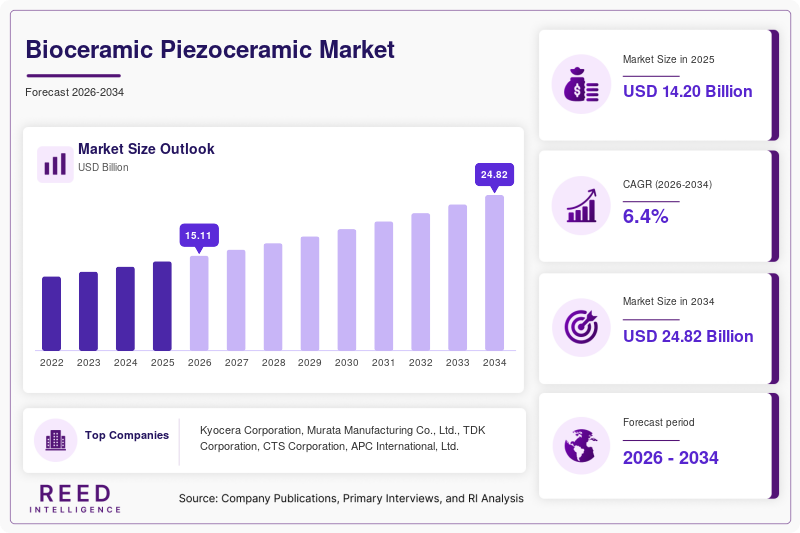
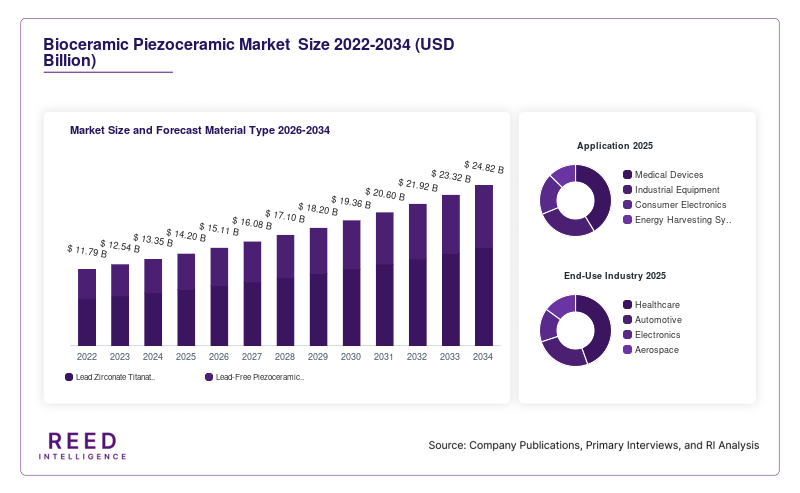
The global Bioceramic Piezoceramic Market size was valued at approximately USD 14.2 billion in 2025 and is projected to reach USD 24.8 billion by 2034, expanding at a CAGR of 6.4% from 2025 to 2034. The market growth is being driven by the increasing integration of advanced piezoelectric materials in medical, industrial, and consumer electronic applications. These materials, known for their ability to convert mechanical energy into electrical signals, have gained significant traction in diagnostic imaging, sensors, actuators, and energy harvesting devices.
A key global factor supporting the growth of the Bioceramic Piezoceramic Market is the rising demand for precision-based medical devices and minimally invasive diagnostic tools. The healthcare sector has increasingly adopted piezoceramic materials in ultrasound imaging, implantable devices, and therapeutic equipment, thereby expanding the market size and application scope. Additionally, advancements in material engineering have improved durability, efficiency, and environmental compatibility, further strengthening market growth.
Key Highlights:
- Asia Pacific dominated the market with a 41.3% share in 2025, while it is expected to remain the fastest-growing region with a CAGR of 7.2%.
- By material, Lead Zirconate Titanate (PZT) led with a 52.6% share in 2024, whereas lead-free piezoceramics are projected to grow fastest at a CAGR of 7.8%.
- By application, medical devices accounted for the largest share, while energy harvesting systems are expected to expand at a CAGR of 8.1%.
- The United States remained the dominant country, with market values of USD 3.1 billion in 2024 and USD 3.3 billion in 2025.
Market Trends
Shift Toward Lead-Free Piezoceramic Materials
The Bioceramic Piezoceramic Market is witnessing a notable transition toward environmentally friendly, lead-free materials. Regulatory frameworks and sustainability initiatives have encouraged manufacturers to reduce reliance on traditional lead-based compounds such as PZT. As a result, materials like bismuth sodium titanate and potassium sodium niobate are gaining traction. These alternatives offer improved environmental compliance while maintaining competitive performance, making them increasingly suitable for healthcare and consumer electronics applications.
Integration in Smart and Wearable Technologies
Another emerging trend shaping the market is the growing integration of piezoceramic components into smart and wearable devices. These materials are being used in sensors, haptic feedback systems, and energy harvesting units within wearable health monitors and IoT devices. Their ability to generate energy from motion supports battery-free or low-power device designs. This trend is expected to enhance the market outlook as demand for compact, efficient, and multifunctional electronic systems continues to rise globally.
Market Drivers
Growing Demand for Advanced Medical Imaging Technologies
The increasing use of high-resolution imaging systems has significantly driven the Bioceramic Piezoceramic Market. Piezoceramic materials are widely used in ultrasound transducers due to their precise signal conversion capabilities. The rise in chronic diseases and the need for early diagnosis have expanded the adoption of such technologies, contributing to steady market growth.
Expansion of Industrial Automation and Sensors
The expansion of automation across industries has accelerated the demand for sensors and actuators, where piezoceramic materials play a critical role. These materials enable accurate motion control and vibration detection, which are essential for manufacturing processes, robotics, and automotive systems. As industries continue to adopt smart manufacturing practices, the demand for piezoceramic-based components is expected to increase.
Market Restraint
High Production Costs and Material Complexity
One of the key challenges in the Bioceramic Piezoceramic Market is the high cost associated with manufacturing and material processing. The production of piezoceramic components involves complex fabrication techniques, including high-temperature sintering and precise material composition control. These processes increase operational costs and limit accessibility for small-scale manufacturers.
Additionally, the need for specialized equipment and skilled labor further contributes to overall production expenses. Variations in raw material availability and quality can also affect consistency, leading to performance issues in end-use applications. This complexity restricts widespread adoption, particularly in cost-sensitive markets, thereby impacting the overall market growth to some extent.
Market Opportunities
Growth in Energy Harvesting Applications
The increasing focus on renewable energy and sustainable solutions presents significant opportunities for the Bioceramic Piezoceramic Market. Piezoceramic materials are being utilized in energy harvesting systems that convert mechanical vibrations into electrical energy. These systems are particularly useful in remote or low-power environments, such as wearable devices and industrial monitoring systems, creating new growth avenues.
Advancements in Biomedical Implants
The development of advanced biomedical implants represents another promising opportunity. Piezoceramic materials are being explored for use in smart implants that can monitor physiological conditions and provide therapeutic responses. Innovations in biocompatibility and miniaturization are expected to enhance the adoption of these materials in next-generation healthcare devices, supporting long-term market expansion.
Segmental Analysis
By Material Type
Lead Zirconate Titanate (PZT) dominated the Bioceramic Piezoceramic Market, accounting for approximately 52.6% of the market share in 2024. Its widespread use is attributed to its superior piezoelectric properties, high sensitivity, and reliability across various applications, including sensors and actuators.
Lead-free piezoceramics are expected to be the fastest-growing segment, with a projected CAGR of 7.8% during the forecast period. Increasing environmental regulations and the need for sustainable materials will drive the adoption of these alternatives, particularly in consumer electronics and medical applications.
By Application
Medical devices emerged as the dominant application segment, holding around 34.2% of the market share in 2024. The extensive use of piezoceramic materials in ultrasound imaging and therapeutic devices contributed to its leading position.
Energy harvesting systems are anticipated to grow at the fastest rate, with a CAGR of 8.1%. The rising demand for self-powered devices and sustainable energy solutions will support this segment’s growth.
By End-Use Industry
The healthcare sector dominated the market, accounting for 31.5% of the share in 2024, driven by the increasing use of advanced diagnostic equipment.
The consumer electronics segment is projected to grow at a CAGR of 7.5%, supported by the integration of piezoceramic components in smartphones, wearables, and smart devices.
By Product Type
Sensors represented the largest segment, with a 38.7% share in 2024, due to their extensive use in industrial and medical applications.
Actuators are expected to grow fastest at a CAGR of 7.6%, driven by increasing demand in automation and robotics systems.
Regional Analysis
North America
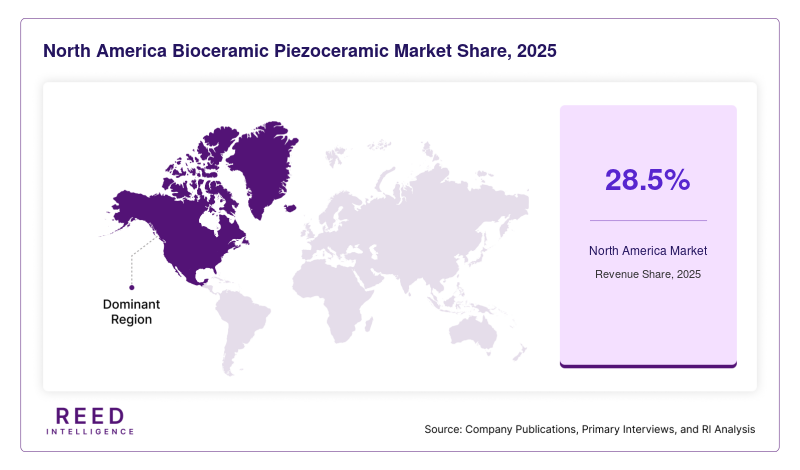
North America accounted for approximately 28.5% of the Bioceramic Piezoceramic Market share in 2025 and was a mature market with stable demand. The region is expected to grow at a CAGR of 5.8% during the forecast period. The presence of advanced healthcare infrastructure and strong adoption of innovative technologies supported regional growth.
The United States dominated the regional market due to its extensive use of piezoceramic materials in medical imaging and aerospace applications. The country’s emphasis on research and development in advanced materials has enabled continuous innovation, supporting consistent demand across multiple industries.
Europe
Europe held around 22.1% of the market share in 2025 and is projected to grow at a CAGR of 5.9% through 2034. The region’s focus on environmental regulations has influenced the adoption of lead-free piezoceramic materials.
Germany emerged as the leading country in Europe, driven by its strong manufacturing base and focus on industrial automation. The integration of piezoceramic components in automotive and industrial equipment has contributed to steady market growth.
Asia Pacific
Asia Pacific dominated the Bioceramic Piezoceramic Market with a 41.3% share in 2025 and is expected to grow at the fastest CAGR of 7.2% during the forecast period. Rapid industrialization and expanding electronics manufacturing supported the region’s dominance.
China led the regional market due to its large-scale production capabilities and increasing demand for consumer electronics. The country’s growing investment in semiconductor and sensor technologies has further accelerated market expansion.
Middle East & Africa
The Middle East & Africa region accounted for approximately 4.6% of the market share in 2025 and is anticipated to grow at a CAGR of 5.2%. The market in this region is gradually expanding with increasing investments in healthcare and infrastructure.
Saudi Arabia emerged as a key country, driven by its focus on modernizing healthcare facilities and adopting advanced diagnostic technologies. These developments have created demand for piezoceramic-based devices.
Latin America
Latin America held about 3.5% of the market share in 2025 and is expected to grow at a CAGR of 5.4%. The region is experiencing gradual growth due to improvements in industrial and healthcare sectors.
Brazil dominated the regional market, supported by its expanding manufacturing industry and increasing adoption of advanced medical technologies. Government initiatives to enhance healthcare access have also contributed to market development.
Competitive Landscape
The Bioceramic Piezoceramic Market is moderately competitive, with several global and regional players focusing on innovation and product development. Companies are investing in research to develop advanced materials with improved efficiency and environmental compatibility.
Kyocera Corporation is recognized as a market leader, supported by its extensive product portfolio and strong global presence. The company has recently expanded its production capacity to meet growing demand in medical and industrial applications.
Other key players are focusing on strategic partnerships, mergers, and acquisitions to strengthen their market position. Continuous advancements in material science and application-specific solutions are expected to shape the competitive landscape over the forecast period.
Key Players
- Kyocera Corporation
- Murata Manufacturing Co., Ltd.
- TDK Corporation
- CTS Corporation
- APC International, Ltd.
- CeramTec GmbH
- PI Ceramic GmbH
- Morgan Advanced Materials
- Sparkler Ceramics Pvt. Ltd.
- Meggitt PLC
Recent Developments
- Kyocera Corporation expanded its piezoceramic production facility to support rising global demand.
- Murata Manufacturing introduced new lead-free piezoceramic components for wearable applications.
- TDK Corporation developed advanced piezoelectric sensors with enhanced sensitivity for industrial automation.
- CeramTec GmbH launched new biocompatible ceramic materials for medical implant applications.
- CTS Corporation strengthened its product portfolio with innovations in actuator technologies.
Bioceramic Piezoceramic Market Segments
Material Type
- Lead Zirconate Titanate (PZT)
- Lead-Free Piezoceramics
Application
- Medical Devices
- Industrial Equipment
- Consumer Electronics
- Energy Harvesting Systems
End-Use Industry
- Healthcare
- Automotive
- Electronics
- Aerospace
Product Type
- Sensors
- Actuators
- Transducers
By Region
- North America
- Europe
- APAC
- Middle East and Africa
- LATAM