Biodegradable Loose Fills Market Size, Share & Demand Report By Material Type (Starch-Based Loose Fills, Plant-Fiber Loose Fills, Recycled Paper Loose Fills, Biopolymer Loose Fills), By End-Use Industry (E-Commerce and Retail, Electronics, Pharmaceutical Packaging, Food and Beverage, Consumer Goods, Industrial Packaging), By Distribution Channel (Direct Sales, Distributors and Wholesalers, Online Distribution Channels), By Region & Segment Forecasts, 2026–2034
USD 3950
Market Overview
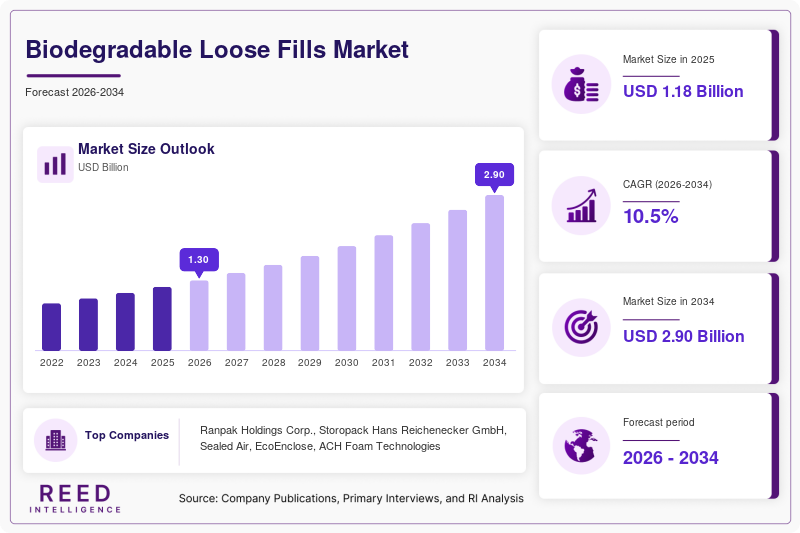
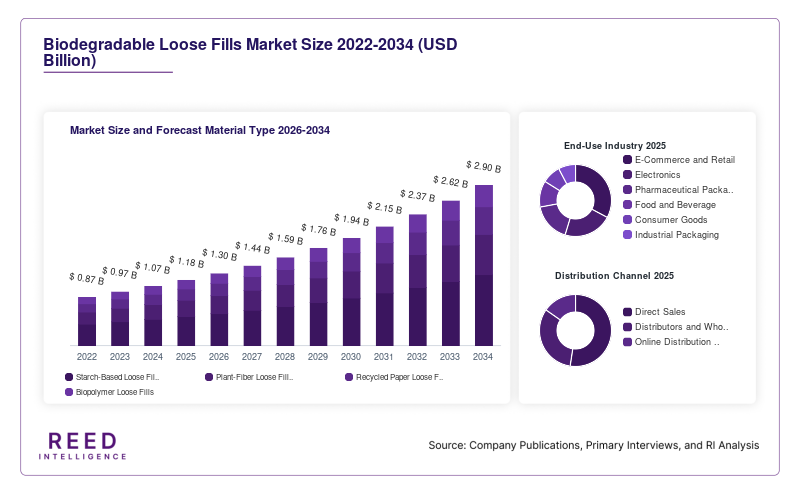
The global Biodegradable Loose Fills Market size was valued at USD 1.18 billion in 2026 and is projected to reach USD 2.63 billion by 2034, expanding at a CAGR of 10.5% during the forecast period from 2026 to 2034. The market is witnessing stable growth due to increasing demand for sustainable packaging materials across e-commerce, consumer goods, healthcare, and food distribution industries. Biodegradable loose fills, commonly manufactured using starch-based compounds, recycled paper, and plant-derived polymers, are gaining traction as governments and corporations continue to reduce dependence on petroleum-based protective packaging materials.
A major global factor supporting market growth is the accelerating implementation of sustainability regulations targeting single-use plastics and non-recyclable packaging waste. Several multinational retail and logistics companies are integrating compostable and biodegradable cushioning materials into shipping operations to align with carbon reduction goals and circular economy strategies. Rising online shopping activity has further intensified the need for lightweight protective packaging that can minimize transportation damage while maintaining environmental compliance. In addition, advancements in bio-based polymer processing technologies have improved product durability, moisture resistance, and storage stability, making biodegradable loose fills more commercially viable across industrial applications.
Key Highlights
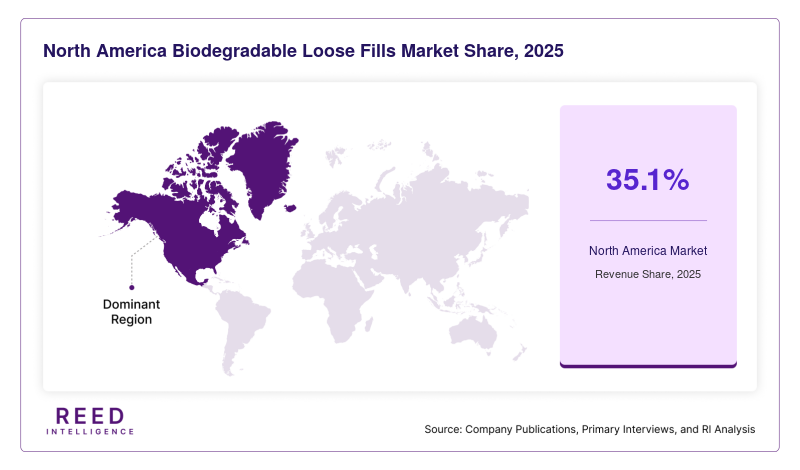
- North America dominated the market with a 35.1% share in 2025.
- Asia Pacific is expected to grow at the fastest CAGR of 11.8% during 2026–2034.
- By material type, starch-based loose fills accounted for the largest share of 46.3%.
- while plant-fiber loose fills are projected to grow at a CAGR of 12.6%.
- By end-use industry, e-commerce and retail led with a 39.4% share, whereas pharmaceutical packaging is expected to expand at a CAGR of 12.1%.
- The United States remained the dominant country, with market values of USD 302 million in 2024 and USD 336 million in 2025.
Market Trends
Expansion of Sustainable E-Commerce Packaging Solutions
The rapid expansion of global e-commerce activities has significantly influenced the adoption of biodegradable loose fills in protective packaging operations. Online retailers are increasingly replacing traditional polystyrene-based cushioning products with compostable loose fills to improve sustainability performance and strengthen brand reputation among environmentally aware consumers. Many logistics providers are implementing green packaging initiatives to reduce waste generation and improve recyclability throughout shipping networks. This transition is particularly visible in electronics, cosmetics, and home décor industries where product protection and environmental compliance are equally important. Additionally, major retailers are promoting zero-plastic shipping programs, encouraging suppliers to adopt biodegradable protective materials that can decompose naturally without causing long-term environmental impact.
Technological Advancements in Bio-Based Packaging Materials
Continuous innovation in starch blends, plant-fiber processing, and biodegradable polymer engineering is transforming product quality across the biodegradable loose fills market. Manufacturers are developing lightweight loose-fill materials with improved shock absorption, moisture resistance, and structural durability to compete more effectively with conventional synthetic alternatives. Research activities focused on corn starch, wheat starch, mushroom-based compounds, and cellulose materials are expanding commercial possibilities for sustainable protective packaging. Improved manufacturing efficiency has also reduced production costs, enabling broader market penetration among medium-sized businesses. In addition, smart packaging integration and enhanced product customization capabilities are encouraging adoption across pharmaceutical and industrial packaging applications where product safety standards remain highly stringent.
Market Drivers
Rising Government Regulations on Plastic Packaging Waste
Government regulations targeting non-biodegradable packaging materials are creating substantial growth opportunities for the biodegradable loose fills market. Countries across North America, Europe, and Asia Pacific are implementing stricter restrictions on single-use plastics and landfill-intensive packaging solutions. Regulatory authorities are encouraging manufacturers to adopt compostable and recyclable materials through environmental taxation, packaging directives, and waste reduction policies. Businesses operating in international supply chains are increasingly selecting biodegradable cushioning products to maintain compliance with evolving sustainability standards. The regulatory environment has also encouraged investment in bio-based packaging research and manufacturing expansion, helping improve supply availability and product affordability for commercial buyers across multiple industries.
Growing Consumer Preference for Environmentally Friendly Packaging
Consumer awareness regarding environmental sustainability continues to influence purchasing behavior across global retail sectors. Buyers increasingly prefer brands that demonstrate responsible packaging practices, especially within e-commerce, cosmetics, food delivery, and electronics industries. Biodegradable loose fills provide businesses with an opportunity to reduce environmental impact while improving customer perception of sustainable operations. Social media campaigns and environmental advocacy initiatives have accelerated awareness regarding packaging waste management and ocean pollution. As a result, retailers and manufacturers are integrating biodegradable protective packaging materials into product shipments to improve customer loyalty and align with sustainability commitments. This consumer-driven transition is expected to remain a significant growth driver during the forecast period.
Market Restraint
Higher Production Costs Compared to Conventional Loose Fills
One of the major restraints affecting the biodegradable loose fills market is the relatively higher production cost associated with bio-based raw materials and specialized processing technologies. Conventional polystyrene loose fills remain less expensive due to established supply chains, large-scale manufacturing infrastructure, and lower raw material costs. In contrast, biodegradable alternatives often require agricultural feedstocks, advanced polymer blending techniques, and controlled manufacturing environments, increasing overall production expenses. Small and medium-sized packaging companies may face financial challenges when transitioning toward sustainable cushioning materials because of limited capital investment capacity.
The pricing gap between biodegradable and traditional loose fills also affects adoption in cost-sensitive industries where packaging expenditure directly influences profit margins. In developing economies, limited composting infrastructure and insufficient awareness regarding biodegradable packaging benefits further slow market penetration. Some biodegradable loose fills additionally face performance limitations related to moisture exposure and long-term storage conditions, restricting use in specific industrial applications. Although technological advancements are gradually improving material efficiency and reducing costs, price competitiveness continues to remain a significant challenge for widespread global adoption.
Market Opportunities
Increasing Adoption Across Pharmaceutical and Healthcare Packaging
The pharmaceutical and healthcare industries present strong growth opportunities for biodegradable loose fills manufacturers. Medical product shipments require reliable protective packaging solutions capable of preventing damage during transportation while meeting strict environmental compliance requirements. Biodegradable cushioning materials are increasingly being adopted for packaging diagnostic equipment, medical devices, and temperature-sensitive pharmaceutical products. Healthcare providers and pharmaceutical companies are also strengthening sustainability commitments within procurement strategies, encouraging suppliers to reduce packaging waste. The rising demand for home healthcare deliveries and online pharmacy services is further supporting the need for lightweight and eco-friendly protective packaging solutions with enhanced shock absorption capabilities.
Expansion of Industrial Composting and Circular Economy Programs
The expansion of industrial composting infrastructure and circular economy initiatives is expected to create favorable conditions for biodegradable loose fills market growth. Governments, municipalities, and waste management organizations are investing in composting facilities capable of processing biodegradable packaging materials efficiently. This development improves disposal convenience for consumers and businesses while strengthening the environmental value proposition of biodegradable loose fills. In addition, corporate sustainability programs emphasizing recyclable and compostable packaging are encouraging long-term procurement contracts with biodegradable packaging suppliers. The increasing integration of circular economy principles within manufacturing and logistics sectors is expected to accelerate demand for packaging materials designed for reuse, recycling, and natural decomposition.
Segmental Analysis
By Material Type
Starch-based loose fills dominated the biodegradable loose fills market in 2024, accounting for approximately 46.3% of the global market share. These products are widely used because they provide effective cushioning performance while remaining lightweight and compostable. Corn starch and wheat starch are commonly utilized raw materials due to their cost efficiency and broad agricultural availability. E-commerce retailers and logistics companies prefer starch-based loose fills because they dissolve easily in water and generate minimal environmental waste. The segment also benefits from compatibility with automated packaging systems used in large-scale shipping operations. Rising consumer demand for naturally degradable packaging solutions has further strengthened adoption across electronics, cosmetics, and food distribution sectors globally.
Plant-fiber loose fills are projected to register the fastest CAGR of 12.6% during the forecast period. The increasing use of cellulose fibers, bamboo pulp, and agricultural residue materials is supporting segment growth across environmentally conscious industries. Manufacturers are developing advanced plant-fiber formulations with improved structural strength and moisture resistance to expand industrial applications. Growth is additionally supported by rising investment in renewable raw material processing technologies and sustainable packaging innovation. Companies focusing on premium and luxury packaging are increasingly selecting plant-fiber loose fills because they offer improved product presentation and enhanced environmental branding opportunities. Growing interest in plastic-free packaging alternatives is expected to accelerate segment expansion over the coming years.
By End-Use Industry
The e-commerce and retail segment held the largest market share in 2024, accounting for nearly 39.4% of global biodegradable loose fills demand. The expansion of online shopping platforms and direct-to-consumer delivery services has significantly increased the requirement for lightweight protective packaging materials. Retailers are increasingly replacing synthetic loose fills with biodegradable alternatives to reduce environmental impact and improve customer satisfaction. Sustainable packaging has become an important brand positioning strategy, particularly among fashion, electronics, and lifestyle product companies. The segment also benefits from increasing consumer scrutiny regarding shipping waste generation and packaging recyclability. Large e-commerce operators are implementing sustainability-focused packaging guidelines that encourage suppliers to adopt biodegradable cushioning materials across shipping operations.
The pharmaceutical packaging segment is anticipated to expand at the fastest CAGR of 12.1% from 2026 to 2034. Rising demand for secure transportation of medical devices, laboratory equipment, and pharmaceutical products is supporting the adoption of biodegradable protective packaging materials. Healthcare companies are increasingly emphasizing sustainability within procurement and supply chain operations, encouraging greater use of compostable packaging components. Growth in online pharmacy services and temperature-sensitive healthcare deliveries is also contributing to segment expansion. Manufacturers are developing specialized biodegradable loose fills with enhanced shock absorption and contamination-resistant properties suitable for pharmaceutical logistics requirements. Regulatory pressure regarding healthcare waste reduction is expected to further strengthen long-term growth opportunities within this segment.
By Distribution Channel
Direct sales accounted for the largest share of the biodegradable loose fills market in 2024, representing approximately 57.2% of total revenue. Large packaging manufacturers and industrial buyers commonly prefer direct procurement arrangements to ensure consistent product quality, bulk supply availability, and customized packaging specifications. Direct sales channels allow manufacturers to establish long-term relationships with logistics providers, e-commerce companies, and industrial distributors. This channel additionally supports technical consultation services and customized biodegradable loose-fill product development tailored to specific shipping applications. Businesses seeking sustainable packaging certification and supply chain transparency often rely on direct sourcing agreements to improve operational efficiency and regulatory compliance within global packaging networks.
Online distribution channels are projected to witness the fastest CAGR of 11.9% during the forecast period due to the increasing digitalization of packaging procurement processes. Small and medium-sized enterprises are increasingly purchasing biodegradable loose fills through online platforms because of product accessibility, pricing transparency, and simplified order management systems. E-commerce marketplaces specializing in sustainable industrial products are also contributing to segment expansion. Manufacturers are improving digital marketing strategies and expanding online product catalogs to strengthen market visibility and customer engagement. Additionally, rising awareness regarding environmentally friendly packaging among startups and independent retailers is accelerating online purchasing activity for biodegradable cushioning materials worldwide.
Regional Analysis
North America
North America accounted for 35.1% of the global biodegradable loose fills market share in 2025 and is expected to maintain a stable growth trajectory during the forecast period. The region is projected to expand at a CAGR of 9.8% from 2026 to 2034 due to increasing adoption of sustainable packaging solutions across retail, healthcare, and industrial sectors. The presence of advanced logistics infrastructure and widespread e-commerce penetration continues to support market demand. Several businesses are transitioning toward compostable packaging systems to align with environmental regulations and corporate sustainability goals.
The United States dominated the regional market owing to high demand from online retail distribution networks and packaging manufacturers. The country recorded market values of USD 302 million in 2024 and USD 336 million in 2025. A major growth factor supporting market expansion is the implementation of stricter state-level regulations limiting expanded polystyrene usage in packaging applications. Large retailers and third-party logistics providers are increasingly integrating biodegradable cushioning materials into shipping operations to improve environmental performance and consumer perception.
Europe
Europe represented a substantial share of the biodegradable loose fills market in 2025 and is forecast to grow at a CAGR of 10.1% during the assessment period. The region benefits from strong environmental awareness, advanced recycling infrastructure, and comprehensive packaging waste management policies. Increasing emphasis on reducing landfill dependency and plastic pollution is encouraging businesses to adopt compostable packaging alternatives. Industries including cosmetics, food delivery, and luxury consumer goods are increasingly using biodegradable loose fills to improve sustainability compliance and enhance packaging aesthetics.
Germany emerged as the dominant country within the European market due to its strong manufacturing base and extensive environmental regulations related to packaging waste reduction. The country continues to invest in bio-based material innovation and industrial composting capabilities. A unique growth factor driving regional demand is the integration of circular economy frameworks within industrial packaging supply chains. Several European manufacturers are also collaborating with research institutions to develop high-performance biodegradable cushioning materials suitable for automated packaging systems.
Asia Pacific
Asia Pacific is anticipated to register the fastest CAGR of 11.8% during 2026–2034 due to rapid industrialization, rising e-commerce penetration, and increasing awareness regarding sustainable packaging practices. Expanding manufacturing operations across China, India, Japan, and Southeast Asia are contributing to higher demand for protective packaging materials. Governments across the region are implementing regulations aimed at reducing plastic waste generation, which is accelerating interest in biodegradable packaging alternatives. Rising disposable income and changing consumer preferences are additionally supporting adoption across retail and food delivery sectors.
China remained the leading country in the Asia Pacific biodegradable loose fills market because of its extensive manufacturing ecosystem and large-scale online retail industry. The country is witnessing increased investment in bio-based packaging production facilities and agricultural raw material processing technologies. A unique factor contributing to regional market growth is the abundance of starch-based agricultural feedstocks used in biodegradable material manufacturing. This availability supports localized production capabilities and reduces dependency on imported petroleum-derived packaging materials.
Middle East & Africa
The Middle East & Africa biodegradable loose fills market is experiencing gradual expansion and is projected to grow at a CAGR of 8.6% during the forecast period. Increasing sustainability awareness among multinational corporations operating in the region is encouraging the adoption of environmentally friendly packaging materials. Growth in e-commerce distribution channels and industrial imports is also supporting demand for protective packaging solutions. Several governments are implementing waste reduction initiatives and environmental sustainability strategies that indirectly support biodegradable packaging adoption across commercial sectors.
The United Arab Emirates dominated the regional market due to rising investments in sustainable retail infrastructure and logistics modernization projects. Businesses in the country are increasingly adopting green packaging materials to align with environmental sustainability targets and tourism-related waste reduction programs. A unique growth factor in the region is the increasing use of biodegradable packaging within premium retail and luxury product distribution channels. Companies targeting environmentally conscious consumers are adopting compostable loose fills to strengthen brand differentiation and sustainability positioning.
Latin America
Latin America accounted for a moderate share of the biodegradable loose fills market in 2025 and is expected to expand steadily throughout the forecast period. The region is projected to grow at a CAGR of 9.1% from 2026 to 2034 due to rising environmental awareness and gradual adoption of sustainable packaging practices. Expanding online retail activity and improving logistics infrastructure are supporting demand for protective packaging materials. Government initiatives promoting waste reduction and recycling are additionally encouraging businesses to explore biodegradable cushioning alternatives.
Brazil emerged as the leading country in the Latin American market because of its large consumer goods industry and growing packaging manufacturing sector. The country is witnessing increasing demand for sustainable packaging products from food distribution and cosmetics companies. A unique factor supporting regional growth is the availability of agricultural biomass resources used in bio-based packaging production. Local manufacturers are leveraging sugarcane derivatives, corn starch, and cellulose materials to develop biodegradable loose fills suitable for domestic and export packaging applications.
Competitive Landscape
The biodegradable loose fills market remains moderately fragmented, with several international and regional packaging companies competing through product innovation, sustainability initiatives, and strategic partnerships. Leading manufacturers are focusing on expanding biodegradable material portfolios, improving moisture resistance capabilities, and strengthening global distribution networks. Competitive strategies also include investments in automated manufacturing technologies and research activities focused on plant-based polymers and compostable packaging solutions.
Ranpak Holdings Corp. emerged as one of the leading companies in the market due to its strong sustainable packaging portfolio and extensive logistics industry partnerships. The company has expanded production capacity for eco-friendly protective packaging materials to address rising demand from e-commerce and industrial customers. Other key participants including Storopack, Sealed Air, EcoEnclose, and ACH Foam Technologies are also investing in biodegradable packaging innovation and international market expansion strategies.
Key Players
- Ranpak Holdings Corp.
- Storopack Hans Reichenecker GmbH
- Sealed Air
- EcoEnclose
- ACH Foam Technologies
- Pregis LLC
- Cortec Corporation
- Green Light Packaging
- Alsamex Products Pvt. Ltd.
- Rengo Co., Ltd.
- FP International
- Veritiv Corporation
- DS Smith
- Smurfit Westrock
Recent Developments
- In February 2026, Storopack Hans Reichenecker GmbH introduced biodegradable loose-fill packaging made from enhanced plant-based starch compounds designed for improved moisture resistance in logistics applications.
- In September 2025, Ranpak Holdings Corp. expanded its sustainable packaging manufacturing operations in North America to increase production capacity for compostable loose-fill solutions used in e-commerce packaging.
- In June 2025, Sealed Air announced the development of advanced biodegradable cushioning materials targeting pharmaceutical, retail, and industrial protective packaging applications.
Biodegradable Loose Fills Market Segments
Material Type
- Starch-Based Loose Fills
- Plant-Fiber Loose Fills
- Recycled Paper Loose Fills
- Biopolymer Loose Fills
End-Use Industry
- E-Commerce and Retail
- Electronics
- Pharmaceutical Packaging
- Food and Beverage
- Consumer Goods
- Industrial Packaging
Distribution Channel
- Direct Sales
- Distributors and Wholesalers
- Online Distribution Channels
By Region
- North America
- Europe
- APAC
- Middle East and Africa
- LATAM