Biodegradable Micro Screw Market Size, Share, Growth Demand Report by Material Type (Polycaprolactone (PCL)-Based Screws, Polyglycolic Acid (PGA) Composite Screws, Hybrid Bioabsorbable Polymer Screws), By Application (Orthopedic Trauma Fixation, Sports Injury Reconstruction, Dental and Maxillofacial Surgery), By End Use (Hospitals, Ambulatory Surgical Centers, Research Institutions), and Regional Forecasts, 2026–2034
USD 3950
Market Overview
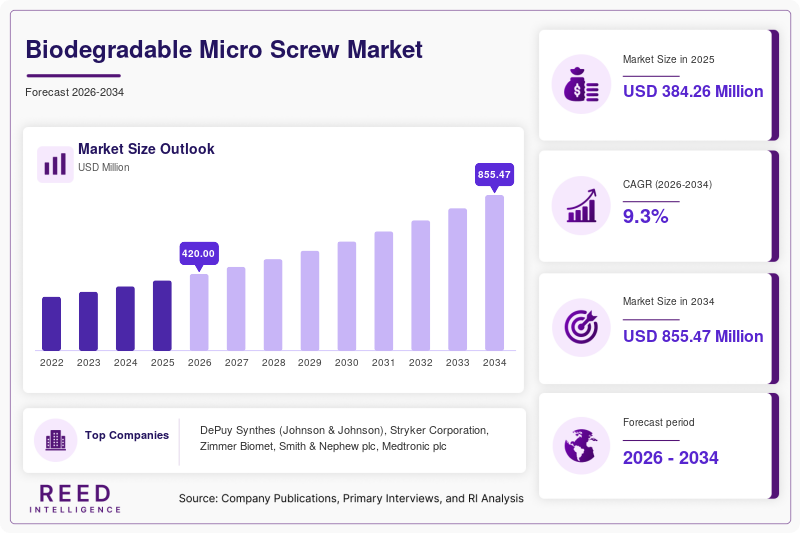
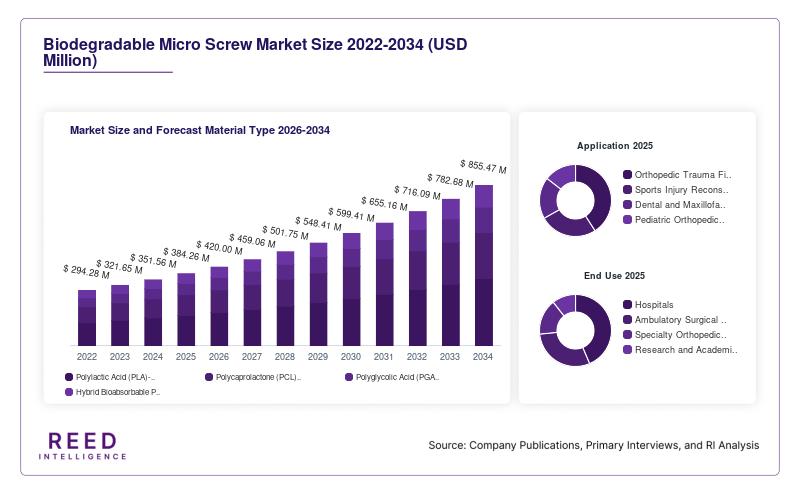
The Biodegradable Micro Screw Market is projected to reach a value of USD 420 million in 2026 and is anticipated to grow to USD 860 million by 2034, registering a CAGR of 9.3% (2026–2034). The market expansion is primarily driven by the rising adoption of bioabsorbable orthopedic fixation devices, especially in minimally invasive surgeries where temporary fixation without secondary removal procedures is preferred. Increasing global surgical volumes, coupled with advancements in biocompatible polymer engineering, have significantly strengthened the adoption of biodegradable micro screws across trauma and orthopedic applications.
A major global factor supporting market growth is the growing emphasis on reducing post-surgical complications and hospital readmission rates. Biodegradable micro screws eliminate the need for implant removal surgeries, reducing healthcare costs and improving patient recovery outcomes. Additionally, increasing investments in regenerative medicine and orthopedic biomaterials have accelerated innovation in screw design, including improved mechanical strength and controlled degradation rates.
Key Highlights
- North America dominated the market with a 34.6% share in 2025.
- Asia Pacific is expected to grow at the fastest CAGR of 10.8% during 2026–2034.
- By material type, polylactic acid (PLA)-based screws accounted for the largest share of 39.2%.
- while polycaprolactone (PCL)-based variants are projected to grow at a CAGR of 11.5%.
- By application, orthopedic trauma fixation led with a 42.1% share, whereas sports injury reconstruction is expected to expand at a CAGR of 10.9%.
- The United States remained the dominant country, with market values of USD 150 million in 2024 and USD 165 million in 2025.
Market Trends
Rising Shift Toward Bioabsorbable Orthopedic Fixation
The adoption of bioabsorbable fixation devices is emerging as a major trend in the biodegradable micro screw market. Hospitals and surgical centers are increasingly replacing metallic implants with biodegradable alternatives to reduce complications associated with long-term implant retention. These screws gradually dissolve in the body, eliminating the need for secondary removal surgery. This shift is particularly prominent in pediatric orthopedics and sports medicine, where patient mobility and reduced surgical interventions are critical. Manufacturers are focusing on improving degradation control and mechanical strength to match or exceed traditional titanium-based screws.
Advancements in Polymer Engineering and 3D Printing Integration
Technological advancements in polymer science and additive manufacturing are transforming biodegradable micro screw production. Innovations in 3D printing allow for customized screw geometries tailored to patient-specific anatomical needs. This enhances surgical precision and fixation stability. Furthermore, the development of composite polymers with enhanced load-bearing capacity and controlled degradation profiles is expanding application scope. Research institutions and medical device companies are collaborating to develop next-generation biodegradable screws with antimicrobial properties and improved osteointegration, supporting long-term market evolution.
Market Drivers
Increasing Prevalence of Orthopedic Injuries and Trauma Cases
The rising incidence of orthopedic injuries, particularly fractures caused by accidents, sports activities, and aging populations, is a key driver of the biodegradable micro screw market. Hospitals are witnessing a higher number of trauma surgeries requiring fixation devices that offer temporary support without long-term complications. Biodegradable micro screws provide an effective solution by stabilizing bone fragments during healing and naturally dissolving afterward. This reduces patient discomfort and eliminates the risks associated with hardware removal surgeries, thereby increasing their adoption in both developed and emerging healthcare systems.
Growing Demand for Minimally Invasive Surgical Procedures
The global shift toward minimally invasive surgical techniques is significantly boosting demand for biodegradable micro screws. Surgeons prefer smaller implants that reduce tissue damage, minimize infection risks, and shorten recovery time. These screws are widely used in arthroscopic and reconstructive procedures where precision and minimal disruption are essential. Healthcare providers are also adopting these devices to improve operational efficiency and patient satisfaction. The compatibility of biodegradable screws with advanced surgical tools and imaging systems further enhances their integration into modern operating environments.
Market Restraint
Limited Mechanical Strength Compared to Metallic Alternatives
One of the primary restraints affecting the biodegradable micro screw market is their comparatively lower mechanical strength when compared to traditional metallic screws. In high-load orthopedic applications, concerns remain regarding their ability to maintain structural integrity during the entire healing process. In certain complex fractures, surgeons still prefer titanium or stainless steel implants due to their superior load-bearing capabilities. This limitation restricts the use of biodegradable screws in high-stress orthopedic conditions, slowing down full-scale market penetration despite ongoing material advancements.
Market Opportunities
Expansion in Pediatric and Sports Medicine Applications
The growing use of biodegradable micro screws in pediatric and sports medicine represents a significant market opportunity. In pediatric cases, avoiding secondary surgeries for implant removal is highly beneficial, as it reduces risk and psychological stress for young patients. Similarly, sports medicine applications require fast recovery and minimal surgical intervention, making biodegradable screws ideal. Increasing sports participation globally and rising awareness of injury management solutions are expected to drive further adoption in these specialized fields over the forecast period.
Emergence of Smart Bioabsorbable Implant Technologies
The development of smart biodegradable implants embedded with sensors and drug-delivery capabilities is opening new growth avenues. These advanced screws can monitor healing progression or release therapeutic agents to accelerate bone regeneration. Research institutions are exploring bioactive coatings and nanotechnology-based enhancements to improve performance. Such innovations are expected to redefine orthopedic treatment approaches and create high-value opportunities for manufacturers focusing on next-generation biodegradable implant systems.
Segmental Analysis
By Material Type
Polylactic acid (PLA)-based micro screws accounted for approximately 39.2% share in 2024, making them the dominant material segment. Their widespread usage is attributed to excellent biocompatibility, predictable degradation behavior, and suitability for a wide range of orthopedic applications. PLA-based screws are extensively used in trauma fixation and reconstructive surgeries due to their balance of mechanical strength and safe absorption within the body over time.
Polycaprolactone (PCL)-based screws are projected to grow at a CAGR of 11.5%, driven by their slower degradation rate and improved flexibility. These characteristics make them suitable for long-term bone healing applications. Increasing research into hybrid polymer compositions is further enhancing their mechanical properties, making them increasingly competitive in advanced orthopedic procedures.
By Application
Orthopedic trauma fixation dominated with a 42.1% share in 2024, driven by high incidence of fractures and accident-related injuries. These screws are widely used in stabilizing bone fragments and supporting healing without requiring removal surgeries. Hospitals prefer them due to reduced post-operative complications and improved patient recovery outcomes.
Sports injury reconstruction is projected to grow at a CAGR of 10.9%, supported by increasing participation in professional and recreational sports. Demand for minimally invasive procedures and faster recovery times is accelerating adoption in ligament and tendon repair surgeries.
By End Use
Hospitals accounted for a 45.6% share in 2024, making them the largest end-use segment due to high surgical volumes and availability of advanced orthopedic facilities. Hospitals continue to be the primary adopters of biodegradable micro screws in trauma and reconstructive procedures.
Ambulatory surgical centers are expected to grow at a CAGR of 10.7%, driven by increasing preference for outpatient surgeries and cost-efficient treatment models. These centers benefit from reduced procedure times and faster patient turnover.
Regional Analysis
North America
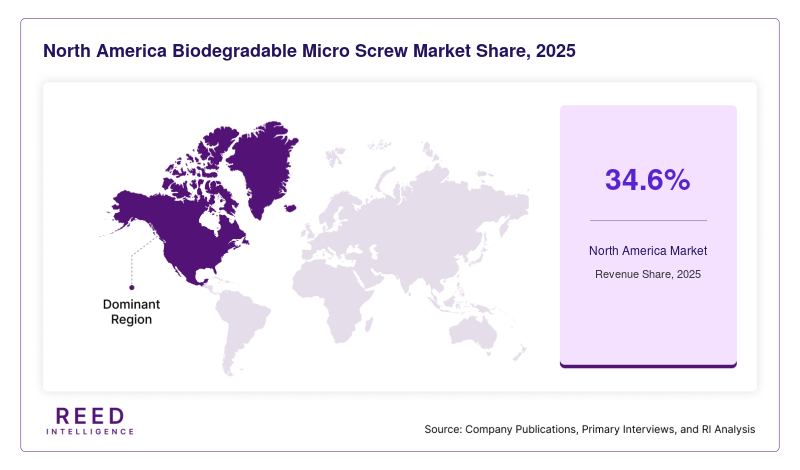
North America accounted for approximately 34.6% market share in 2025, with steady growth projected at a CAGR of 8.9% through 2034.
The region benefits from advanced healthcare infrastructure and high adoption of minimally invasive surgical procedures, which strongly support demand for biodegradable micro screws.
The United States dominates the regional market due to strong presence of leading medical device manufacturers and high orthopedic surgery volumes. Increasing investments in biodegradable biomaterials research and favorable reimbursement policies further enhance adoption across hospitals and specialty clinics.
Europe
Europe held around 27.3% market share in 2025, expanding at a CAGR of 8.5% during 2026–2034.
Strong regulatory support for sustainable medical devices and increasing preference for bioabsorbable implants contribute to regional growth.
Germany leads the European market, driven by its well-established orthopedic device industry and strong focus on medical innovation. Rising aging population and increasing demand for joint reconstruction surgeries also support consistent market expansion.
Asia Pacific
Asia Pacific captured nearly 23.8% market share in 2025, expected to grow at the fastest CAGR of 10.8%.
Rapid healthcare infrastructure development and increasing surgical procedures are key growth factors.
China dominates the region due to large patient population and expanding hospital networks. Rising medical tourism and government investments in advanced surgical technologies further strengthen regional adoption.
Middle East & Africa
The Middle East & Africa accounted for 7.2% market share in 2025, with a CAGR of 8.2% projected through 2034.
Growth is supported by improving healthcare systems and rising orthopedic treatment demand.
Saudi Arabia leads the region due to increasing healthcare modernization programs and growing investments in specialized surgical centers.
Latin America
Latin America held around 6.9% market share in 2025, expanding at a CAGR of 8.4%.
Increasing awareness of advanced orthopedic solutions is driving adoption.
Brazil dominates the regional market, supported by expanding private healthcare infrastructure and growing demand for minimally invasive surgical procedures.
Competitive Landscape
The Biodegradable Micro Screw Market is moderately consolidated with key players focusing on biomaterial innovation and strategic collaborations. Leading companies include DePuy Synthes (Johnson & Johnson), Stryker Corporation, Zimmer Biomet, Smith & Nephew, and Medtronic. These companies are investing in next-generation bioabsorbable implant technologies and expanding their orthopedic portfolios.
DePuy Synthes remains a leading player due to its strong global distribution network and extensive orthopedic product range. Recent developments include advancements in bioresorbable polymer screw systems designed for improved load-bearing capacity and controlled degradation performance.
Key Players
- DePuy Synthes (Johnson & Johnson)
- Stryker Corporation
- Zimmer Biomet
- Smith & Nephew
- Medtronic
- Arthrex Inc.
- B. Braun Melsungen AG
- Integra LifeSciences
- Wright Medical Group
- KLS Martin Group
- OsteoMed
- Acumed LLC
- Medartis AG
- Globus Medical
- CONMED Corporation
Recent Developments
- Several manufacturers have introduced next-generation PLA-PGA hybrid screws with enhanced mechanical strength and controlled degradation timelines.
- Research collaborations between universities and medical device companies have accelerated development of antimicrobial biodegradable screws to reduce post-surgical infections.
- Leading orthopedic firms have expanded production facilities in Asia Pacific to meet rising regional demand for bioabsorbable surgical implants.
Biodegradable Micro Screw Market Segments
Material Type
- Polylactic Acid (PLA)-Based Micro Screws
- Polycaprolactone (PCL)-Based Micro Screws
- Polyglycolic Acid (PGA) Composite Screws
- Hybrid Bioabsorbable Polymer Screws
Application
- Orthopedic Trauma Fixation
- Sports Injury Reconstruction
- Dental and Maxillofacial Surgery
- Pediatric Orthopedic Procedures
End Use
- Hospitals
- Ambulatory Surgical Centers
- Specialty Orthopedic Clinics
- Research and Academic Institutes
By Region
- North America
- Europe
- APAC
- Middle East and Africa
- LATAM