Bioengineered Protein Drugs Market Size, Share & Demand Report By Type (Monoclonal Antibodies, Recombinant Hormones, Recombinant Enzymes, Fusion Proteins), By Application (Oncology, Autoimmune Diseases, Infectious Diseases, Rare Diseases), By End-Use (Hospitals, Specialty Clinics, Research Institutes), By Distribution Channel (Hospital Pharmacies, Retail Pharmacies, Online Pharmacies), By Region & Segment Forecasts, 2025–2034
USD 3950
Market Overview
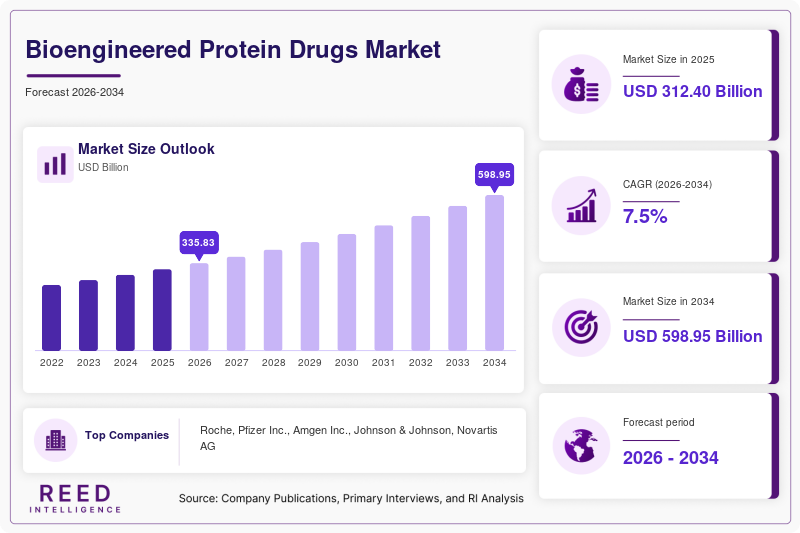
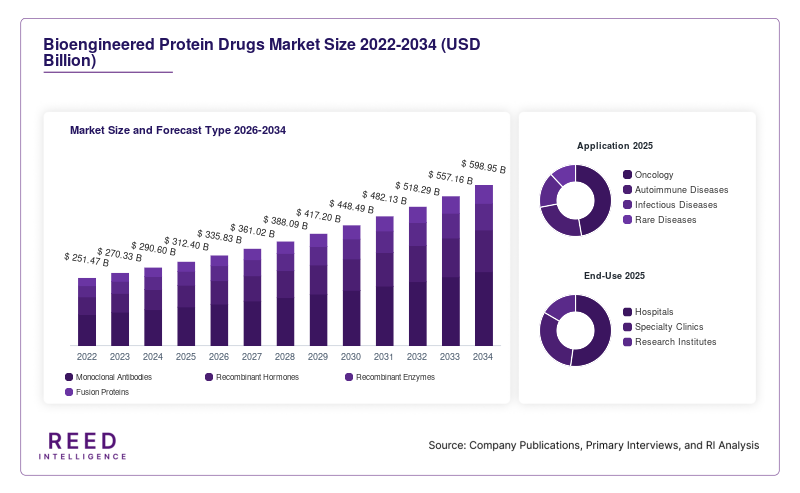
The global Bioengineered Protein Drugs Market size was valued at USD 312.4 billion in 2025 and is projected to reach USD 598.7 billion by 2034, expanding at a CAGR of 7.5% during 2025–2034. The market growth has been supported by the rising global demand for targeted therapeutics and precision medicine approaches, particularly in treating chronic and complex diseases such as cancer, autoimmune disorders, and rare genetic conditions.
A major global factor contributing to the expansion of the Bioengineered Protein Drugs Market is the increasing integration of recombinant DNA technology and advanced biologics manufacturing. Pharmaceutical companies are leveraging bioengineering techniques to develop highly specific protein-based drugs with improved efficacy and reduced side effects compared to conventional small-molecule drugs. Additionally, favorable regulatory pathways for biologics and biosimilars have accelerated product approvals, enhancing market penetration across developed and emerging economies.
Key Highlights
- North America dominated the market with 41.2% share in 2025, while Asia Pacific is expected to register the fastest CAGR of 9.1%.
- Monoclonal antibodies emerged as the leading type segment with 48.6% share, while recombinant enzymes are projected to grow at a CAGR of 8.8%.
- Oncology was the dominant application segment with 36.9% share, while rare diseases are anticipated to grow at a CAGR of 9.4%.
- The U.S. market was valued at USD 118.6 billion in 2025 and is estimated to reach USD 125.9 billion in 2026.
Market Trends
Expansion of Biosimilars and Biobetters
The Bioengineered Protein Drugs Market is witnessing increased development and adoption of biosimilars and biobetters. As patents for major biologics expire, manufacturers are introducing cost-effective biosimilars that enhance accessibility while maintaining comparable efficacy. Biobetters, which are improved versions of existing biologics, are also gaining traction due to their enhanced pharmacokinetic profiles and longer half-lives. This trend is reducing treatment costs and expanding patient reach across emerging economies.
Integration of Artificial Intelligence in Protein Engineering
Artificial intelligence is transforming drug discovery and protein engineering by enabling faster identification of therapeutic targets and optimization of protein structures. AI-driven platforms are improving the accuracy of protein folding predictions and reducing development timelines. This technological shift is accelerating innovation in the Bioengineered Protein Drugs Market, allowing companies to bring novel therapies to market more efficiently while minimizing research costs.
Market Drivers
Rising Prevalence of Chronic and Genetic Disorders
The increasing global burden of chronic diseases such as cancer, diabetes, and autoimmune disorders is a major driver of the Bioengineered Protein Drugs Market. Protein-based therapeutics offer targeted mechanisms of action, making them highly effective for conditions requiring precision treatment. As disease prevalence continues to rise, demand for advanced biologics is expected to increase steadily.
Advancements in Bioprocessing Technologies
Technological advancements in upstream and downstream bioprocessing have significantly improved the production efficiency of bioengineered protein drugs. Innovations such as single-use bioreactors, continuous manufacturing, and improved cell line development have reduced production costs and increased scalability. These advancements are enabling pharmaceutical companies to meet growing demand while maintaining quality and compliance standards.
Market Restraint
High Development and Manufacturing Costs
Despite strong growth prospects, the Bioengineered Protein Drugs Market faces challenges related to high development and manufacturing costs. The production of bioengineered proteins involves complex processes, including cell culture, purification, and quality control, which require significant investment in infrastructure and expertise. Additionally, stringent regulatory requirements for biologics increase the cost and time associated with product development and approval.
These cost-related challenges can limit market entry for smaller players and restrict the affordability of biologics in low- and middle-income countries. Pricing pressures and reimbursement limitations further constrain market expansion, particularly in regions with underdeveloped healthcare systems.
Market Opportunities
Growth in Personalized Medicine
The shift toward personalized medicine presents significant opportunities for the Bioengineered Protein Drugs Market. Advances in genomics and biomarker identification are enabling the development of tailored protein therapies that target specific patient populations. This approach improves treatment outcomes and reduces adverse effects, driving demand for customized biologics.
Expansion in Emerging Markets
Emerging economies in Asia Pacific, Latin America, and the Middle East are offering lucrative growth opportunities due to improving healthcare infrastructure and increasing investment in biotechnology. Governments in these regions are supporting local manufacturing and encouraging foreign investment, which is expected to boost the availability and adoption of bioengineered protein drugs.
Segmental Analysis
By Type
Monoclonal antibodies dominated the Bioengineered Protein Drugs Market with a 48.6% share in 2025, owing to their widespread use in treating cancer and autoimmune diseases. Their high specificity and effectiveness made them a preferred choice among healthcare providers.
Recombinant enzymes are projected to be the fastest-growing subsegment, with a CAGR of 8.8%. Their increasing use in enzyme replacement therapies for rare diseases will drive growth, supported by advancements in protein engineering techniques.
By Application
Oncology held the largest share of 36.9% in 2025, driven by the increasing incidence of cancer and the effectiveness of protein-based therapies in targeted treatment.
Rare diseases are expected to grow at the fastest CAGR of 9.4%, as ongoing research and orphan drug incentives encourage the development of specialized therapies for underserved patient populations.
By End-Use
Hospitals accounted for the largest share of 52.3% in 2025, due to the availability of advanced treatment facilities and skilled healthcare professionals.
Specialty clinics are anticipated to grow at a CAGR of 8.5%, driven by the increasing demand for focused and personalized treatment services.
By Distribution Channel
Hospital pharmacies dominated with a 45.7% share in 2025, as most biologics are administered in clinical settings requiring professional supervision.
Online pharmacies are projected to grow at a CAGR of 9.0%, supported by the expansion of digital healthcare platforms and increasing patient preference for convenience.
Regional Analysis
North America
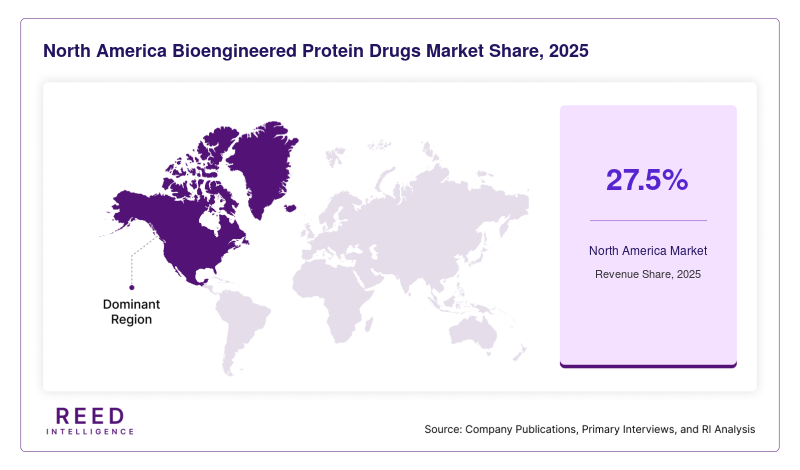
Accounted for 41.2% of the Bioengineered Protein Drugs Market share in 2025 and is projected to grow at a CAGR of 6.8% during the forecast period. The region had a well-established biopharmaceutical industry and strong research infrastructure supporting biologics development.
The United States dominated the regional market due to its advanced healthcare system and high adoption of innovative therapies. A key growth factor was the presence of leading biopharmaceutical companies and extensive clinical research activities, which facilitated rapid development and commercialization of protein-based drugs.
Europe
Europe held 27.5% market share in 2025 and is expected to grow at a CAGR of 6.9% through 2034. The region benefited from supportive regulatory frameworks and increasing focus on biosimilars adoption.
Germany emerged as the dominant country, driven by strong manufacturing capabilities and government support for biotechnology innovation. The country’s emphasis on research collaboration between academic institutions and industry players contributed to market expansion.
Asia Pacific
Asia Pacific captured 19.8% share in 2025 and is anticipated to grow at the fastest CAGR of 9.1%. Rapid economic development and increasing healthcare expenditure supported market growth.
China led the region due to its expanding biopharmaceutical sector and government initiatives promoting domestic biologics production. Investments in research facilities and favorable policies encouraged both local and international companies to establish operations in the country.
Middle East & Africa
The Middle East & Africa accounted for 6.1% share in 2025 and is projected to grow at a CAGR of 7.3%. The region experienced gradual growth supported by improving healthcare infrastructure and rising awareness of advanced therapies.
Saudi Arabia dominated the regional market, driven by government investments in healthcare modernization and increasing demand for biologics treatments. Strategic partnerships with global pharmaceutical companies further enhanced market development.
Latin America
Latin America held 5.4% share in 2025 and is expected to grow at a CAGR of 7.0%. The region showed steady growth due to increasing access to biologics and expanding healthcare coverage.
Brazil emerged as the leading country, supported by government initiatives to promote biosimilars and local production. Growing investments in biotechnology research and development contributed to the country’s market growth.
Competitive Landscape
The Bioengineered Protein Drugs Market is characterized by the presence of established biopharmaceutical companies focusing on innovation and strategic collaborations. Leading players are investing in research and development to expand their biologics portfolios and strengthen market positions.
One prominent market leader is Roche, which continues to advance its monoclonal antibody pipeline and recently introduced a next-generation biologic targeting oncology indications. The company’s strong global presence and focus on precision medicine have reinforced its leadership in the market.
Other key players are actively engaged in mergers, acquisitions, and partnerships to enhance their capabilities and expand their geographic reach. The competitive landscape remains dynamic, with companies striving to develop differentiated products and improve manufacturing efficiency.
Key Players List
- Roche
- Pfizer Inc.
- Amgen Inc.
- Johnson & Johnson
- Novartis AG
- Sanofi S.A.
- AbbVie Inc.
- Bristol-Myers Squibb
- Merck & Co., Inc.
- Eli Lilly and Company
- GlaxoSmithKline plc
- AstraZeneca plc
- Biogen Inc.
- Takeda Pharmaceutical Company Limited
- Regeneron Pharmaceuticals, Inc.
Recent Developments
- 2024: A leading biopharmaceutical company launched a novel monoclonal antibody for oncology treatment, improving patient response rates.
- 2024: Strategic collaboration between global firms to enhance biosimilars production capacity.
- 2023: Expansion of biologics manufacturing facilities in Asia Pacific to meet rising demand.
- 2023: Regulatory approval of a recombinant enzyme therapy for rare genetic disorders.
- 2023: Increased investment in AI-driven protein engineering platforms to accelerate drug discovery.
Bioengineered Protein Drugs Market Segments
Type
- Monoclonal Antibodies
- Recombinant Hormones
- Recombinant Enzymes
- Fusion Proteins
Application
- Oncology
- Autoimmune Diseases
- Infectious Diseases
- Rare Diseases
End-Use
- Hospitals
- Specialty Clinics
- Research Institutes
Distribution Channel
- Hospital Pharmacies
- Retail Pharmacies
- Online Pharmacies
By Region
- North America
- Europe
- APAC
- Middle East and Africa
- LATAM