Biomedical Tester Market Size, Share & Demand Report By Product Type (Electrical Safety Testers, Performance Testers, Multifunction Testers), By Application (Hospital Equipment Testing, Laboratory Diagnostics, Medical Device Manufacturing), By End-Use (Hospitals, Diagnostic Laboratories, Research Institutes), By Region & Segment Forecasts, 2026–2034
USD 3950
Market Overview
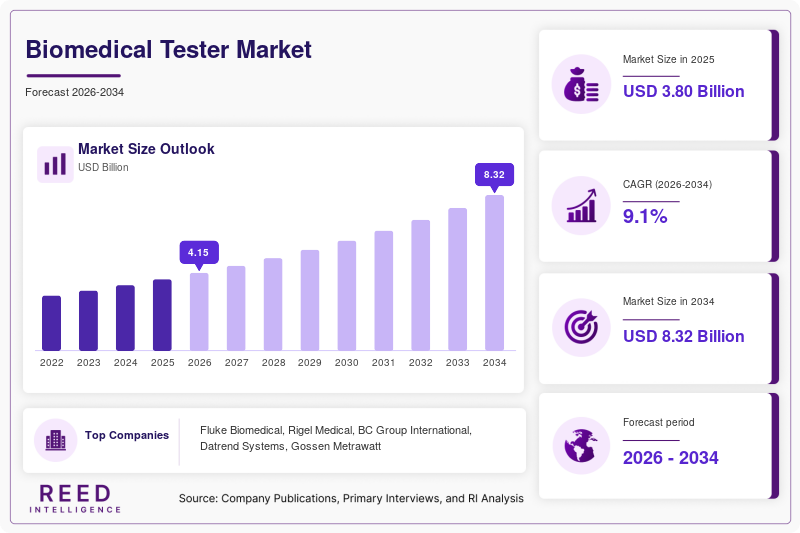
The Biomedical Tester Market was valued at approximately USD 3.8 billion in 2026 and is projected to reach USD 7.6 billion by 2034, expanding at a CAGR of 9.1% during the forecast period (2026–2034). The market growth is primarily driven by the increasing need for accurate diagnostic testing and quality assurance in medical devices and laboratory equipment. Biomedical testers play a critical role in ensuring compliance with safety standards, enhancing diagnostic precision, and supporting healthcare infrastructure modernization.
A key global factor supporting market growth is the rapid expansion of healthcare infrastructure, especially in emerging economies. Governments and private institutions are investing heavily in hospitals, diagnostic labs, and medical device manufacturing facilities. This expansion has created sustained demand for advanced biomedical testing solutions to ensure reliability and regulatory compliance. Additionally, the integration of digital technologies into healthcare systems has increased the need for sophisticated testing equipment that can deliver precise, real-time results.
Key Highlights
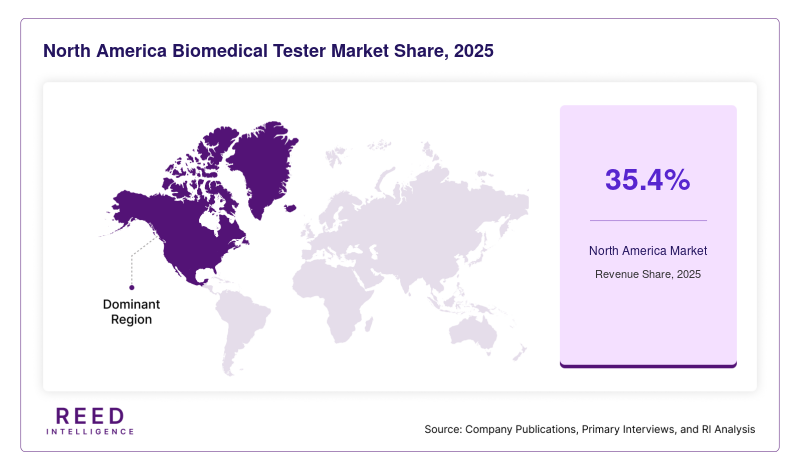
- North America dominated the market with a 35.4% share in 2025.
- Asia Pacific is expected to grow at the fastest CAGR of 10.8% during 2026–2034.
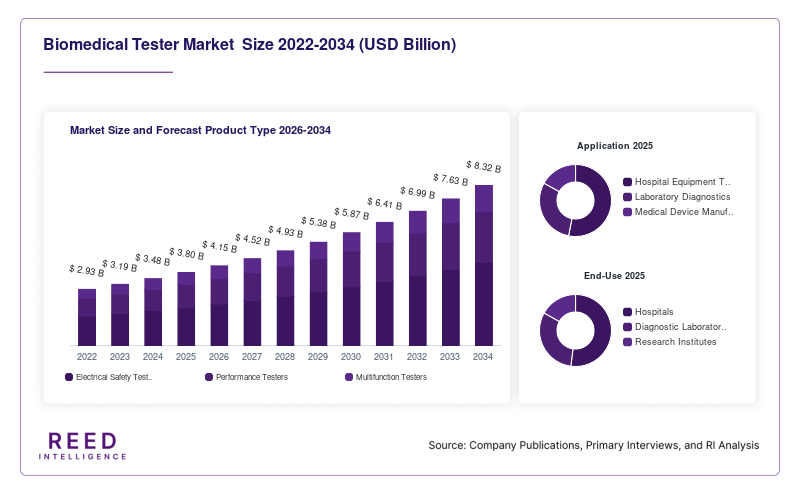
- By product type, electrical safety testers accounted for the largest share of 39.2%.
- while multifunction testers are projected to grow at a CAGR of 11.6%.
- By application, hospital equipment testing led with a 42.8% share, whereas laboratory diagnostics is expected to expand at a CAGR of 10.9%.
- The United States remained the dominant country, with market values of USD 820 million in 2024 and USD 890 million in 2025.
Market Trends
Integration of Automation and AI in Biomedical Testing
Automation and artificial intelligence are becoming central to the evolution of the Biomedical Tester Market. Modern biomedical testers are increasingly equipped with intelligent software capable of performing self-calibration, predictive maintenance, and automated reporting. These systems reduce human intervention, which improves accuracy and consistency in testing outcomes. Laboratories and hospitals are adopting AI-enabled testers to streamline workflows and manage large volumes of diagnostic data efficiently. Furthermore, automation allows technicians to focus on analytical tasks rather than repetitive procedures, improving operational productivity. The trend is also supported by regulatory bodies that emphasize standardized and traceable testing procedures. As a result, manufacturers are investing in smart testing platforms that integrate seamlessly with hospital information systems, enhancing interoperability and data-driven decision-making.
Rising Adoption of Portable and Handheld Testing Devices
The demand for portable biomedical testers is increasing due to the growing need for point-of-care diagnostics and field-based equipment validation. Handheld devices offer flexibility and ease of use, making them suitable for remote healthcare settings, emergency services, and home healthcare environments. These compact testers are designed to deliver reliable results while maintaining compliance with safety standards. The shift toward decentralized healthcare models has accelerated the adoption of such devices, as they enable faster diagnostics without requiring centralized laboratory infrastructure. Additionally, advancements in battery technology and wireless connectivity have enhanced the functionality of portable testers. This trend is expected to continue as healthcare providers prioritize mobility, efficiency, and rapid response capabilities in patient care and equipment maintenance.
Market Drivers
Increasing Demand for Medical Device Safety and Compliance
The growing emphasis on patient safety and regulatory compliance is a major driver of the Biomedical Tester Market. Medical devices must undergo rigorous testing to ensure they meet international safety standards before being deployed in clinical settings. Biomedical testers are essential for verifying electrical safety, performance accuracy, and operational reliability of devices such as ventilators, infusion pumps, and imaging systems. Regulatory agencies worldwide are enforcing stricter guidelines, which has increased the demand for advanced testing solutions. Healthcare providers and manufacturers are investing in high-quality testers to avoid compliance issues and potential liabilities. This driver is particularly strong in developed markets, where adherence to standards is mandatory, but it is also gaining momentum in emerging economies as regulatory frameworks evolve.
Expansion of Healthcare Infrastructure in Emerging Markets
Emerging economies are witnessing significant growth in healthcare infrastructure, which is fueling demand for biomedical testing equipment. Governments are investing in building hospitals, diagnostic centers, and research facilities to improve healthcare accessibility. This expansion requires reliable testing systems to ensure the safety and performance of medical equipment. Additionally, rising healthcare expenditure and increasing awareness about quality diagnostics are encouraging institutions to adopt advanced biomedical testers. The growth of medical tourism in countries across Asia and Latin America has further amplified the need for high-standard equipment testing. As healthcare systems continue to modernize, the demand for efficient and accurate biomedical testing solutions is expected to rise steadily.
Market Restraint
High Cost of Advanced Biomedical Testing Equipment
The high cost associated with advanced biomedical testers poses a significant restraint to market growth. Sophisticated testing systems equipped with automation, AI capabilities, and multifunction features require substantial investment, which can be challenging for small healthcare facilities and laboratories. In developing regions, budget constraints often limit the adoption of high-end testing equipment, leading to reliance on outdated or manual methods. This can impact the overall efficiency and accuracy of testing processes. Additionally, maintenance and calibration costs add to the financial burden, making it difficult for institutions to sustain long-term usage. The lack of skilled professionals to operate complex systems further complicates adoption. As a result, market penetration remains uneven across regions, with developed economies leading in adoption while emerging markets face barriers. Manufacturers are attempting to address this issue by offering cost-effective solutions and flexible pricing models, but affordability remains a key challenge influencing market dynamics.
Market Opportunities
Growth of Telehealth and Remote Diagnostics
The expansion of telehealth services presents a significant opportunity for the Biomedical Tester Market. Remote diagnostics require reliable and portable testing devices that can be used outside traditional healthcare settings. Biomedical testers designed for remote monitoring and point-of-care applications are gaining traction as healthcare providers seek to extend services to underserved areas. This trend is particularly relevant in rural regions where access to centralized laboratories is limited. The integration of cloud-based data systems with biomedical testers allows real-time sharing of diagnostic results, enhancing patient care. As telehealth adoption continues to rise globally, the demand for innovative testing solutions is expected to grow, creating new avenues for market expansion.
Technological Advancements in Multifunction Testing Systems
Advancements in multifunction biomedical testers offer significant growth opportunities for market players. These systems combine multiple testing capabilities into a single device, reducing the need for separate equipment and lowering operational costs. Multifunction testers are particularly beneficial for hospitals and laboratories that require comprehensive testing solutions. The ability to perform electrical safety, performance validation, and calibration using a single device improves efficiency and saves time. Manufacturers are focusing on developing user-friendly interfaces and enhanced connectivity features to attract a broader customer base. As healthcare facilities aim to optimize resources and improve workflow efficiency, the adoption of multifunction testing systems is expected to increase, driving market growth.
Segmental Analysis
By Product Type
Electrical safety testers held the dominant share of the Biomedical Tester Market, accounting for approximately 39.2% in 2024. These devices are widely used to ensure the safety and compliance of medical equipment, making them essential in hospitals and diagnostic centers. The increasing number of medical devices in use has driven the demand for reliable safety testing solutions. Electrical safety testers are designed to detect faults and ensure that equipment operates within safe parameters. Their widespread adoption is supported by regulatory requirements that mandate regular testing of medical devices. As healthcare facilities continue to expand, the demand for these testers remains strong.
Multifunction testers are the fastest-growing subsegment, projected to expand at a CAGR of 11.6% during the forecast period. These devices combine multiple testing capabilities, offering convenience and efficiency. The growing need for cost-effective solutions is driving their adoption, as they reduce the need for multiple devices. Healthcare providers are increasingly opting for multifunction testers to streamline operations and improve productivity. The integration of advanced features such as automation and connectivity further enhances their appeal.
By Application
Hospital equipment testing emerged as the leading application segment, holding a share of 42.8% in 2024. Hospitals rely heavily on biomedical testers to ensure the safety and performance of critical medical devices. The increasing complexity of medical equipment has heightened the need for regular testing and maintenance. Biomedical testers play a crucial role in preventing equipment failures and ensuring patient safety. The growing number of hospitals and healthcare facilities worldwide continues to drive demand in this segment.
Laboratory diagnostics is the fastest-growing application, with a projected CAGR of 10.9%. The increasing focus on accurate and timely diagnostics is driving the adoption of advanced testing solutions in laboratories. Biomedical testers are used to validate the performance of diagnostic equipment, ensuring reliable results. The rise in chronic diseases and the need for early detection further contribute to market growth. Technological advancements in diagnostic tools are also supporting the expansion of this segment.
By End-Use
Hospitals accounted for the largest share of the Biomedical Tester Market, representing 45.6% in 2024. Hospitals require a wide range of testing solutions to maintain the safety and functionality of medical equipment. The increasing patient load and the need for high-quality healthcare services drive the demand for biomedical testers in this segment. Hospitals are investing in advanced testing equipment to improve operational efficiency and ensure compliance with safety standards.
Diagnostic laboratories are the fastest-growing end-use segment, expected to grow at a CAGR of 10.5%. The expansion of diagnostic services and the increasing demand for accurate testing are key factors driving this growth. Laboratories are adopting advanced biomedical testers to enhance the reliability of diagnostic results. The shift toward preventive healthcare and early disease detection further supports the growth of this segment.
Regional Analysis
North America
North America held a dominant position in the Biomedical Tester Market, accounting for approximately 35.4% of the global share in 2025. The region is expected to grow at a CAGR of 8.7% during the forecast period. This growth is supported by advanced healthcare infrastructure, high adoption of innovative medical technologies, and strong regulatory frameworks. The presence of established medical device manufacturers and testing solution providers further strengthens the market. Additionally, continuous investments in research and development contribute to technological advancements in biomedical testing equipment.
The United States remains the leading country in North America, driven by its well-established healthcare system and stringent regulatory standards. A unique growth factor in this region is the high adoption of digital healthcare solutions, which require advanced testing systems for validation and compliance. The increasing focus on patient safety and quality assurance continues to drive demand for biomedical testers.
Europe
Europe accounted for a significant share of the Biomedical Tester Market in 2025, with steady growth projected at a CAGR of 8.3% during the forecast period. The region benefits from a strong regulatory environment and widespread adoption of standardized testing procedures. Countries across Europe are investing in modernizing healthcare facilities, which supports the demand for advanced biomedical testing solutions. The presence of leading medical technology companies further contributes to market growth.
Germany stands out as the dominant country in the European market. A unique growth factor is the country’s focus on precision engineering and high-quality manufacturing standards. This emphasis drives the adoption of advanced testing equipment to ensure compliance with strict safety regulations. Additionally, increasing investments in healthcare innovation support market expansion.
Asia Pacific
Asia Pacific is expected to be the fastest-growing region, with a CAGR of 10.8% during 2026–2034. The region is experiencing rapid expansion in healthcare infrastructure, driven by increasing population and rising healthcare expenditure. Governments are focusing on improving healthcare accessibility, which creates demand for reliable biomedical testing solutions. The growing presence of medical device manufacturers further boosts market growth.
China is the dominant country in this region, supported by large-scale healthcare investments. A unique growth factor is the rapid industrialization of the medical device sector, which requires extensive testing and quality assurance processes. The increasing adoption of advanced technologies in healthcare further accelerates market growth.
Middle East & Africa
The Middle East & Africa region is witnessing gradual growth in the Biomedical Tester Market, with a projected CAGR of 7.6%. The market is driven by improving healthcare infrastructure and increasing government initiatives to enhance medical services. Investments in hospital construction and diagnostic facilities are contributing to the demand for biomedical testing equipment.
Saudi Arabia is a leading country in this region. A unique growth factor is the government’s focus on healthcare modernization under national development plans. This includes investments in advanced medical technologies, which require robust testing systems. The growing emphasis on quality healthcare services supports market growth.
Latin America
Latin America is expected to grow at a CAGR of 8.1% during the forecast period. The region is experiencing steady improvements in healthcare infrastructure, supported by government initiatives and private investments. The demand for biomedical testing solutions is increasing as healthcare providers focus on improving diagnostic accuracy and equipment reliability.
Brazil dominates the Latin American market. A unique growth factor is the expansion of private healthcare facilities, which are investing in advanced medical equipment and testing solutions. The growing awareness about healthcare quality and safety standards further drives market demand.
Competitive Landscape
The Biomedical Tester Market is characterized by the presence of several established players and emerging companies. Leading companies are focusing on innovation, product development, and strategic partnerships to strengthen their market position. The market is moderately competitive, with key players investing in research and development to introduce advanced testing solutions.
Fluke Biomedical is recognized as a leading player in the market, known for its comprehensive range of testing equipment. The company recently introduced advanced multifunction testers designed to improve efficiency and accuracy in healthcare settings. Other companies are also focusing on expanding their product portfolios and enhancing their global presence. Strategic collaborations and acquisitions are common strategies adopted by market players to gain a competitive edge. The increasing demand for reliable and efficient testing solutions continues to drive competition in the market.
Key Players List
- Fluke Biomedical
- Rigel Medical
- BC Group International
- Datrend Systems
- Gossen Metrawatt
- Chroma ATE Inc.
- EXFO Inc.
- Keysight Technologies
- Tektronix Inc.
- Rohde & Schwarz
- Yokogawa Electric Corporation
- National Instruments Corporation
- Fortive Corporation
- Siemens Healthineers
- Philips Healthcare
Recent Developments
- In 2025, Fluke Biomedical launched a new AI-enabled testing platform to enhance diagnostic accuracy and efficiency.
- In 2024, Rigel Medical expanded its product portfolio with portable biomedical testers for remote healthcare applications.
- In 2025, Siemens Healthineers invested in advanced testing technologies to support digital healthcare transformation.
Biomedical Tester Market Segments
Product Type
- Electrical Safety Testers
- Performance Testers
- Multifunction Testers
Application
- Hospital Equipment Testing
- Laboratory Diagnostics
- Medical Device Manufacturing
End-Use
- Hospitals
- Diagnostic Laboratories
- Research Institutes
By Region
- North America
- Europe
- APAC
- Middle East and Africa
- LATAM