Biotherapeutics Cell Line Development Market Size, Share & Demand Report By Cell Line Type (Mammalian Cell Lines, Microbial Cell Lines), By Product (Reagents & Media, Expression Vectors), By Application (Biopharmaceutical Production, Gene Therapy Production, Vaccine Production), By End User (Biopharmaceutical Companies, Contract Development & Manufacturing Organizations) By Region & Segment Forecasts, 2025–2033
USD 3950
Market Overview
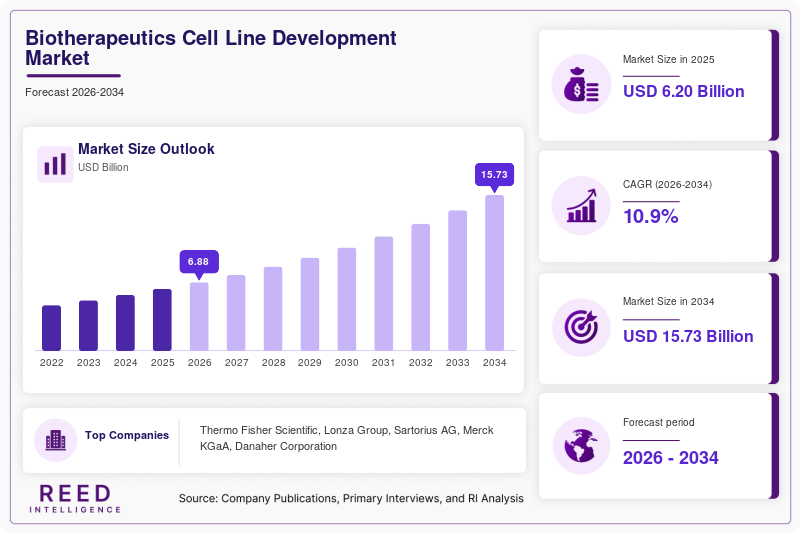
The Biotherapeutics Cell Line Development Market size was valued at USD 6.2 billion in 2024 and is projected to reach USD 15.8 billion by 2033, expanding at a CAGR of 10.9% from 2025 to 2033. The market size growth reflects increasing demand for biologics, monoclonal antibodies, recombinant proteins, and next-generation therapies. Biopharmaceutical manufacturers are investing heavily in cell line engineering technologies to enhance productivity, reduce development timelines, and improve therapeutic efficacy.
A key global factor supporting the growth of the Biotherapeutics Cell Line Development Market is the expansion of the biologics pipeline. Pharmaceutical companies are shifting from traditional small-molecule drugs to biologics due to higher clinical success rates and targeted therapeutic benefits. As a result, cell line development has become a critical upstream process in biopharmaceutical manufacturing. Innovations in gene editing technologies such as CRISPR, high-throughput screening platforms, and automated cloning systems are accelerating the development of high-yield stable cell lines. Additionally, increasing outsourcing to contract development and manufacturing organizations (CDMOs) is improving accessibility to advanced cell line development platforms for small and mid-sized biotech companies.
Key Highlights
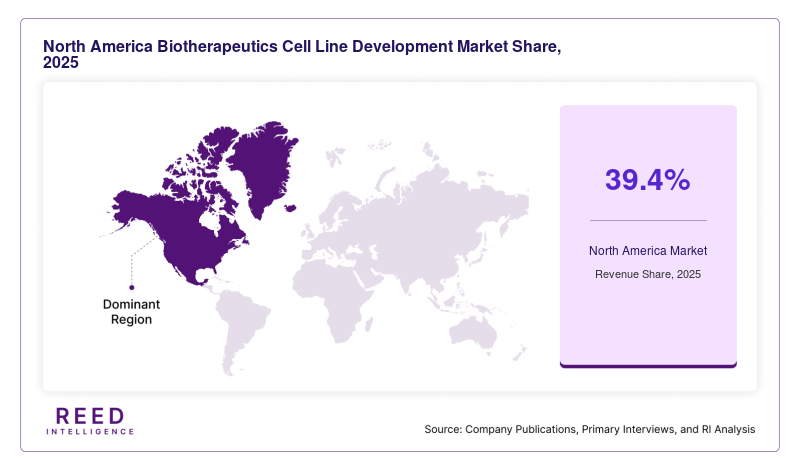
- North America held the dominant regional share of 39.4% in 2025, while Asia Pacific will register the fastest growth at a CAGR of 12.8% during the forecast period.
- Mammalian cell lines represented the leading type segment with 63.2% share in 2024, while microbial cell lines will grow at a CAGR of 11.6%.
- Biopharmaceutical production applications accounted for the largest share at 54.1% in 2024, while gene therapy production will expand at 13.2% CAGR.
- The United States remained the dominant country with a market value of USD 2.1 billion in 2024, reaching approximately USD 2.3 billion in 2025.
Market Trends
Increasing Adoption of Gene Editing Technologies
Advanced gene editing technologies are transforming the Biotherapeutics Cell Line Development Market. Tools such as CRISPR and TALEN enable precise genetic modifications in host cells, allowing researchers to develop high-yield and stable production cell lines. These technologies significantly reduce the time required to generate optimized clones for therapeutic protein production. As biologics pipelines expand, pharmaceutical companies are prioritizing rapid cell line engineering to shorten drug development timelines. Automation and digital cell line screening platforms are also supporting this trend by enabling the rapid identification of high-performing clones. This technological shift is expected to reshape cell line engineering workflows and enhance productivity across biopharmaceutical manufacturing.
Expansion of Outsourced Cell Line Development Services
Outsourcing has emerged as a major trend in the Biotherapeutics Cell Line Development Market. Biotechnology startups and emerging pharmaceutical companies increasingly rely on specialized contract development organizations for cell line generation, characterization, and stability testing. Outsourcing reduces infrastructure investments and accelerates time-to-market for biologics. Contract development and manufacturing organizations are expanding integrated services that include cell line engineering, process development, and early-stage manufacturing. As the complexity of biologics increases, partnerships between pharmaceutical companies and service providers are expected to become more common, contributing to the long-term growth of the market.
Market Drivers
Rising Biologics and Biosimilars Development
The rapid expansion of biologics pipelines is a major driver of the Biotherapeutics Cell Line Development Market. Biologics such as monoclonal antibodies, recombinant proteins, and therapeutic enzymes require specialized host cells for production. Pharmaceutical companies are developing a growing number of biologics to address complex diseases including cancer, autoimmune disorders, and rare genetic conditions. Biosimilar development is also increasing globally as patents for major biologic drugs expire. Manufacturers developing biosimilars require efficient cell line platforms capable of producing proteins with consistent quality and yield. This growing demand for biologic therapeutics is significantly increasing investments in cell line development technologies and services.
Technological Advancements in Cell Line Engineering
Technological progress in cell line engineering is another key factor supporting market growth. High-throughput screening systems, automated cloning platforms, and advanced expression vectors are improving the efficiency of cell line selection. These innovations allow researchers to identify high-productivity clones more rapidly and optimize protein expression levels. Furthermore, integration of computational modeling and artificial intelligence tools is helping scientists predict cell line performance during early development stages. These advancements are improving process scalability and reducing development costs, which is encouraging pharmaceutical manufacturers to adopt advanced cell line engineering platforms.
Market Restraint
High Development Costs and Complex Regulatory Requirements
High development costs represent a major restraint in the Biotherapeutics Cell Line Development Market. Establishing stable and high-productivity cell lines requires advanced laboratory infrastructure, specialized equipment, and highly skilled personnel. The entire development process—from vector design and transfection to clone selection and characterization—can be resource intensive. Small biotechnology companies often face financial constraints when attempting to establish in-house cell line development capabilities.
Regulatory requirements also add complexity to the development process. Regulatory agencies require detailed documentation and validation of cell line stability, genetic integrity, and product consistency before biologics can proceed to clinical development. These regulatory expectations require extensive testing and quality control procedures, which increase development timelines and costs.
Furthermore, maintaining long-term cell line stability is technically challenging. Variability in cell productivity or genetic drift during large-scale production can impact biologic drug quality. Addressing these challenges requires continuous monitoring and optimization, further increasing operational costs. These factors collectively limit market adoption in resource-constrained biotechnology organizations.
Market Opportunities
Growth of Personalized and Cell-Based Therapies
The expansion of personalized medicine and cell-based therapies is creating new opportunities in the Biotherapeutics Cell Line Development Market. Gene therapies, engineered immune cells, and other advanced therapeutic approaches require highly specialized cell lines for vector production and protein expression. As personalized treatment strategies gain traction, demand for customized cell line engineering solutions is increasing. Companies capable of developing optimized host cells for gene therapy vectors and complex biologics are expected to benefit significantly from this trend.
Increasing Demand for High-Productivity Expression Systems
Biopharmaceutical manufacturers are increasingly seeking high-productivity expression systems to improve manufacturing efficiency. Advanced host cells capable of producing higher protein yields can reduce production costs and shorten manufacturing cycles. Technologies such as optimized Chinese hamster ovary (CHO) cell lines and microbial expression systems are gaining interest among manufacturers aiming to scale biologics production. Companies offering high-performance expression platforms and integrated cell line optimization tools are likely to capture significant growth opportunities in the market.
Segmental Analysis
By Cell Line Type
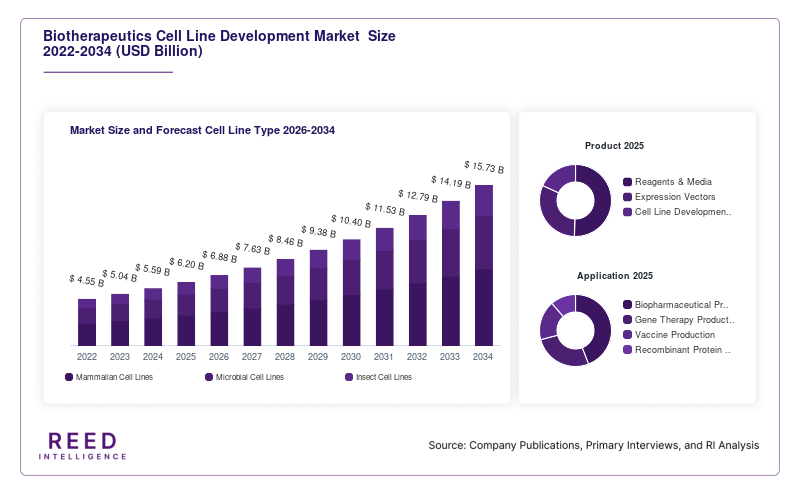
Mammalian cell lines represented the dominant subsegment in the Biotherapeutics Cell Line Development Market and accounted for 63.2% of the market share in 2024. These cell lines have been widely used in biologics production due to their ability to perform complex post-translational modifications required for therapeutic proteins. Chinese hamster ovary (CHO) cells and human embryonic kidney (HEK) cells are commonly used host systems for producing monoclonal antibodies and recombinant proteins. Their compatibility with large-scale bioreactors and established regulatory acceptance contributed to their strong adoption among biopharmaceutical manufacturers.
Microbial cell lines will emerge as the fastest-growing segment with a CAGR of 11.6% during the forecast period. Microbial hosts such as Escherichia coli and yeast are widely used for producing enzymes, vaccines, and recombinant proteins that do not require complex glycosylation patterns. These expression systems enable faster growth rates and lower production costs compared to mammalian cells. As pharmaceutical companies seek cost-effective manufacturing platforms for specific biologics, microbial expression systems will gain increasing adoption.
By Product
Reagents and media dominated the product segment and accounted for 48.7% share in 2024. Cell culture media, transfection reagents, and cloning kits are essential components of cell line development workflows. These products are used repeatedly throughout the development process, from initial cell transfection to clone selection and stability testing. The continuous demand for optimized culture media formulations has driven consistent revenue generation within this segment.
Expression vectors will record the fastest growth with a CAGR of 12.4% during the forecast period. Expression vectors are crucial for introducing genes into host cells and controlling protein expression levels. Advances in vector design, including improved promoters and regulatory elements, are enabling more efficient gene expression. The growing use of engineered vectors for gene therapy and recombinant protein production will contribute to the rapid expansion of this segment.
By Application
Biopharmaceutical production held the largest share in the Biotherapeutics Cell Line Development Market and represented 54.1% of the market in 2024. Pharmaceutical manufacturers rely on stable and high-yield cell lines to produce monoclonal antibodies, vaccines, and therapeutic proteins. As biologic drug approvals increase globally, demand for optimized cell line platforms continues to grow. These platforms enable manufacturers to achieve consistent product quality and efficient large-scale production.
Gene therapy production will be the fastest-growing application segment with a CAGR of 13.2% through 2033. Gene therapy requires specialized host cells capable of producing viral vectors and complex therapeutic molecules. Advances in vector design and increasing clinical trials for gene therapies are expected to drive demand for advanced cell line engineering solutions. Companies developing cell lines optimized for viral vector production will experience strong demand in the coming years.
By End User
Biopharmaceutical companies accounted for the largest end-user share at 57.6% in 2024. These companies develop and manufacture biologic therapeutics that require stable production cell lines. Large pharmaceutical firms often maintain internal cell line development capabilities to control intellectual property and optimize manufacturing processes. The growing pipeline of biologics and biosimilars continues to support demand within this segment.
Contract development and manufacturing organizations (CDMOs) will experience the fastest growth with a CAGR of 12.7% during the forecast period. CDMOs provide specialized cell line engineering and manufacturing services to biotechnology companies that lack internal capabilities. The increasing trend of outsourcing early-stage biologics development will support rapid expansion of this segment.
Regional Analysis
North America
North America accounted for 39.4% of the Biotherapeutics Cell Line Development Market share in 2025 and remained the largest regional market. The region will expand at a CAGR of 9.8% between 2025 and 2033. The strong presence of major biopharmaceutical companies, advanced biotechnology infrastructure, and high research spending supported regional market leadership. North America has a well-established ecosystem for biologics development, including specialized research institutes, biotechnology clusters, and contract development organizations. The availability of advanced gene editing technologies and automation platforms further strengthened the region’s capabilities in cell line engineering.
The United States represented the dominant country in the regional market. The country’s growth has been supported by significant investment in biologics research and an extensive pipeline of monoclonal antibodies and recombinant therapeutics. Academic research institutions and biotechnology startups frequently collaborate with pharmaceutical companies to develop new biologic drugs, which increases the demand for high-quality cell line development platforms. The strong presence of contract development organizations also enables emerging biotech companies to access advanced cell line engineering services without building internal infrastructure.
Europe
Europe held approximately 26.1% share of the Biotherapeutics Cell Line Development Market in 2025 and will grow at a CAGR of 10.2% during the forecast period. The region benefits from strong pharmaceutical research capabilities and supportive regulatory frameworks for biologics development. European biotechnology companies are actively investing in advanced protein expression technologies and stable cell line platforms to support the development of innovative biologics and biosimilars.
Germany emerged as the leading country in the European market. The country’s biotechnology sector is supported by government research initiatives, strong academic collaborations, and advanced manufacturing facilities. Pharmaceutical companies in Germany are focusing on improving biologics production efficiency through optimized cell line engineering techniques. This focus on innovation and research has contributed to the country’s leadership in cell line development technologies within the region.
Asia Pacific
Asia Pacific captured 21.7% of the Biotherapeutics Cell Line Development Market share in 2025 and will register the fastest growth at a CAGR of 12.8% from 2025 to 2033. The region is becoming an important hub for biologics manufacturing due to expanding pharmaceutical industries and increasing investment in biotechnology infrastructure. Several countries are developing specialized biotechnology parks and research centers dedicated to biologics and biosimilars development.
China dominated the regional market due to strong government support for biotechnology innovation and expanding pharmaceutical manufacturing capacity. The country has witnessed significant investment in biologics production facilities and research programs focused on monoclonal antibodies and recombinant proteins. Local pharmaceutical companies are adopting advanced cell line engineering platforms to improve productivity and compete in global biologics markets. These developments are expected to accelerate demand for cell line development technologies across the region.
Middle East & Africa
The Middle East & Africa accounted for 6.3% of the Biotherapeutics Cell Line Development Market share in 2025 and will expand at a CAGR of 9.5% through 2033. The region’s biotechnology sector is gradually developing as governments increase investment in healthcare research and pharmaceutical manufacturing capabilities. Several countries are focusing on establishing research centers and biotechnology incubators to promote innovation in life sciences.
Saudi Arabia represented the leading country within the region. The country has launched several national initiatives aimed at strengthening biotechnology research and domestic pharmaceutical production. Investments in advanced research laboratories and collaborations with international biotechnology companies are supporting the development of biologics research capabilities. These efforts are gradually increasing the adoption of cell line development technologies across the regional pharmaceutical sector.
Latin America
Latin America held approximately 6.5% share of the Biotherapeutics Cell Line Development Market in 2025 and will grow at a CAGR of 9.9% during the forecast period. The region is witnessing steady growth in biotechnology research activities and pharmaceutical manufacturing capabilities. Increasing demand for biosimilars and biologic therapies is encouraging regional pharmaceutical companies to invest in upstream bioprocessing technologies.
Brazil dominated the regional market due to its expanding pharmaceutical manufacturing industry and growing research investments in biologics development. The country has established several biotechnology research centers focused on developing recombinant proteins and monoclonal antibodies. These initiatives are gradually increasing demand for advanced cell line development platforms and services across the Brazilian biotechnology sector.
Competitive Landscape
The Biotherapeutics Cell Line Development Market is moderately consolidated, with several biotechnology companies providing specialized technologies and services for cell line engineering. Market participants focus on expanding service portfolios, improving expression platforms, and forming strategic collaborations with pharmaceutical manufacturers.
Among leading companies, Thermo Fisher Scientific holds a strong market position due to its integrated cell line development solutions and advanced expression systems. The company recently expanded its biologics development services to accelerate stable cell line generation for monoclonal antibody production.
Other prominent players include Lonza Group, Sartorius AG, Merck KGaA, and Danaher Corporation. These companies are investing in advanced cell engineering platforms and high-throughput screening technologies to improve productivity and reduce development timelines. Strategic partnerships with biotechnology startups are also becoming common as companies aim to strengthen their presence in the biologics development ecosystem.
Key Players List
- Thermo Fisher Scientific
- Lonza Group
- Sartorius AG
- Merck KGaA
- Danaher Corporation
- WuXi Biologics
- Selexis SA
- Charles River Laboratories
- Samsung Biologics
- FUJIFILM Diosynth Biotechnologies
Recent Developments
- In 2024, Lonza Group expanded its stable cell line development platform to accelerate monoclonal antibody production.
- In 2024, WuXi Biologics launched an optimized CHO cell expression system to improve biologics yield and scalability.
- In 2023, Sartorius AG introduced advanced cell culture media formulations designed for high-density mammalian cell growth.
- In 2023, Thermo Fisher Scientific expanded its CDMO capabilities for integrated biologics development services.
Biotherapeutics Cell Line Development Market Segments
Cell Line Type
- Mammalian Cell Lines
- Microbial Cell Lines
- Insect Cell Lines
Product
- Reagents & Media
- Expression Vectors
- Cell Line Development Equipment
Application
- Biopharmaceutical Production
- Gene Therapy Production
- Vaccine Production
- Recombinant Protein Production
End User
- Biopharmaceutical Companies
- Contract Development & Manufacturing Organizations (CDMOs)
- Academic & Research Institutes
By Region
- North America
- Europe
- APAC
- Middle East and Africa
- LATAM