Bipolar Forceps Market Size, Share, Demand Report by Product Type (Reusable Bipolar Forceps, Disposable Bipolar Forceps), By Application (Neurosurgery, ENT Surgery, Ophthalmic Surgery, General Surgery), By End-Use (Hospitals, Ambulatory Surgical Centers, Specialty Clinics), and Regional Forecasts, 2025–2034
USD 3950
Market Overview
The Bipolar Forceps Market size is estimated at approximately USD 820 million, reflecting consistent demand from advanced healthcare systems and emerging surgical centers. By 2026, the market is projected to reach around USD 880 million, supported by increased surgical volumes and improvements in hospital infrastructure. Looking ahead, the market is expected to attain nearly USD 1850 million by 2034, registering a compound annual growth rate (CAGR) of around 9.8% from 2025 to 2034.
Growth in the Bipolar Forceps Market is influenced by several structural healthcare factors. First, the increasing prevalence of chronic neurological disorders and tumors is leading to higher demand for microsurgical procedures where bipolar forceps are essential. Second, the shift toward minimally invasive and bloodless surgical techniques is accelerating adoption across developed and developing economies. Third, continuous advancements in electrosurgical technology, including improved insulation materials and ergonomic handle designs, are enhancing surgical precision and safety, further driving market penetration.
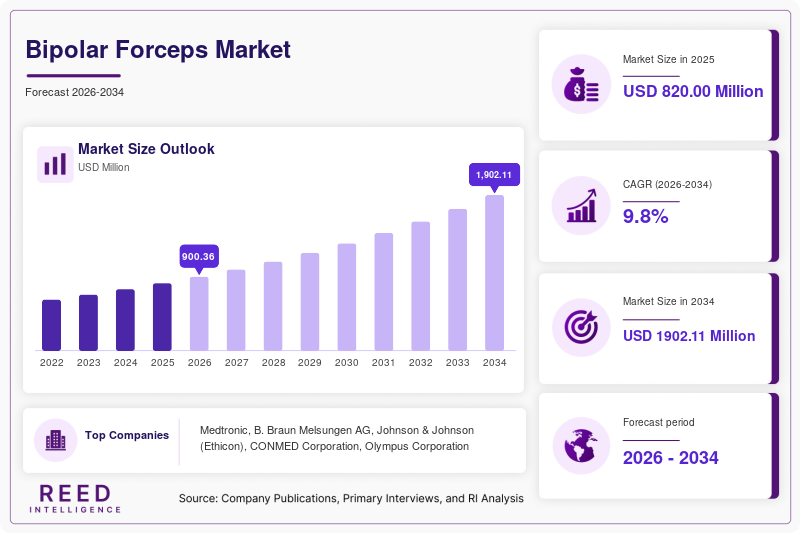
Key Highlights
- North America holds ~38%–40% share in 2025, supported by advanced surgical infrastructure and high adoption of electrosurgical technologies
- Asia Pacific is projected to grow at ~11%–11.5% CAGR (2025–2034) due to rising healthcare investment and expanding surgical capacity
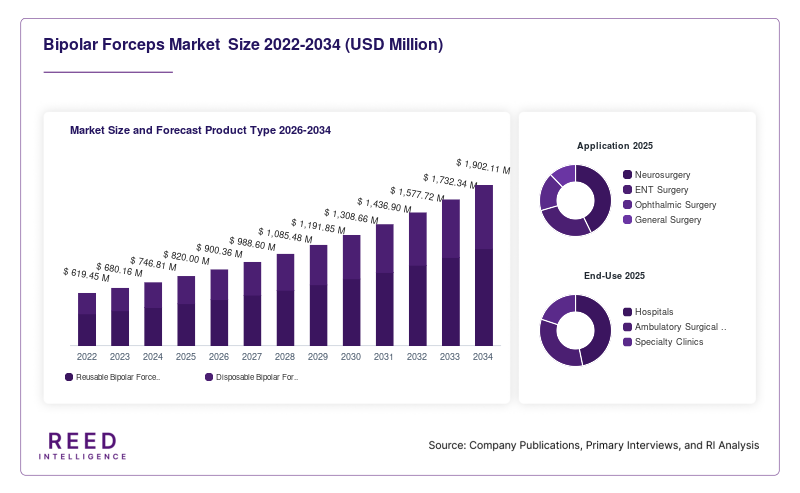
- Reusable Bipolar Forceps dominate with ~58% share (2024) due to cost efficiency and widespread hospital usage
- Disposable Bipolar Forceps at ~10.6% CAGR driven by infection control and single-use adoption trends
- Neurosurgery accounts for ~41% share (2024) owing to high demand for precision in delicate surgical procedures
Market Trends
Shift Toward Minimally Invasive and Precision Surgery Tools
One of the most prominent trends shaping the Bipolar Forceps Market is the growing shift toward minimally invasive surgical procedures. Surgeons are increasingly preferring bipolar forceps due to their ability to provide precise coagulation with minimal thermal damage to surrounding tissues. This trend is especially evident in neurosurgery and microsurgery, where accuracy is critical. Hospitals are investing in advanced electrosurgical units that integrate bipolar forceps with digital energy control systems. The demand is further strengthened by shorter hospital stays, faster recovery times, and reduced postoperative complications associated with minimally invasive techniques. This shift is expected to continue as healthcare systems prioritize efficiency and patient safety outcomes.
Integration of Advanced Materials and Ergonomic Design Improvements
Another key trend in the Bipolar Forceps Market is the integration of advanced materials and improved ergonomic designs. Manufacturers are focusing on developing forceps with high-grade stainless steel, ceramic insulation, and anti-stick coatings to enhance durability and performance. Ergonomic handle designs are also gaining traction to reduce surgeon fatigue during long and complex procedures. Additionally, disposable bipolar forceps are being introduced to address infection control concerns in hospitals. These technological improvements are contributing to enhanced surgical precision and operational efficiency, making bipolar forceps more adaptable across multiple surgical disciplines.
Market Drivers
Rising Volume of Surgical Procedures Globally
The increasing number of surgical procedures worldwide is a major driver of the Bipolar Forceps Market. Growing incidences of chronic diseases such as cancer, neurological disorders, and cardiovascular conditions are leading to higher surgical intervention rates. Bipolar forceps are widely used in delicate surgeries where controlled coagulation is required. Hospitals and surgical centers are witnessing rising patient inflow, particularly in aging populations, which further increases procedural demand. Additionally, expanding healthcare infrastructure in emerging economies is enabling more surgeries to be performed annually. This growing surgical volume directly correlates with higher consumption of bipolar forceps across both public and private healthcare sectors.
Technological Advancements in Electrosurgical Devices
Technological innovation is significantly driving market growth in the Bipolar Forceps Market. Modern bipolar forceps are being designed with enhanced energy delivery systems that allow precise cutting and coagulation simultaneously. Innovations such as temperature-controlled forceps and smart feedback systems are improving surgical accuracy and safety. Integration with advanced electrosurgical generators is also enhancing usability across complex surgical environments. These advancements reduce intraoperative bleeding and improve patient outcomes, encouraging hospitals to adopt newer systems. As medical technology continues to evolve, demand for high-performance bipolar forceps is expected to increase steadily.
Market Restraint
High Cost of Advanced Electrosurgical Systems and Limited Access in Developing Regions
A significant restraint in the Bipolar Forceps Market is the high cost associated with advanced electrosurgical systems and premium-quality bipolar forceps. Many healthcare facilities in low- and middle-income countries face budget constraints, limiting their ability to adopt technologically advanced surgical instruments. While reusable bipolar forceps reduce long-term costs, the initial investment in electrosurgical generators and compatible accessories remains high. Additionally, maintenance and sterilization requirements add to operational expenses, making it difficult for smaller hospitals and clinics to adopt these devices widely.
In developing regions, lack of access to advanced surgical infrastructure further restricts market penetration. Many healthcare centers still rely on conventional surgical tools due to limited funding and inadequate training in electrosurgical techniques. This disparity creates uneven adoption across global markets. Furthermore, price sensitivity among healthcare providers often leads to preference for low-cost alternatives, even if they offer reduced precision or durability. As a result, despite strong demand potential, cost-related barriers continue to hinder full-scale adoption of bipolar forceps, especially in resource-constrained healthcare systems.
Market Opportunities
Expansion of Ambulatory Surgical Centers (ASCs)
The rapid expansion of ambulatory surgical centers presents a significant opportunity for the Bipolar Forceps Market. ASCs are increasingly preferred for outpatient surgeries due to lower costs, reduced hospital stay, and faster patient turnover. Bipolar forceps are extensively used in these settings because of their efficiency in minimizing bleeding and improving procedural speed. As healthcare systems shift toward decentralized surgical care, demand for compact, easy-to-use, and cost-effective electrosurgical instruments is expected to grow. Manufacturers can capitalize on this trend by developing lightweight, reusable, and portable bipolar forceps tailored for ASC environments.
Growing Demand in Emerging Healthcare Markets
Emerging economies in Asia Pacific, Latin America, and parts of Africa present strong growth opportunities for the Bipolar Forceps Market. Increasing healthcare investments, rising medical tourism, and expanding hospital networks are driving demand for advanced surgical instruments. Governments are also improving healthcare accessibility through public health initiatives and infrastructure development. As surgical awareness increases, hospitals in these regions are gradually adopting modern electrosurgical tools. Companies focusing on affordable product lines and local distribution networks can significantly expand their market share in these high-growth regions.
Segmental Analysis
Type Segment
Reusable bipolar forceps dominate the market with approximately 58% share in 2024, driven by their cost-effectiveness and durability. These instruments are widely used in hospitals performing high volumes of surgical procedures, where sterilization infrastructure is well established.
Disposable bipolar forceps represent the fastest-growing subsegment with a CAGR of around 10.6%, driven by increasing concerns regarding infection control and cross-contamination. Hospitals are increasingly adopting single-use instruments in high-risk surgical environments, particularly in outpatient and emergency procedures.
Application Segment
Neurosurgery applications hold the dominant share of approximately 41% in 2024, due to the high precision required in brain and nerve-related surgeries. Bipolar forceps are essential in controlling bleeding during delicate microsurgical procedures.
ENT and ophthalmic surgeries represent the fastest-growing subsegment with a CAGR of around 9.9%, driven by increasing prevalence of sinus disorders and eye-related conditions. The demand for minimally invasive procedures in these specialties is supporting market growth.
End-Use Segment
Hospitals dominate the end-use segment with approximately 67% share in 2024, supported by advanced surgical infrastructure and high patient inflow. Hospitals continue to be the primary centers for complex surgical procedures requiring bipolar forceps.
Ambulatory surgical centers are the fastest-growing segment with a CAGR of around 11.1%, driven by cost efficiency and increasing preference for outpatient surgeries. Their growing presence in both developed and emerging economies is significantly boosting demand for compact electrosurgical tools.
Regional Analysis
North America
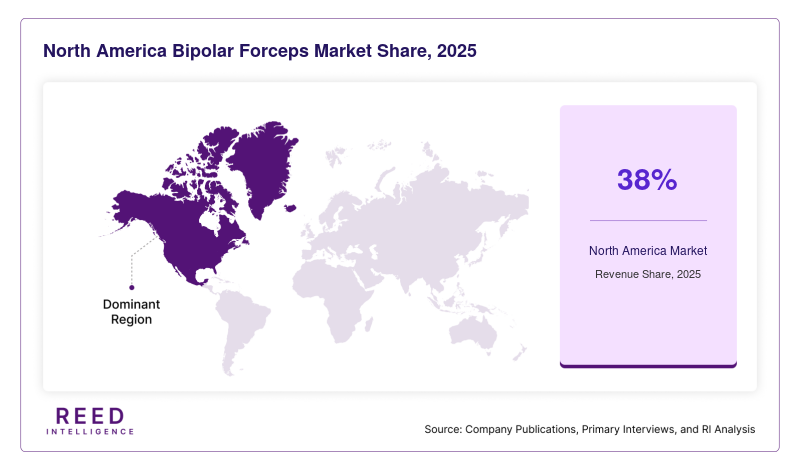
North America accounts for approximately 38%–40% market share in 2025, with a projected CAGR of around 9%–9.5% through 2034. The region continues to dominate the Bipolar Forceps Market due to its advanced surgical infrastructure and high volume of minimally invasive procedures. Strong adoption of robotic-assisted surgeries and precision-based neurosurgical techniques further strengthens demand across hospitals and ambulatory surgical centers.
The United States is the leading country in the region, driven by high healthcare expenditure and widespread availability of technologically advanced surgical systems. A key growth factor is the increasing use of bipolar forceps in robot-assisted procedures such as urology, gynecology, and oncology surgeries, where precision and thermal control are critical. Canada also contributes significantly due to rising hospital investments in modern surgical equipment.
Europe
Europe holds around 25%–27% market share in 2025, expanding at a CAGR of approximately 8.5%–9.0% during the forecast period. The region benefits from a strong regulatory framework, high surgical standards, and widespread adoption of advanced electrosurgical technologies in public healthcare systems.
Germany leads the European market due to its strong medical device manufacturing base and high adoption of precision neurosurgical tools. A major growth factor is the increasing demand for minimally invasive neurological and ENT procedures, supported by continuous innovation in surgical instrument design. The UK and France also contribute significantly due to rising hospital investments in advanced operating room technologies.
Asia Pacific
Asia Pacific represents approximately 22%–24% market share in 2025, and is expected to register the fastest CAGR of around 11%–11.5% through 2034. Rapid healthcare infrastructure expansion, increasing surgical volumes, and growing awareness of advanced electrosurgical tools are key growth drivers in the region.
China dominates the Asia Pacific market due to its large patient population and significant government investment in hospital modernization. A key growth factor is the rising adoption of minimally invasive surgeries in urban hospitals, along with increasing availability of cost-effective bipolar forceps in tier-2 and tier-3 cities. India and Japan are also witnessing strong growth, supported by expanding healthcare access and technological innovation in surgical instruments.
Middle East & Africa
The Middle East & Africa region holds approximately 5%–6% market share in 2025, with a CAGR of around 8%–8.5% during 2025–2034. Growth is driven by improving healthcare infrastructure, rising medical tourism, and increasing government investments in specialized surgical care facilities.
Saudi Arabia leads the region, supported by healthcare diversification initiatives under national development programs. A key growth factor is the expansion of specialty surgical centers and tertiary care hospitals, which are increasingly adopting advanced bipolar forceps for neurosurgery and general surgery applications. The UAE also contributes significantly due to rapid healthcare modernization and adoption of advanced medical technologies.
Latin America
Latin America accounts for approximately 4%–6% market share in 2025, with a projected CAGR of 8%–8.3% through 2034. Growth is supported by improving access to surgical care, increasing private hospital investments, and rising adoption of minimally invasive techniques.
Brazil dominates the regional market due to its expanding private healthcare sector and increasing surgical procedures across urban hospitals. A key growth factor is the growing focus on cost-effective reusable bipolar forceps in public hospitals, which helps improve surgical efficiency while managing healthcare budgets. Mexico and Argentina also contribute to steady market expansion.
Competitive Landscape
The Bipolar Forceps Market is moderately consolidated, with several global and regional players competing through innovation, pricing strategies, and distribution expansion. Key companies include Medtronic, B. Braun Melsungen AG, Johnson & Johnson (Ethicon), CONMED Corporation, and Olympus Corporation. These companies focus on product innovation, ergonomic design improvements, and integration with advanced electrosurgical platforms.
Medtronic holds a strong position due to its extensive electrosurgical portfolio and global distribution network. A recent development includes the expansion of its advanced energy-based surgical tools portfolio aimed at improving precision in minimally invasive surgeries. Competitive strategies also include partnerships with hospitals and investments in R&D for next-generation forceps with improved thermal control and safety features.
Key Players List
- Medtronic
- B. Braun Melsungen AG
- Johnson & Johnson (Ethicon)
- CONMED Corporation
- Olympus Corporation
- Stryker Corporation
- Smith & Nephew
- Teleflex Incorporated
- KLS Martin Group
- ERBE Elektromedizin GmbH
- Bovie Medical Corporation
- Abbott Laboratories
- Karl Storz SE & Co. KG
- Zimmer Biomet
- Utah Medical Products
Recent Developments
- Introduction of temperature-controlled bipolar forceps designed to improve surgical precision and reduce tissue damage in neurosurgical procedures.
- Expansion of disposable electrosurgical instrument product lines by major manufacturers to address infection control concerns in hospital settings.
- Strategic collaborations between medical device companies and healthcare providers to develop next-generation minimally invasive surgical toolkits integrated with digital energy platforms.
Bipolar Forceps Market Segments
Product Type
- Reusable Bipolar Forceps
- Disposable Bipolar Forceps
Application
- Neurosurgery
- ENT Surgery
- Ophthalmic Surgery
- General Surgery
End-Use
- Hospitals
- Ambulatory Surgical Centers
- Specialty Clinics
By Region
- North America
- Europe
- APAC
- Middle East and Africa
- LATAM