Bird Repellent Market Size, Share & Demand Report By Product Type (Physical Repellents, Chemical Repellents), By Application (Agriculture, Commercial Infrastructure, Industrial Facilities), By Distribution Channel (Direct Sales, Distributors & Wholesalers), By End User (Commercial Facilities, Agricultural Farms, Municipal Infrastructure, Transportation Hubs), By Technology (Ultrasonic Systems, Laser Deterrent Systems) By Region & Segment Forecasts, 2026–2034
USD 3950
Market Overview
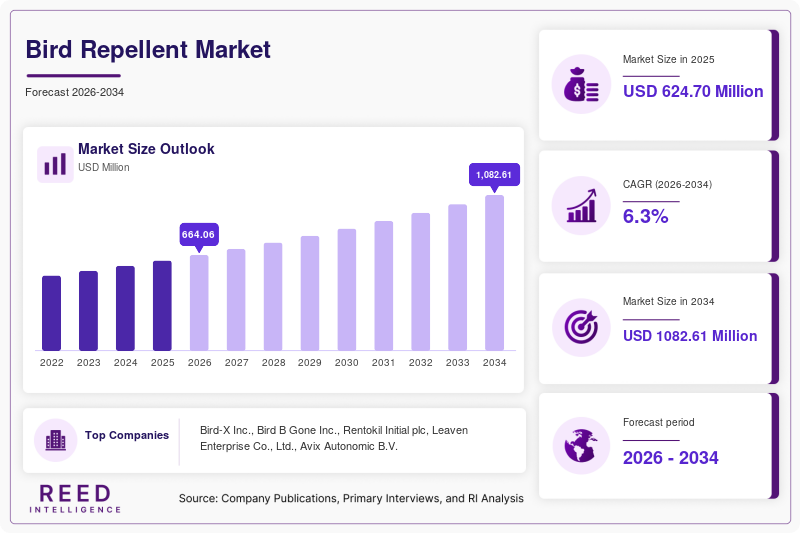
The Bird Repellent Market size was valued at USD 624.7 million in 2026 and is projected to reach USD 1.02 billion by 2034, expanding at a CAGR of 6.3% during the forecast period from 2026 to 2034. The global Bird Repellent Market growth has been supported by rising concerns regarding infrastructure damage, agricultural losses, and public health risks associated with uncontrolled bird populations across urban and rural environments.
Bird repellents are widely used across agriculture, commercial infrastructure, industrial facilities, aviation, residential buildings, and public spaces to prevent bird nesting, roosting, and crop destruction. The increasing need for humane bird management solutions has accelerated the adoption of advanced repellent technologies, including ultrasonic systems, visual deterrents, bird spikes, chemical repellents, and automated laser-based solutions.
Key Highlights
- North America accounted for 34.8% of the global Bird Repellent Market share in 2025, while Asia Pacific is projected to register the fastest CAGR of 7.1% during the forecast period.
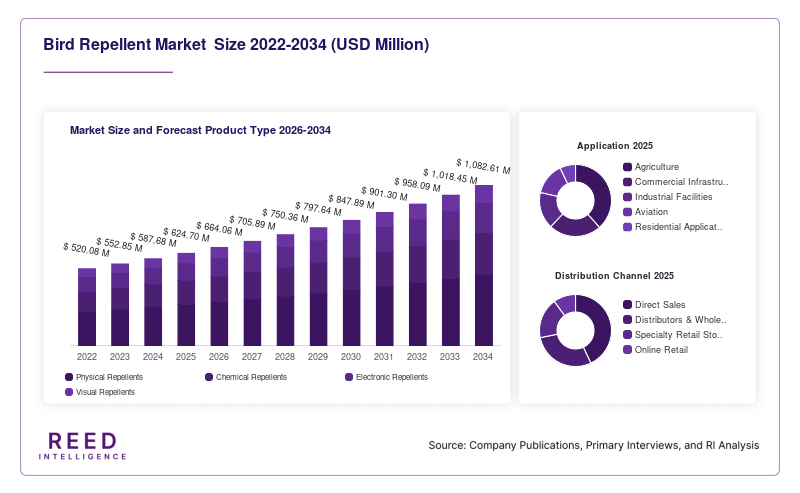
- By product type, physical bird repellents held the leading market share of 41.7% in 2025, whereas electronic bird repellents are expected to expand at a CAGR of 7.4% through 2034.
- By application, agriculture accounted for 38.6% of the Bird Repellent Market share in 2025, while commercial infrastructure is projected to grow at a CAGR of 7.0%.
- By distribution channel, direct sales represented 46.2% of the market share in 2025, whereas online retail channels are anticipated to witness a CAGR of 7.8% during the study period.
- By end user, commercial facilities accounted for 35.4% of the market share in 2025, while municipal infrastructure projects are expected to grow at a CAGR of 7.2%.
- The United States Bird Repellent Market was valued at USD 142.6 million in 2024 and increased to USD 149.8 million in 2025 due to rising adoption of humane bird control systems across commercial and industrial sectors.
Market Trends
Growing Adoption of Humane Bird Deterrent Technologies
One of the major trends shaping the Bird Repellent Market is the growing adoption of humane and non-lethal bird deterrent technologies. Governments, environmental organizations, and consumers are increasingly encouraging wildlife-safe bird management practices that minimize harm to birds while effectively protecting infrastructure and crops.
Manufacturers are responding by developing low-impact deterrent systems such as ultrasonic emitters, reflective devices, laser deterrents, and non-toxic chemical sprays. These technologies are gaining popularity across airports, solar farms, agricultural fields, and urban commercial buildings.
Increasing Integration of Smart Monitoring Systems
Another significant trend influencing the Bird Repellent Market is the integration of smart monitoring technologies with bird deterrent systems. Advanced repellent products now include programmable sensors, motion detection systems, and automated activation features to improve operational efficiency.
Smart bird management systems enable users to monitor bird activity remotely and optimize repellent performance based on environmental conditions. This trend is expected to accelerate product adoption across industrial and infrastructure applications.
Market Drivers
Rising Agricultural Crop Protection Requirements
The increasing need for crop protection has emerged as a major driver for the Bird Repellent Market. Birds can cause substantial losses in fruit orchards, vineyards, grain farms, and vegetable cultivation areas by feeding on crops and damaging produce quality.
Farmers are increasingly adopting bird deterrent systems to reduce crop loss and improve agricultural productivity. Growing global food demand and rising investments in precision farming technologies are expected to strengthen market growth during the forecast period.
Expansion of Commercial Infrastructure and Urban Facilities
The rapid expansion of commercial infrastructure has significantly contributed to Bird Repellent Market growth. Bird infestation in warehouses, shopping centers, transportation hubs, and industrial facilities can increase maintenance costs and create sanitation challenges.
Property owners and infrastructure operators are increasingly implementing preventive bird management systems to protect building structures and improve operational efficiency. Rising urban development activities are expected to continue supporting market demand.
Market Restraint
High Installation Costs of Advanced Repellent Systems
High installation and maintenance costs associated with advanced bird repellent systems remain a major restraint for the Bird Repellent Market. Automated laser systems, integrated ultrasonic networks, and smart monitoring technologies often require substantial upfront investment.
Small agricultural operators and budget-sensitive commercial facilities may face difficulties adopting premium bird deterrent solutions. This cost-related challenge could limit market penetration in certain developing regions.
Market Opportunities
Expansion of Solar Energy Infrastructure
The growing deployment of solar energy infrastructure presents a major opportunity for the Bird Repellent Market. Birds often nest under solar panels and create debris accumulation that can reduce energy generation efficiency.
Solar farm operators are increasingly investing in specialized bird deterrent systems to improve equipment protection and minimize maintenance downtime. The global transition toward renewable energy is expected to create favorable growth opportunities for market participants.
Increasing Demand from Aviation Safety Applications
The aviation sector is generating new opportunities for the Bird Repellent Market due to increasing concerns regarding bird strike incidents. Airports are adopting advanced deterrent systems to improve runway safety and reduce aircraft operational risks.
The use of radar-assisted bird monitoring, automated sound systems, and laser deterrent technologies is expected to increase significantly across airport infrastructure projects during the forecast period.
Segmental Analysis
By Product Type
Based on product type, the Bird Repellent Market is segmented into physical repellents, chemical repellents, electronic repellents, and visual repellents.
Physical repellents dominated the market with a 41.7% share in 2025 due to widespread adoption of bird spikes, nets, and barriers across commercial and industrial facilities.
Electronic repellents are expected to witness the fastest CAGR of 7.4% during the forecast period. Increasing demand for automated and programmable deterrent systems is expected to support segment growth.
By Application
Based on application, the Bird Repellent Market is segmented into agriculture, commercial infrastructure, industrial facilities, aviation, and residential applications.
Agriculture accounted for the highest market share of 38.6% in 2025 because farmers increasingly invested in crop protection technologies to minimize production losses caused by birds.
Commercial infrastructure is anticipated to expand at a CAGR of 7.0% through 2034. Growing urban development and rising maintenance costs associated with bird infestations are expected to support segment demand.
By Distribution Channel
Based on distribution channel, the Bird Repellent Market is segmented into direct sales, distributors & wholesalers, specialty retail stores, and online retail.
Direct sales dominated the market with a 46.2% share in 2025 due to strong manufacturer relationships with agricultural enterprises and commercial infrastructure operators.
Online retail is projected to register the fastest CAGR of 7.8% during the forecast period. Increasing digital commerce adoption and wider product accessibility are likely to strengthen segment growth.
By End User
Based on end user, the Bird Repellent Market is categorized into commercial facilities, agricultural farms, municipal infrastructure, transportation hubs, and residential users.
Commercial facilities held the leading market share of 35.4% in 2025 because shopping centers, warehouses, and office complexes increasingly adopted preventive bird management systems.
Municipal infrastructure is expected to grow at a CAGR of 7.2% through 2034. Expanding smart city projects and urban sanitation initiatives are anticipated to support demand for bird deterrent technologies.
By Technology
Based on technology, the Bird Repellent Market is segmented into ultrasonic systems, laser deterrent systems, reflective deterrents, and bioacoustic systems.
Ultrasonic systems accounted for the dominant market share of 37.1% in 2025 due to their ease of installation and ability to cover large operational areas.
Laser deterrent systems are expected to witness a CAGR of 7.5% during the study period. Growing adoption in aviation safety and solar farm applications is projected to strengthen segment demand.
Regional Analysis
North America
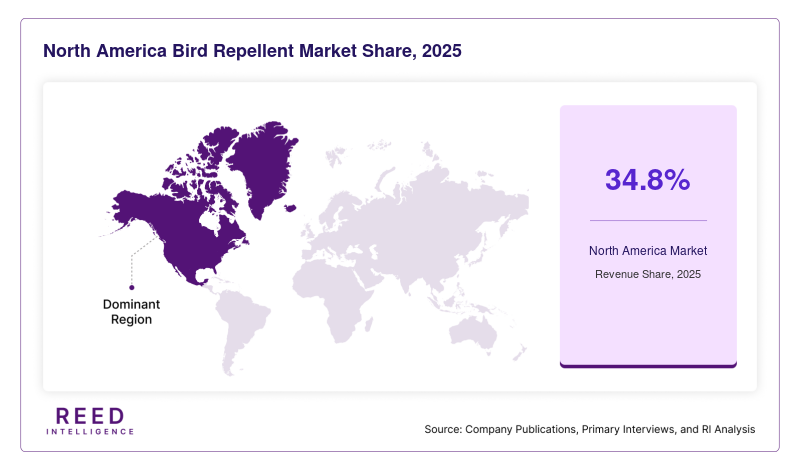
North America accounted for 34.8% of the Bird Repellent Market share in 2025 and is projected to expand at a CAGR of 6.0% during the forecast period. The region maintained strong market demand due to increasing investments in commercial infrastructure protection and advanced agricultural technologies.
The United States represented the dominant country within the regional market because of rising adoption of automated bird deterrent systems across airports, warehouses, and crop cultivation facilities.
Europe
Europe held 28.1% of the global Bird Repellent Market share in 2025 and is expected to grow at a CAGR of 6.1% through 2034. The regional market benefited from strong environmental regulations encouraging humane bird management solutions.
Germany dominated the regional market due to increasing adoption of sustainable pest control systems and expanding industrial infrastructure requiring preventive bird protection measures.
Asia Pacific
Asia Pacific accounted for 24.5% of the Bird Repellent Market share in 2025 and is anticipated to register the fastest CAGR of 7.1% during the study period. Rising agricultural production and rapid urbanization supported regional market growth.
China emerged as the dominant country within the region because of expanding commercial infrastructure development and increasing investment in large-scale agricultural operations.
Middle East & Africa
The Middle East & Africa represented 7.2% of the Bird Repellent Market share in 2025 and is projected to grow at a CAGR of 6.5% during the forecast period. Infrastructure modernization and airport expansion projects supported market demand across the region.
Saudi Arabia dominated the regional market due to increasing investments in smart infrastructure projects and large-scale solar energy installations requiring bird protection systems.
Latin America
Latin America accounted for 5.4% of the Bird Repellent Market share in 2025 and is expected to witness a CAGR of 6.2% through 2034. Agricultural modernization and increasing crop protection awareness contributed to regional market growth.
Brazil represented the leading country within Latin America because of its extensive agricultural sector and growing use of bird deterrent technologies across fruit and grain farming operations.
Competitive Landscape
The Bird Repellent Market remains moderately fragmented, with companies focusing on product innovation, smart deterrent technologies, and environmentally safe bird management systems. Manufacturers are increasingly investing in automated monitoring systems and energy-efficient repellent solutions to strengthen competitive positioning.
Bird-X Inc. maintained a leading position in the market due to its broad portfolio of ultrasonic, visual, and electronic bird deterrent systems. The company recently introduced upgraded solar-powered bird repellent systems designed for agricultural and industrial applications.
Bird B Gone Inc. continued expanding its commercial infrastructure solutions portfolio through advanced bird netting and spike systems. Rentokil Initial plc focused on integrated pest management services combining bird control with sanitation monitoring.
Leaven Enterprise Co., Ltd. strengthened its presence in the Asia Pacific market through expanded electronic bird repellent production. Avix Autonomic B.V. increased investment in laser-based bird deterrent technologies for airport and solar energy applications.
Key Players List
- Bird-X Inc.
- Bird B Gone Inc.
- Rentokil Initial plc
- Leaven Enterprise Co., Ltd.
- Avix Autonomic B.V.
- Nixalite of America Inc.
- Bird Barrier America Inc.
- Martley Electronics
- Primetake Ltd.
- PestFix Ltd.
- Bird Gard LLC
- Sonic Bird Repeller Systems
- Pelsis Group Ltd.
- Western Pest Services
- Bird Control Group
Recent Developments
- In March 2026, Bird-X Inc. launched upgraded solar-powered ultrasonic bird deterrent systems for agricultural and industrial applications.
- In August 2025, Bird B Gone Inc. expanded its stainless-steel bird spike product line for commercial infrastructure projects.
- In November 2025, Avix Autonomic B.V. introduced enhanced laser bird deterrent systems designed for airport safety operations.
- In January 2026, Rentokil Initial plc strengthened integrated bird control services through digital pest monitoring platforms.
- In July 2025, Leaven Enterprise Co., Ltd. expanded manufacturing capacity for electronic bird repellent systems targeting Asia Pacific demand.
Bird Repellent Market Segments
Product Type
- Physical Repellents
- Chemical Repellents
- Electronic Repellents
- Visual Repellents
Application
- Agriculture
- Commercial Infrastructure
- Industrial Facilities
- Aviation
- Residential Applications
Distribution Channel
- Direct Sales
- Distributors & Wholesalers
- Specialty Retail Stores
- Online Retail
End User
- Commercial Facilities
- Agricultural Farms
- Municipal Infrastructure
- Transportation Hubs
- Residential Users
Technology
- Ultrasonic Systems
- Laser Deterrent Systems
- Reflective Deterrents
- Bioacoustic Systems
By Region
- North America
- Europe
- APAC
- Middle East and Africa
- LATAM