Bismaleimide Monomer Market Size, Share & Demand Report By Type (Aliphatic Bismaleimide Monomers, Modified Bismaleimide Monomers), By Application (Aerospace Composites, Electronics and Semiconductor Packaging, Adhesives and Coatings, Industrial Laminates), By End Use (Aerospace and Defense, Automotive and Electric Mobility, Electronics and Electrical, Industrial Manufacturing, Renewable Energy), By Region & Segment Forecasts, 2026–2034
USD 3950
Market Overview
The global Bismaleimide Monomer Market size was valued at USD 428.6 million in 2026 and is projected to reach USD 786.4 million by 2034, expanding at a CAGR of 7.9% during the forecast period from 2026 to 2034. The market is witnessing stable growth due to increasing demand for high-performance thermosetting polymers across aerospace, electronics, automotive, and defense applications. Bismaleimide monomers are widely used in composite materials because of their excellent thermal resistance, dimensional stability, mechanical strength, and flame-retardant properties. These materials are increasingly preferred in environments where conventional epoxy systems fail to maintain performance under high temperatures and aggressive operating conditions.
One of the major global factors supporting market expansion is the rapid increase in lightweight material adoption across transportation and industrial manufacturing sectors. Aerospace manufacturers continue to replace metal components with advanced composite materials to reduce aircraft weight and improve fuel efficiency. Bismaleimide-based resins play a major role in this transition due to their ability to maintain structural integrity at elevated temperatures. In addition, electronics manufacturers are integrating advanced polymer materials into semiconductor packaging and printed circuit boards to improve reliability and thermal endurance.
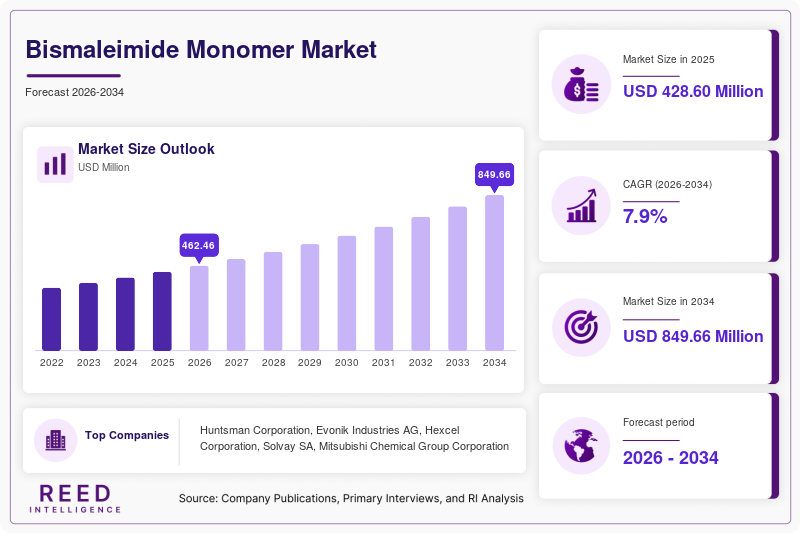
Key Highlights
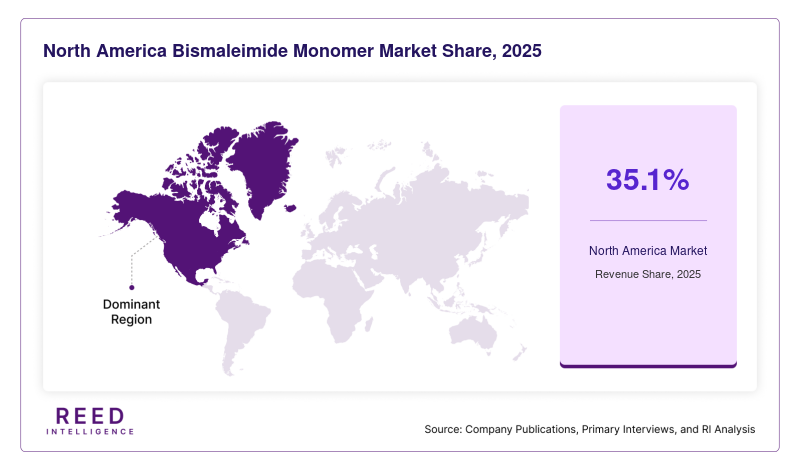
- North America dominated the market with a 35.1% share in 2025.
- Asia Pacific is expected to grow at the fastest CAGR of 9.8% during 2026–2034.
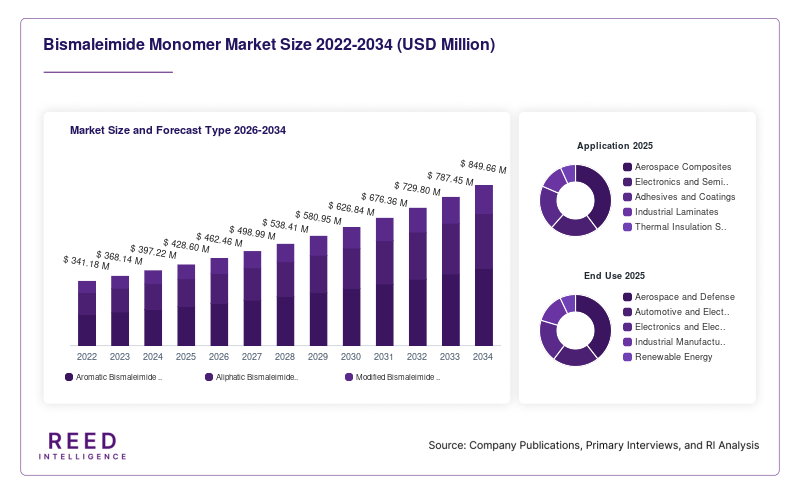
- By type, aromatic bismaleimide monomers accounted for the largest share of 44.3%.
- while aliphatic bismaleimide monomers are projected to grow at a CAGR of 9.5%.
- By application, aerospace composites led with a 39.6% share.
- whereas electronics and semiconductor packaging is expected to expand at a CAGR of 10.1%.
- By end use, aerospace and defense held the dominant share of 42.7%.
- while automotive and electric mobility is anticipated to grow at a CAGR of 9.7%.
- The United States remained the dominant country, with market values of USD 118 million in 2024 and USD 128 million in 2025.
Market Trends
Rising Integration of High-Temperature Composite Materials in Aerospace Manufacturing
The increasing integration of high-temperature composite materials into aerospace manufacturing processes is emerging as a notable trend in the Bismaleimide Monomer Market. Aircraft manufacturers are continuously seeking materials capable of delivering low weight, strong mechanical performance, and thermal endurance under extreme operational environments. Bismaleimide monomers are increasingly used in structural components, engine housings, insulation systems, and aircraft interiors because they maintain dimensional stability under high thermal stress. Commercial aviation growth and defense aircraft modernization programs are encouraging manufacturers to expand production capacity for advanced composite materials. The trend is further supported by rising investments in next-generation aircraft platforms, including unmanned aerial vehicles and space exploration systems, where lightweight and heat-resistant materials are critical for operational reliability and fuel efficiency.
Increasing Adoption of Advanced Electronic Packaging Materials
The electronics sector is witnessing increased adoption of advanced packaging materials that can tolerate high operating temperatures and dense circuit integration. This trend is contributing to stronger demand for bismaleimide monomers in semiconductor packaging, laminates, and high-frequency electronic systems. Modern electronic devices require enhanced thermal conductivity and electrical insulation to support miniaturized architectures and faster processing capabilities. Bismaleimide-based materials are gaining traction because they provide improved dielectric properties and resistance to thermal degradation compared to conventional resin systems. Expansion of 5G infrastructure, electric vehicle electronics, industrial automation systems, and data center investments is accelerating demand for durable electronic materials. Manufacturers are also developing modified bismaleimide formulations that support faster curing cycles and improved compatibility with advanced electronic manufacturing processes.
Market Drivers
Expansion of Aerospace and Defense Manufacturing Activities
The expansion of aerospace and defense manufacturing activities continues to drive demand within the Bismaleimide Monomer Market. Governments across multiple countries are increasing investments in military modernization, advanced aircraft fleets, missile systems, and satellite technologies. These applications require high-performance composite materials capable of withstanding elevated temperatures and mechanical stress. Bismaleimide monomers are widely utilized in aerospace-grade resin systems because of their superior heat resistance and low smoke emission properties. Commercial aircraft production is also increasing due to rising passenger traffic and airline fleet expansion. The growing use of lightweight composite structures to improve fuel efficiency and reduce maintenance costs is strengthening the market outlook. In addition, long operational life cycles and strict safety requirements in aerospace manufacturing continue to support the adoption of advanced thermosetting materials.
Growing Demand for High-Performance Materials in Electric Vehicles
The rising production of electric vehicles is creating strong demand for high-performance polymer materials, including bismaleimide monomers. Electric vehicles generate substantial thermal loads within battery systems, power electronics, charging infrastructure, and motor assemblies. Manufacturers are increasingly using thermally stable resin systems to improve safety, energy efficiency, and operational reliability. Bismaleimide monomers provide excellent insulation properties and mechanical durability, making them suitable for advanced electrical applications. The transition toward lightweight automotive platforms is also encouraging the use of composite materials to reduce vehicle weight and improve driving range. Automotive manufacturers are investing in advanced materials research to meet performance and regulatory requirements associated with electric mobility. This shift is expected to support long-term growth opportunities for the market across developed and emerging automotive manufacturing economies.
Market Restraint
High Production Costs and Complex Processing Requirements
High production costs and complex processing requirements remain major challenges for the Bismaleimide Monomer Market. Manufacturing bismaleimide monomers involves sophisticated synthesis procedures, strict temperature control, and specialized raw materials, which significantly increase operational expenses. Compared to conventional epoxy and polyester resin systems, bismaleimide-based materials are more expensive, limiting adoption among cost-sensitive industries and small-scale manufacturers. In addition, processing these materials often requires advanced curing technologies and highly controlled manufacturing environments to achieve optimal mechanical performance and thermal stability.
The cost barrier affects broader commercialization, particularly in regions where industrial manufacturers prioritize low-cost alternatives for standard applications. Fluctuations in petrochemical feedstock prices and supply chain disruptions can also influence raw material availability and pricing structures. Some manufacturers face challenges associated with brittleness and limited flexibility in certain applications, which can increase engineering complexity during product development. For example, automotive component suppliers operating in mass-market vehicle segments may continue using conventional thermoset systems because of lower processing costs and established production infrastructure. These limitations may slow market penetration in industries where pricing competitiveness remains a critical purchasing factor.
Market Opportunities
Development of Advanced Space Exploration and Satellite Programs
The development of advanced space exploration and satellite programs is creating new opportunities for the Bismaleimide Monomer Market. Spacecraft components operate under severe temperature fluctuations, radiation exposure, and mechanical stress, requiring materials with exceptional thermal stability and structural integrity. Bismaleimide-based composites are increasingly being evaluated for use in satellite structures, propulsion systems, insulation materials, and communication equipment. Government agencies and private aerospace companies are expanding investments in reusable launch systems, satellite constellations, and deep-space missions, which is increasing demand for high-performance polymer materials.
The commercialization of low-earth orbit satellite networks and growing investments in space-based communication infrastructure are expected to accelerate material innovation. Manufacturers are also exploring hybrid resin systems that combine bismaleimide monomers with nanomaterials and carbon fiber composites to improve durability and reduce weight. As global competition in the space industry intensifies, suppliers capable of delivering advanced lightweight materials are likely to gain long-term business opportunities across commercial and defense-related aerospace applications.
Increasing Penetration of Renewable Energy Infrastructure
The expansion of renewable energy infrastructure presents another significant opportunity for the Bismaleimide Monomer Market. Wind energy systems, solar power equipment, and energy storage technologies increasingly require durable composite materials that can withstand harsh environmental conditions and prolonged operational stress. Bismaleimide monomers are being used in structural components, insulation systems, and electrical assemblies because of their resistance to heat, corrosion, and moisture.
Offshore wind farms in particular require lightweight and high-strength materials capable of maintaining long-term performance under extreme weather exposure. As countries increase investments in renewable energy capacity and energy transition programs, manufacturers are expected to adopt advanced composite systems to improve equipment efficiency and reduce maintenance costs. In addition, energy storage systems and smart grid infrastructure are generating demand for thermally stable electronic materials. The ongoing modernization of power transmission networks and expansion of industrial renewable projects are expected to create new revenue streams for market participants over the forecast period.
Segmental Analysis
By Type
Aromatic bismaleimide monomers accounted for the largest share of the global market in 2024, representing approximately 44.3% of total revenue. These monomers are widely utilized because of their excellent thermal resistance, mechanical strength, and dimensional stability under high-temperature operating conditions. Aerospace manufacturers extensively use aromatic bismaleimide systems in aircraft structural components, insulation materials, and engine-related applications where durability is critical. Electronics and defense sectors also rely on aromatic formulations for advanced circuit systems and protective materials. Their compatibility with carbon fiber composites and advanced reinforcement technologies further strengthens demand across industrial applications. Manufacturers continue investing in formulation improvements to enhance processing efficiency and reduce brittleness concerns associated with traditional high-performance thermosetting materials.
Aliphatic bismaleimide monomers are projected to witness the fastest growth during the forecast period, expanding at a CAGR of 9.5% from 2026 to 2034. The growth is supported by increasing demand for flexible and low-viscosity resin systems that offer improved processability across electronics and automotive applications. Aliphatic variants provide enhanced toughness and reduced curing stress compared to conventional aromatic systems, making them suitable for lightweight composite manufacturing. Automotive component suppliers are increasingly adopting these materials for electric mobility systems and advanced insulation components. The segment is also benefiting from technological advancements in polymer chemistry that enable improved compatibility with hybrid composites and nanomaterial-enhanced formulations. Growing industrial interest in customized resin solutions is expected to support further market expansion.
By Application
Aerospace composites represented the dominant application segment in 2024, accounting for nearly 39.6% of the global Bismaleimide Monomer Market. The segment continues to benefit from rising aircraft production and increasing use of lightweight composite materials in commercial and defense aviation platforms. Bismaleimide-based composites are preferred in aerospace manufacturing due to their high heat resistance, low flammability, and strong mechanical performance under extreme operating conditions. These materials are widely used in fuselage components, engine structures, radomes, and thermal protection systems. Growing investments in next-generation aircraft technologies and unmanned aerial systems are further strengthening segment growth. Manufacturers are also focusing on developing advanced curing techniques to improve production efficiency and reduce manufacturing cycle times for aerospace-grade composite structures.
Electronics and semiconductor packaging is expected to emerge as the fastest-growing application segment, recording a CAGR of 10.1% during the forecast period. Rapid expansion of semiconductor manufacturing, high-frequency communication systems, and advanced computing technologies is creating strong demand for thermally stable materials. Bismaleimide monomers are increasingly utilized in printed circuit boards, chip packaging materials, and high-performance electronic laminates because of their superior dielectric and insulation characteristics. The growing adoption of artificial intelligence infrastructure, cloud computing systems, and electric vehicle electronics is further accelerating demand for advanced packaging materials. Manufacturers are also investing in low-loss and high-reliability resin systems capable of supporting miniaturized electronic architectures and elevated operating temperatures in next-generation electronic devices.
By End Use
The aerospace and defense segment held the dominant share of the Bismaleimide Monomer Market in 2024, contributing approximately 42.7% of total industry revenue. Demand from this sector is driven by increasing military modernization programs, rising aircraft deliveries, and strong investment in space exploration technologies. Bismaleimide monomers are widely used in high-performance composites that require exceptional thermal endurance and mechanical stability. Defense organizations increasingly rely on these materials for missile systems, radar equipment, thermal barriers, and lightweight structural components. Commercial aviation companies are also adopting advanced thermosetting composites to improve fuel efficiency and reduce aircraft weight. The segment continues to benefit from long product lifecycles, stringent safety standards, and the need for durable materials capable of operating under severe environmental conditions.
Automotive and electric mobility is projected to witness the fastest growth through 2034, expanding at a CAGR of 9.7% during the forecast period. The transition toward electric vehicles and lightweight transportation platforms is creating substantial demand for advanced polymer materials. Bismaleimide monomers are increasingly utilized in battery insulation systems, power electronics, lightweight body structures, and charging infrastructure components due to their thermal resistance and mechanical strength. Automotive manufacturers are also adopting composite materials to reduce vehicle mass and improve energy efficiency. Increasing government support for electric mobility adoption and stricter emission regulations are encouraging manufacturers to invest in high-performance material technologies. Advancements in composite molding techniques and scalable production methods are expected to further accelerate market growth within this segment.
Regional Analysis
North America
North America accounted for the largest share of the Bismaleimide Monomer Market in 2025, representing approximately 35.1% of global revenue. The regional market is projected to expand at a CAGR of 7.3% during the forecast period due to strong demand from aerospace, defense, and advanced electronics industries. The presence of established aircraft manufacturers and military contractors continues to support high consumption of heat-resistant composite materials. In addition, investments in semiconductor manufacturing and electric mobility infrastructure are increasing the use of high-performance thermosetting polymers across industrial applications.
The United States remained the dominant country within North America due to its extensive aerospace manufacturing ecosystem and defense modernization programs. Government funding for advanced military aircraft, missile systems, and satellite technologies is creating stable demand for bismaleimide-based composite materials. The country is also witnessing increased research activity related to lightweight structural materials for electric vehicles and next-generation aviation systems. Strong collaboration between material science companies, universities, and defense agencies is supporting technological innovation and long-term market growth.
Europe
Europe held a substantial share of the global Bismaleimide Monomer Market in 2025 and is expected to record a CAGR of 7.1% between 2026 and 2034. The regional market is benefiting from growing investments in sustainable transportation systems and advanced industrial manufacturing technologies. European aerospace companies continue to prioritize lightweight composite materials to improve fuel efficiency and reduce emissions. In addition, increasing adoption of advanced electronics and industrial automation systems is creating steady demand for thermally stable polymer materials.
Germany emerged as the leading country within Europe due to its strong automotive engineering base and advanced manufacturing capabilities. The country is expanding investments in electric vehicle production and lightweight composite technologies to improve energy efficiency and regulatory compliance. German manufacturers are also integrating advanced resin systems into industrial machinery, renewable energy systems, and electronics production. Supportive research funding and collaboration between industrial suppliers and engineering institutions continue to strengthen regional material innovation.
Asia Pacific
Asia Pacific is projected to witness the fastest growth in the Bismaleimide Monomer Market, with an estimated CAGR of 9.8% during the forecast period. The region accounted for a significant market share in 2025 due to rapid industrialization, increasing electronics manufacturing, and expanding aerospace production capabilities. Countries across Asia Pacific are investing heavily in semiconductor fabrication plants, electric vehicle supply chains, and renewable energy infrastructure. These developments are increasing the consumption of high-performance polymer materials capable of delivering superior thermal and mechanical performance.
China remained the dominant country in the Asia Pacific market because of its large manufacturing base and growing investments in aerospace and electronics industries. The country is expanding domestic aircraft production programs and increasing research activities focused on advanced composite materials. Rapid growth in electric vehicle production and battery manufacturing is also contributing to higher demand for thermally resistant polymers. In addition, government support for industrial modernization and local semiconductor manufacturing capacity expansion is accelerating the adoption of advanced resin systems.
Middle East & Africa
The Middle East & Africa region represented a smaller but steadily expanding portion of the global Bismaleimide Monomer Market in 2025. The market is expected to register a CAGR of 6.8% during the forecast period due to increasing industrial diversification and infrastructure investments. Several countries in the region are focusing on aerospace maintenance capabilities, defense manufacturing, and renewable energy development. Growing industrial activity is creating demand for durable composite materials capable of operating under extreme environmental conditions.
Saudi Arabia emerged as the dominant country within the regional market due to its expanding industrial diversification initiatives and aerospace investments. The country is strengthening domestic manufacturing capabilities through long-term economic transformation programs that encourage advanced material adoption. Investments in renewable energy infrastructure and defense production are also supporting demand for thermally stable polymers and composite materials. The presence of large-scale industrial projects and rising partnerships with international technology companies are expected to support future market development.
Latin America
Latin America accounted for a moderate share of the Bismaleimide Monomer Market in 2025 and is projected to grow at a CAGR of 6.5% during the forecast period. Industrial modernization and increasing investments in automotive manufacturing are supporting regional demand for advanced polymer materials. The region is also witnessing gradual expansion in renewable energy projects and industrial electronics applications, creating opportunities for composite material suppliers. Economic recovery in several countries is encouraging greater infrastructure and manufacturing investments.
Brazil dominated the Latin American market due to its strong industrial base and growing aerospace manufacturing activities. The country has an established aviation sector that increasingly relies on lightweight composite materials to improve aircraft performance and operational efficiency. Brazil is also expanding electric mobility initiatives and renewable energy installations, which are contributing to demand for high-performance resin systems. Government incentives supporting industrial innovation and local manufacturing development are expected to strengthen future market opportunities.
Competitive Landscape
The Bismaleimide Monomer Market is moderately consolidated, with several global chemical manufacturers competing through product innovation, strategic partnerships, and regional expansion initiatives. Leading companies are focusing on advanced resin development, improved thermal performance, and customized composite solutions to strengthen their market positions. Many manufacturers are also investing in research activities aimed at reducing curing time and enhancing process efficiency for aerospace and electronics applications.
Huntsman Corporation remains one of the leading participants in the market due to its diversified high-performance materials portfolio and strong global distribution network. The company recently expanded its advanced composite materials development initiatives to support aerospace and electric mobility applications. Other key players are emphasizing joint ventures and production expansion strategies to address increasing demand from semiconductor packaging and renewable energy sectors.
Competition within the market is also influenced by technological expertise, raw material sourcing capabilities, and long-term relationships with aerospace and defense contractors. Regional manufacturers in Asia Pacific are strengthening their market presence through cost-competitive production and growing investments in specialty polymer manufacturing. The increasing demand for customized formulations and hybrid composite systems is expected to intensify product development activities among global industry participants over the coming years.
Key Players
- Huntsman Corporation
- Evonik Industries AG
- Hexcel Corporation
- Solvay SA
- Mitsubishi Chemical Group Corporation
- DIC Corporation
- Toray Industries Inc.
- HOS-Technik GmbH
- ABR Organics Limited
- Renegade Materials Corporation
- K.I Chemical Industry Co. Ltd.
- Qinyang Tianyi Chemical Co. Ltd.
- JFE Chemical Corporation
- Designer Molecules Inc.
Recent Developments
- Huntsman Corporation announced expanded research initiatives focused on advanced composite resin systems for aerospace and electric vehicle applications in 2025.
- Mitsubishi Chemical Group Corporation introduced a new high-temperature resistant bismaleimide formulation designed for semiconductor packaging and industrial electronics applications in 2024.
- Solvay SA expanded its advanced materials production capabilities in Asia Pacific to address rising demand from aerospace and renewable energy industries in 2025.
- Toray Industries Inc. collaborated with regional aerospace component manufacturers to develop lightweight composite structures utilizing advanced bismaleimide resin technologies in 2024.
- Evonik Industries AG invested in specialty polymer development programs aimed at improving low-viscosity bismaleimide systems for high-performance industrial applications in 2025.
Bismaleimide Monomer Market Segments
Type
- Aromatic Bismaleimide Monomers
- Aliphatic Bismaleimide Monomers
- Modified Bismaleimide Monomers
Application
- Aerospace Composites
- Electronics and Semiconductor Packaging
- Adhesives and Coatings
- Industrial Laminates
- Thermal Insulation Systems
End Use
- Aerospace and Defense
- Automotive and Electric Mobility
- Electronics and Electrical
- Industrial Manufacturing
- Renewable Energy
By Region
- North America
- Europe
- APAC
- Middle East and Africa
- LATAM