Black Phosphorus Market Size, Share & Demand Report By Type (Bulk Black Phosphorus, Phosphorene, Black Phosphorus Nanoribbons), By Application (Electronics, Optoelectronics, Energy Storage, Sensors, Biomedical Applications), By End-Use Industry (Semiconductor Industry, Energy & Power, Healthcare, Research & Academia, Electronics Manufacturing), By Region & Segment Forecasts, 2025–2034
USD 3950
Market Overview
The Black Phosphorus Market size was valued at USD 38.6 million in 2025 and is projected to reach USD 214.7 million by 2033, registering a CAGR of 24.1% during 2025–2034. Black phosphorus, a layered allotrope of phosphorus with tunable bandgap and high carrier mobility, has emerged as a promising material in advanced electronics, optoelectronics, and energy storage technologies. The material’s ability to form phosphorene layers with anisotropic electronic characteristics has strengthened its adoption across next-generation semiconductor devices and nanoelectronics.
One global factor supporting the Black Phosphorus Market growth is the rising investment in two-dimensional (2D) materials research. Governments and private technology companies are expanding funding for nanomaterial research to develop faster electronic components and efficient energy systems. Research programs across North America, Europe, and Asia Pacific have increased commercialization prospects for black phosphorus in flexible electronics, sensors, and photodetectors. As semiconductor manufacturers explore alternatives to traditional materials such as silicon and graphene, black phosphorus has gained recognition for its unique electronic structure and tunable optical properties.
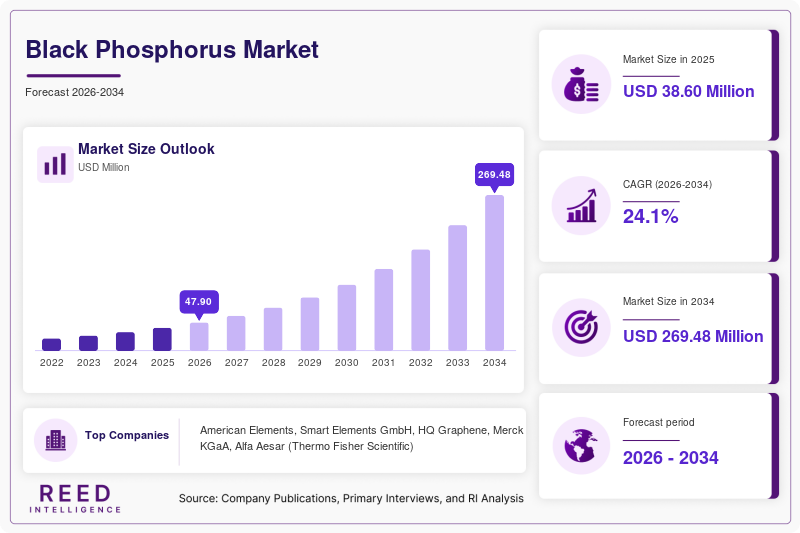
Key Highlights
- Asia Pacific dominated the market with 41.8% share in 2025, while North America is projected to register the fastest CAGR of 25.7% through 2034.
- Bulk Black Phosphorus led the type segment with 46.2% share, whereas phosphorene is expected to grow at 27.3% CAGR.
- Electronics applications accounted for 38.9% share in 2025, while energy storage applications are forecast to expand at 26.4% CAGR.
- China remained the dominant country, with a market value of USD 10.1 million in 2025 and USD 12.5 million in 2026.
Market Trends
Expansion of Phosphorene Research in Nanoelectronics
Research into phosphorene-based materials has accelerated across universities and semiconductor laboratories. Phosphorene, a single or few-layer derivative of black phosphorus, demonstrates tunable bandgap and high electron mobility. These properties have positioned the material as a promising candidate for future transistors and flexible electronics. Increasing collaborations between academic institutions and semiconductor manufacturers have supported pilot-scale production of phosphorene. This trend is influencing the Black Phosphorus Market share, particularly in applications requiring high-performance nanoscale components.
Integration in Advanced Energy Storage Systems
Another notable Black Phosphorus Market trend involves the material’s integration into next-generation battery technologies. Black phosphorus exhibits high theoretical capacity and rapid ion diffusion, which supports improved battery performance. Researchers are exploring the use of black phosphorus as an anode material in lithium-ion and sodium-ion batteries. As energy storage technologies evolve to meet demands from electric mobility and renewable energy systems, the incorporation of black phosphorus in electrode structures is expected to expand. The trend is also encouraging material processing innovations aimed at improving stability and cycle performance.
Market Drivers
Rising Demand for High-Performance Semiconductor Materials
The transition toward miniaturized and high-speed electronic devices has increased demand for advanced semiconductor materials. Black phosphorus offers strong carrier mobility and tunable electronic properties, making it suitable for field-effect transistors and photonic devices. Semiconductor manufacturers are exploring alternative materials that can address performance limitations of silicon at nanoscale levels. As research laboratories demonstrate improved device efficiency using black phosphorus, the Black Phosphorus Market growth continues to gain momentum across advanced electronics applications.
Growing Investments in Nanotechnology Research
Another factor driving the Black Phosphorus Market size is the increasing level of investment in nanotechnology research. Governments in regions such as Asia Pacific and Europe are allocating funding to support development of 2D materials. Research institutions are investigating black phosphorus for sensors, biomedical imaging, and photodetection technologies. These investments have expanded experimental studies and pilot manufacturing capabilities. The broader interest in nanomaterials for industrial and scientific applications is expected to support sustained expansion of the market during the forecast period.
Market Restraint
Stability Challenges in Ambient Conditions
A major restraint affecting the Black Phosphorus Market is the material’s sensitivity to oxygen and moisture. Black phosphorus tends to degrade when exposed to ambient conditions, which limits its stability in practical applications. Oxidation can lead to structural deterioration and performance decline, particularly in electronic and optoelectronic devices.
These stability concerns have created technical challenges for manufacturers seeking to commercialize black phosphorus-based products. The need for protective coatings, encapsulation techniques, and controlled storage environments increases production complexity and costs. For large-scale electronics manufacturing, maintaining consistent material quality remains an operational challenge.
Researchers are currently exploring surface passivation techniques and hybrid material structures to address these limitations. Although advancements are progressing, the requirement for improved stabilization technologies continues to influence adoption rates across commercial sectors. As a result, stability issues remain a limiting factor in the Black Phosphorus Market outlook, particularly for applications requiring long-term material reliability.
Market Opportunities
Development of Flexible Electronics
Flexible electronics represent a promising opportunity for the Black Phosphorus Market. Black phosphorus possesses strong mechanical flexibility and anisotropic electrical properties that support flexible transistor and sensor development. Consumer electronics manufacturers are exploring foldable displays, wearable sensors, and lightweight electronic devices that require advanced semiconductor materials. The compatibility of black phosphorus with flexible substrates is expected to encourage new product innovations within this application segment.
Emerging Use in Biomedical Imaging and Phototherapy
Black phosphorus nanoparticles have demonstrated potential in biomedical imaging and phototherapy applications. The material’s photothermal characteristics enable efficient light absorption and heat conversion, which can support targeted cancer therapy and diagnostic imaging techniques. Research institutions are evaluating biocompatibility and controlled degradation properties of black phosphorus for medical use. As the healthcare sector explores nanomaterial-based therapies, the integration of black phosphorus in biomedical research may open new avenues for the Black Phosphorus Market forecast over the coming decade.
Segmental Analysis
By Type
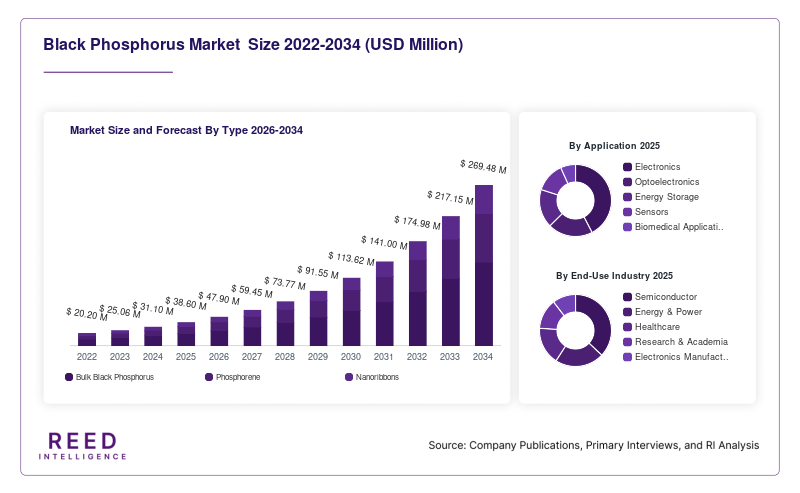
Bulk black phosphorus represented the dominant subsegment in 2025 with 46.2% share of the Black Phosphorus Market. Bulk material forms serve as the primary source for exfoliating phosphorene layers used in experimental electronic applications. Many research laboratories rely on bulk black phosphorus crystals for material processing and device fabrication. The segment maintained a significant share due to its role as the base material in multiple nanotechnology experiments and semiconductor research projects.
The phosphorene segment is projected to grow at the fastest CAGR of 27.3% through 2034. Phosphorene refers to atomically thin layers derived from black phosphorus, offering unique electronic and optical properties. Growing interest in two-dimensional semiconductors will likely increase the use of phosphorene in nanoscale transistors and optoelectronic devices. Researchers are expected to focus on improving large-scale synthesis and stability techniques, which could accelerate adoption of phosphorene materials in advanced electronic applications.
By Application
Electronics applications accounted for 38.9% of the Black Phosphorus Market share in 2025. The segment includes field-effect transistors, photodetectors, and optoelectronic devices. Black phosphorus exhibits strong carrier mobility and adjustable bandgap characteristics that support improved device performance. Research institutions and semiconductor laboratories have continued to explore the material for nanoscale electronic components. As experimental devices demonstrate favorable performance characteristics, electronics remained the primary application segment.
The energy storage segment is expected to grow at a CAGR of 26.4% during the forecast period. Black phosphorus demonstrates promising characteristics for battery electrode materials due to its high theoretical capacity and ion transport capabilities. Researchers are investigating its use in lithium-ion and sodium-ion batteries to enhance energy density and charge rates. Advancements in electrode design and material stabilization are expected to support expansion of this application area within the Black Phosphorus Market forecast.
By End-Use Industry
The semiconductor industry represented the dominant end-use segment in 2025 with 42.7% share of the Black Phosphorus Market. Semiconductor manufacturers and research laboratories are evaluating black phosphorus as a potential material for high-performance electronic devices. Its tunable bandgap properties allow for potential applications in nanoscale transistors and integrated circuits. As semiconductor technology approaches physical limits of traditional materials, experimental adoption of black phosphorus has expanded within research programs.
The energy and power sector is anticipated to register the fastest CAGR of 25.9% during the forecast period. Energy storage systems require materials that support higher capacity and efficient ion diffusion. Black phosphorus offers structural properties that can improve battery electrode performance. Continued research into battery technology and renewable energy storage solutions is expected to create growth opportunities for the Black Phosphorus Market analysis in this sector.
Regional Analysis
North America
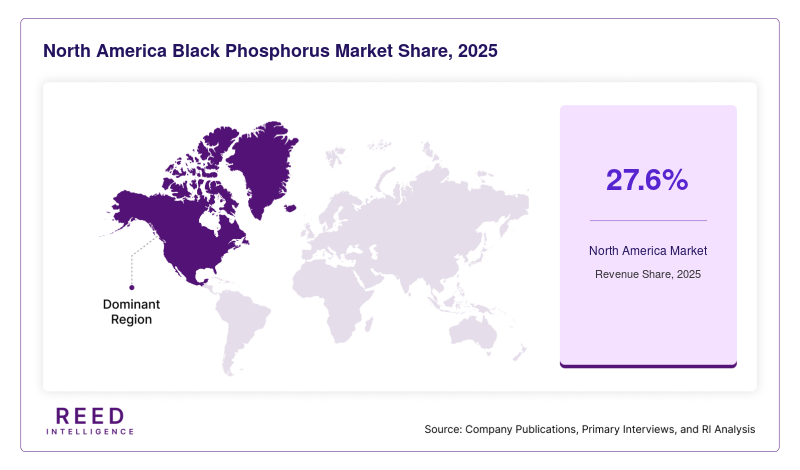
North America accounted for 27.6% of the Black Phosphorus Market share in 2025. The region is projected to grow at a CAGR of 25.7% during 2025–2034. Strong research infrastructure and the presence of advanced semiconductor companies have supported regional demand for black phosphorus materials. Universities and technology research laboratories across the United States and Canada have increased exploration of phosphorene-based electronic components. The region has also experienced steady funding from government agencies for nanotechnology development, contributing to sustained innovation within the market.
The United States dominated the North American Black Phosphorus Market in 2025. The country benefits from a well-established semiconductor ecosystem and strong collaboration between research institutions and technology firms. Federal research programs supporting advanced materials and quantum electronics have encouraged further investigation of black phosphorus. Additionally, the presence of several nanomaterial startups and specialized material suppliers has expanded the commercial availability of black phosphorus for experimental device manufacturing.
Europe
Europe held 21.9% of the global Black Phosphorus Market in 2025 and is expected to expand at a CAGR of 23.4% through 2034. The region’s growth is supported by structured research initiatives focused on advanced materials and microelectronics. European universities and research organizations have conducted extensive studies on 2D materials, including black phosphorus, for optoelectronics and sensing technologies. These research activities have contributed to increased regional awareness and adoption of black phosphorus across experimental electronics applications.
Germany represented the dominant country within the European Black Phosphorus Market. The country’s established semiconductor and electronics manufacturing industries provide a foundation for advanced materials research. German research institutes have explored black phosphorus for photodetectors, nano-transistors, and energy storage systems. Collaboration between industry and academic institutions has strengthened the development of scalable production techniques, which may contribute to future commercialization.
Asia Pacific
Asia Pacific captured the largest share of the Black Phosphorus Market at 41.8% in 2025 and is projected to grow at a CAGR of 24.8% during the forecast period. Rapid expansion of the semiconductor industry and increasing research funding across countries such as China, Japan, and South Korea have supported the region’s leadership position. Many research institutes in the region are actively investigating 2D materials to improve electronic device performance.
China led the Asia Pacific Black Phosphorus Market in 2025. The country’s strong investment in nanotechnology research and material science has encouraged development of advanced phosphorene applications. Several Chinese universities and technology laboratories have produced research findings related to black phosphorus transistors and photonic devices. In addition, the presence of large electronics manufacturing facilities creates potential opportunities for future integration of black phosphorus materials in commercial semiconductor production.
Middle East & Africa
The Middle East & Africa accounted for 4.7% of the global Black Phosphorus Market share in 2025 and will likely grow at a CAGR of 20.6% through 2034. The market in this region remains in an early stage of development but is gradually expanding due to growing research activities in advanced materials and nanotechnology. Universities and technology centers in countries such as the United Arab Emirates and Saudi Arabia are exploring nanomaterials for electronics and renewable energy applications.
The United Arab Emirates emerged as a key country in the regional market. Government initiatives supporting research infrastructure and technological innovation have contributed to the development of advanced materials laboratories. Academic institutions have initiated collaborative projects with international research groups focusing on nanomaterial synthesis and characterization. These initiatives are expected to gradually increase the regional presence of the Black Phosphorus Market.
Latin America
Latin America represented 4.0% of the Black Phosphorus Market in 2025 and is forecast to grow at a CAGR of 21.3% during the forecast period. Growth in the region is primarily associated with academic research activities and emerging nanotechnology programs. Universities and scientific research institutions are studying the potential applications of black phosphorus in sensors and energy storage systems.
Brazil accounted for the largest share of the Latin American Black Phosphorus Market. The country’s growing research ecosystem in nanotechnology has contributed to experimental studies involving black phosphorus materials. Brazilian universities and technology centers have initiated research projects focused on nanomaterial synthesis and electronic applications. These initiatives are expected to gradually expand the market presence across the region.
Competitive Landscape
The Black Phosphorus Market is characterized by the presence of specialized nanomaterial manufacturers, research-oriented chemical companies, and advanced material suppliers. Companies are focusing on improving synthesis methods, material purity, and stability to support research and early-stage commercial applications.
American Elements is considered a leading participant in the market due to its extensive portfolio of advanced materials and nanomaterial products. The company recently expanded its production capacity for high-purity black phosphorus crystals used in electronics and research applications. Other companies are concentrating on collaborations with research institutions to explore potential commercial uses of phosphorene.
Market participants are also investing in advanced material processing technologies to support scalable manufacturing. Partnerships between universities and private companies continue to influence product development and experimental commercialization across the industry.
Key Players in the Black Phosphorus Market
- American Elements
- Smart Elements GmbH
- HQ Graphene
- Merck KGaA
- Alfa Aesar (Thermo Fisher Scientific)
- ACS Material
- 2D Semiconductors
- SixCarbon Technology
- Nanochemazone
- MSE Supplies
- Graphene Supermarket
- Nanoshel LLC
- Strem Chemicals
- Stanford Advanced Materials
- Tokyo Chemical Industry
Recent Developments
- 2024: American Elements expanded production capacity for high-purity black phosphorus crystals for research laboratories.
- 2024: Several academic research institutions introduced new phosphorene synthesis methods to improve material stability.
- 2023: Nanomaterial suppliers collaborated with semiconductor research laboratories to explore black phosphorus transistor prototypes.
- 2023: Research groups in Asia Pacific reported advancements in black phosphorus battery electrode structures.
- 2022: European research institutes initiated collaborative programs focused on scalable production of phosphorene materials.
Black Phosphorus Market Segments
By Type
- Bulk Black Phosphorus
- Phosphorene
- Nanoribbons
By Application
- Electronics
- Optoelectronics
- Energy Storage
- Sensors
- Biomedical Applications
By End-Use Industry
- Semiconductor
- Energy & Power
- Healthcare
- Research & Academia
- Electronics Manufacturing
By Region
- North America
- Europe
- APAC
- Middle East and Africa
- LATAM