Blanking Machine Market Size, Share, Demand Report By Machine Type (Hydraulic Blanking Machines,Servo-Electric Blanking Machines), By Application (Automotive Manufacturing, Electronics Component Fabrication,Industrial Equipment Manufacturing, Construction & Heavy Machinery), By End-Use Industry (Industrial Manufacturing,Aerospace & Defense, Electrical & Electronics, Construction Industry), By Region & Segment Forecasts, 2026–2034
USD 3950
Market Overview
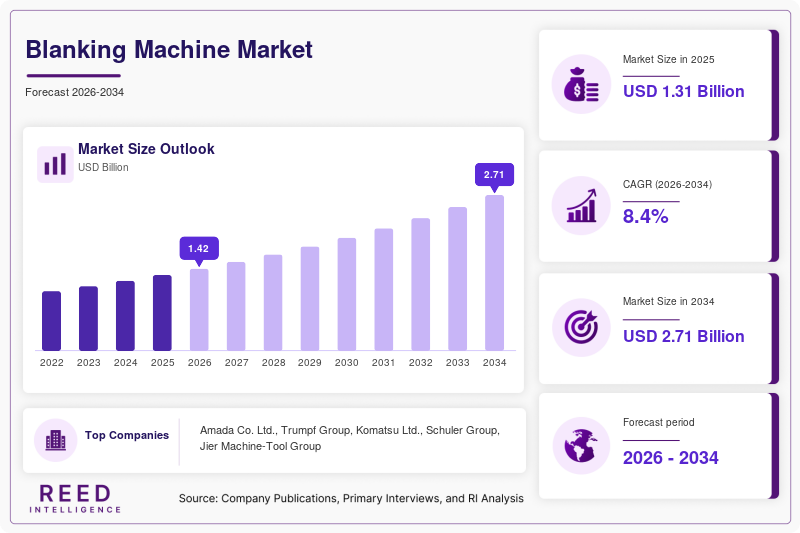
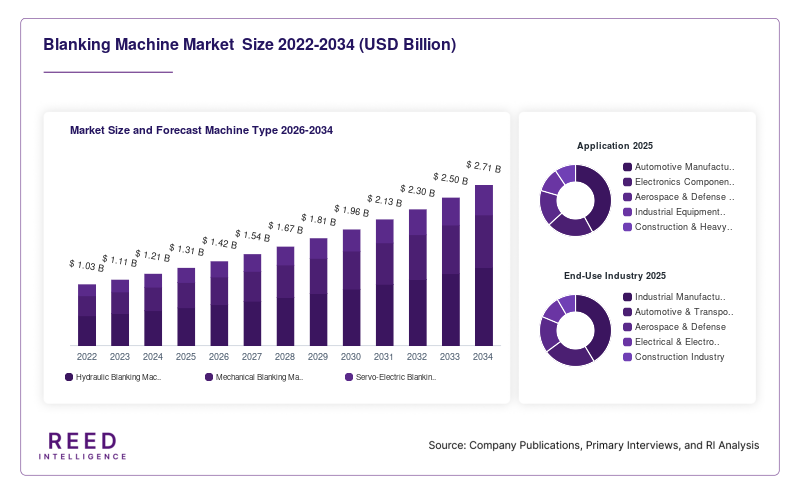
The Blanking Machine Market size is estimated at USD 1.42 billion, and it is projected to reach approximately USD 2.71 billion by 2034, registering a CAGR of 8.4% during the forecast period (2026–2034). Growth is primarily supported by the rising adoption of high-speed stamping and blanking technologies that enhance productivity while minimizing material waste in large-scale production environments.
A key global factor supporting market growth is the accelerated shift toward smart manufacturing and Industry 4.0 integration. Manufacturers are increasingly adopting CNC-controlled blanking machines equipped with IoT-based monitoring systems, enabling real-time performance tracking, predictive maintenance, and improved operational efficiency. This transition has significantly enhanced production accuracy across automotive body panels, electrical components, and precision industrial parts.
Key Highlights
- North America dominated the market with a 34.2% share in 2025.
- Asia Pacific is expected to grow at the fastest CAGR of 11.2% during 2026–2034.
- By machine type, hydraulic blanking machines accounted for the largest share of 39.6%.
- while servo-electric machines are projected to grow at a CAGR of 12.1%.
- By application, automotive manufacturing led with a 42.3% share, whereas electronics component fabrication is expected to expand at a CAGR of 11.5%.
- The United States remained the dominant country, with market values of USD 540 million in 2024 and USD 590 million in 2025.
Market Trends
Increasing Integration of Automation and CNC Technologies
The adoption of automation and CNC-based blanking systems is transforming the production landscape of the Blanking Machine Market. Manufacturers are increasingly investing in digitally controlled machines that offer higher precision, reduced cycle time, and minimal human intervention. These systems are integrated with programmable logic controllers (PLCs) and IoT-enabled sensors, allowing operators to monitor machine health and performance in real time. The trend is particularly strong in automotive and aerospace industries, where component accuracy is critical. Additionally, automated blanking machines help reduce operational costs by minimizing material waste and improving production throughput, thereby enhancing overall manufacturing efficiency.
Rising Demand for Energy-Efficient Servo-Electric Machines
Energy efficiency has become a major focus in industrial manufacturing, driving demand for servo-electric blanking machines. These machines consume significantly less power compared to traditional hydraulic systems while delivering higher precision and repeatability. Manufacturers are increasingly shifting toward sustainable production practices, leading to widespread adoption of low-energy consumption equipment. Servo-electric machines also offer faster setup times and reduced maintenance requirements, making them suitable for high-volume production environments. This trend is gaining momentum in Europe and Asia Pacific, where regulatory frameworks and industrial sustainability goals are pushing companies toward greener manufacturing technologies.
Market Drivers
Expansion of Automotive and Electric Vehicle Manufacturing
The growth of the automotive and electric vehicle industries is a major driver for the Blanking Machine Market. Blanking machines are essential in producing precise metal sheets used in vehicle body structures, chassis components, and battery enclosures. With global EV production expanding rapidly, manufacturers require high-precision stamping and blanking systems to handle lightweight materials such as aluminum and advanced high-strength steel. This demand is further amplified by the need for mass production efficiency and reduced production defects. Automotive OEMs are increasingly collaborating with machine manufacturers to integrate advanced blanking solutions into automated production lines, boosting market expansion.
Increasing Industrial Automation and Smart Manufacturing Adoption
The shift toward smart factories and automated production systems is significantly driving demand for advanced blanking machines. Industries are integrating Industry 4.0 technologies such as AI-based monitoring, machine learning algorithms, and cloud connectivity into manufacturing equipment. This allows real-time optimization of production processes and predictive maintenance, reducing downtime and improving efficiency. As industries seek higher productivity and lower operational costs, the adoption of automated blanking systems continues to rise. Sectors such as electronics, aerospace, and heavy machinery are increasingly deploying intelligent blanking solutions to achieve precision manufacturing at scale.
Market Restraint
High Initial Investment and Maintenance Costs
One of the primary restraints affecting the Blanking Machine Market is the high capital investment required for advanced machines, particularly CNC and servo-electric systems. Small and medium-sized manufacturers often face financial challenges in adopting these technologies due to high upfront costs and the need for skilled operators. Additionally, maintenance costs associated with precision components and software upgrades further increase the total cost of ownership. In developing regions, limited access to financing options restricts widespread adoption, slowing down market penetration despite growing industrial demand. This cost barrier continues to influence purchasing decisions across several end-use industries.
Market Opportunities
Growth in Lightweight Manufacturing and Material Innovation
The increasing demand for lightweight and high-strength materials presents significant opportunities for the Blanking Machine Market. Industries such as automotive and aerospace are transitioning toward aluminum alloys, titanium, and composite materials to improve fuel efficiency and performance. This shift requires advanced blanking machines capable of handling complex material properties with high precision. Manufacturers are investing in next-generation equipment that supports multi-material processing and enhanced cutting accuracy. As material innovation continues, machine developers have opportunities to design flexible and adaptive systems that cater to evolving industrial requirements.
Expansion of Manufacturing Facilities in Emerging Economies
Emerging economies in Asia Pacific, Latin America, and parts of Africa are witnessing rapid industrialization, creating strong opportunities for blanking machine manufacturers. Governments in these regions are promoting local manufacturing through incentives and infrastructure development. As automotive, electronics, and consumer goods production expands, demand for cost-effective and efficient metal forming solutions is increasing. Companies are establishing production facilities in countries such as India, Vietnam, and Mexico to leverage lower production costs and growing domestic demand. This geographic expansion is expected to significantly boost market growth over the forecast period.
Segmental Analysis
Machine Type Segment
Hydraulic blanking machines dominated the segment with approximately 39.6% share in 2024 due to their high force output and suitability for heavy-duty industrial applications. These machines are widely used in automotive and construction industries where thick metal sheets require precise cutting and forming. Their reliability and ability to handle diverse materials make them a preferred choice among large-scale manufacturers.
Servo-electric blanking machines are expected to be the fastest-growing subsegment with a CAGR of 12.1% during 2026–2034. Their growth is driven by superior energy efficiency, lower maintenance requirements, and high precision. Increasing adoption in electronics and lightweight component manufacturing is accelerating demand for these advanced systems.
Application Segment
Automotive manufacturing accounted for the largest share of 42.3% in 2024 due to extensive use of blanking processes in vehicle body parts, structural components, and safety systems. High production volumes and continuous innovation in vehicle design contribute to sustained demand.
Electronics component fabrication is expected to grow at the fastest CAGR of 11.5%, driven by miniaturization trends and rising demand for precision metal parts. The expansion of consumer electronics and semiconductor industries is further boosting adoption of advanced blanking machines.
End-Use Industry Segment
Industrial manufacturing held the dominant share of 37.8% in 2024, supported by widespread use of blanking machines in machinery and equipment production. These systems ensure high efficiency in mass production environments.
Aerospace and defense is projected to grow at the fastest CAGR of 10.9% due to increasing demand for lightweight, high-strength components. Precision engineering requirements in aircraft and defense equipment are driving adoption of advanced blanking technologies.
Regional Analysis
North America
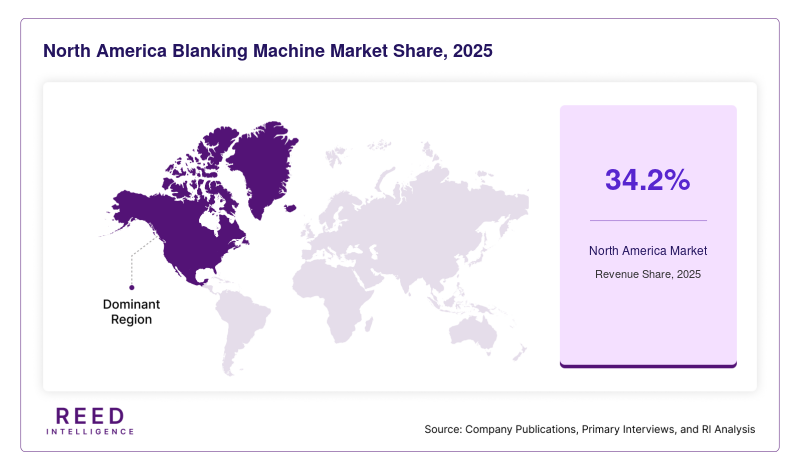
North America accounted for approximately 34.2% share of the Blanking Machine Market in 2025 and is expected to grow at a CAGR of 7.9% from 2026 to 2034. The region’s strong industrial base and high adoption of automation technologies support its dominant position.
The United States leads the regional market due to its advanced automotive and aerospace manufacturing industries. The presence of major OEMs and technology-driven production facilities has driven continuous investment in high-precision blanking systems. Additionally, increasing reshoring of manufacturing activities is further strengthening demand for advanced metal forming equipment.
Europe
Europe held nearly 27.5% market share in 2025 and is projected to grow at a CAGR of 7.6% during the forecast period. Strong regulatory emphasis on energy efficiency and sustainable manufacturing is driving adoption of advanced blanking machines.
Germany dominates the European market due to its strong automotive manufacturing sector and engineering excellence. The country’s focus on Industry 4.0 integration and smart factory development is boosting demand for automated blanking systems with digital monitoring capabilities.
Asia Pacific
Asia Pacific captured around 29.8% market share in 2025 and is expected to register the fastest CAGR of 11.2% during 2026–2034. Rapid industrialization and expanding manufacturing bases are key growth drivers.
China leads the regional market due to its massive automotive and electronics production ecosystem. Rising investments in manufacturing infrastructure and increasing export-oriented production are significantly boosting demand for high-speed blanking machines across industrial sectors.
Middle East & Africa
The Middle East & Africa region accounted for 4.8% share in 2025 and is expected to grow at a CAGR of 6.9% during the forecast period. Growth is driven by industrial diversification initiatives.
Saudi Arabia is the dominant country due to expanding industrial manufacturing projects under economic diversification programs. Investments in automotive assembly and metal fabrication industries are increasing demand for modern blanking equipment.
Latin America
Latin America held 3.7% market share in 2025 and is projected to grow at a CAGR of 6.5% through 2034. Gradual industrial expansion and foreign investments are supporting market development.
Brazil leads the region due to its growing automotive production sector. Increasing localization of manufacturing activities and rising demand for cost-efficient metal forming solutions are driving adoption of blanking machines.
Competitive Landscape
The Blanking Machine Market is moderately consolidated with key players focusing on technological innovation and global expansion. Leading companies include Amada Co. Ltd., Trumpf Group, Komatsu Ltd., Schuler Group, and Jier Machine-Tool Group. Amada Co. Ltd. remains a market leader due to its strong product portfolio in CNC and servo-electric blanking systems. Recent developments include expansion of smart manufacturing solutions integrated with AI-based monitoring systems, enhancing production efficiency and predictive maintenance capabilities across industrial applications.
Key Players List
- Amada Co. Ltd.
- Trumpf Group
- Komatsu Ltd.
- Schuler Group
- Jier Machine-Tool Group
- Haco Group
- Murata Machinery Ltd.
- Bystronic Group
- Dalian Machine Tool Group
- LVD Company NV
- Durma Machinery
- Fagor Arrasate
- Yangli Group
- Accurpress
- Ermaksan Machinery
Recent Developments
- Manufacturers are increasingly launching AI-integrated blanking machines that enable predictive maintenance and real-time production monitoring, improving operational efficiency and reducing downtime.
- Several key players have expanded production facilities in Asia Pacific to meet growing demand from automotive and electronics industries, enhancing regional supply chain capabilities.
- Technology upgrades in servo-electric systems have improved energy efficiency by nearly 20%, encouraging wider adoption in sustainable manufacturing environments across Europe and North America.
Blanking Machine Market Segments
Machine Type
- Hydraulic Blanking Machines
- Mechanical Blanking Machines
- Servo-Electric Blanking Machines
Application
- Automotive Manufacturing
- Electronics Component Fabrication
- Aerospace & Defense Components
- Industrial Equipment Manufacturing
- Construction & Heavy Machinery
End-Use Industry
- Industrial Manufacturing
- Automotive & Transportation
- Aerospace & Defense
- Electrical & Electronics
- Construction Industry
By Region
- North America
- Europe
- APAC
- Middle East and Africa
- LATAM