Bleached Linter Cellulose Market Size, Share, Demand Report By Grade Type (Pharmaceutical Grade, Industrial Grade), By Application (Pharmaceuticals, Specialty Chemicals, Coatings & Adhesives, Explosives), By End-Use Industry (Healthcare & Pharmaceuticals, Chemical Industry, Industrial Manufacturing, Textile & Paper Industry), By Region & Segment Forecasts, 2026–2034
USD 3950
Market Overview
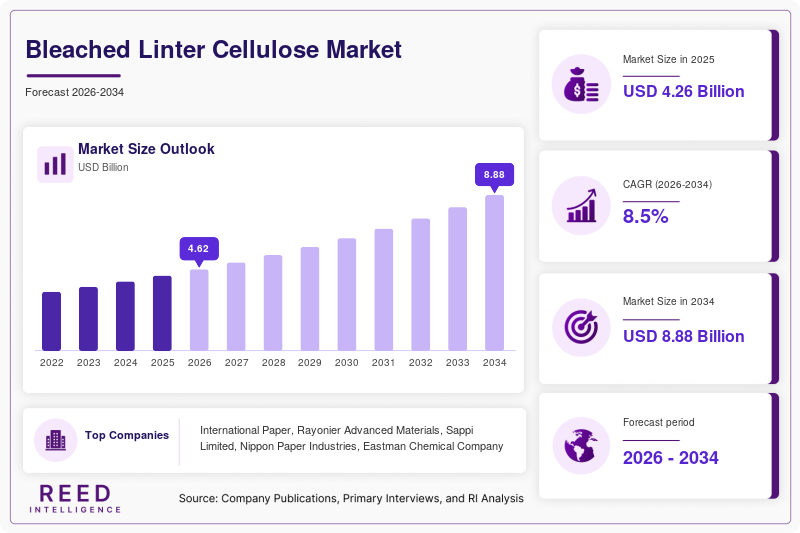
The global Bleached Linter Cellulose Market SIZE is projected to reach a value of USD 4.62 billion in 2026 and is anticipated to expand to USD 8.91 billion by 2034, registering a CAGR of 8.5% during 2026–2034. Bleached linter cellulose, derived from cotton linters, is a highly purified form of cellulose widely used in pharmaceuticals, textiles, explosives, and specialty chemicals due to its superior purity and absorbency characteristics.
One of the primary global factors supporting market growth is the increasing demand for high-purity cellulose in pharmaceutical-grade excipients and biocompatible materials. The expansion of the pharmaceutical manufacturing sector, particularly in emerging economies, has significantly boosted the consumption of bleached linter cellulose as a critical raw material for tablet binders, coatings, and controlled-release drug formulations. Additionally, sustainability trends promoting bio-based and biodegradable materials are strengthening its adoption across industries.
Key Highlights
- North America dominated the market with a 34.2% share in 2025.
- Asia Pacific is expected to grow at the fastest CAGR of 11.2% during 2026–2034.
- By grade type, pharmaceutical grade cellulose accounted for the largest share of 38.5%.
- while industrial grade cellulose is projected to grow at a CAGR of 10.8%.
- By application, pharmaceuticals led with a 41.7% share, whereas specialty chemicals are expected to expand at a CAGR of 11.5%.
- The United States remained the dominant country, with market values of USD 520 million in 2024 and USD 565 million in 2025.
Market Trends
Rising Adoption in Pharmaceutical Formulations
The increasing reliance on bleached linter cellulose in pharmaceutical applications is a major trend shaping the market. It is widely used as a binder, disintegrant, and stabilizer in tablet manufacturing due to its high purity and consistency. Pharmaceutical companies are focusing on excipients that ensure better drug bioavailability and stability, which has positioned bleached linter cellulose as a preferred ingredient. Additionally, the rise in generic drug production and contract manufacturing organizations (CMOs) is expanding demand. The growing global burden of chronic diseases has further increased pharmaceutical production volumes, indirectly supporting market expansion for high-grade cellulose materials.
Shift Toward Bio-Based and Sustainable Materials
Another prominent trend is the global shift toward sustainable and renewable raw materials. Industries such as packaging, textiles, and specialty chemicals are replacing synthetic polymers with bio-based alternatives like bleached linter cellulose. Regulatory pressure to reduce plastic usage and carbon emissions has accelerated this transition. Manufacturers are investing in eco-friendly production technologies to reduce chemical bleaching waste and improve energy efficiency. This trend is particularly strong in Europe and North America, where sustainability compliance frameworks are more stringent, encouraging industries to adopt cellulose-based solutions for long-term environmental benefits.
Market Drivers
Growing Pharmaceutical and Healthcare Industry Demand
The expansion of the global pharmaceutical and healthcare industries is a major driver of the bleached linter cellulose market. This material is extensively used in drug formulation processes due to its inert nature, high absorbency, and compatibility with active pharmaceutical ingredients. Increasing healthcare expenditure, aging populations, and rising prevalence of chronic diseases are boosting pharmaceutical production worldwide. As drug manufacturers prioritize high-quality excipients for improved formulation performance, demand for bleached linter cellulose continues to rise steadily. Moreover, the expansion of biopharmaceutical research is further enhancing its application scope.
Expanding Applications in Industrial and Specialty Uses
The growing utilization of bleached linter cellulose in industrial applications is another key growth driver. It is used in nitrocellulose production for explosives, lacquers, and coatings, as well as in specialty chemicals and paper industries. Increasing infrastructure development and defense spending in several regions are indirectly supporting demand. Additionally, the rise of high-performance coatings and advanced material formulations is creating new opportunities. The material’s excellent chemical purity and structural stability make it highly suitable for demanding industrial applications, further strengthening its global market position.
Market Restraint
High Production Costs and Raw Material Dependency
One of the major restraints in the bleached linter cellulose market is the high production cost associated with cotton linters and bleaching processes. The dependence on cotton as the primary raw material makes the supply chain vulnerable to agricultural fluctuations, seasonal variations, and climatic conditions. Additionally, the chemical-intensive bleaching process increases operational costs and environmental compliance expenses. Smaller manufacturers often struggle to compete with large-scale producers due to these cost constraints. This results in pricing pressures across the supply chain, limiting broader adoption in cost-sensitive markets and applications.
Market Opportunities
Expansion in Emerging Pharmaceutical Markets
Emerging economies present significant opportunities for bleached linter cellulose manufacturers due to rapid pharmaceutical industry expansion. Countries in Asia Pacific and Latin America are witnessing increased investments in drug manufacturing facilities and healthcare infrastructure. Rising domestic pharmaceutical production is driving demand for high-quality excipients, including bleached linter cellulose. Government initiatives supporting local drug manufacturing and export-oriented production are further enhancing market potential. Additionally, increasing regulatory alignment with global pharmaceutical standards is encouraging manufacturers to adopt high-purity cellulose materials for improved product quality and compliance.
Technological Advancements in Cellulose Processing
Technological innovation in cellulose extraction and bleaching processes is creating new growth opportunities. Advanced enzymatic and eco-friendly bleaching methods are reducing environmental impact while improving product efficiency and purity. Automation in production facilities is enhancing consistency and reducing operational costs. These innovations are making bleached linter cellulose more competitive against synthetic alternatives. Furthermore, research into nano-cellulose derivatives is expanding application possibilities in biomedical engineering, packaging, and advanced composites. This technological evolution is expected to significantly enhance market penetration across multiple industrial sectors.
Segmental Analysis
By Grade Type
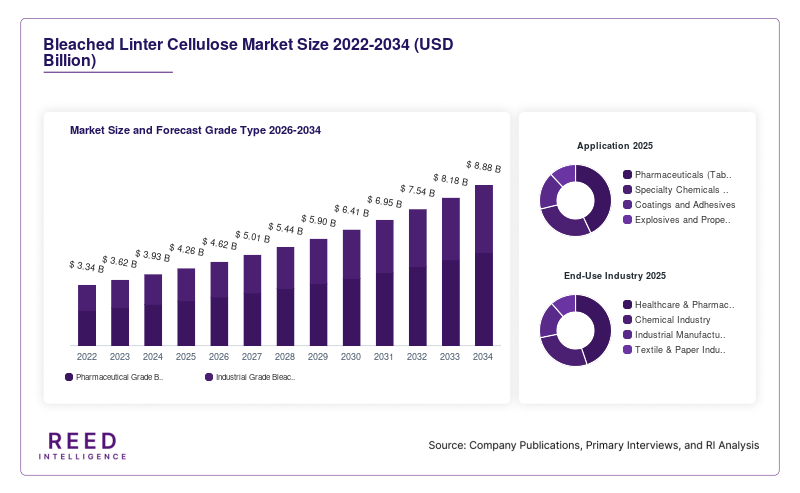
Pharmaceutical grade bleached linter cellulose dominated the market with a 2024 share of 38.5%, driven by its extensive use in drug formulation and strict quality requirements. Its high purity and compliance with pharmacopeia standards make it the preferred choice across global pharmaceutical manufacturers. Demand continues to rise as drug production volumes increase globally.
Industrial grade cellulose is expected to grow at a CAGR of 10.8%, supported by expanding applications in coatings, explosives, and specialty chemicals. Growth is driven by infrastructure development, defense sector expansion, and increasing use of cellulose in high-performance industrial materials.
By Application
The pharmaceuticals segment held a 41.7% share in 2024, making it the dominant application area. Its widespread use in tablets, capsules, and drug delivery systems supports consistent demand. Increasing chronic disease prevalence and drug consumption further reinforce this dominance.
The specialty chemicals segment is projected to grow at a CAGR of 11.5%, driven by rising demand for nitrocellulose, coatings, and eco-friendly chemical formulations. Industrial innovation and sustainability trends are accelerating its adoption.
By End-Use Industry
The healthcare and pharmaceutical industry accounted for a 40.2% share in 2024, reflecting its strong reliance on high-purity cellulose materials. The segment benefits from continuous drug development and global healthcare expansion.
The chemical industry is expected to grow at a CAGR of 10.9%, supported by increasing demand for cellulose derivatives in advanced material production and industrial applications.
Regional Analysis
North America
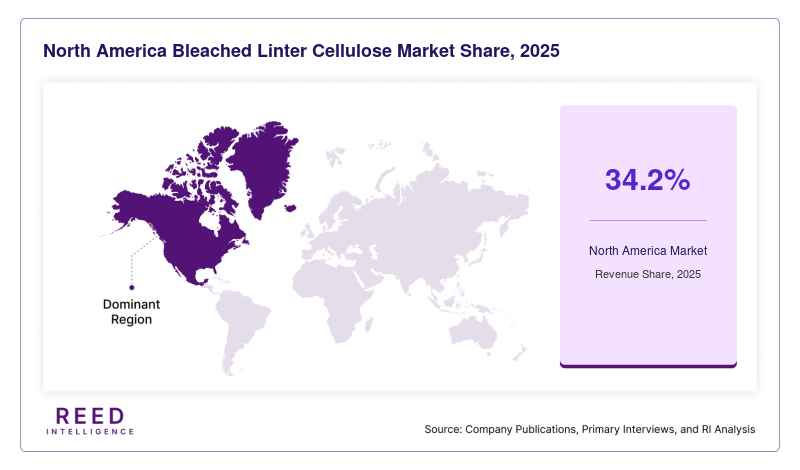
North America accounted for approximately 34.2% market share in 2025, with a projected CAGR of 7.9% during 2026–2034. The region benefits from strong pharmaceutical manufacturing capacity and advanced industrial infrastructure supporting cellulose-based applications.
The United States dominates the regional market due to its large pharmaceutical industry and extensive use of high-purity excipients. Increasing R&D investments in drug formulation technologies and specialty chemical production continue to strengthen market growth. Additionally, strict regulatory standards for pharmaceutical-grade materials support sustained demand.
Europe
Europe held a 28.6% market share in 2025, with a projected CAGR of 7.5%. The region’s growth is supported by strong regulatory frameworks promoting sustainable and bio-based materials.
Germany leads the European market due to its advanced chemical and pharmaceutical industries. Growing emphasis on green manufacturing practices and circular economy initiatives is increasing adoption of cellulose-based raw materials across multiple sectors.
Asia Pacific
Asia Pacific captured 25.4% market share in 2025 and is expected to grow at a CAGR of 11.2%, the highest globally. Rapid industrialization and expanding pharmaceutical production are key growth drivers.
China dominates the regional market due to large-scale manufacturing capabilities and government support for pharmaceutical exports. Increasing healthcare investments and rising demand for affordable medicines are boosting consumption of bleached linter cellulose.
Middle East & Africa
The Middle East & Africa region accounted for 6.1% market share in 2025, with a CAGR of 8.3% expected. Growth is supported by gradual industrial diversification efforts.
South Africa leads the regional market due to its developing pharmaceutical sector and increasing industrial applications. Investments in healthcare infrastructure and import substitution strategies are supporting steady market expansion.
Latin America
Latin America held a 5.7% market share in 2025, with a CAGR of 8.1% forecasted during 2026–2034. The region is gradually increasing its pharmaceutical manufacturing base.
Brazil dominates the regional market due to its strong pharmaceutical production ecosystem and growing demand for high-quality excipients. Government initiatives to strengthen domestic manufacturing are further supporting market growth.
Competitive Landscape
The global bleached linter cellulose market is moderately consolidated, with leading companies focusing on capacity expansion, product purity improvement, and sustainable manufacturing processes. Key players include International Paper, Rayonier Advanced Materials, Sappi Limited, Nippon Paper Industries, and Eastman Chemical Company. Among these, Rayonier Advanced Materials is a market leader due to its strong production capabilities and global distribution network.
Recent developments include investments in eco-friendly bleaching technologies, expansion of pharmaceutical-grade cellulose production lines, and strategic partnerships with chemical manufacturers to enhance supply chain integration.
Key Players List
- International Paper
- Rayonier Advanced Materials
- Sappi Limited
- Nippon Paper Industries
- Eastman Chemical Company
- Ashland Global Holdings
- Borregaard ASA
- Dow Inc.
- Celanese Corporation
- Daicel Corporation
- Mercer International
- Buckeye Technologies
- Lenzing AG
- Bracell Limited
- Grasim Industries
Recent Developments
- Several manufacturers have recently expanded production capacities to meet rising demand for pharmaceutical-grade cellulose. Investments in sustainable bleaching technologies have increased, aiming to reduce environmental impact and improve process efficiency.
- Companies are also entering long-term supply agreements with pharmaceutical firms to ensure stable raw material availability.
- Additionally, research initiatives focusing on high-performance cellulose derivatives are gaining momentum, supporting innovation in biomedical and industrial applications.
Bleached Linter Cellulose Market Segments
Grade Type
- Pharmaceutical Grade Bleached Linter Cellulose
- Industrial Grade Bleached Linter Cellulose
Application
- Pharmaceuticals (Tablets, Capsules, Drug Formulations)
- Specialty Chemicals (Nitrocellulose, Coatings, Inks)
- Coatings and Adhesives
- Explosives and Propellants
End-Use Industry
- Healthcare & Pharmaceuticals
- Chemical Industry
- Industrial Manufacturing
- Textile & Paper Industry
By Region
- North America
- Europe
- APAC
- Middle East and Africa
- LATAM