Blind Spot Object Detection System Market Size, Share & Trends Analysis Report By Component (Radar, Camera, Ultrasonic, LiDAR & Other Sensors), By Vehicle Type (Passenger Cars, Commercial Vehicles, Two-Wheelers), By Function (Blind Spot Detection, Lane Change Assist, Rear Cross-Traffic Alert, Safe Exit & Dooring Detection, Moving-Off & Turn Assist) and By Region (North America, Europe, APAC, Middle East and Africa, LATAM) Forecasts, 2026–2034
USD 3950
Blind Spot Object Detection System Market Size
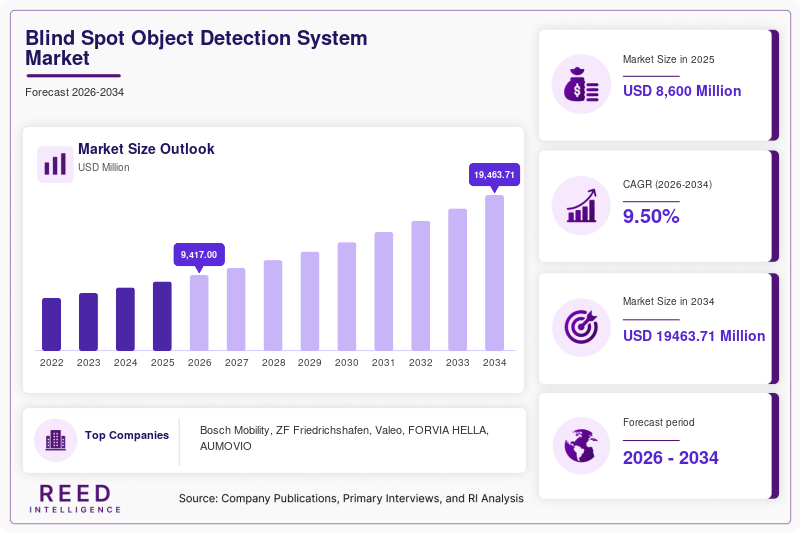
The global blind spot object detection system market is valued at USD 8,600 Million in 2025 and USD 9,417.00 Million in 2026. The market is projected to reach USD 19.463.71 Million by 2034, registering a 9.50% CAGR during the forecast period.
The blind spot object detection system market comprises vehicle-mounted sensing and processing systems that identify vehicles, motorcycles, bicycles, pedestrians and other relevant objects in areas that are difficult for the driver to see directly or through conventional mirrors. These systems can provide visual, acoustic or haptic warnings and, in more advanced configurations, can connect to braking or steering systems to help avoid or mitigate a collision.
Modern blind spot systems typically combine radar, camera and ultrasonic sensing with electronic control and object-classification software. Bosch describes passenger-car blind spot detection using ultrasonic and radar sensors, with software combining sensor information and categorizing detected objects to reduce false alarms. For heavy commercial vehicles, Bosch uses corner radar sensors to monitor areas alongside the full vehicle and trailer and provide warnings when another road user enters the monitored zone.
Blind Spot Object Detection System Market Drivers
Regulatory requirements are expanding the installation base for blind-spot information systems
Regulatory momentum is creating a structural technology requirement, particularly in commercial vehicles. UNECE Regulation No. 151 establishes requirements for Blind Spot Information Systems, while 2026 UNECE documents continue to address amendments to the regulation. EU Regulation 2019/2144 also requires M2, M3, N2 and N3 vehicles to improve direct visibility of vulnerable road users and forms part of a wider general-safety framework for advanced vehicle systems.
The result is increasing OEM specification pressure around side perception, vulnerable-road-user detection and automated warnings. For suppliers, this creates demand not only for individual radar sensors but also for integrated sensing, control units, software and calibration services.
Expanding vehicle electronic content is increasing the number of safety-sensing functions sharing the same sensor architecture
Blind-spot detection increasingly operates alongside lane-change assistance, rear cross-traffic alert, safe-exit warning, automated parking, moving-off information and collision avoidance.
Continental says its radar technology supports a broad set of functions including blind spot detection, lane-change assistance, cross-traffic alerts and parking, while Valeo's latest corner-radar platform is designed to support blind-spot, lane-change, parking and rear-cross-traffic functions from common hardware and software.
This allows OEMs to distribute sensor costs across multiple features instead of treating blind-spot detection as a standalone option. As vehicle architectures become centralized and software-defined, the same sensing data can increasingly be reused across safety and automated-driving functions.
Growth in commercial vehicles, EVs and advanced vehicle architectures is widening the addressable application base
Large vehicles create particularly difficult visibility conditions. Bosch's heavy-commercial-vehicle system uses multiple corner radar sensors to monitor the full length of a trailer and the adjacent road space, while ZF is extending sensor coverage from the tractor into the trailer as part of its 360-degree safety architecture.
At the same time, electrified and software-defined vehicles are incorporating increasingly sophisticated sensor architectures. Valeo's June 2026 radar contract specifically concerns a North American electric-vehicle manufacturer, while OICA reports continued global vehicle-production growth and strong Asian manufacturing output.
These trends increase both the number of vehicles equipped with blind-spot systems and the sophistication of the systems installed in each vehicle.
Blind Spot Object Detection System Market Restraints
Sensor calibration and integration complexity can increase system deployment and lifecycle costs
Modern blind-spot systems depend on correct sensor position, orientation, calibration and communication with vehicle-control systems. Fine differences in mounting angle or vehicle geometry can affect detection zones and object localization.
FORVIA HELLA's February 2026 CSC-Tool PRO launch illustrates the increasing calibration requirement. The tool supports modern front, rear and side radar systems, including radar systems installed on BMW models, and uses automated alignment, cloud-based calibration data and reporting.
As systems become multi-sensor and software-defined, OEMs and service providers require more sophisticated calibration equipment, diagnostic capabilities and lifecycle support.
False positives and environmental conditions can complicate object classification
A blind-spot system must distinguish relevant road users from stationary infrastructure, parked vehicles, barriers and other non-threatening objects. Bosch explicitly describes object categorization as a method of reducing false alarms, while its commercial-vehicle system filters stationary objects so they do not unnecessarily trigger warnings.
Radar performance is generally resilient in darkness and poor visibility, but sensor occlusion, contamination, complex urban environments and challenging object geometries still require robust algorithms and sensor fusion. Increasing detection accuracy therefore raises processing, validation and software-development requirements.
Blind Spot Object Detection System Market Opportunities
High-resolution radar and sensor fusion can move blind-spot systems toward active collision prevention
The market is moving beyond warning indicators toward systems that can influence vehicle control. ZF's 2026 360-degree commercial-vehicle architecture integrates radar, camera, braking and steering, while its OnGuardMAX can automatically apply braking when an imminent collision is detected.
Valeo's 2026 corner-radar platform similarly supports high-resolution object perception and future automated-driving functions.
This creates opportunities for suppliers that can combine sensing, perception and control into a single architecture capable of escalating from driver warning to assisted avoidance.
Two-wheelers and emerging-market vehicle platforms can broaden adoption beyond premium passenger vehicles
Valeo and Hero MotoCorp's January 2026 partnership demonstrates that radar-based blind-spot and lane-change functions are moving into motorcycles and scooters. The companies are developing ARAS solutions across entry-level, premium and electric two-wheelers.
Valeo's May 2026 VSS360 nomination for an Indian commercial-vehicle OEM provides another example of ADAS localization. The system incorporates three radars and one camera and includes Blind Spot Information System and Moving Off Information System functions, with production planned at Valeo's Sanand facility in Gujarat.
This creates an opportunity to develop cost-optimized architectures for markets where vehicle volumes are large but the installed cost of premium multi-sensor ADAS remains a constraint.
Component Analysis
Radar holds the dominant component share because it provides robust range, speed and direction information across demanding driving conditions
Radar is the principal sensing technology in blind-spot object detection because it can determine object distance, relative speed and movement direction while remaining functional in darkness and many poor-visibility conditions.
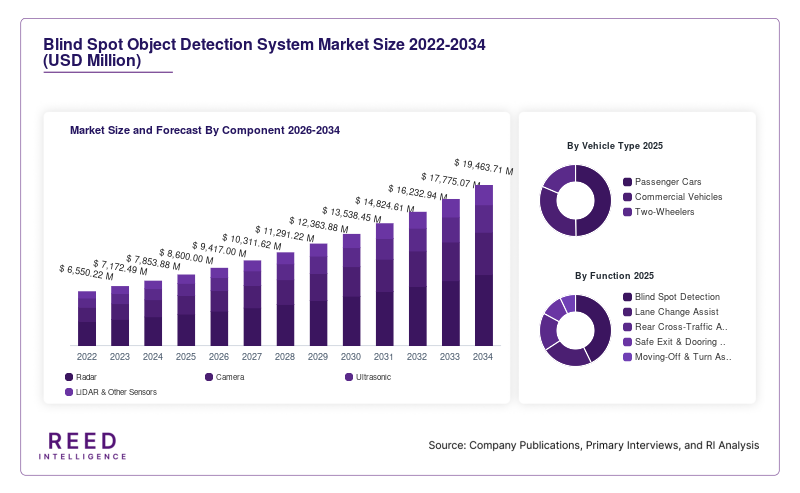
The Radar segment accounts for 52% of the global market in 2026 and is projected to register a 9.10% CAGR.
Bosch, ZF, Valeo and AUMOVIO all use corner or side radar as a central sensing element for blind-spot and surrounding-object detection. Continental notes that radar sensors are increasingly deployed alongside cameras and other sensors to create broader vehicle perception.
Camera is the fastest-growing major component as object classification and multi-sensor perception become more sophisticated
The Camera segment accounts for 25% of the global market in 2026 and is projected to register a 10.60% CAGR, making it the fastest-growing major component category.
Camera systems can provide object classification and contextual information that complements radar measurements. ZF's 2026 commercial-vehicle architecture combines radar and camera sensing, while Valeo's VSS360 integrates radar fusion within a smart front camera architecture.
The integration of camera perception with radar is increasingly important for distinguishing pedestrians, cyclists, motorcycles and vehicles in complex environments.
Vehicle Type Analysis
Passenger Cars remain the dominant vehicle category as blind-spot assistance becomes part of broader consumer ADAS packages
Passenger cars account for the largest deployment base because blind-spot detection is increasingly bundled with lane-change assist, rear cross-traffic alert, parking and broader driver-assistance packages.
The Passenger Cars segment accounts for 73% of the global market in 2026 and is projected to register a 9.10% CAGR.
Bosch provides passenger-vehicle blind-spot systems based on radar and ultrasonic sensing, while AUMOVIO and Valeo are developing broader sensor architectures that combine side perception with advanced ADAS and automated-driving functions.
Commercial Vehicles are the fastest-growing major vehicle category as regulations and fleet safety requirements intensify
The Commercial Vehicles segment accounts for 22% of the global market in 2026 and is projected to register a 12.10% CAGR, making it the fastest-growing major vehicle category.
Trucks, buses and large trailers have substantial blind areas, particularly during turning, lane changes and moving-off maneuvers. ZF, Bosch and Euro NCAP are all developing or assessing technologies that address these specific risks.
Function Analysis
Blind Spot Detection remains the dominant function because it is the foundational safety application
The Blind Spot Detection segment accounts for 48% of the global market in 2026 and is projected to register a 9.20% CAGR.
The function monitors adjacent lanes and other areas that are difficult to observe using mirrors alone and typically delivers a warning through a mirror indicator, instrument display, acoustic signal or haptic feedback.
Bosch, ZF and HELLA all provide radar-based blind-spot systems, while Euro NCAP formally defines Blind Spot Monitoring as a sensing system that detects and warns the driver about an object in an adjacent lane that may be obscured from direct vision.
Moving-Off & Turn Assist is the fastest-growing major function as commercial-vehicle protection expands toward vulnerable road users
The Moving-Off & Turn Assist segment accounts for 18% of the global market in 2026 and is projected to register an 11.80% CAGR, making it the fastest-growing major function category.
The application is particularly relevant to trucks and buses where cyclists and pedestrians may enter large side and front blind zones during low-speed maneuvers.
Bosch's heavy-commercial-vehicle corner radar supports both Blind Spot Information System and Moving Off Information System functions, while ZF's 2026 360-degree architecture extends sensing and intervention across truck and trailer configurations.
Blind Spot Object Detection System Market Regional Analysis
APAC Blind Spot Object Detection System Market
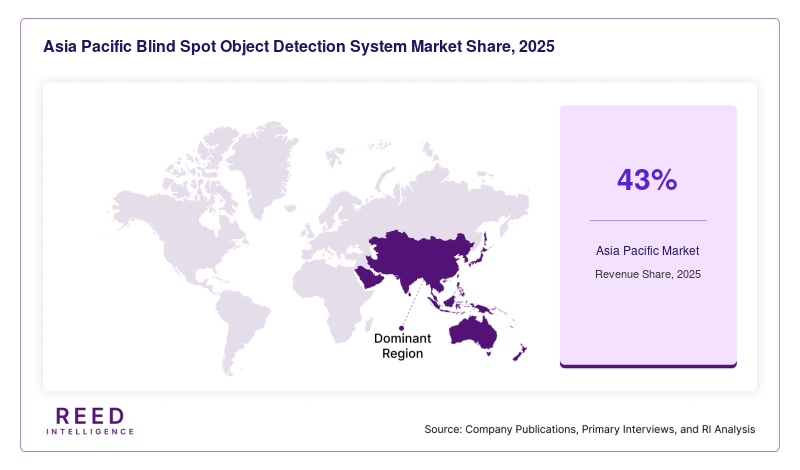
APAC remains the dominant regional market as it combines the world's largest vehicle-production base with expanding automotive-electronics manufacturing and increasingly localized ADAS development.
The APAC region accounts for 43% of the global market in 2026 and is projected to register an 11.20% CAGR, making it the fastest-growing regional market.
OICA reported approximately 59.2 million motor vehicles produced in Asia-Oceania in 2025, including approximately 34.5 million in China and 6.5 million in India. The scale of regional automotive production provides a large platform for factory-installed safety technologies.
Local technology development is also accelerating. Valeo's May 2026 VSS360 nomination in India includes Blind Spot Information System and Moving Off Information System functions and is planned for local production in Sanand, Gujarat. Valeo's January 2026 partnership with Hero MotoCorp adds radar- and camera-based ARAS development for motorcycles and scooters.
China, Japan, South Korea and India therefore remain important both as vehicle markets and as engineering and component-production centers.
North America Blind Spot Object Detection System Market
North America is projected to register a 8.90% CAGR, supported by a large passenger-vehicle market, commercial-vehicle fleets, highway travel and increasing integration of radar-based ADAS.
Valeo secured a June 2026 contract with a North American electric-vehicle manufacturer for next-generation corner radar serving L2+ and L3 systems. ZF and Bosch also maintain extensive commercial-vehicle safety portfolios for trucks and trailers.
The region also supports a large aftermarket and calibration ecosystem as vehicles equipped with advanced radar systems require specialized repair and sensor-alignment capabilities.
Europe Blind Spot Object Detection System Market
Europe is projected to register a 9.40% CAGR, supported by established ADAS adoption, regulatory requirements, automotive engineering capabilities and strong commercial-vehicle safety programs.
EU Regulation 2019/2144 establishes a general safety framework covering vulnerable road-user protection and advanced vehicle safety systems, while UNECE Regulation No. 151 provides the regulatory foundation for Blind Spot Information Systems.
Europe is also a major technology-development center. FORVIA HELLA's ForWave7HD program uses high-resolution radar with up to 32 transmit and receive channels, while ZF is developing scalable 360-degree radar-and-camera architectures for trucks and trailers.
Middle East and Africa Blind Spot Object Detection System Market
The Middle East and Africa market is projected to register a 7.80% CAGR, supported by commercial vehicles, logistics fleets, road infrastructure and increasing adoption of modern safety technologies.
Commercial vehicles represent a particularly relevant opportunity because side visibility limitations are more pronounced in heavy trucks and buses. ZF's and Bosch's commercial-vehicle portfolios provide regionally adaptable radar-based systems for blind-spot and vulnerable-road-user detection.
LATAM Blind Spot Object Detection System Market
LATAM is projected to register an 8.50% CAGR, supported by automotive manufacturing in Mexico and Brazil, commercial fleets, road transport and increasing adoption of electronic safety systems.
Localized ADAS development can support regional adoption. Valeo's broader 2026 expansion program includes commercial-vehicle ADAS development in India and other markets, while global suppliers increasingly offer scalable architectures that can be adapted for differing cost and regulatory requirements.
Blind Spot Object Detection System Market Competitive Landscape
The blind spot object detection system market is characterized by competition among automotive Tier 1 suppliers, radar specialists, ADAS software companies, sensor manufacturers and commercial-vehicle safety-system providers.
Bosch Mobility offers passenger-car and heavy-commercial-vehicle blind-spot systems using radar and ultrasonic sensing. Its commercial-vehicle corner-radar architecture can monitor the vehicle and trailer side areas and supports both BSIS and MOIS requirements.
ZF has a particularly broad commercial-vehicle position through OnSide, OnGuardMAX and its newer 360-degree safety architecture. Its 2026 systems combine radar, cameras, braking and steering and are being developed for truck-trailer integration and increasingly automated operation.
Key Market Players
- Bosch Mobility
- ZF Friedrichshafen
- Valeo
- FORVIA HELLA
- AUMOVIO
- Mobileye
- Aptiv
- Magna International
- DENSO
- Autoliv
- Hitachi Astemo
- NXP Semiconductors
- Harman International
- Panasonic Automotive Systems
- Hyundai Mobis
Recent Developments
June 2026 – ZF showcased new safety and motion systems for software-defined commercial vehicles. The company described a new architecture in which radar and camera sensors positioned around trucks and trailers provide continuous perception and support integrated safety functions rather than isolated driver-assistance functions.
June 2026 – Valeo secured a major contract for its next-generation corner-radar technology with a North American electric-vehicle manufacturer. The platform combines hardware and embedded software, delivers substantially higher resolution than the preceding generation and supports Blind Spot Detection, Lane Change Assist, Rear Cross-Traffic Alert and advanced parking functions.
Blind Spot Object Detection System Market Segments
By Component
- Radar
- Camera
- Ultrasonic
- LiDAR & Other Sensors
By Vehicle Type
- Passenger Cars
- Commercial Vehicles
- Two-Wheelers
By Function
- Blind Spot Detection
- Lane Change Assist
- Rear Cross-Traffic Alert
- Safe Exit & Dooring Detection
- Moving-Off & Turn Assist
By Region
- North America
- Europe
- APAC
- Middle East and Africa
- LATAM