Blood Ammonia Meter Equipment Market Size, Share & Demand Report By Product Type (Portable Ammonia Meters, Benchtop Ammonia Analyzers, Wearable Monitoring Devices), By Technology (Electrochemical Detection, Optical Detection, Enzymatic Assay-Based), By Application (Liver Disease Diagnosis, Metabolic Disorder Monitoring, Critical Care Monitoring), By End-Use (Hospitals, Diagnostic Laboratories, Home Care Settings), By Region & Segment Forecasts, 2025–2034
USD 3950
Market Overview
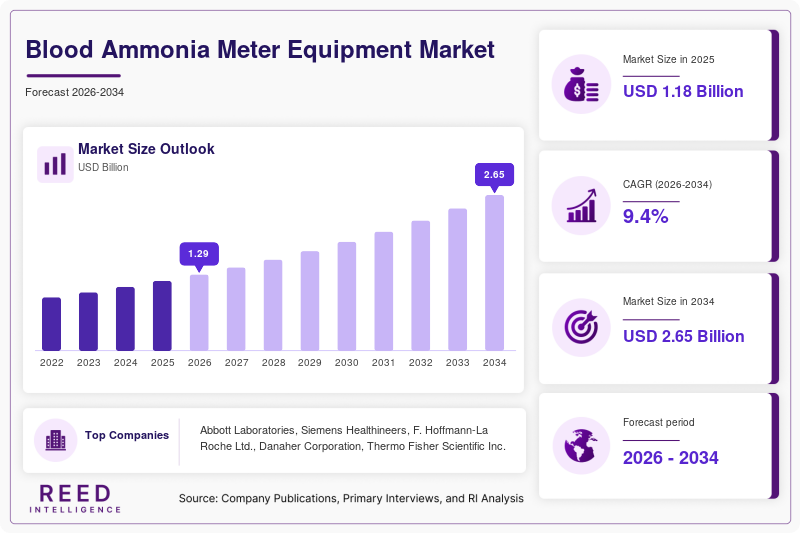
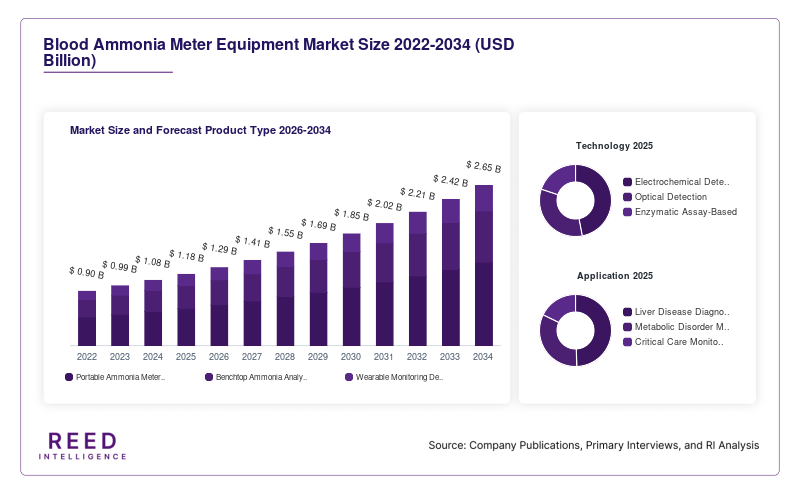
The global Blood Ammonia Meter Equipment Market size was valued at approximately USD 1.18 billion in 2025 and is projected to reach USD 2.64 billion by 2034, expanding at a CAGR of 9.4% during the forecast period (2025–2034). The market has gained steady traction due to the growing clinical importance of ammonia level monitoring in diagnosing liver disorders, metabolic conditions, and neurological complications. Blood ammonia testing is widely used in intensive care units, emergency settings, and diagnostic laboratories to assess hepatic encephalopathy and urea cycle disorders.
One of the primary global factors supporting market growth is the rising prevalence of chronic liver diseases linked to lifestyle changes and increasing alcohol consumption. Additionally, the expansion of decentralized diagnostics and point-of-care testing infrastructure has enhanced accessibility to blood ammonia testing, thereby supporting market expansion.
Key Highlights
- North America dominated the market with a 38.2% share in 2025, while Asia Pacific is expected to register the fastest CAGR of 11.2% during the forecast period.
- By product type, portable ammonia meters led with a 56.7% share, while wearable monitoring devices are projected to grow fastest at a CAGR of 12.5%.
- By end-use, hospitals held the largest share at 48.5%, whereas home care settings are expected to expand at a CAGR of 10.8%.
- The U.S. market was valued at USD 402 million in 2025 and is estimated to reach USD 428 million in 2026.
Market Trends
Rising Adoption of Point-of-Care Testing Devices
The shift toward decentralized healthcare has accelerated the adoption of point-of-care (POC) diagnostic tools within the Blood Ammonia Meter Equipment Market. Healthcare providers are increasingly utilizing portable ammonia meters in emergency rooms, ambulances, and outpatient settings to obtain rapid results. These devices reduce dependency on centralized laboratories and enable immediate clinical decisions, which is critical in acute conditions such as hepatic encephalopathy. Improved portability, ease of use, and faster turnaround times are driving this trend across both developed and emerging healthcare systems.
Integration of Digital Connectivity and Data Management
Digital transformation is reshaping diagnostic equipment, including blood ammonia meters. Manufacturers are incorporating Bluetooth, cloud connectivity, and electronic medical record (EMR) integration into devices. This trend enhances data tracking, remote monitoring, and patient management. Connected devices allow clinicians to monitor ammonia levels in real time, improving treatment accuracy and follow-up care. The integration of artificial intelligence for predictive analysis is also emerging, providing insights into disease progression and treatment outcomes, thereby influencing the long-term growth trajectory of the market.
Market Drivers
Increasing Burden of Liver and Metabolic Disorders
The rising global incidence of liver diseases such as cirrhosis, hepatitis, and non-alcoholic fatty liver disease has significantly increased the demand for ammonia monitoring. Elevated ammonia levels are a key biomarker in diagnosing hepatic encephalopathy, making blood ammonia testing essential in clinical practice. Additionally, inherited metabolic disorders requiring continuous monitoring further contribute to the demand for advanced ammonia measurement devices. The growing patient pool is expected to sustain demand across hospitals and diagnostic centers.
Advancements in Diagnostic Technologies
Technological innovation has led to the development of compact, accurate, and user-friendly blood ammonia meters. Modern devices offer improved sensitivity, minimal sample requirements, and rapid results. Automation and integration with digital systems have streamlined workflows in clinical settings. These advancements reduce human error and enhance diagnostic efficiency, encouraging adoption across diverse healthcare environments. The availability of handheld and portable solutions has also expanded the use of ammonia meters beyond traditional laboratory settings.
Market Restraint
High Cost of Advanced Equipment and Maintenance
One of the key challenges in the Blood Ammonia Meter Equipment Market is the relatively high cost associated with advanced diagnostic devices. Portable and digital ammonia meters with enhanced features such as connectivity, automation, and high accuracy often come at a premium price. In addition, recurring costs related to calibration, consumables, and maintenance further increase the overall expenditure for healthcare facilities.
This cost burden can limit adoption, particularly in small healthcare centers and low-resource settings. Budget constraints in developing regions may hinder the widespread implementation of advanced ammonia monitoring systems. Furthermore, the need for trained personnel to operate and maintain sophisticated equipment adds to operational complexities. These factors collectively restrain market growth, especially in price-sensitive markets.
Market Opportunities
Expansion in Emerging Healthcare Markets
Emerging economies present significant growth opportunities for the Blood Ammonia Meter Equipment Market. Increasing healthcare investments, improving diagnostic infrastructure, and rising awareness about early disease detection are driving demand in these regions. Governments are focusing on expanding access to healthcare services, including diagnostic testing, which is expected to boost market penetration. Manufacturers can capitalize on this opportunity by offering cost-effective and portable solutions tailored to local needs.
Development of Wearable and Continuous Monitoring Devices
The emergence of wearable health technologies offers a promising avenue for market growth. Continuous ammonia monitoring devices are being developed to provide real-time data for patients with chronic liver conditions. These innovations can improve disease management by enabling timely interventions and reducing hospital visits. As demand for personalized healthcare increases, wearable ammonia monitoring solutions are expected to gain traction, opening new revenue streams for market players.
Segmental Analysis
By Product Type
Portable ammonia meters dominated the market in 2025, accounting for 56.7% of the total share. Their widespread adoption is attributed to ease of use, rapid results, and suitability for point-of-care settings. These devices are commonly used in emergency departments and outpatient clinics.
Wearable monitoring devices are expected to grow at the fastest CAGR of 12.5% during the forecast period. The increasing demand for continuous monitoring and personalized healthcare solutions will drive their adoption. These devices offer real-time tracking and improved patient management.
By Technology
Electrochemical detection technology held the largest share of 49.3% in 2025. This technology is widely used due to its high sensitivity, reliability, and cost-effectiveness. It is commonly integrated into portable and handheld devices.
Optical detection technology is projected to grow at a CAGR of 11.7% over the forecast period. Advancements in optical sensors and improved accuracy will drive adoption, particularly in advanced diagnostic laboratories.
By End-Use
Hospitals accounted for the largest share of 48.5% in 2025. The high patient volume and availability of advanced diagnostic infrastructure contribute to their dominance. Hospitals rely on ammonia meters for critical care and emergency diagnostics.
Home care settings are expected to grow at a CAGR of 10.8% during the forecast period. The increasing focus on remote patient monitoring and home-based healthcare services will support this growth. Portable devices enable patients to monitor their condition without frequent hospital visits.
By Application
Liver disease diagnosis dominated the market with a 52.1% share in 2025. Blood ammonia testing is essential for diagnosing hepatic encephalopathy and other liver-related conditions.
Metabolic disorder monitoring is projected to grow at a CAGR of 10.5%. The rising prevalence of genetic and metabolic conditions requiring continuous monitoring will drive demand in this segment.
Regional Analysis
North America
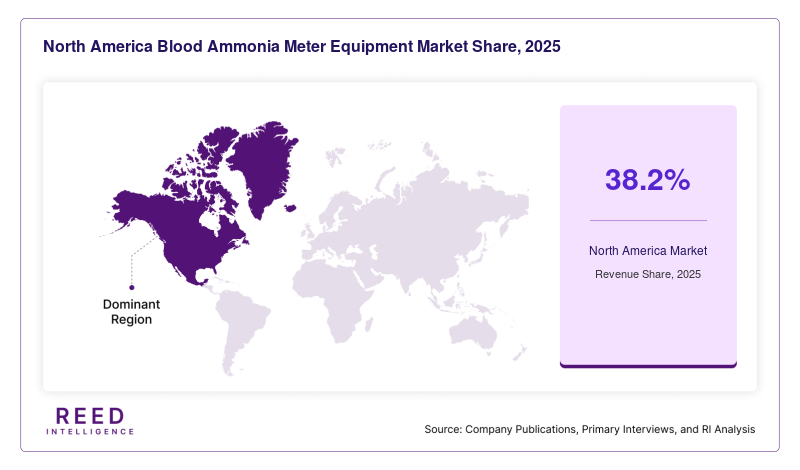
North America accounted for 38.2% of the Blood Ammonia Meter Equipment Market share in 2025 and will grow at a CAGR of 8.7% during the forecast period. The region’s growth is driven by advanced healthcare infrastructure and high adoption of diagnostic technologies.
The United States dominated the regional market due to strong healthcare spending and early adoption of innovative diagnostic devices. The presence of leading manufacturers and continuous product innovation has strengthened the market. Increasing focus on rapid diagnostics in emergency care settings further supports growth.
Europe
Europe held a 27.5% share of the market in 2025 and is expected to expand at a CAGR of 8.9% from 2025 to 2034. The region benefits from well-established healthcare systems and increasing demand for accurate diagnostic tools.
Germany emerged as the dominant country due to its strong medical device industry and emphasis on research and development. Government support for healthcare innovation and growing awareness of liver disease management contribute to the region’s expansion.
Asia Pacific
Asia Pacific captured 20.3% of the Blood Ammonia Meter Equipment Market in 2025 and is projected to register the fastest CAGR of 11.2% during the forecast period. The region’s growth is supported by improving healthcare infrastructure and rising patient awareness.
China led the regional market due to its large population base and increasing incidence of liver diseases. Rapid urbanization and expanding healthcare access have boosted demand for diagnostic equipment, including ammonia meters.
Middle East & Africa
The Middle East & Africa accounted for 7.1% of the market share in 2025 and is expected to grow at a CAGR of 9.6% during the forecast period. The region is witnessing gradual improvements in healthcare infrastructure.
Saudi Arabia dominated the market due to increased healthcare investments and government initiatives to modernize medical facilities. The growing focus on early diagnosis and treatment is driving demand for ammonia monitoring devices.
Latin America
Latin America held a 6.9% share of the Blood Ammonia Meter Equipment Market in 2025 and is projected to grow at a CAGR of 9.1% over the forecast period. The region is experiencing steady growth in healthcare services and diagnostic capabilities.
Brazil emerged as the leading country due to its expanding healthcare sector and increasing awareness of liver-related diseases. Government initiatives to improve healthcare accessibility are supporting market growth.
Competitive Landscape
The Blood Ammonia Meter Equipment Market is moderately competitive, with several global and regional players focusing on product innovation and strategic collaborations. Companies are investing in research and development to enhance device accuracy, portability, and connectivity.
A leading player in the market is Abbott Laboratories, which has strengthened its position through continuous innovation in point-of-care diagnostic devices. The company recently introduced an upgraded portable ammonia testing system with improved turnaround time and digital integration features.
Other key players are focusing on expanding their product portfolios and entering emerging markets to increase their global presence. Partnerships with healthcare providers and distribution networks are also common strategies adopted to gain a competitive edge.
Key Players List
- Abbott Laboratories
- Siemens Healthineers
- F. Hoffmann-La Roche Ltd.
- Danaher Corporation
- Thermo Fisher Scientific Inc.
- Nova Biomedical
- EKF Diagnostics Holdings plc
- ARKRAY Inc.
- HORIBA Ltd.
- Shenzhen Mindray Bio-Medical Electronics Co., Ltd.
- Randox Laboratories Ltd.
- Instrumentation Laboratory
- PTS Diagnostics
- Nova StatStrip
- Erba Diagnostics
Recent Developments
- 2025: Abbott Laboratories launched an advanced handheld ammonia meter with enhanced digital connectivity.
- 2024: Siemens Healthineers expanded its diagnostic portfolio with improved ammonia testing solutions.
- 2024: EKF Diagnostics introduced a compact analyzer designed for point-of-care applications.
- 2023: Nova Biomedical developed a next-generation ammonia monitoring system for critical care use.
- 2023: Mindray announced the integration of ammonia testing capabilities into its diagnostic platforms.
Blood Ammonia Meter Equipment Market Segments
Product Type
- Portable Ammonia Meters
- Benchtop Ammonia Analyzers
- Wearable Monitoring Devices
Technology
- Electrochemical Detection
- Optical Detection
- Enzymatic Assay-Based
Application
- Liver Disease Diagnosis
- Metabolic Disorder Monitoring
- Critical Care Monitoring
End-Use
- Hospitals
- Diagnostic Laboratories
- Home Care Settings
Distribution Channel
- Direct Sales
- Online Sales
- Medical Device Distributors
- Retail Pharmacies
By Region
- North America
- Europe
- APAC
- Middle East and Africa
- LATAM