Blood Bank Refrigerator Market Size, Share & Demand Report By Product Type (Plasma Storage Refrigerators, Whole Blood Refrigerators, Platelet Incubators), By Capacity (Small Capacity, Medium Capacity, Large Capacity), By Technology (Conventional Refrigeration) By End-Use (Hospitals, Blood Banks, Diagnostic Laboratories), By Distribution Channel (Direct Sales, Distributors, Online Sales), By Region & Segment Forecasts, 2026–2034
USD 3950
Market Overview
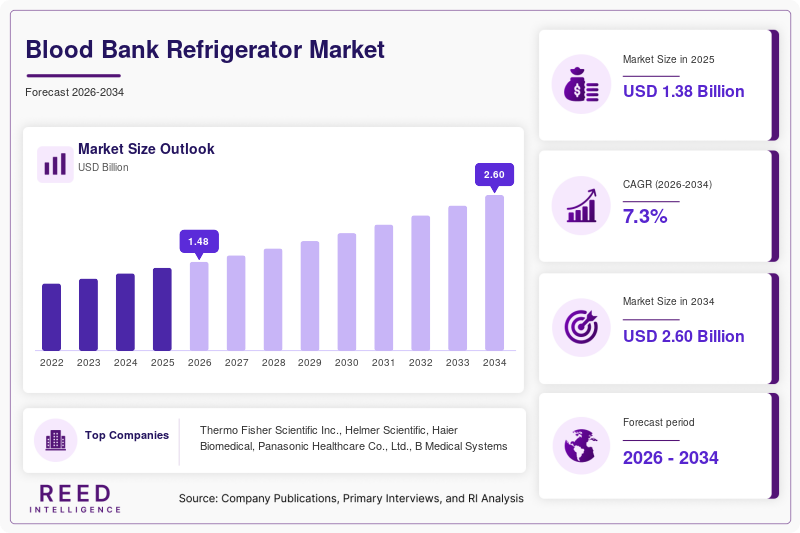
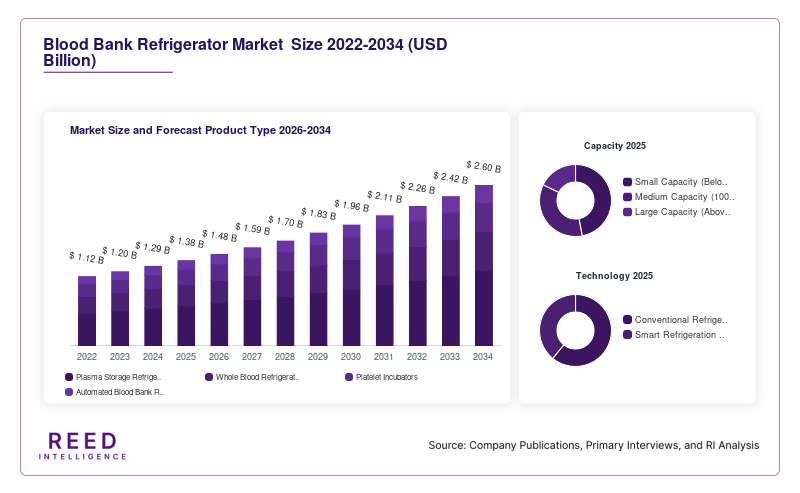
The Blood Bank Refrigerator Market size was valued at approximately USD 1.38 billion in 2026 and is projected to reach USD 2.42 billion by 2034, expanding at a CAGR of 7.3% during 2026–2034. The market growth is primarily supported by the increasing global demand for safe blood storage systems driven by rising surgical procedures, trauma cases, and chronic disease management.
A key global factor supporting the expansion of the Blood Bank Refrigerator Market is the strengthening of healthcare infrastructure and regulatory compliance standards for blood storage. Governments and healthcare organizations are emphasizing proper cold chain systems to ensure the safety, quality, and longevity of blood and blood components. This has led to widespread adoption of technologically advanced refrigeration systems with precise temperature control and monitoring capabilities.
Key Highlights
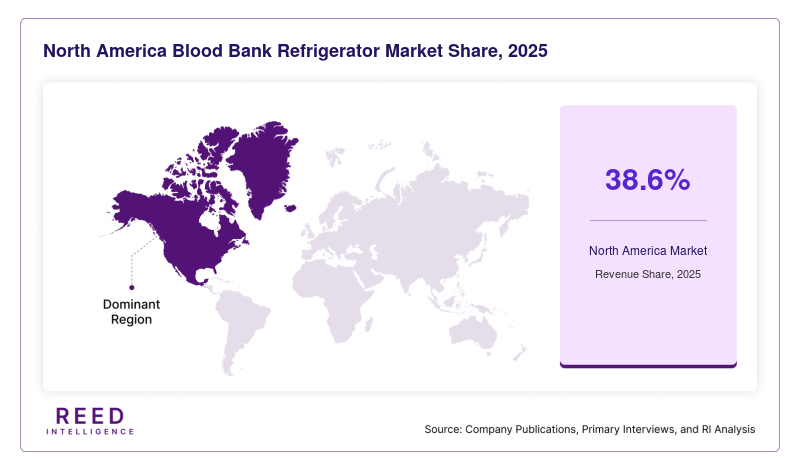
- Dominant region: North America held approximately 38.6% market share in 2025, while Asia Pacific is expected to register the fastest growth at a CAGR of 8.5%.
- Leading subsegments: Plasma storage refrigerators dominated the type segment with 34.2% share, while automated blood bank refrigerators are projected to grow fastest at a CAGR of 8.9%.
- Dominant country: The United States recorded market values of USD 420 million in 2024 and USD 448 million in 2025, driven by high healthcare spending and advanced blood bank networks.
Market Trends
Integration of Smart Monitoring Systems
The Blood Bank Refrigerator Market is witnessing a shift toward smart refrigeration systems equipped with IoT-enabled monitoring and real-time alerts. These systems ensure temperature consistency and compliance with regulatory standards. The growing need for traceability and remote monitoring is pushing manufacturers to incorporate advanced digital interfaces and cloud-based tracking systems.
Energy-Efficient and Eco-Friendly Designs
Sustainability is becoming a key focus in the Blood Bank Refrigerator Market. Manufacturers are introducing energy-efficient refrigeration units that reduce operational costs and environmental impact. The adoption of eco-friendly refrigerants and low-energy compressors is gaining traction, particularly in developed healthcare systems.
Market Drivers
Rising Demand for Blood and Blood Components
The increasing number of surgeries, accidents, and chronic illnesses has significantly raised the demand for blood and its components. This has directly boosted the need for reliable storage solutions, contributing to the expansion of the Blood Bank Refrigerator Market.
Expansion of Healthcare Infrastructure
Developing regions are investing heavily in healthcare facilities, including blood banks and diagnostic centers. The establishment of new hospitals and laboratories is driving the demand for advanced refrigeration systems, supporting market growth.
Market Restraint
High Initial Investment Costs
The cost associated with advanced blood bank refrigeration systems remains a key barrier, particularly for small healthcare facilities in emerging economies. Maintenance and calibration expenses further add to the overall cost burden, limiting widespread adoption.
Market Opportunities
Growth in Emerging Markets
Rapid healthcare development in countries across Asia, Africa, and Latin America presents strong opportunities for the Blood Bank Refrigerator Market. Increasing government initiatives to improve blood storage facilities will support future demand.
Technological Advancements in Cold Chain Solutions
Innovations such as solar-powered refrigerators and portable blood storage units are expected to create new growth avenues. These solutions are particularly beneficial in remote and underserved regions, expanding the market scope.
Segmental Analysis
By Product Type
The plasma storage refrigerators subsegment dominated the Blood Bank Refrigerator Market with a 34.2% share in 2025, as they are essential for preserving plasma at stable temperatures for extended periods.
The automated blood bank refrigerators segment is projected to grow at a CAGR of 8.9%, driven by the increasing adoption of automation in healthcare facilities to reduce human error and improve operational efficiency.
By Capacity
The medium-capacity refrigerators (100–300 liters) held the largest share at 41.6% in 2025, as they are widely used in hospitals and mid-sized blood banks.
The large-capacity segment (above 300 liters) is expected to grow at a CAGR of 8.1%, supported by the expansion of centralized blood storage facilities.
By End-Use
The hospitals segment dominated with a 46.8% share in 2025, due to the high volume of blood storage required for surgeries and emergency treatments.
The blood banks segment is projected to grow at a CAGR of 8.3%, driven by increasing blood donation campaigns and infrastructure development.
By Technology
The conventional refrigeration systems accounted for 52.3% share in 2025, as they remain widely used due to cost-effectiveness.
The smart refrigeration systems are expected to grow at a CAGR of 9.2%, fueled by demand for real-time monitoring and data integration.
By Distribution Channel
The direct sales channel dominated with a 58.7% share in 2025, as manufacturers prefer direct partnerships with hospitals and laboratories.
The online distribution channel is anticipated to grow at a CAGR of 8.7%, driven by increasing digital procurement practices in healthcare.
Regional Analysis
North America
North America accounted for 38.6% of the Blood Bank Refrigerator Market share in 2025 and is expected to grow at a CAGR of 6.8% during 2026–2034. The United States dominated the region due to established blood donation systems and strict regulatory frameworks ensuring blood safety.
Europe
Europe held around 27.4% share in 2025 and will grow at a CAGR of 6.9%. Germany emerged as the leading country due to its strong healthcare system and increasing demand for advanced laboratory equipment.
Asia Pacific
Asia Pacific captured 21.8% share in 2025 and is projected to grow at a CAGR of 8.5%, making it the fastest-growing region in the Blood Bank Refrigerator Market. China led the region, driven by rapid hospital expansion and increasing investments in healthcare infrastructure.
Middle East & Africa
The Middle East & Africa accounted for 6.5% share in 2025 and will grow at a CAGR of 7.6%. Saudi Arabia dominated due to government-led healthcare modernization programs.
Latin America
Latin America held 5.7% share in 2025 and is expected to grow at a CAGR of 7.2%. Brazil led the region, supported by improving healthcare access and rising awareness of blood donation systems.
Competitive Landscape
The Blood Bank Refrigerator Market is moderately consolidated, with several global and regional players competing on innovation, pricing, and distribution networks. Key companies are focusing on technological advancements such as smart monitoring systems and energy-efficient designs to strengthen their market position.
Thermo Fisher Scientific Inc. is recognized as a market leader, offering a wide range of high-performance refrigeration systems. The company recently introduced advanced temperature-controlled units with enhanced digital monitoring features. Helmer Scientific is known for its specialized blood bank solutions and strong presence in North America. Haier Biomedical has expanded its footprint in emerging markets with cost-effective products. Panasonic Healthcare focuses on energy-efficient systems, while B Medical Systems emphasizes reliable cold chain solutions for remote regions.
Strategic collaborations, product launches, and geographic expansions remain key strategies among market participants to enhance their competitive positioning in the global Blood Bank Refrigerator Market.
Key Players List
- Thermo Fisher Scientific Inc.
- Helmer Scientific
- Haier Biomedical
- Panasonic Healthcare Co., Ltd.
- B Medical Systems
- Eppendorf AG
- Follett LLC
- Vestfrost Solutions
- Liebherr Group
- Zhongke Meiling Cryogenics Company Limited
- Labcold Ltd.
- Dometic Group
- Aegis Scientific
- Kirsch Medical GmbH
- Angelantoni Life Science
Recent Developments
- In 2025, Thermo Fisher Scientific launched a next-generation blood bank refrigerator with AI-based temperature monitoring.
- Helmer Scientific introduced energy-efficient refrigeration units designed to reduce power consumption in hospitals.
- Haier Biomedical expanded its manufacturing capacity in Asia to meet rising demand.
- Panasonic Healthcare developed eco-friendly refrigerants for its latest product line.
- B Medical Systems partnered with healthcare organizations to deploy solar-powered blood storage units in remote regions.
Blood Bank Refrigerator Market Segments
Product Type
- Plasma Storage Refrigerators
- Whole Blood Refrigerators
- Platelet Incubators
- Automated Blood Bank Refrigerators
Capacity
- Small Capacity (Below 100 Liters)
- Medium Capacity (100–300 Liters)
- Large Capacity (Above 300 Liters)
Technology
- Conventional Refrigeration
- Smart Refrigeration Systems
End-Use
- Hospitals
- Blood Banks
- Diagnostic Laboratories
- Research Institutes
Distribution Channel
- Direct Sales
- Distributors
- Online Sales
By Region
- North America
- Europe
- APAC
- Middle East and Africa
- LATAM