Bluetooth Low Energy (BLE) IC Market Size, Share & Demand Report By Device Type (Standalone BLE ICs, Dual-Mode BLE ICs, BLE System-on-Chip (SoC), BLE Modules), By Application (Consumer Electronics, Healthcare & Medical Devices, Industrial IoT, Automotive & Transportation, Smart Home & Building Automation, Retail & Asset Tracking), By End-Use Industry (Consumer Electronics, Healthcare, Industrial Manufacturing, Automotive, Retail, Telecommunications), By Region & Segment Forecasts, 2026–2034
USD 3950
Market Overview
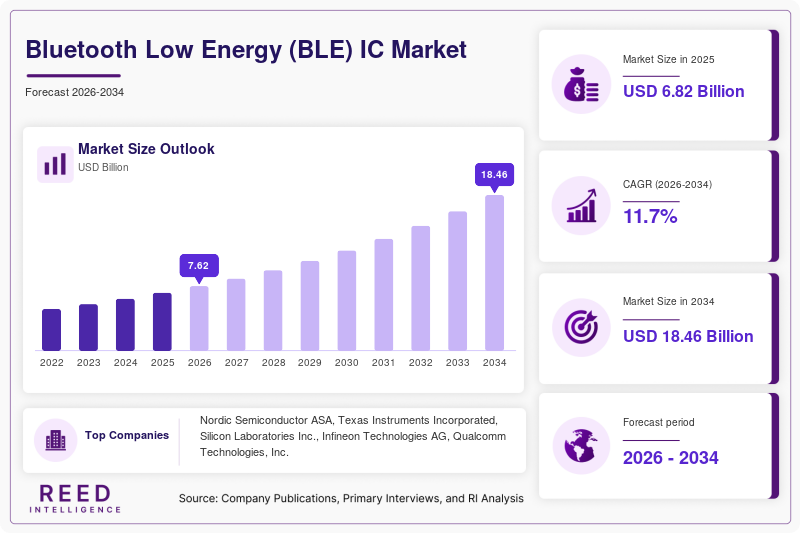
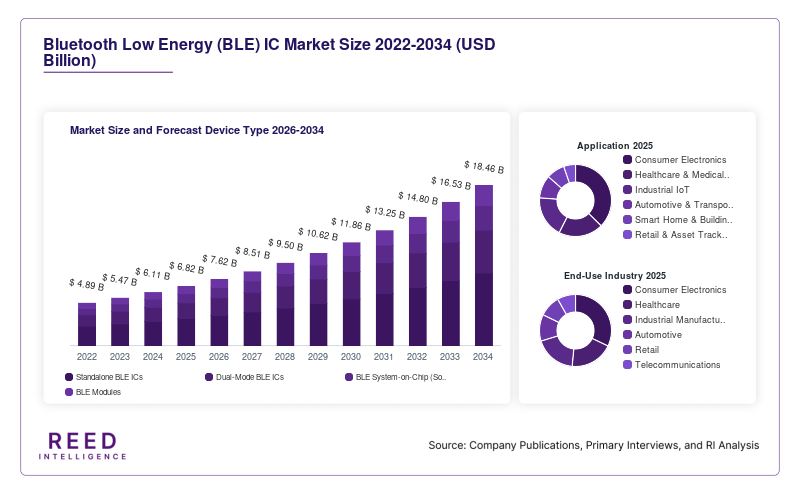
The Bluetooth Low Energy (BLE) IC Market size was valued at USD 6.82 billion in 2026 and is projected to reach USD 16.47 billion by 2034, expanding at a CAGR of 11.7% during 2026–2034. The global Bluetooth Low Energy (BLE) IC Market continues to experience significant growth as wireless connectivity becomes a fundamental requirement across consumer electronics, healthcare devices, industrial automation systems, smart home products, and connected infrastructure. BLE integrated circuits provide low-power wireless communication capabilities that enable extended battery life, cost-efficient deployment, and reliable connectivity for a broad range of Internet of Things (IoT) applications.
A major global factor supporting market growth has been the rapid proliferation of IoT ecosystems worldwide. Enterprises, consumers, and governments are increasingly adopting connected devices to improve operational efficiency, automation, data collection, and user convenience. BLE technology has emerged as a preferred connectivity solution due to its low energy consumption, interoperability, compact footprint, and compatibility with smartphones and wearable devices. These advantages continue to drive widespread integration of BLE ICs into next-generation connected products.
Key Highlights
- Asia Pacific dominated the market with a 41.7% share in 2025.
- Middle East & Africa is expected to be the fastest-growing region, registering a CAGR of 13.2% during 2026–2034.
- By Device Type, Standalone BLE ICs held the leading 45.9% market share in 2025.
- By Device Type, Multi-Protocol Wireless ICs are projected to grow at the fastest 13.8% CAGR through 2034.
- By Application, Consumer Electronics accounted for 36.8% market share in 2025.
- By Application, Healthcare Devices are forecast to expand at a 14.4% CAGR.
- By End-Use Industry, Consumer Electronics Manufacturers represented 33.6% share in 2025.
- By End-Use Industry, Industrial Automation Providers are expected to register a 13.6% CAGR during the forecast period.
- China remained the dominant country market, valued at USD 1.02 billion in 2024 and USD 1.15 billion in 2025.
Market Trends
Integration of BLE ICs with Multi-Protocol Connectivity Platforms
One of the major trends shaping the Bluetooth Low Energy (BLE) IC Market is the growing adoption of multi-protocol wireless chipsets. Manufacturers increasingly develop integrated solutions that combine BLE functionality with Zigbee, Thread, Wi-Fi, Matter, and proprietary wireless technologies. This integration simplifies product development while reducing hardware complexity and overall system costs.
Multi-protocol architectures are becoming particularly important for smart home ecosystems, industrial monitoring platforms, and building automation networks where multiple communication standards operate simultaneously. As interoperability requirements continue increasing, demand for flexible wireless integrated circuits is expected to rise steadily.
Growing Adoption of AI-Enabled Edge Connectivity Devices
Artificial intelligence is becoming increasingly integrated with low-power wireless systems. BLE IC manufacturers are incorporating enhanced processing capabilities that support edge analytics, sensor fusion, and local decision-making functions. Intelligent connected devices can process information closer to the source while minimizing network traffic and latency.
The combination of BLE connectivity and edge intelligence is creating new opportunities across wearable health monitoring devices, predictive maintenance systems, asset tracking platforms, and smart consumer electronics. This trend is expected to accelerate innovation throughout the semiconductor ecosystem.
Market Drivers
Expansion of Connected Consumer Electronics
The increasing adoption of wireless consumer devices continues to drive substantial demand for BLE integrated circuits. Smartwatches, wireless earbuds, fitness trackers, smart speakers, gaming accessories, and connected household products require reliable low-power communication capabilities.
Consumers increasingly prefer devices that offer seamless connectivity with smartphones and digital ecosystems. BLE technology enables efficient communication while maintaining extended battery performance, making it an essential component across numerous consumer electronics categories.
Rising Deployment of Industrial IoT Infrastructure
Industrial digitalization initiatives are generating significant demand for BLE-enabled connectivity solutions. Manufacturing facilities, logistics centers, warehouses, and utility operators are deploying connected sensors and monitoring devices to improve operational visibility and asset utilization.
BLE ICs provide cost-effective communication capabilities suitable for industrial tracking, environmental monitoring, predictive maintenance, and equipment management applications. The expansion of Industrial IoT networks continues to support long-term market growth.
Market Restraint
Security and Data Privacy Concerns
Security vulnerabilities associated with wireless communication systems remain a key restraint for the Bluetooth Low Energy (BLE) IC Market. Organizations deploying connected devices often require robust authentication, encryption, and data protection capabilities to safeguard sensitive information.
Concerns regarding unauthorized access, cyberattacks, and network vulnerabilities may increase implementation complexity and development costs. Manufacturers continue investing in advanced security architectures to address evolving cybersecurity requirements.
Market Opportunities
Expansion of Digital Healthcare Ecosystems
The growing adoption of connected healthcare devices presents substantial opportunities for BLE IC manufacturers. Wearable monitoring systems, remote patient management devices, diagnostic equipment, and smart medical sensors increasingly rely on low-power wireless communication technologies.
Healthcare providers are expanding digital care delivery models that require continuous patient monitoring and secure device connectivity. These developments are expected to create strong demand for advanced BLE semiconductor solutions.
Growth of Smart Building Infrastructure
Commercial buildings, residential developments, and public facilities are increasingly deploying intelligent automation systems. Smart lighting, occupancy monitoring, energy management, security controls, and access management solutions utilize BLE-enabled devices for connectivity and communication.
The continued expansion of smart building investments is expected to generate new opportunities for BLE IC suppliers serving infrastructure and building technology markets.
Segmental Analysis
By Device Type
Standalone BLE ICs
Standalone BLE ICs dominated the market and accounted for 45.9% of revenue in 2025. These solutions remained widely utilized across wearable electronics, wireless accessories, asset-tracking devices, and smart sensors due to their energy efficiency and cost-effectiveness.
Multi-Protocol Wireless ICs
Multi-protocol wireless ICs are projected to grow at a 13.8% CAGR through 2034. Growth will be supported by increasing interoperability requirements and adoption of integrated connectivity solutions across smart home and industrial applications.
By Application
Consumer Electronics
Consumer electronics represented 36.8% market share in 2025. The segment benefited from extensive deployment of BLE-enabled smartwatches, headphones, fitness bands, gaming devices, and connected accessories.
Healthcare Devices
Healthcare devices will register a 14.4% CAGR during the forecast period. Expansion will be driven by growing utilization of remote monitoring systems, connected diagnostic tools, and wearable medical technologies.
By End-Use Industry
Consumer Electronics Manufacturers
Consumer electronics manufacturers accounted for 33.6% market share in 2025. Continuous innovation in personal technology devices and connected accessories supported segment leadership.
Industrial Automation Providers
Industrial automation providers are expected to expand at a 13.6% CAGR through 2034. Increasing deployment of wireless industrial sensors and connected operational technologies will contribute to future growth.
By Connectivity Range
Short-Range Connectivity Solutions
Short-range connectivity solutions captured 58.1% market share in 2025. These products remained popular in personal electronics and proximity-based communication applications requiring low power consumption.
Long-Range BLE Solutions
Long-range BLE solutions are projected to grow at a 13.1% CAGR. Improved communication distance capabilities and expanding industrial deployments will support adoption across enterprise environments.
By Sales Channel
Direct OEM Sales
Direct OEM sales represented 63.7% of market revenue in 2025. Semiconductor suppliers maintained long-term partnerships with device manufacturers to support large-scale production requirements.
Authorized Distribution Networks
Authorized distribution networks are forecast to register a 11.9% CAGR through 2034. Increasing demand from small and medium-sized device developers will continue supporting channel expansion.
Regional Analysis
North America
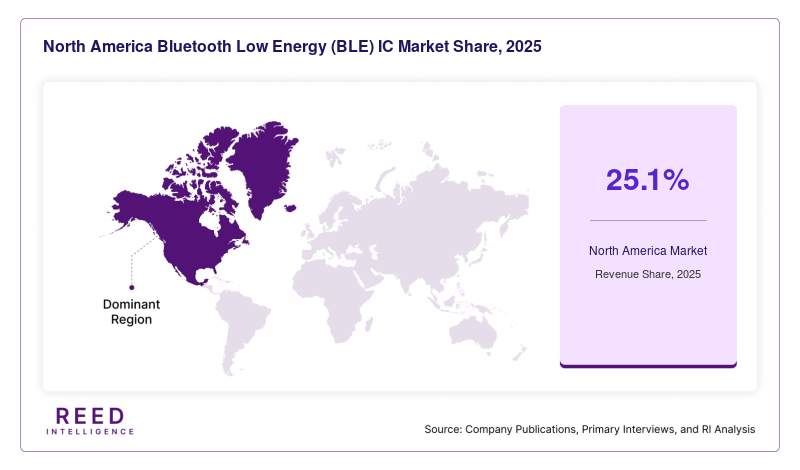
North America accounted for 25.1% of the global Bluetooth Low Energy (BLE) IC Market share in 2025. The region benefited from advanced semiconductor innovation, high adoption of connected devices, and substantial investments in IoT technologies. The market will expand at a CAGR of 10.8% during 2026–2034.
The United States remained the dominant country market due to strong demand for wearable electronics, connected healthcare technologies, and enterprise IoT deployments. Continued investments in semiconductor research and wireless innovation support regional market development.
Europe
Europe held 22.4% market share in 2025. The region benefited from widespread digital transformation initiatives, industrial automation programs, and smart infrastructure development. The market will grow at a CAGR of 10.5% through 2034.
Germany emerged as the leading country due to its advanced manufacturing ecosystem and extensive adoption of industrial connectivity technologies. Smart factory initiatives and connected production systems continue supporting demand for BLE semiconductor solutions.
Asia Pacific
Asia Pacific represented 41.7% of global revenue in 2025, making it the largest regional market. The region is expected to register a CAGR of 12.4% between 2026 and 2034.
China dominated regional revenue generation owing to large-scale electronics manufacturing activities and expanding deployment of connected consumer devices. Continued investments in smart technologies and semiconductor development remain important contributors to market growth.
Middle East & Africa
The Middle East & Africa accounted for 5.3% market share in 2025. The region will grow at a CAGR of 13.2% during the forecast period, making it the fastest-growing regional market.
The United Arab Emirates remained the dominant country due to increasing investments in smart city infrastructure, digital government initiatives, and connected building technologies. Expanding adoption of intelligent infrastructure solutions supports regional market expansion.
Latin America
Latin America captured 5.5% of global revenue in 2025 and is forecast to expand at a CAGR of 10.9% through 2034.
Brazil led the regional market as enterprises accelerated adoption of digital transformation technologies and wireless connectivity solutions. Growth in consumer electronics consumption and industrial modernization initiatives continues supporting demand for BLE-enabled devices.
Competitive Landscape
The Bluetooth Low Energy (BLE) IC Market is highly competitive, characterized by continuous innovation, product differentiation, and strategic technology partnerships. Manufacturers compete through power efficiency, connectivity performance, security features, integration capabilities, and software ecosystem support.
Nordic Semiconductor maintained a leading position through its extensive BLE chipset portfolio, developer tools, and IoT-focused wireless solutions. The company recently introduced next-generation low-power wireless platforms designed to support advanced edge computing capabilities and multi-protocol connectivity requirements.
Texas Instruments Incorporated continues expanding its wireless semiconductor portfolio through energy-efficient connectivity solutions for industrial and consumer applications.
Silicon Laboratories Inc. focuses on integrated wireless platforms designed for smart home, industrial automation, and connected infrastructure deployments.
Infineon Technologies AG remains active in secure wireless semiconductor development, supporting connected automotive, industrial, and IoT applications.
NXP Semiconductors N.V. continues strengthening its market presence through advanced wireless communication solutions and embedded connectivity technologies.
Key Players List
- Nordic Semiconductor ASA
- Texas Instruments Incorporated
- Silicon Laboratories Inc.
- NXP Semiconductors N.V.
- Infineon Technologies AG
- Qualcomm Technologies Inc.
- STMicroelectronics N.V.
- Renesas Electronics Corporation
- Dialog Semiconductor PLC
- Microchip Technology Incorporated
- Toshiba Electronic Devices & Storage Corporation
- Telink Semiconductor
- Realtek Semiconductor Corporation
- Espressif Systems
- Cypress Semiconductor Corporation
Bluetooth Low Energy (BLE) IC Market Segments
Device Type
- Standalone BLE ICs
- Dual-Mode BLE ICs
- BLE System-on-Chip (SoC)
- BLE Modules
Application
- Consumer Electronics
- Healthcare & Medical Devices
- Industrial IoT
- Automotive & Transportation
- Smart Home & Building Automation
- Retail & Asset Tracking
End-Use Industry
- Consumer Electronics
- Healthcare
- Industrial Manufacturing
- Automotive
- Retail
- Telecommunications
Distribution Channel
- Direct Sales
- Authorized Distributors
- Online Component Marketplaces
- Value-Added Resellers
By Region
- North America
- Europe
- APAC
- Middle East and Africa
- LATAM