Bmi Resins Market Size, Share & Demand Report By Type (Unmodified BMI Resins, Modified BMI Resins), By Application (Composites, Adhesives & Coatings, Others), By End-Use Industry (Aerospace & Defense, Automotive, Electronics, Industrial), By Form (Powder, Liquid), By Region & Segment Forecasts, 2026–2034
USD 3950
Market Overview
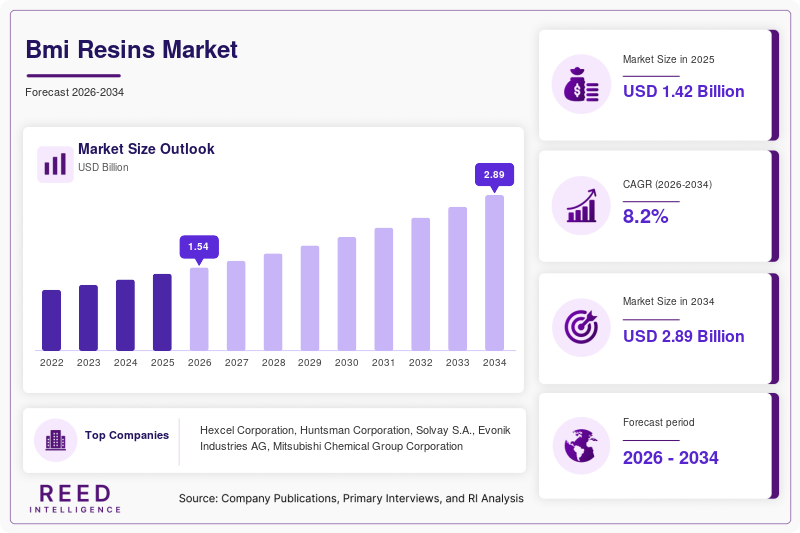
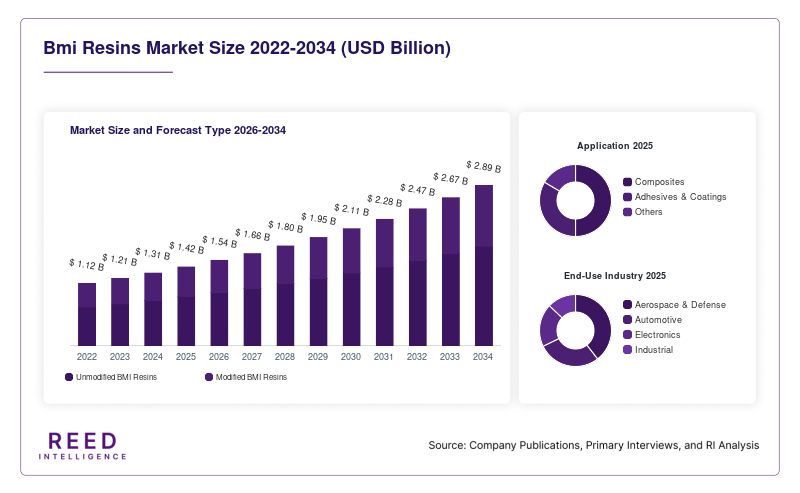
The global Bmi Resins Market size was valued at approximately USD 1.42 billion in 2026 and is projected to reach around USD 2.67 billion by 2034, expanding at a CAGR of 8.2% during the forecast period (2026–2034). The market has witnessed consistent growth due to increasing demand for high-performance thermosetting resins in advanced engineering applications, particularly where superior thermal stability and mechanical strength are required.
A key global factor supporting the expansion of the Bmi Resins Market is the rising demand for lightweight and high-strength materials in aerospace and defense industries. Bismaleimide (BMI) resins offer exceptional heat resistance, chemical stability, and structural integrity, making them suitable for aircraft components, satellites, and defense-grade composites. As governments and private players continue to invest in aerospace innovation and fuel efficiency, the demand for BMI-based composites has strengthened steadily.
Key Highlights
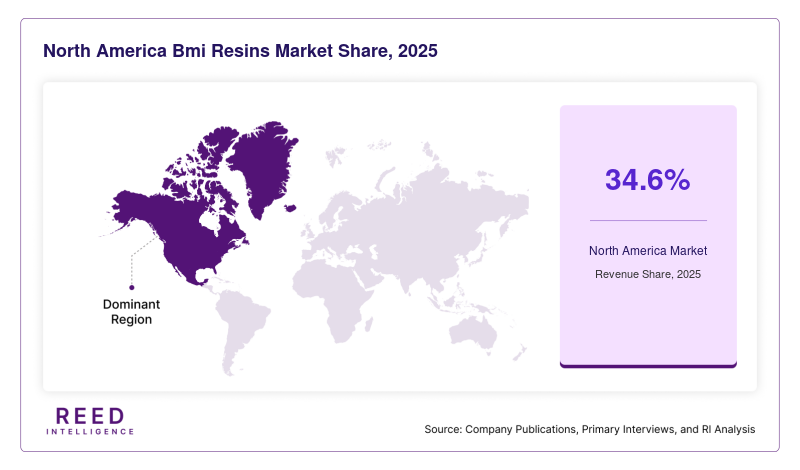
- North America dominated the market with a share of 34.6% in 2025, while Asia Pacific is expected to grow at the fastest CAGR of 9.5% during the forecast period.
- By type, Unmodified BMI resins held the largest share of 48.2% in 2025, while Modified BMI resins are projected to grow at a CAGR of 8.9%.
- By application, Composites dominated with 51.7% share in 2025, while Adhesives & Coatings are anticipated to expand at a CAGR of 8.7%.
- The United States remained the dominant country with a market value of USD 420 million in 2024, increasing to USD 445 million in 2025, supported by robust aerospace manufacturing and defense investments.
Market Trends
Increasing Adoption of High-Temperature Composite Materials
The Bmi Resins Market is experiencing a shift toward high-temperature composite applications, especially in aerospace and automotive sectors. Manufacturers are increasingly replacing traditional epoxy resins with BMI resins due to their superior thermal endurance and flame resistance. This trend is influencing product innovation, particularly in next-generation aircraft and electric vehicles requiring advanced heat-resistant materials.
Integration of Advanced Manufacturing Technologies
The adoption of automated fiber placement (AFP) and resin transfer molding (RTM) is transforming the production landscape. These technologies enhance precision and reduce material waste, making BMI resins more viable for large-scale manufacturing. This trend is expected to accelerate production efficiency and expand the application scope of BMI-based composites.
Market Drivers
Growing Demand from Aerospace & Defense Sector
The aerospace and defense industries remain a primary driver of the Bmi Resins Market. BMI resins are extensively used in aircraft structural components, engine parts, and radomes due to their excellent mechanical properties and resistance to extreme temperatures. The increasing production of commercial aircraft and defense modernization programs worldwide are contributing to sustained demand.
Rising Need for Lightweight Materials in Automotive Industry
The automotive industry is gradually adopting BMI resins to reduce vehicle weight and improve fuel efficiency. These resins enable the production of lightweight composite parts without compromising durability. As electric vehicle adoption grows, manufacturers are focusing on advanced materials to enhance battery efficiency and structural performance, further driving market expansion.
Market Restraint
High Cost of Bmi Resins
One of the major restraints affecting the Bmi Resins Market is the high production cost associated with these materials. Compared to conventional resins such as epoxy and polyester, BMI resins involve complex manufacturing processes and expensive raw materials. This cost factor limits their adoption in price-sensitive industries and emerging markets.
Market Opportunities
Expansion in Renewable Energy Sector
BMI resins are gaining attention in the renewable energy sector, particularly in wind energy applications. Their ability to withstand harsh environmental conditions and high mechanical stress makes them suitable for wind turbine components. This emerging application area presents significant growth opportunities for manufacturers.
Development of Hybrid Resin Systems
The development of hybrid resin systems combining BMI with other polymers is opening new avenues for performance optimization. These hybrid systems offer improved flexibility, reduced brittleness, and enhanced processing capabilities. This innovation is expected to broaden the applicability of BMI resins across multiple industries.
Segmental Analysis
By Type
Unmodified BMI resins dominated the segment with a 48.2% share in 2025, as they are widely used in high-performance applications requiring excellent thermal stability.
Modified BMI resins will grow at the fastest CAGR of 8.9%, driven by their improved toughness and processing characteristics, making them suitable for advanced composite applications.
By Application
Composites accounted for the largest share of 51.7% in 2025, due to their extensive use in aerospace and automotive components.
Adhesives & coatings are expected to grow at a CAGR of 8.7%, supported by increasing demand for high-performance bonding solutions in industrial applications.
By End-Use Industry
Aerospace & defense dominated the segment with 42.5% share in 2025, owing to the widespread use of BMI resins in aircraft structures.
Automotive will grow at the fastest CAGR of 8.6%, driven by the need for lightweight and durable materials in electric vehicles.
By Form
Powder form held a 44.1% share in 2025, as it is widely used in composite manufacturing processes.
Liquid form is projected to grow at a CAGR of 8.4%, due to its ease of application in coatings and adhesives.
Regional Analysis
North America
North America accounted for 34.6% of the Bmi Resins Market share in 2025 and will grow at a CAGR of 7.8% during 2026–2034. The United States dominated the region due to strong aerospace manufacturing infrastructure and consistent defense spending. The presence of major aircraft manufacturers and ongoing investments in next-generation aviation technologies supported market growth.
Europe
Europe held 27.3% market share in 2025 and is projected to grow at a CAGR of 7.9%. Germany emerged as the dominant country, driven by its advanced automotive engineering sector and focus on lightweight materials. The region also benefits from strong research initiatives in composite materials and sustainability.
Asia Pacific
Asia Pacific captured 24.8% share in 2025 and is expected to grow at the fastest CAGR of 9.5%. China led the regional market due to rapid industrialization and expanding aerospace capabilities. Increasing investments in defense and infrastructure development are contributing to strong regional demand.
Middle East & Africa
The Middle East & Africa accounted for 7.1% share in 2025 and will grow at a CAGR of 7.2%. The United Arab Emirates dominated the region, supported by investments in aviation and infrastructure projects. The growing focus on diversifying economies beyond oil is also driving demand for advanced materials.
Latin America
Latin America held 6.2% market share in 2025 and is anticipated to grow at a CAGR of 7.4%. Brazil emerged as the leading country due to its aerospace manufacturing capabilities and increasing industrial development. Government initiatives supporting manufacturing growth are aiding market expansion.
Competitive Landscape
The Bmi Resins Market is moderately consolidated, with key players focusing on product innovation, strategic partnerships, and capacity expansion. Leading companies are investing in research and development to enhance resin performance and reduce production costs.
Hexcel Corporation is considered a market leader, leveraging its strong presence in aerospace composites and continuous innovation in high-performance materials. The company recently introduced advanced BMI resin formulations designed for next-generation aircraft applications, improving heat resistance and durability.
Other prominent players such as Huntsman Corporation, Solvay S.A., and Evonik Industries AG are expanding their product portfolios and strengthening their global distribution networks. Mitsubishi Chemical Group Corporation is also focusing on developing sustainable and high-performance resin solutions.
The competitive environment is characterized by technological advancements and increasing collaborations between manufacturers and end-use industries to meet evolving application requirements.
Key Players List
- Hexcel Corporation
- Huntsman Corporation
- Solvay S.A.
- Evonik Industries AG
- Mitsubishi Chemical Group Corporation
- Toray Industries, Inc.
- SABIC
- Sumitomo Chemical Co., Ltd.
- Arkema S.A.
- BASF SE
- Dow Inc.
- Lonza Group AG
- DIC Corporation
- Renegade Materials Corporation
- Hexion Inc.
Recent Developments
- In 2025, Hexcel Corporation launched a new range of high-temperature BMI resins for aerospace applications.
- Solvay S.A. expanded its composite materials production capacity in Europe to meet rising demand.
- Huntsman Corporation introduced modified BMI resins with enhanced toughness and processing capabilities.
- Mitsubishi Chemical Group Corporation developed eco-friendly BMI resin solutions for sustainable applications.
Bmi Resins Market Segments
Type
- Unmodified BMI Resins
- Modified BMI Resins
Application
- Composites
- Adhesives & Coatings
- Others
End-Use Industry
- Aerospace & Defense
- Automotive
- Electronics
- Industrial
Form
- Powder
- Liquid
By Region
- North America
- Europe
- APAC
- Middle East and Africa
- LATAM