Board Portal Market Size, Share & Demand Report By Deployment Mode (Cloud-Based, On-Premise, Hybrid), By Organization Size (Large Enterprises, Small and Medium Enterprises), By End-Use Industry (BFSI, Healthcare and Life Sciences, Government and Public Sector, IT and Telecommunications, Manufacturing, Education and Nonprofit Organizations, Others) By Region & Segment Forecasts, 2026–2034
USD 3950
Market Overview
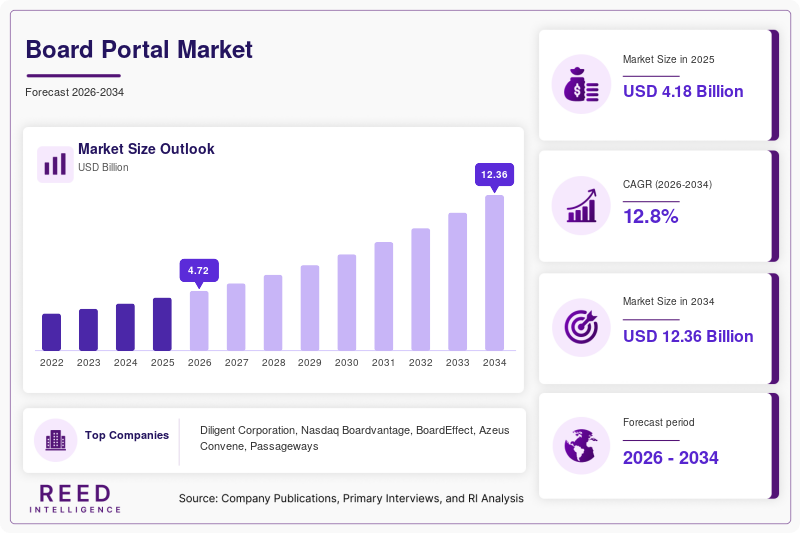
The global Board Portal Market size was valued at USD 4.18 billion in 2026 and is projected to reach USD 10.92 billion by 2034, expanding at a CAGR of 12.8% during the forecast period. The market is experiencing stable expansion due to the increasing adoption of digital governance tools among enterprises, public institutions, financial organizations, and non-profit entities. Board portal platforms are widely used to streamline board communication, improve document security, simplify voting processes, and enhance meeting collaboration across geographically distributed leadership teams. The growing shift toward cloud-based enterprise management systems has also accelerated the deployment of secure digital board management solutions.
A major global factor supporting market growth is the rapid increase in cybersecurity concerns associated with corporate governance and confidential data handling. Organizations are increasingly replacing traditional paper-based board management methods with encrypted digital platforms that provide secure document access, electronic signatures, audit tracking, and role-based permissions. Regulatory compliance requirements across industries such as banking, healthcare, insurance, and government administration are further encouraging the use of board portal software for transparent and traceable governance practices. In addition, remote and hybrid working models continue to strengthen demand for mobile-enabled board collaboration platforms that support real-time communication and decision-making.
Key Highlights
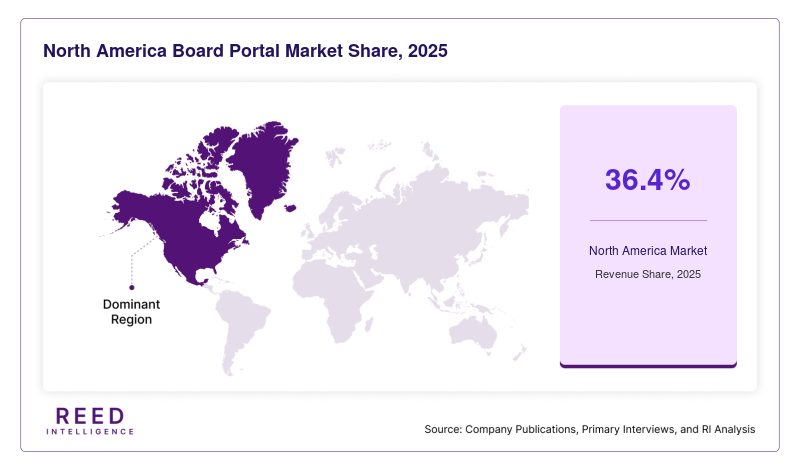
- North America dominated the market with a 36.4% share in 2025.
- Asia Pacific is expected to grow at the fastest CAGR of 14.1% during 2026–2034.
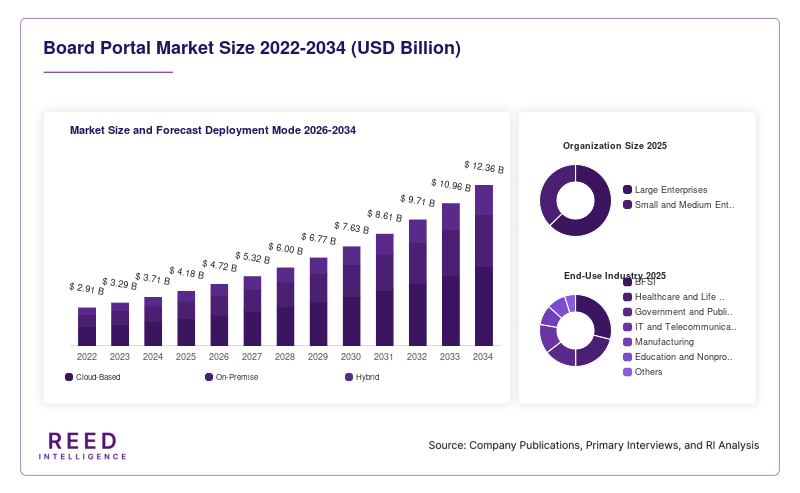
- By deployment mode, cloud-based platforms accounted for the largest share of 61.8%, while hybrid deployment solutions are projected to grow at a CAGR of 13.7%.
- By organization size, large enterprises led with a 68.9% share, whereas small and medium enterprises are expected to expand at a CAGR of 14.5%.
- The United States remained the dominant country, with market values of USD 1.02 billion in 2024 and USD 1.16 billion in 2025.
Market Trends
Artificial Intelligence Integration in Governance Workflows
Artificial intelligence integration is becoming a notable trend in the Board Portal Market as organizations seek more efficient governance processes and faster decision-making capabilities. Vendors are incorporating AI-powered features such as automated agenda creation, meeting summarization, sentiment analysis, document classification, and predictive recommendations into their board management platforms. These capabilities help executives reduce administrative workloads and improve meeting productivity. AI-driven search functionality also enables directors to retrieve governance documents more efficiently, improving collaboration across dispersed teams. Enterprises operating across multiple regions are increasingly adopting intelligent translation and transcription tools integrated within board portal systems to simplify multilingual communication.
The growing need for data-driven governance is further encouraging companies to integrate analytics dashboards into board portal solutions. These dashboards provide insights related to meeting participation, voting patterns, compliance status, and strategic priorities. Organizations in regulated sectors such as finance and healthcare are adopting AI-enabled portals to strengthen governance transparency and audit preparedness. Technology providers are also investing in machine learning algorithms that can identify unusual access behavior and potential cybersecurity risks. As businesses continue to prioritize digital governance modernization, AI-enabled board portal platforms are expected to become a standard component of enterprise governance infrastructure.
Expansion of Mobile-First and Remote Collaboration Platforms
The increasing preference for mobile-first enterprise applications is reshaping the Board Portal Market. Corporate leaders, directors, and committee members are demanding secure access to governance materials through smartphones and tablets, especially in hybrid working environments. Vendors are responding by developing mobile-optimized board portals with advanced encryption, biometric authentication, offline document access, and integrated video conferencing capabilities. This trend is particularly important for multinational organizations where board members operate across different locations and require uninterrupted access to strategic documents.
Remote governance practices have accelerated the need for cloud-enabled collaboration platforms that support digital voting, live annotation, and real-time meeting updates. Many enterprises are replacing legacy governance systems with centralized digital workspaces that allow board members to participate securely from any location. Mobile-enabled board portals are also improving executive responsiveness during mergers, acquisitions, crisis management, and compliance reviews. Educational institutions, government bodies, and nonprofit organizations are increasingly adopting mobile-centric governance tools to improve participation rates and reduce administrative costs. As enterprise mobility strategies continue to evolve, demand for responsive and secure board portal applications is expected to increase steadily.
Market Drivers
Increasing Regulatory Compliance and Governance Requirements
The growing complexity of corporate governance regulations is a major driver supporting the expansion of the Board Portal Market. Organizations across banking, insurance, healthcare, energy, and public administration sectors are under pressure to maintain secure and transparent governance frameworks. Board portal platforms help organizations centralize confidential documents, maintain audit trails, manage voting records, and enforce role-based access controls. These capabilities are becoming increasingly valuable as regulators require stronger oversight of executive decision-making and board accountability.
Enterprises operating across international markets also face challenges related to data protection laws, financial reporting standards, and compliance documentation. Digital board management platforms simplify compliance by enabling secure storage, automated reporting, and controlled document sharing. Many companies are investing in governance technology to reduce the risk of data leaks and compliance penalties. The growing focus on environmental, social, and governance reporting is further increasing demand for platforms capable of supporting secure collaboration and transparent governance communication. As governance frameworks become more sophisticated, organizations are expected to continue investing in board portal solutions that improve operational transparency and compliance efficiency.
Rising Adoption of Cloud-Based Enterprise Collaboration Solutions
The rapid adoption of cloud computing technologies is significantly driving growth in the Board Portal Market. Organizations are increasingly shifting away from traditional on-premise governance systems toward cloud-based platforms that provide flexibility, scalability, and lower infrastructure costs. Cloud-based board portals enable directors and executives to securely access meeting materials from multiple devices and locations while maintaining centralized document management. These platforms also support automated updates, simplified maintenance, and integration with enterprise productivity tools.
Small and medium enterprises are particularly benefiting from subscription-based cloud deployment models that reduce upfront implementation expenses. Cloud infrastructure providers are enhancing security capabilities through multi-factor authentication, encryption technologies, and continuous monitoring systems, which is increasing enterprise confidence in cloud-based governance platforms. The demand for digital transformation initiatives across industries is also supporting adoption. Many organizations are implementing cloud-based governance ecosystems that integrate board portals with enterprise resource planning systems, communication tools, and analytics platforms. As businesses continue prioritizing operational agility and remote accessibility, cloud-based board portal solutions are expected to witness sustained demand globally.
Market Restraint
Concerns Related to Data Privacy and High Implementation Complexity
Data privacy concerns and implementation complexity remain significant restraints affecting the Board Portal Market. Board portals handle highly confidential information including financial reports, merger plans, legal documentation, executive compensation records, and strategic governance discussions. Any cybersecurity breach involving such sensitive information can lead to reputational damage, financial losses, and regulatory penalties. As a result, many organizations remain cautious about migrating governance activities to digital platforms, especially in sectors with strict data localization and privacy regulations.
Large enterprises often require customized integrations between board portals and existing enterprise software systems, which can increase deployment complexity and implementation timelines. Legacy infrastructure limitations and compatibility challenges may also create operational disruptions during migration processes. In developing regions, smaller organizations sometimes hesitate to adopt board portal solutions because of concerns regarding training requirements, recurring subscription costs, and limited technical expertise. Resistance from board members accustomed to traditional paper-based governance practices can further slow adoption rates. Although vendors continue investing in stronger encryption technologies and simplified onboarding tools, concerns regarding data security, compliance management, and implementation costs may continue to limit adoption among conservative organizations during the forecast period.
Market Opportunities
Growing Demand from Small and Medium Enterprises
The increasing digital transformation of small and medium enterprises presents a significant opportunity for the Board Portal Market. Historically, board portal solutions were primarily adopted by large enterprises due to higher implementation costs and complex deployment structures. However, vendors are now introducing affordable subscription-based solutions tailored specifically for mid-sized organizations and growing businesses. These platforms provide simplified governance workflows, cloud-based deployment, and user-friendly interfaces that reduce operational complexity.
SMEs are increasingly recognizing the importance of structured governance practices to attract investors, improve compliance readiness, and strengthen strategic decision-making. Digital board portals help smaller organizations centralize meeting documentation, improve communication transparency, and reduce administrative expenses associated with physical board meetings. Startups and rapidly expanding companies are also adopting governance platforms to manage distributed leadership teams and external advisory boards. Vendors offering modular pricing, mobile accessibility, and scalable deployment models are likely to benefit from rising SME adoption. As awareness regarding governance efficiency continues to expand across emerging economies, the SME segment is expected to become a major revenue contributor for board portal providers.
Expansion Across Government and Nonprofit Organizations
Government agencies and nonprofit institutions are creating new growth opportunities for the Board Portal Market as these organizations increasingly modernize administrative operations. Public institutions are adopting digital governance tools to improve transparency, reduce paper usage, and streamline committee management activities. Board portal platforms help government organizations manage policy discussions, budget approvals, compliance documentation, and voting procedures within secure digital environments.
Nonprofit organizations are also investing in board portal solutions to improve collaboration among trustees, donors, and executive committees located across different regions. Digital governance platforms support efficient fundraising coordination, meeting scheduling, and document sharing while maintaining strong accountability standards. International nonprofit organizations particularly benefit from multilingual support capabilities and secure remote accessibility. Vendors are introducing customized solutions designed specifically for public administration and nonprofit governance requirements, including grant tracking and volunteer committee management features. As digital governance initiatives continue expanding across the public sector, demand for scalable and secure board portal solutions is expected to increase substantially during the forecast period.
Segmental Analysis
By Deployment Mode
Cloud-based deployment emerged as the dominant subsegment in the Board Portal Market and accounted for 61.8% of the global market share in 2024. Organizations across industries are increasingly selecting cloud-based board portal solutions because they provide flexible access, lower infrastructure requirements, and simplified maintenance processes. Enterprises benefit from centralized document management, automatic software updates, and remote accessibility for geographically dispersed board members. Financial institutions, healthcare providers, and multinational corporations are among the leading adopters of cloud-based governance platforms due to the need for continuous collaboration and secure document sharing. Vendors are also improving cloud security through advanced encryption technologies, multi-factor authentication systems, and real-time monitoring capabilities. The growing demand for scalable enterprise software solutions and digital governance modernization initiatives continues to strengthen the position of cloud deployment within the global market.
Hybrid deployment solutions are projected to witness the fastest CAGR of 13.7% during the forecast period due to increasing enterprise demand for flexible governance infrastructure. Many organizations prefer hybrid models because they allow sensitive governance data to remain within private infrastructure while leveraging cloud capabilities for collaboration and accessibility. Large enterprises operating in regulated industries are increasingly implementing hybrid board portals to balance compliance requirements with operational efficiency. Government agencies and financial organizations particularly favor hybrid systems because they provide greater control over confidential information. Vendors are investing in customizable deployment architectures that support integration with existing enterprise software systems and cybersecurity frameworks. The growing need for operational continuity, secure remote collaboration, and adaptable infrastructure is expected to drive strong demand for hybrid board portal solutions across both developed and emerging markets.
By Organization Size
Large enterprises accounted for the largest share of the Board Portal Market in 2024, representing 68.9% of total revenue. Large corporations typically manage complex governance structures involving multiple committees, international operations, and extensive compliance responsibilities. Board portal platforms help these organizations centralize governance documents, improve communication efficiency, and maintain secure audit trails for executive decisions. Industries such as banking, insurance, pharmaceuticals, and energy have demonstrated particularly high adoption rates due to strict regulatory obligations and increased cybersecurity concerns. Large enterprises also possess the financial capacity to invest in advanced governance technologies featuring analytics dashboards, AI-powered meeting management tools, and enterprise-grade security systems. The increasing importance of digital governance transparency and remote executive collaboration continues to support strong demand among multinational corporations and publicly listed companies.
Small and medium enterprises are expected to register the fastest CAGR of 14.5% during 2026–2034 due to increasing awareness regarding structured governance practices. SMEs are adopting board portal solutions to improve investor confidence, streamline communication among leadership teams, and reduce operational inefficiencies associated with traditional governance processes. Cloud-based subscription pricing models are making governance platforms more accessible for smaller organizations with limited technology budgets. Vendors are introducing simplified interfaces and modular solutions specifically designed for SMEs seeking affordable governance management tools. Startups, technology firms, and rapidly growing private companies are among the leading adopters within this segment. The increasing availability of mobile-enabled governance platforms and the growing emphasis on digital transformation strategies are expected to accelerate adoption among SMEs globally during the forecast period.
By End-Use Industry
The banking, financial services, and insurance sector held the dominant share in the Board Portal Market in 2024, accounting for 32.6% of total revenue. Financial institutions require secure governance systems capable of managing confidential documents, regulatory compliance records, and executive communication activities. Board portal platforms help financial organizations improve operational transparency, strengthen cybersecurity, and simplify audit preparation processes. The increasing complexity of financial regulations and the rising frequency of cybersecurity threats are encouraging banks and insurance companies to invest in encrypted digital governance infrastructure. Financial institutions also benefit from real-time collaboration features, digital voting systems, and automated reporting capabilities integrated within modern board portals. The expansion of digital banking services and remote financial operations is further increasing demand for secure and centralized governance management solutions.
Healthcare and life sciences are projected to witness the fastest CAGR of 13.9% during the forecast period due to the growing need for secure governance and compliance management. Hospitals, pharmaceutical companies, healthcare networks, and medical research organizations are increasingly adopting board portal solutions to manage sensitive operational and regulatory information. Digital governance platforms support secure communication among executive teams, ethics committees, and regulatory advisors while improving decision-making efficiency. The rising adoption of electronic health systems and digital healthcare infrastructure is also encouraging organizations to modernize governance processes. Vendors are developing healthcare-specific governance solutions featuring advanced security controls and compliance tracking functionalities. Increasing investment in healthcare digital transformation initiatives and expanding telemedicine operations are expected to support strong growth within the healthcare and life sciences segment.
Regional Analysis
North America
North America accounted for 36.4% of the global Board Portal Market in 2025 and maintained its position as the leading regional market. The region is projected to expand at a CAGR of 11.6% during the forecast period due to the widespread adoption of digital governance technologies across large enterprises and financial institutions. Organizations in the United States and Canada continue to invest heavily in cybersecurity infrastructure, cloud computing, and enterprise collaboration platforms. Regulatory frameworks related to corporate governance and data protection are also encouraging companies to implement secure board management systems.
The United States remained the dominant country in North America due to the presence of large technology providers, advanced digital infrastructure, and strong enterprise spending capabilities. Financial institutions, healthcare organizations, and publicly traded companies are major adopters of board portal platforms across the country. A unique growth factor supporting the U.S. market is the increasing use of AI-powered governance analytics tools among enterprise boards. Companies are integrating predictive insights, automated reporting, and digital voting systems to improve governance efficiency and strategic decision-making processes.
Europe
Europe represented 28.1% of the global Board Portal Market in 2025 and is expected to witness a CAGR of 11.9% during 2026–2034. Demand across the region is supported by strict regulatory standards associated with data privacy, financial transparency, and corporate governance. Enterprises are adopting board portal platforms to simplify compliance with regional regulations and improve secure collaboration among directors operating across multiple countries. Increasing digital transformation investments among financial services, manufacturing, and energy companies are also contributing to market growth.
Germany emerged as the leading country within the European market due to its strong industrial base and high adoption of enterprise software solutions. Large manufacturing companies and financial organizations are implementing board portal systems to manage governance documentation and cross-border executive communication. A unique growth factor supporting the German market is the rapid adoption of digital governance platforms within family-owned industrial enterprises seeking more structured succession planning and corporate transparency. These organizations are increasingly modernizing governance processes to align with international compliance standards.
Asia Pacific
Asia Pacific held a 22.7% share of the global Board Portal Market in 2025 and is projected to register the fastest CAGR of 14.1% during the forecast period. Rapid digital transformation initiatives, expanding enterprise ecosystems, and rising cloud adoption are driving market expansion across the region. Organizations in countries such as China, India, Japan, and Australia are investing in secure governance platforms to improve operational efficiency and support remote executive collaboration. Growing awareness regarding cybersecurity and regulatory compliance is also accelerating market demand.
China remained the dominant country within the Asia Pacific market due to its large enterprise sector and growing investment in cloud-based digital infrastructure. Technology companies, state-owned enterprises, and financial institutions are among the primary adopters of board portal solutions. A unique growth factor supporting the Chinese market is the rapid expansion of digital governance initiatives among large domestic corporations pursuing international business operations. These enterprises require secure multilingual collaboration systems capable of supporting complex governance structures across global markets.
Middle East & Africa
The Middle East & Africa region accounted for 6.4% of the global Board Portal Market in 2025 and is expected to grow at a CAGR of 12.3% through 2034. Increasing investments in digital government initiatives, financial modernization programs, and enterprise cloud infrastructure are contributing to regional growth. Organizations across the Gulf Cooperation Council countries are adopting governance technologies to improve operational transparency and support secure executive collaboration. Rising cybersecurity awareness is also encouraging companies to replace traditional governance systems with digital board management platforms.
The United Arab Emirates dominated the regional market due to its strong digital infrastructure development and proactive government modernization strategies. Large enterprises, financial institutions, and public agencies are investing in advanced governance technologies to improve administrative efficiency. A unique growth factor supporting the UAE market is the increasing implementation of paperless government initiatives and smart city programs. These initiatives are encouraging public organizations and corporate entities to adopt digital governance platforms capable of supporting secure and efficient decision-making processes.
Latin America
Latin America represented 6.4% of the global Board Portal Market in 2025 and is projected to expand at a CAGR of 11.4% during the forecast period. The market is benefiting from the growing adoption of cloud-based enterprise solutions and the modernization of corporate governance frameworks across the region. Financial institutions, telecommunications providers, and multinational corporations are increasingly implementing board portal systems to improve communication security and governance transparency. Demand for remote collaboration technologies has also increased significantly following the expansion of hybrid work models.
Brazil remained the leading country within the Latin American market due to its large corporate sector and growing enterprise software investments. Major organizations in banking, energy, and healthcare industries are deploying digital governance platforms to improve operational oversight and compliance management. A unique growth factor supporting the Brazilian market is the increasing participation of international investors in domestic enterprises, which is encouraging companies to strengthen governance standards and adopt secure digital board management solutions aligned with global practices.
Competitive Landscape
The Board Portal Market remains moderately consolidated, with established software providers competing through product innovation, cybersecurity capabilities, cloud infrastructure expansion, and strategic partnerships. Leading companies are focusing on artificial intelligence integration, mobile application enhancement, and advanced analytics tools to improve governance efficiency for enterprise clients. Vendors are also expanding their presence in emerging markets through subscription-based pricing models and localized service offerings.
Diligent Corporation maintained a leading position in the market due to its extensive product portfolio, global customer base, and strong investment in governance technology innovation. The company continues to expand its AI-powered governance analytics capabilities and secure collaboration tools for enterprise boards. Nasdaq Boardvantage, BoardEffect, Azeus Convene, and Passageways are also prominent participants competing through cloud deployment flexibility and compliance-focused solutions.
Key Players
- Diligent Corporation
- Nasdaq Boardvantage
- BoardEffect
- Azeus Convene
- Passageways
- OnBoard
- BoardPAC
- Admincontrol
- Aprio Inc.
- iBabs
- Directorpoint
- BoardMaps
- Sherpany
- Govenda
- Convene AG
Recent Developments
- Diligent Corporation introduced an AI-enabled governance intelligence module in 2025 designed to automate board meeting summaries and improve executive decision analytics.
- Nasdaq Boardvantage expanded its cloud security infrastructure in 2024 by integrating advanced multi-factor authentication and enhanced compliance monitoring capabilities.
- Azeus Convene launched a mobile-first board portal platform update in 2025 featuring multilingual support, offline document access, and integrated virtual meeting tools.
- OnBoard partnered with enterprise cybersecurity providers in 2024 to strengthen encrypted document sharing and real-time threat monitoring functionalities.
- BoardPAC expanded its presence in Asia Pacific during 2025 through strategic collaborations with financial institutions and government organizations focused on digital governance modernization.
Board Portal Market Segments
Deployment Mode
- Cloud-Based
- On-Premise
- Hybrid
Organization Size
- Large Enterprises
- Small and Medium Enterprises
End-Use Industry
- BFSI
- Healthcare and Life Sciences
- Government and Public Sector
- IT and Telecommunications
- Manufacturing
- Education and Nonprofit Organizations
- Others
By Region
- North America
- Europe
- APAC
- Middle East and Africa
- LATAM