Body Composition Monitor Scale Market Size, Share & Demand Report By Product Type (Smart Body Composition Scales), By Technology (Bioelectrical Impedance Analysis (BIA), Dual-Frequency BIA, Multi-Frequency BIA), By End User (Home Users, Fitness Centers, Hospitals and Clinics, Wellness Centers), By Distribution Channel (Online Retail, Specialty Stores, Hypermarkets and Supermarkets), By Region & Segment Forecasts, 2026–2034
USD 3950
Market Overview
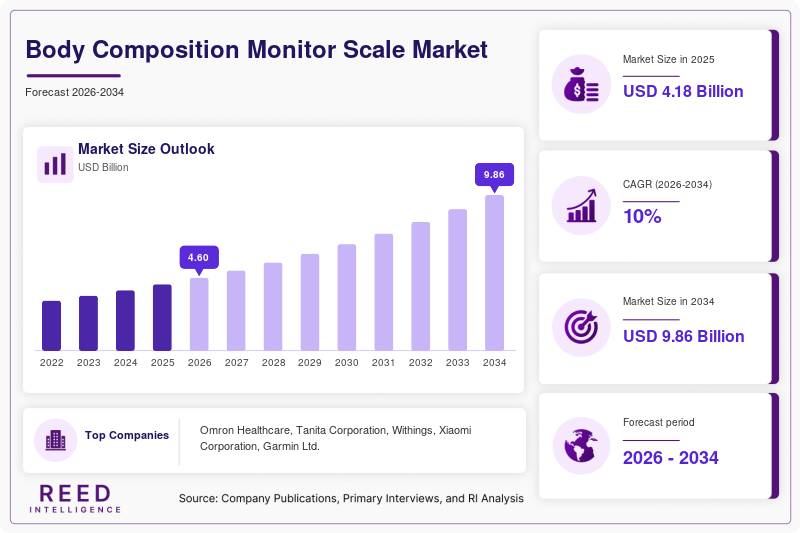
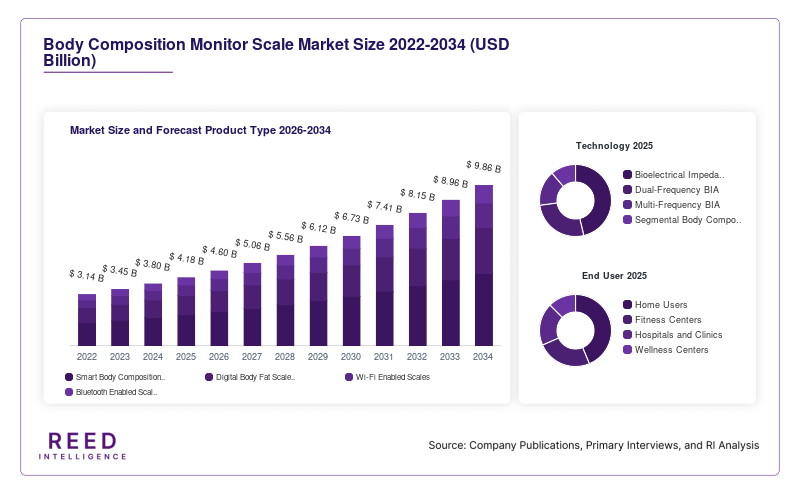
The Body Composition Monitor Scale Market size was valued at USD 4.18 billion in 2026 and is projected to reach USD 8.96 billion by 2034, expanding at a CAGR of 10.0% during the forecast period (2026–2034). The global Body Composition Monitor Scale Market growth has been supported by the increasing global focus on preventive healthcare, weight management, and personalized wellness monitoring. Rising awareness regarding obesity, metabolic disorders, and fitness tracking has encouraged consumers to adopt smart body composition monitoring devices for routine health assessment.
Body composition monitor scales are increasingly being integrated with digital health ecosystems, including mobile applications, wearable devices, and cloud-based analytics platforms. The growing popularity of connected health devices among consumers and healthcare providers has accelerated product demand across residential and clinical environments. In addition, technological developments in bioelectrical impedance analysis (BIA), wireless synchronization, and AI-driven health recommendations have improved the accuracy and usability of these devices.
Key Highlights
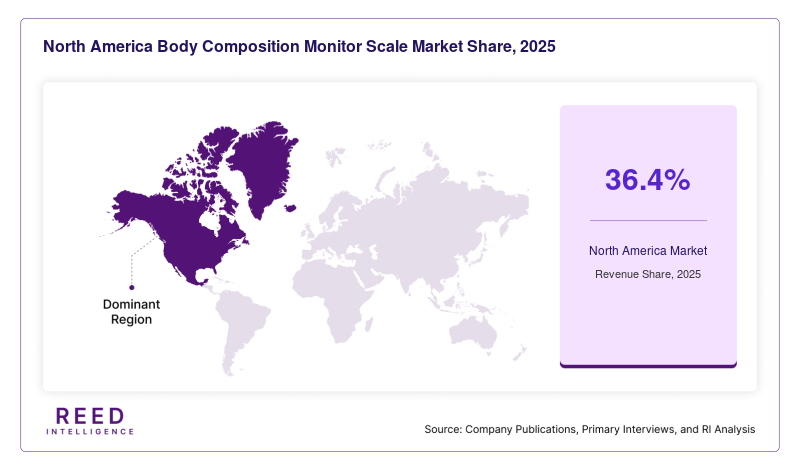
- North America accounted for 36.4% of the global Body Composition Monitor Scale Market share in 2025, while Asia Pacific is projected to register the fastest CAGR of 11.8% during the forecast period.
- By product type, smart body composition scales held the dominant share of 58.7% in 2025, whereas Wi-Fi enabled scales are anticipated to witness the fastest CAGR of 12.4% through 2034.
- By technology, bioelectrical impedance analysis (BIA) dominated with a 71.2% share in 2025, while multi-frequency BIA systems are projected to expand at a CAGR of 13.1%.
- By end user, home users represented 61.5% of the market share in 2025, while fitness centers and wellness facilities are expected to grow at a CAGR of 11.9%.
- The United States remained the dominant country market and was valued at USD 1.18 billion in 2024 and USD 1.29 billion in 2025.
Market Trends
Increasing Integration of Smart Health Ecosystems
One of the notable trends shaping the Body Composition Monitor Scale Market is the growing integration of smart health ecosystems. Consumers are increasingly seeking devices capable of synchronizing with smartphones, wearable fitness trackers, and digital wellness platforms. Manufacturers are introducing Bluetooth and Wi-Fi enabled scales that can track body fat percentage, muscle mass, hydration levels, and metabolic age in real time.
The trend toward connected healthcare has improved long-term user engagement and data-driven wellness management. Healthcare professionals are also utilizing connected monitoring devices to remotely assess patient progress in weight management and rehabilitation programs. As interoperability between health applications continues to improve, demand for advanced body composition monitoring scales is expected to rise steadily.
Expansion of AI-Driven Personalized Wellness Features
Artificial intelligence and predictive analytics are becoming increasingly important in the Body Composition Monitor Scale Market. Advanced scales are now equipped with AI-powered recommendations that analyze user health patterns and provide customized dietary, exercise, and wellness insights.
Consumers are showing preference for devices that offer personalized health coaching rather than only displaying weight metrics. Companies are responding by incorporating machine learning algorithms that can identify trends related to obesity management, muscle development, and fitness improvement. This trend is anticipated to support the development of premium smart scales across both consumer and professional healthcare applications.
Market Drivers
Rising Awareness of Preventive Healthcare
Growing public awareness regarding preventive healthcare has become a major driver for the Body Composition Monitor Scale Market. Consumers are increasingly monitoring health indicators to reduce the risk of obesity, diabetes, cardiovascular disease, and lifestyle-related disorders.
Healthcare campaigns promoting healthy living and early diagnosis have encouraged individuals to adopt home-based health monitoring solutions. Body composition monitor scales provide detailed insights beyond conventional weight measurement, enabling users to better understand fat distribution, muscle composition, and hydration status. This functionality has expanded product demand among health-conscious consumers.
Growth in Fitness and Wellness Participation
The increasing participation in fitness activities and wellness programs has significantly contributed to market expansion. Fitness centers, sports facilities, and wellness clinics are adopting body composition analysis devices to support customized training programs and performance tracking.
Athletes and fitness enthusiasts are increasingly relying on body composition metrics to optimize nutrition and exercise routines. The rising popularity of gym memberships, virtual fitness coaching, and personalized wellness plans has further strengthened the demand for smart body monitoring solutions globally.
Market Restraint
Accuracy Variations Across Consumer Devices
One of the primary restraints affecting the Body Composition Monitor Scale Market is the variation in measurement accuracy across consumer-grade devices. Factors such as hydration levels, age, body posture, and calibration inconsistencies can influence measurement outcomes.
Concerns regarding data reliability may limit adoption among medical professionals and consumers seeking highly precise clinical assessments. Although manufacturers are investing in advanced sensor technologies and multi-frequency analysis systems, accuracy challenges remain a notable market limitation.
Market Opportunities
Expansion of Telehealth and Remote Patient Monitoring
The rapid adoption of telehealth services is creating new opportunities for the Body Composition Monitor Scale Market. Remote patient monitoring programs increasingly require connected health devices capable of transmitting health metrics directly to healthcare providers.
Body composition scales integrated with cloud platforms can support obesity management, chronic disease monitoring, and rehabilitation tracking. Healthcare providers are expected to incorporate these devices into digital care models, particularly for aging populations and patients requiring long-term health monitoring.
Increasing Demand in Emerging Economies
Emerging economies present substantial growth opportunities due to rising disposable incomes, urbanization, and expanding middle-class populations. Consumers in developing countries are becoming more aware of digital wellness technologies and preventive healthcare solutions.
The growth of e-commerce platforms and affordable smart scale offerings is improving product accessibility across Asia Pacific, Latin America, and parts of the Middle East & Africa. Local manufacturers are also entering the market with cost-effective devices tailored for regional consumer preferences.
Segmental Analysis
By Product Type
Smart Body Composition Scales Dominated the Market
Smart body composition scales accounted for 58.7% of the global Body Composition Monitor Scale Market share in 2025. Their dominance was attributed to increasing consumer preference for connected devices capable of tracking multiple health parameters, including body fat percentage, BMI, hydration, and muscle mass.
These devices offered synchronization with smartphones and fitness applications, improving long-term user engagement and wellness tracking. Growing demand for digital health integration supported the segment’s leading position.
Wi-Fi Enabled Scales Will Witness the Fastest Growth
Wi-Fi enabled body composition scales are projected to register a CAGR of 12.4% during the forecast period. The growth will be driven by increasing demand for cloud-based health monitoring and seamless data sharing across multiple platforms.
The ability to automatically upload health metrics to remote healthcare providers and wellness applications is expected to strengthen adoption among consumers seeking advanced connectivity features.
By Technology
Bioelectrical Impedance Analysis (BIA) Held the Largest Share
Bioelectrical impedance analysis technology held 71.2% of the Body Composition Monitor Scale Market share in 2025. The technology remained widely adopted due to its cost efficiency, non-invasive nature, and compatibility with home-use devices.
Manufacturers increasingly utilized BIA technology in both entry-level and premium products because of its ability to measure body fat, muscle mass, and hydration through simple electrical signals.
Multi-Frequency BIA Systems Will Grow Rapidly
Multi-frequency BIA systems are expected to grow at a CAGR of 13.1% through 2034. The segment growth will be supported by increasing demand for higher measurement accuracy and clinical-grade assessment capabilities.
These systems provide improved analysis of intracellular and extracellular water distribution, enabling more accurate body composition evaluation for healthcare and sports performance applications.
By End User
Home Users Accounted for the Largest Share
Home users represented 61.5% of the global Body Composition Monitor Scale Market share in 2025. The dominance of this segment was supported by increasing health awareness, growing obesity concerns, and rising adoption of home wellness monitoring solutions.
Consumers increasingly preferred compact smart scales that could provide personalized health tracking without requiring clinical visits. The expansion of e-commerce retail channels further accelerated household adoption.
Fitness Centers and Wellness Facilities Will Expand Significantly
Fitness centers and wellness facilities are anticipated to witness a CAGR of 11.9% during the forecast period. The segment growth will be fueled by the increasing emphasis on personalized fitness assessment and performance monitoring.
Gyms and wellness centers are expected to adopt advanced body composition monitoring systems to support customized training programs and nutrition planning for members.
By Distribution Channel
Online Retail Channels Led the Market
Online retail channels accounted for 46.8% of the Body Composition Monitor Scale Market share in 2025. The segment benefited from wider product availability, competitive pricing, and increasing consumer preference for digital shopping platforms.
E-commerce platforms enabled consumers to compare device specifications, customer reviews, and pricing options efficiently, supporting higher product penetration globally.
Specialty Stores Will Witness Rapid Growth
Specialty health and electronics stores are projected to register a CAGR of 10.6% during the forecast period. The growth will be supported by rising consumer demand for in-store product demonstrations and professional consultation before purchasing premium smart scales.
Retailers are expected to expand interactive product displays and health technology sections to enhance customer engagement.
Regional Analysis
North America
North America accounted for 36.4% of the global Body Composition Monitor Scale Market share in 2025 and is projected to grow at a CAGR of 9.2% during the forecast period. The region benefited from strong consumer adoption of connected healthcare technologies and widespread awareness regarding obesity management.
The United States dominated the regional market due to the high penetration of smart home devices and digital fitness applications. The growing adoption of subscription-based wellness programs and home fitness ecosystems contributed to regional demand for body composition monitoring scales.
Europe
Europe held 27.1% of the global Body Composition Monitor Scale Market share in 2025 and is anticipated to expand at a CAGR of 8.8% through 2034. Demand in the region was supported by increasing health consciousness and growing utilization of wellness monitoring technologies.
Germany represented the leading country market in Europe due to strong consumer spending on preventive healthcare products. The country experienced rising demand for technologically advanced smart health devices integrated with mobile wellness platforms and connected healthcare systems.
Asia Pacific
Asia Pacific captured 23.5% of the global Body Composition Monitor Scale Market share in 2025 and is forecast to register the fastest CAGR of 11.8% during the study period. Rapid urbanization, expanding digital connectivity, and increasing awareness regarding lifestyle diseases contributed to regional growth.
China emerged as the dominant country in the region owing to the rapid expansion of consumer electronics manufacturing and rising adoption of smart wellness products. The growth of online retail channels and digital health applications further accelerated regional product penetration.
Middle East & Africa
The Middle East & Africa accounted for 7.2% of the global Body Composition Monitor Scale Market share in 2025 and is expected to grow at a CAGR of 8.1% over the forecast period. Increasing healthcare modernization and rising awareness regarding obesity management supported regional demand.
Saudi Arabia remained the dominant country market due to growing investments in digital healthcare infrastructure and wellness initiatives. Rising demand for connected health technologies among urban consumers also contributed to market expansion.
Latin America
Latin America represented 5.8% of the global Body Composition Monitor Scale Market share in 2025 and is projected to expand at a CAGR of 7.9% through 2034. Increasing consumer interest in fitness monitoring and wellness tracking supported regional market development.
Brazil dominated the regional market due to growing gym participation and increasing adoption of digital health applications. Expansion of e-commerce distribution networks and rising availability of affordable smart devices further strengthened market growth.
Competitive Landscape
The Body Composition Monitor Scale Market remains moderately competitive, with global electronics manufacturers and healthcare technology companies focusing on product innovation, connectivity features, and AI-driven wellness integration. Companies are increasingly investing in smart ecosystem compatibility, multi-user functionality, and advanced sensor technologies to strengthen market presence.
Market Leader
Omron Healthcare remained one of the leading participants in the global market due to its broad portfolio of clinically oriented body composition monitoring devices and strong global distribution network. The company continued expanding its connected healthcare ecosystem through integration with mobile wellness applications and cloud-enabled health monitoring solutions.
Other Major Participants
- Withings focused on premium smart health devices featuring advanced connectivity and personalized analytics.
- Tanita Corporation emphasized professional-grade body composition analysis systems for healthcare and sports applications.
- Xiaomi Corporation expanded its affordable smart scale portfolio targeting emerging consumer markets.
- Garmin Ltd. strengthened its wellness ecosystem through integration between smart scales and wearable fitness devices.
Key Players List
- Omron Healthcare
- Tanita Corporation
- Withings
- Xiaomi Corporation
- Garmin Ltd.
- Fitbit Inc.
- Huawei Technologies Co., Ltd.
- RENPHO
- Eufy
- Beurer GmbH
- InBody Co., Ltd.
- Qardio, Inc.
- A&D Company, Limited
- NuraLogix Corporation
- Greater Goods
Recent Developments
- In 2025, Omron Healthcare expanded its connected wellness platform with upgraded mobile analytics capabilities for smart body composition scales.
- In 2025, Withings introduced an advanced AI-enabled smart scale featuring cardiovascular health tracking functions.
- In 2024, Tanita Corporation launched a professional-grade multi-frequency body composition analyzer targeting sports performance applications.
- In 2025, Xiaomi Corporation expanded its smart health device portfolio with affordable Wi-Fi enabled body composition scales for emerging markets.
- In 2024, Garmin Ltd. enhanced compatibility between its wearable ecosystem and smart body composition monitoring devices to improve integrated wellness tracking.
Body Composition Monitor Scale Market Segments
Product Type
- Smart Body Composition Scales
- Digital Body Fat Scales
- Wi-Fi Enabled Scales
- Bluetooth Enabled Scales
Technology
- Bioelectrical Impedance Analysis (BIA)
- Dual-Frequency BIA
- Multi-Frequency BIA
- Segmental Body Composition Analysis
End User
- Home Users
- Fitness Centers
- Hospitals and Clinics
- Wellness Centers
Distribution Channel
- Online Retail
- Specialty Stores
- Hypermarkets and Supermarkets
- Healthcare Equipment Stores
By Region
- North America
- Europe
- APAC
- Middle East and Africa
- LATAM