Bookbinding Adhesive Market Size, Share, Demand Report By Type (Hot Melt Adhesives, Water-Based Adhesives, Polyurethane Reactive Adhesives), By Application (Commercial Printing, On-Demand Printing, Publishing, Packaging), By End-Use (Educational Publishing, Trade Publishing, Commercial Printing Houses, Packaging Industry), By Region & Segment Forecasts, 2026–2034
USD 3950
Market Overview
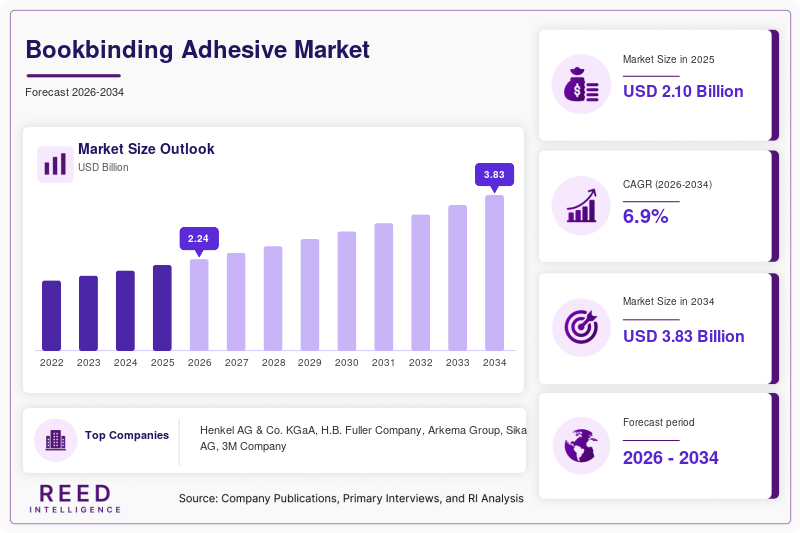
The Bookbinding Adhesive Market size was valued at approximately USD 2.1 billion in 2026 and is projected to reach around USD 3.6 billion by 2034, expanding at a CAGR of 6.9% during the forecast period (2026–2034). The market demonstrates steady growth driven by sustained demand across educational publishing, commercial printing, and packaging applications. Bookbinding adhesives play a crucial role in ensuring durability, flexibility, and aesthetic quality in bound materials, making them essential across traditional and digital print ecosystems.
One of the major global factors supporting market growth is the continuous expansion of the education sector, particularly in emerging economies. Increasing literacy rates, government investments in school infrastructure, and rising enrollment in higher education institutions have contributed to consistent demand for printed textbooks and learning materials. Despite the shift toward digital media, printed books remain widely used due to accessibility, cost efficiency, and user preference, thereby sustaining the demand for high-performance adhesives.
Key Highlights
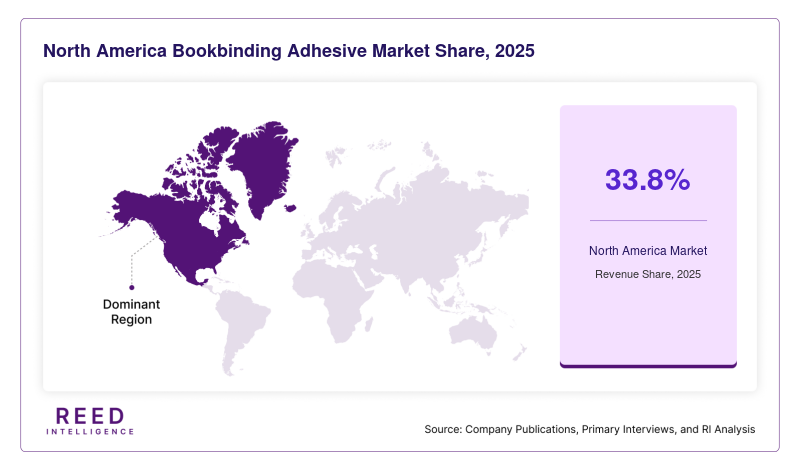
- North America dominated the market with a 33.8% share in 2025.
- Asia Pacific is expected to grow at the fastest CAGR of 8.4% during 2026–2034.
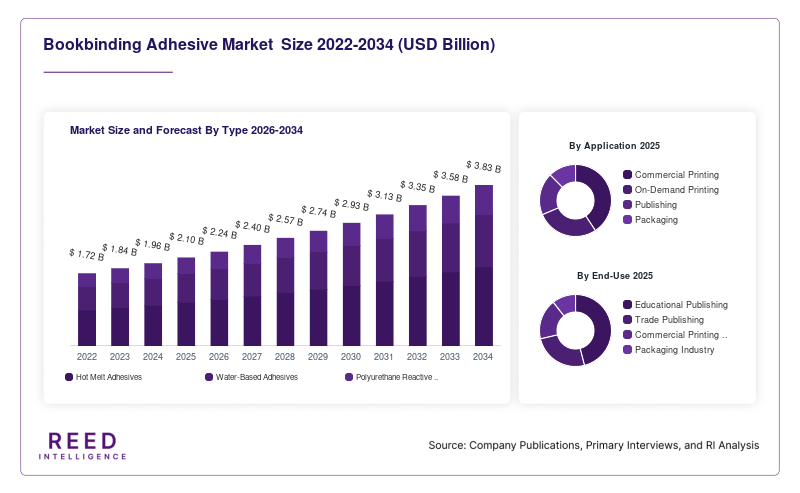
- By type, hot melt adhesives accounted for the largest share of 42.6%.
- while PUR adhesives are projected to grow at a CAGR of 9.1%.
- By application, commercial printing led with a 45.3% share, whereas on-demand printing is expected to expand at a CAGR of 8.7%.
- The United States remained the dominant country, with market values of USD 520 million in 2024 and USD 565 million in 2025.
Market Trends
Rising adoption of eco-friendly adhesive formulations
Sustainability is becoming a central focus within the Bookbinding Adhesive Market, influencing product development and procurement decisions. Manufacturers are increasingly shifting toward water-based and bio-based adhesives to meet regulatory standards and environmental expectations. These formulations reduce volatile organic compound emissions and improve workplace safety, making them suitable for large-scale printing facilities. Additionally, publishing companies are aligning with sustainability goals by choosing recyclable and biodegradable binding solutions. This trend is particularly evident in Europe and North America, where environmental regulations are stringent. As awareness increases globally, demand for eco-friendly adhesives is expected to grow, encouraging innovation and expanding product portfolios.
Growth of digital and short-run printing technologies
The expansion of digital printing technologies has transformed the bookbinding process, leading to increased demand for adhesives compatible with short-run and on-demand printing. Unlike traditional large-volume printing, digital printing requires flexible adhesives that can perform efficiently across varied substrates and formats. This shift is driven by the rising popularity of personalized publishing, self-publishing platforms, and print-on-demand services. Adhesives used in these applications must offer fast setting times and strong bonding across different paper qualities. As printing technologies evolve, adhesive manufacturers are focusing on developing products that enhance productivity while maintaining consistent quality, thereby supporting the growth of this segment.
Market Drivers
Expansion of the global publishing and education sector
The growth of the global publishing industry continues to be a significant driver for the Bookbinding Adhesive Market. Educational institutions, particularly in developing countries, are expanding rapidly, increasing the demand for textbooks and academic materials. Governments are investing heavily in improving literacy rates and access to education, which in turn supports consistent printing volumes. Even with the adoption of digital learning tools, physical books remain a primary medium for education due to their affordability and ease of use. This ongoing demand ensures stable consumption of bookbinding adhesives across both developed and emerging markets, supporting long-term industry growth.
Technological advancements in adhesive performance
Innovations in adhesive technologies are playing a key role in driving market expansion. Manufacturers are developing advanced formulations such as polyurethane reactive adhesives that offer superior strength, flexibility, and resistance to temperature variations. These adhesives are particularly beneficial for high-quality and durable bookbinding applications, including hardcover books and premium publications. Additionally, improvements in hot melt adhesives have enhanced processing speed and efficiency, making them suitable for automated production lines. As the printing industry continues to modernize, the demand for high-performance adhesives that improve productivity and product quality is expected to rise significantly.
Market Restraint
Volatility in raw material prices and environmental compliance costs
Fluctuations in raw material prices pose a challenge for manufacturers operating in the Bookbinding Adhesive Market. Key components such as polymers, resins, and additives are derived from petrochemical sources, making them susceptible to price volatility driven by global oil market dynamics. These fluctuations can impact production costs and profit margins, particularly for small and medium-sized manufacturers. In addition, stringent environmental regulations require companies to invest in sustainable production processes and compliance measures, increasing operational costs. For instance, transitioning to eco-friendly adhesive formulations often involves higher research and development expenses and changes in manufacturing infrastructure. These factors collectively act as restraints, limiting rapid market expansion.
Market Opportunities
Increasing demand for print-on-demand and customized publishing
The rise of print-on-demand services presents a significant opportunity for the Bookbinding Adhesive Market. This model allows publishers and authors to produce books in smaller quantities, reducing inventory costs and waste. As a result, there is growing demand for adhesives that can perform efficiently in short-run production environments. These adhesives must provide consistent quality across varying print volumes and formats. Additionally, customized publishing, including personalized books and niche content, is gaining popularity among consumers. This trend creates opportunities for manufacturers to develop specialized adhesive solutions tailored to diverse applications, enhancing market growth potential.
Expansion in emerging economies
Emerging markets in Asia Pacific, Latin America, and Africa offer considerable growth opportunities for the bookbinding adhesive industry. Rapid urbanization, improving education systems, and increasing disposable incomes are driving demand for printed materials. Governments in these regions are investing in educational infrastructure, leading to higher consumption of textbooks and learning resources. Moreover, the growth of local publishing industries is supporting the demand for efficient and cost-effective binding solutions. Adhesive manufacturers can capitalize on these opportunities by expanding their presence, establishing local production facilities, and developing region-specific products that cater to evolving market needs.
Segmental Analysis
By Type
Hot melt adhesives dominated the Bookbinding Adhesive Market in 2024, accounting for approximately 42.6% of the total market share. These adhesives are widely used due to their fast setting time, cost efficiency, and compatibility with high-speed binding processes. They are particularly suitable for paperback books and commercial printing applications where production speed is critical. The widespread adoption of automated binding systems has further increased the demand for hot melt adhesives, as they enable efficient and consistent performance. Additionally, their ability to bond various paper types makes them a preferred choice among manufacturers.
Polyurethane reactive adhesives are the fastest-growing subsegment, projected to expand at a CAGR of 9.1% during the forecast period. These adhesives offer superior bonding strength, flexibility, and resistance to environmental conditions such as heat and moisture. They are increasingly used in high-quality bookbinding applications, including hardcover and premium publications. The growing demand for durable and long-lasting books is driving the adoption of PUR adhesives. Furthermore, advancements in formulation technology are improving their performance and reducing curing time, making them more suitable for modern printing processes.
By Application
Commercial printing emerged as the dominant application segment, holding a market share of 45.3% in 2024. This segment includes magazines, catalogs, brochures, and other printed materials that require efficient binding solutions. The high volume of production in commercial printing drives the demand for reliable and cost-effective adhesives. Additionally, the use of advanced printing technologies and automated systems enhances the efficiency of adhesive application, supporting the growth of this segment. The continued demand for printed marketing materials and publications contributes to the dominance of commercial printing.
On-demand printing is the fastest-growing application segment, with a projected CAGR of 8.7%. The increasing popularity of customized publishing and short-run printing is driving the demand for adhesives that can perform effectively in small-scale production environments. These adhesives must provide consistent quality and quick setting times to meet the requirements of on-demand printing. The growth of self-publishing platforms and digital printing technologies is further supporting this trend. As consumer preferences shift toward personalized content, the demand for on-demand printing is expected to increase significantly.
By End-Use
The publishing industry dominated the end-use segment, accounting for a significant share of the market in 2024. This segment includes educational, academic, and trade publishing, which collectively drive the demand for bookbinding adhesives. The consistent production of textbooks and printed materials ensures steady consumption of adhesives. Additionally, the adoption of advanced binding technologies in publishing houses enhances efficiency and product quality. The growing demand for educational resources in emerging markets further supports the dominance of this segment.
The packaging sector is the fastest-growing end-use segment, projected to grow at a CAGR of 7.8% during the forecast period. The increasing use of bookbinding adhesives in packaging applications such as corrugated boxes and paperboard products is driving this growth. These adhesives provide strong bonding and durability, making them suitable for packaging solutions. The growth of e-commerce and retail industries is further increasing the demand for packaging materials, thereby supporting the expansion of this segment.
Regional Analysis
North America
North America held a significant share of the Bookbinding Adhesive Market in 2025, accounting for approximately 33.8% of the global market. The region is expected to grow at a CAGR of 5.9% during the forecast period. The presence of a well-established publishing industry and advanced printing technologies supports consistent demand for adhesives. Additionally, the region's focus on automation in printing processes drives the adoption of high-performance adhesive solutions, particularly in commercial printing and packaging applications.
The United States dominates the regional market due to its extensive publishing ecosystem and technological advancements. A key growth factor is the increasing adoption of print-on-demand services, which require flexible and efficient adhesive solutions. The growing popularity of self-publishing platforms further supports demand, as independent authors rely on high-quality binding for their publications.
Europe
Europe accounted for around 28.5% of the market share in 2025 and is projected to grow at a CAGR of 6.2% through 2034. The region's strong emphasis on sustainability and environmental regulations influences adhesive production and usage. Manufacturers are focusing on developing eco-friendly formulations to meet regulatory standards, which is driving innovation in the market.
Germany leads the European market, supported by its robust printing and publishing industry. A unique growth factor is the region’s strict environmental compliance requirements, which encourage the adoption of water-based and low-emission adhesives. This trend is fostering the development of sustainable solutions and enhancing market growth.
Asia Pacific
Asia Pacific is the fastest-growing region, with a projected CAGR of 8.4% during the forecast period and a market share of 24.6% in 2025. Rapid economic development, increasing literacy rates, and expanding educational infrastructure are key factors driving growth. The region's large population base contributes to high demand for textbooks and printed materials.
China dominates the Asia Pacific market due to its large-scale publishing industry and manufacturing capabilities. A significant growth factor is the expansion of educational institutions and government initiatives to improve literacy. These developments are increasing the demand for cost-effective and efficient bookbinding adhesives.
Middle East & Africa
The Middle East & Africa region accounted for approximately 7.1% of the market in 2025 and is expected to grow at a CAGR of 6.5% during the forecast period. The market is driven by gradual improvements in education systems and increasing investments in infrastructure. Demand for printed materials is rising as literacy rates improve across several countries.
South Africa is a key contributor to the regional market. A unique growth factor is the expansion of educational programs and government initiatives aimed at improving access to learning resources. These initiatives are driving the demand for textbooks and, consequently, bookbinding adhesives.
Latin America
Latin America held a market share of 6.0% in 2025 and is projected to grow at a CAGR of 6.7% through 2034. The region is experiencing steady growth due to increasing demand for educational and commercial printing materials. Economic development and rising literacy rates are contributing to market expansion.
Brazil dominates the Latin American market, supported by its growing publishing industry. A key growth factor is the increasing demand for educational materials driven by government initiatives to improve literacy and education standards. This trend is supporting consistent demand for bookbinding adhesives.
Competitive Landscape
The Bookbinding Adhesive Market is moderately competitive, with several global and regional players focusing on product innovation and strategic expansion. Key companies are investing in research and development to enhance adhesive performance and meet evolving customer requirements. The market is characterized by collaborations, mergers, and product launches aimed at strengthening market presence.
Henkel AG & Co. KGaA is a leading player in the market, known for its extensive portfolio of adhesive solutions. The company recently introduced advanced eco-friendly adhesive formulations to align with sustainability trends. Other major players are also focusing on expanding their product offerings and improving production efficiency to maintain competitiveness.
Key Players List
- Henkel AG & Co. KGaA
- H.B. Fuller Company
- Arkema Group
- Sika AG
- 3M Company
- Dow Inc.
- Jowat SE
- Ashland Global Holdings Inc.
- Paramelt B.V.
- Avery Dennison Corporation
- Toyochem Co., Ltd.
- Franklin International
- Wacker Chemie AG
- Beardow Adams Group
- Bostik SA
Recent Developments
- A leading adhesive manufacturer introduced a new range of water-based adhesives designed for sustainable bookbinding applications.
- A major company expanded its production capacity in Asia Pacific to meet increasing regional demand.
- An industry player launched advanced PUR adhesives with improved curing time and durability for high-performance binding.
Bookbinding Adhesive Market Segments
By Type
- Hot Melt Adhesives
- Water-Based Adhesives
- Polyurethane Reactive (PUR) Adhesives
By Application
- Commercial Printing
- On-Demand Printing
- Publishing
- Packaging
By End-Use
- Educational Publishing
- Trade Publishing
- Commercial Printing Houses
- Packaging Industry
By Region
- North America
- Europe
- APAC
- Middle East and Africa
- LATAM