Bottle Sealing Wax Market Size, Share Demand Report By Type (Flexible Bottle Sealing Wax, Traditional Brittle Wax, Synthetic Polymer-Based Wax), By Application (Wine Bottles, Premium Spirits Bottles, Specialty Food Packaging, Cosmetic and Luxury Product Bottles), By End-Use Industry (Alcoholic Beverage Manufacturers, Specialty Food Producers, Cosmetics and Personal Care Companies), By Distribution Channel (Direct Sales to Packaging Manufacturers, Packaging Distributors, Online Retail Platforms),
USD 3950
Market Overview
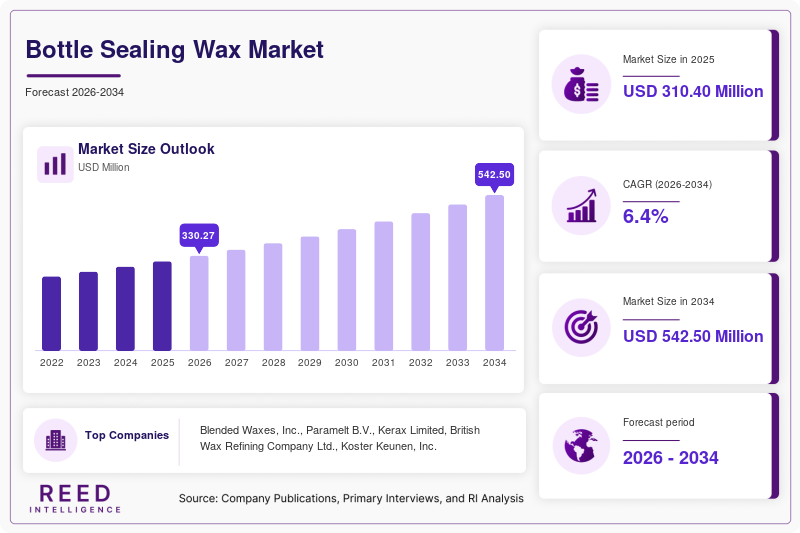
The global Bottle Sealing Wax Market size was valued at USD 310.4 million in 2025 and is projected to reach USD 542.7 million by 2033, expanding at a compound annual growth rate (CAGR) of 6.4% during 2025–2034. The market is experiencing steady expansion as premium beverage brands increasingly adopt decorative and protective sealing solutions to enhance product presentation and authenticity. Bottle sealing wax is widely used in wine, spirits, gourmet food products, and specialty packaging to create tamper-evident seals while reinforcing brand identity.
A key global factor supporting the growth of the Bottle Sealing Wax Markethas been the rising demand for premium packaging across alcoholic beverages and luxury food segments. Premiumization trends in wine and spirits industries have encouraged manufacturers to adopt distinctive packaging elements that improve shelf appeal and communicate product authenticity. Bottle sealing wax provides both functional sealing and aesthetic differentiation, which supports brand positioning in competitive retail environments.
Key Highlights
- Europe held the dominant 36.8% share of the Bottle Sealing Wax Market in 2025, while Asia Pacific is projected to register the fastest CAGR of 7.5% during 2025–2034.
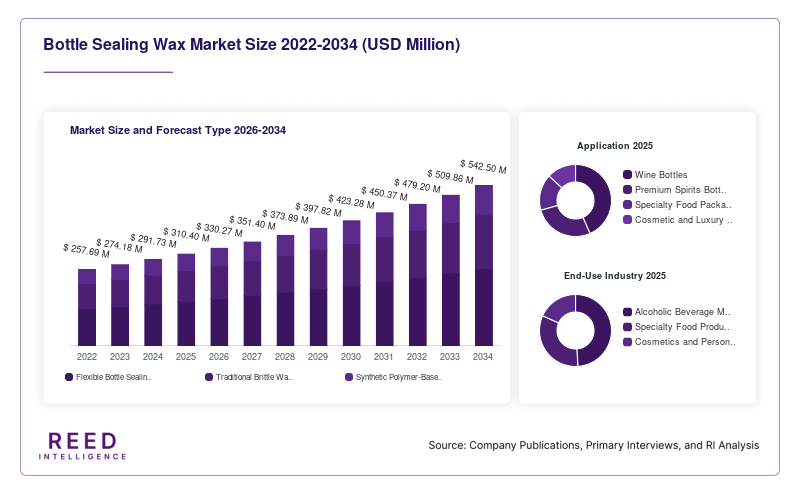
- By type, flexible bottle sealing wax accounted for 48.6% share in 2025, while synthetic polymer-based wax is projected to grow at 7.8% CAGR.
- By application, wine bottle sealing remained the leading segment with 41.9% share, whereas premium spirits packaging is expected to expand at 7.6% CAGR.
- The United States represented the dominant national market with USD 68.4 million in 2025 and is estimated to reach USD 72.1 million in 2026.
Market Trends
Increasing Adoption of Decorative Premium Packaging
One prominent trend shaping the Bottle Sealing Wax Marketis the rising adoption of decorative packaging elements within premium product categories. Beverage producers, particularly wineries and craft distilleries, increasingly use sealing wax to differentiate their bottles in retail environments. The wax seal enhances visual appeal while communicating product authenticity and heritage. Brands use custom colors, embossed stamps, and textured wax finishes to reinforce brand identity and create a distinctive consumer experience.
Luxury food and specialty cosmetic brands are also exploring wax seals as a design feature in limited-edition packaging. As consumer purchasing decisions become more influenced by packaging aesthetics, decorative bottle sealing wax solutions are gaining traction across multiple product categories.
Development of Flexible and Machine-Applied Wax Formulations
Another important trend in the Bottle Sealing Wax Marketis the development of flexible wax formulations designed for automated bottling lines. Traditional wax often cracked during transportation or storage, which limited its application in high-volume production. Manufacturers are now producing polymer-modified sealing wax that remains flexible after solidification.
These formulations support machine-based dipping and spraying processes, improving manufacturing efficiency and reducing labor requirements. As beverage companies increasingly automate packaging operations, flexible wax products compatible with industrial machinery are expected to gain wider adoption across global bottling facilities.
Market Drivers
Growth of Craft Beverage Production
The expansion of craft beverage industries has significantly influenced the Bottle Sealing Wax Market. Small and independent breweries, wineries, and distilleries frequently rely on unique packaging designs to attract consumers and communicate product craftsmanship. Wax seals help these producers create a traditional and artisanal appearance, which aligns with the branding strategies commonly used in craft beverage markets.
Craft beverage producers also release seasonal and limited-edition products that require distinctive packaging elements. As these industries continue to expand globally, demand for bottle sealing wax solutions is increasing.
Rising Demand for Tamper-Evident Packaging
Another key driver of the Bottle Sealing Wax Marketis the growing importance of tamper-evident packaging in food and beverage products. Consumers and regulatory authorities increasingly emphasize product safety and authenticity. Bottle sealing wax provides a visible protective layer that indicates whether a product has been opened or tampered with.
This feature is particularly valuable for premium alcoholic beverages, gourmet sauces, and specialty oils. The ability of wax seals to combine safety assurance with decorative branding has strengthened their role in modern packaging strategies.
Market Restraint
Availability of Alternative Packaging Sealing Technologies
A notable restraint affecting the Bottle Sealing Wax Marketis the increasing availability of alternative sealing technologies. Modern packaging solutions such as shrink capsules, foil seals, and tamper-evident plastic closures provide cost-effective and automated alternatives to traditional wax sealing.
These alternatives often require less manual labor and integrate more easily with large-scale packaging lines. As a result, some beverage manufacturers prefer modern closure systems to reduce production time and operational complexity.
Additionally, wax sealing may increase packaging costs due to material usage and additional application steps. For high-volume beverage producers focused on cost efficiency, alternative sealing technologies can represent a more practical option.
While bottle sealing wax continues to hold strong appeal within premium and artisanal product segments, competition from alternative packaging solutions may influence adoption rates across large-scale manufacturing operations.
Market Opportunities
Expansion in Premium Spirits Packaging
The premium spirits sector presents a growing opportunity for the Bottle Sealing Wax Market. Luxury whisky, rum, tequila, and craft gin brands increasingly emphasize premium packaging to communicate product exclusivity. Wax-sealed bottles are widely associated with authenticity and heritage in the spirits industry.
As global demand for premium alcoholic beverages continues to expand, distilleries are investing in distinctive packaging formats that support brand storytelling. Bottle sealing wax enables producers to differentiate limited releases and collector editions, supporting long-term market expansion.
Adoption in Specialty Food and Gourmet Packaging
Another emerging opportunity lies in the use of bottle sealing wax in specialty food products such as olive oils, balsamic vinegar, artisanal sauces, and gourmet syrups. These products are often positioned as premium offerings and rely heavily on attractive packaging to influence purchasing decisions.
Wax seals provide a handcrafted appearance that aligns with the branding of artisanal food products. As specialty food markets expand in both developed and emerging economies, packaging innovations such as wax sealing are expected to gain wider adoption.
Segmental Analysis
By Type
Flexible bottle sealing wax accounted for the largest share of the Bottle Sealing Wax Market at 48.6% in 2025. Flexible wax formulations are widely preferred because they resist cracking and maintain seal integrity during transportation. These formulations typically contain polymer additives that improve elasticity while maintaining the traditional appearance of wax seals.
Synthetic polymer-based wax is projected to be the fastest-growing type segment with a CAGR of 7.8% during the forecast period. These advanced wax formulations are compatible with automated bottling equipment and offer improved durability. As beverage manufacturers adopt high-speed packaging systems, synthetic wax products designed for machine application are expected to gain significant adoption.
By Application
Wine bottle sealing represented the largest application segment, accounting for 41.9% share of the Bottle Sealing Wax Market in 2025. Wineries often use wax seals to enhance bottle aesthetics and reinforce the perception of quality and authenticity. Wax-sealed wine bottles also provide an additional protective layer over cork closures.
Premium spirits packaging is expected to become the fastest-growing application segment with a CAGR of 7.6%. Craft distilleries and luxury spirits brands frequently use wax seals to highlight limited-edition releases. As consumer interest in premium whisky and craft gin grows, wax-sealed packaging solutions will gain greater prominence.
By End-Use Industry
Alcoholic beverage manufacturers accounted for the dominant end-use segment with 58.7% share in 2025. The widespread use of wax seals in wine and spirits bottles contributed to the segment’s leading position. Beverage producers utilize wax sealing to create distinctive packaging designs that attract consumer attention.
Specialty food manufacturers are projected to record the fastest growth with a CAGR of 7.2%. Gourmet food brands increasingly adopt wax-sealed packaging to highlight product authenticity and craftsmanship. The growth of premium food retail markets is expected to support this segment.
By Distribution Channel
Direct sales to packaging manufacturers represented the largest distribution channel segment with 46.3% share in 2025. Many beverage producers purchase sealing wax directly from manufacturers to ensure consistent supply for bottling operations.
Online distribution channels are expected to expand at the fastest CAGR of 7.4% during the forecast period. Small craft producers and specialty brands are increasingly sourcing packaging materials through digital platforms. Online distribution enables access to a wide range of wax colors, formulations, and customization options.
Regional Analysis
North America
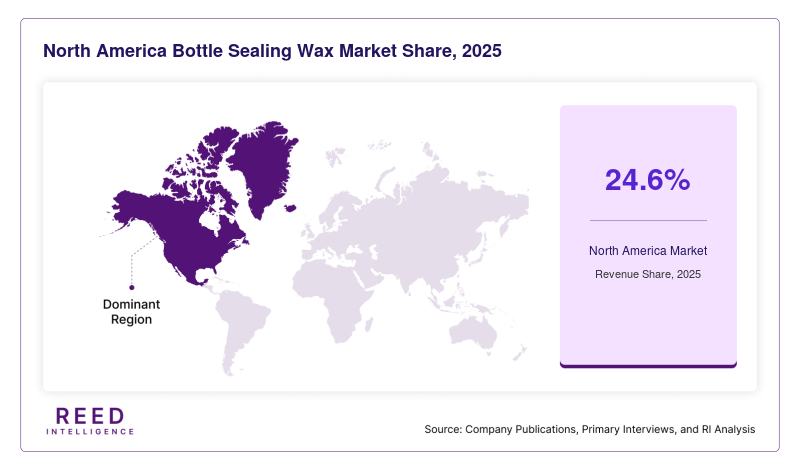
North America accounted for 24.6% of the Bottle Sealing Wax Market share in 2025. The regional market benefited from strong demand across craft beverage industries and premium packaging segments. During the forecast period, the regional market is expected to grow at a CAGR of 6.1% between 2025 and 2034.
The United Statesrepresented the dominant country within North America. The growth of independent distilleries and boutique wineries has increased the demand for decorative bottle packaging solutions. Additionally, the presence of established packaging material manufacturers has supported innovation in wax formulations designed for commercial bottling operations.
Europe
Europe held 36.8% share of the Bottle Sealing Wax Market in 2025, reflecting the region’s strong wine production and long-standing tradition of wax-sealed bottles. The regional market is projected to grow at a CAGR of 6.0% during the forecast period.
Franceemerged as the dominant national market due to its globally recognized wine industry. Many French wineries maintain traditional packaging practices that include wax bottle sealing as part of brand identity. The continued global demand for premium wines supports the adoption of decorative sealing solutions.
Asia Pacific
Asia Pacific represented 21.9% of global market share in 2025and is expected to expand at the fastest CAGR of 7.5% during 2025–2034. Rising consumption of premium beverages and the expansion of domestic wineries and distilleries are supporting regional market growth.
Chinadominated the regional market as wine consumption continues to grow among urban consumers. Domestic wineries and imported wine brands are increasingly adopting decorative packaging strategies to appeal to premium consumer segments.
Middle East & Africa
The Middle East & Africa accounted for 8.4% share of the Bottle Sealing Wax Market in 2025. The regional market is anticipated to grow at a CAGR of 6.7% during the forecast period.
The United Arab Emiratesemerged as the dominant market within the region. The country’s growing hospitality and luxury retail sectors have increased demand for premium packaged products, including imported wines and specialty food items.
Latin America
Latin America held 8.3% share of the Bottle Sealing Wax Market in 2025and is projected to grow at a CAGR of 6.5% between 2025 and 2034.Argentinarepresented the dominant country market due to its strong wine production industry. Argentine wineries increasingly use wax seals for premium product lines aimed at international export markets.
Competitive Landscape
The Bottle Sealing Wax Marketis characterized by the presence of packaging material manufacturers and specialty wax producers focusing on product innovation and customization. Companies compete by offering flexible wax formulations, a wide range of colors, and compatibility with automated bottling systems.
Among the leading players, Blended Waxes, Inc.has established a strong market presence through its diversified portfolio of industrial and packaging wax solutions. The company has recently introduced advanced polymer-modified sealing wax designed for automated dipping processes.
Other notable companies in the market include Paramelt B.V., Kerax Limited, British Wax Refining Company Ltd., and Koster Keunen, Inc.. These firms focus on expanding production capacity and developing customized wax formulations to meet the evolving needs of beverage and specialty packaging manufacturers.
Key Players in the Bottle Sealing Wax Market
- Blended Waxes, Inc.
- Paramelt B.V.
- Kerax Limited
- British Wax Refining Company Ltd.
- Koster Keunen, Inc.
- Strahl & Pitsch, Inc.
- Candlewic Company
- Sonneborn LLC
- Calwax LLC
- Sasol Limited
- Hase Petroleum Wax Company
- Frank B. Ross Co., Inc.
- Michelman, Inc.
- Kahl GmbH & Co. KG
- IGI Wax
Recent Developments
- 2024: Blended Waxes, Inc. introduced flexible sealing wax formulations designed for automated bottle dipping systems.
- 2024: Paramelt B.V. expanded its specialty wax product line for beverage packaging applications.
- 2023: Kerax Limited developed colored sealing wax products targeted at craft distilleries and boutique wineries.
- 2023: British Wax Refining Company Ltd. increased production capacity to support growing demand from wine packaging manufacturers.
- 2022: Koster Keunen, Inc. launched customizable wax sealing solutions designed for specialty food and luxury product packaging.
Bottle Sealing Wax Market Segments
Type
- Flexible Bottle Sealing Wax
- Traditional Brittle Wax
- Synthetic Polymer-Based Wax
Application
- Wine Bottles
- Premium Spirits Bottles
- Specialty Food Packaging
- Cosmetic and Luxury Product Bottles
End-Use Industry
- Alcoholic Beverage Manufacturers
- Specialty Food Producers
- Cosmetics and Personal Care Companies
Distribution Channel
- Direct Sales to Packaging Manufacturers
- Packaging Distributors
- Online Retail Platforms
By Region
- North America
- Europe
- APAC
- Middle East and Africa
- LATAM