Bovine Ephemeral Fever Vaccine Market Size, Share Demand Report By Type (Inactivated Vaccines, Live Attenuated Vaccines, Recombinant Vaccines), By Dosage Form (Liquid, Lyophilized), By End-Use (Veterinary Hospitals, Veterinary Clinics, Farm-Based Settings), By Distribution Channel (Veterinary Clinics, Retail Pharmacies, Online Platforms), By Region & Segment Forecasts, 2025–2034
USD 3950
Market Overview
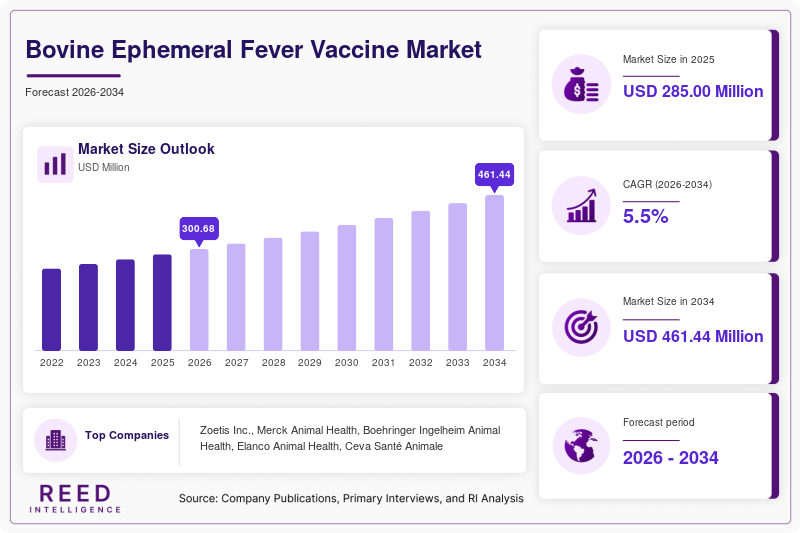
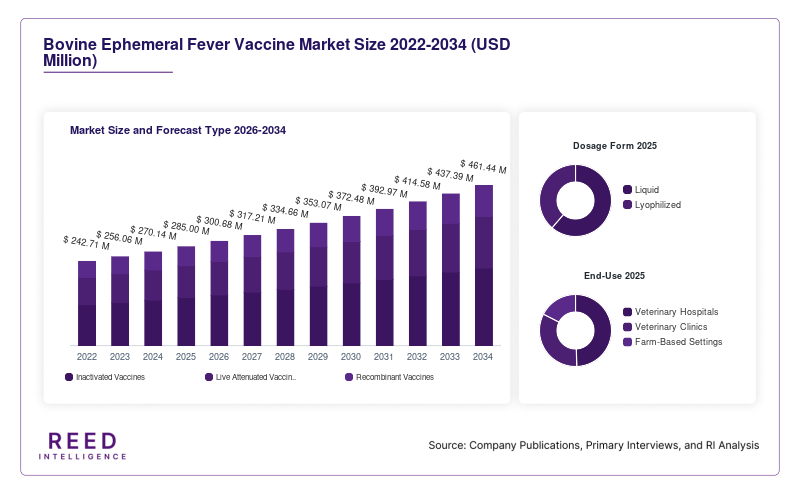
The global Bovine Ephemeral Fever Vaccine Market size was valued at approximately USD 285 million in 2025 and is projected to reach USD 462 million by 2034, expanding at a CAGR of 5.5% during the forecast period (2025–2034). The market is experiencing steady growth due to increasing awareness of livestock health management and the rising economic importance of cattle farming across both developed and emerging economies. Governments and veterinary organizations are emphasizing preventive healthcare to reduce production losses associated with bovine ephemeral fever outbreaks, which has significantly supported vaccine adoption globally.
One of the primary global factors driving market expansion is the growing demand for high-quality dairy and meat products. This demand has encouraged farmers to adopt vaccination programs that improve herd productivity and minimize disease-related losses. Additionally, advancements in veterinary biotechnology and improved cold-chain logistics have enhanced vaccine accessibility in remote regions.
Key Highlights
- Asia Pacific dominated the market with a 38% share in 2025, while the region is projected to grow at the fastest CAGR of 6.3% through 2034.
- Inactivated vaccines led the type segment with a 61% share, while recombinant vaccines are expected to grow fastest at a CAGR of 6.8%.
- Veterinary hospitals represented the leading end-use segment with a 47% share, while farm-based vaccination is expected to expand at a CAGR of 6.1%.
- Australia emerged as the dominant country, with market values of USD 42 million in 2025 and USD 44 million in 2026.
Market Trends
Increasing Adoption of Recombinant Vaccines
The market is witnessing a shift toward recombinant and next-generation vaccines due to their enhanced efficacy and safety profiles. These vaccines reduce the risk of adverse reactions and provide longer immunity, making them attractive for large-scale cattle operations. As biotechnology capabilities improve, manufacturers are focusing on precision vaccine development, which is expected to reshape product offerings in the coming years.
Integration of Digital Livestock Monitoring
The adoption of digital tools such as livestock tracking systems and herd health monitoring platforms is influencing vaccination strategies. Farmers are increasingly using data analytics to schedule vaccinations and detect early signs of disease outbreaks. This integration is improving vaccination compliance rates and optimizing vaccine demand patterns. As precision agriculture expands, the synergy between digital tools and veterinary care is expected to strengthen the overall market outlook.
Market Drivers
Rising Incidence of Bovine Ephemeral Fever Outbreaks
The increasing frequency of bovine ephemeral fever outbreaks in tropical and subtropical regions has created a strong demand for preventive vaccines. Climatic conditions such as high temperatures and vector prevalence contribute to disease transmission, encouraging farmers to adopt vaccination programs as a primary defense mechanism.
Expansion of Commercial Dairy and Meat Industries
The rapid expansion of commercial livestock farming has significantly increased the need for disease management solutions. Large-scale farms prioritize herd immunity to maintain productivity and profitability. As a result, vaccine procurement has become a standard operational practice, supporting consistent market growth across major livestock-producing regions.
Market Restraint
Limited Awareness in Small-Scale Farming Communities
A key challenge in the Bovine Ephemeral Fever Vaccine Market is the limited awareness and accessibility among small-scale farmers, particularly in developing regions. Many farmers lack adequate knowledge about vaccination schedules and disease prevention strategies, leading to lower adoption rates. Additionally, logistical challenges such as inadequate cold-chain infrastructure and limited veterinary services hinder vaccine distribution in rural areas. Cost sensitivity among smallholders further restricts widespread usage, as vaccines are often perceived as an additional expense rather than a long-term investment. Addressing these barriers requires coordinated efforts from governments, veterinary organizations, and private stakeholders to improve education, accessibility, and affordability.
Market Opportunities
Expansion in Emerging Markets
Emerging economies in Asia, Africa, and Latin America present significant growth opportunities due to increasing livestock populations and improving veterinary infrastructure. Governments in these regions are launching disease control programs, which are expected to boost vaccine demand over the forecast period.
Development of Combination Vaccines
The development of multivalent or combination vaccines targeting multiple bovine diseases is gaining traction. These vaccines reduce the need for multiple injections, improving compliance and cost efficiency for farmers. Manufacturers investing in combination vaccine research are likely to gain a competitive advantage, as demand for integrated livestock healthcare solutions continues to rise.
Segmental Analysis
By Type
Inactivated vaccines dominated the market in 2025, accounting for approximately 61% of the total share. These vaccines are widely preferred due to their established safety profile and effectiveness in preventing bovine ephemeral fever. Their ease of storage and compatibility with existing vaccination programs have further strengthened their market position.
Recombinant vaccines are expected to be the fastest-growing subsegment, with a projected CAGR of 6.8% through 2034. Their ability to provide targeted immunity with minimal side effects is driving their adoption. Advances in genetic engineering and biotechnology are expected to accelerate the development and commercialization of these vaccines.
By Dosage Form
Liquid vaccines held the dominant share of around 68% in 2025, primarily due to their ease of administration and widespread availability. Veterinary professionals prefer liquid formulations for their consistent dosing and rapid immune response.
Lyophilized vaccines are projected to grow at the fastest CAGR of 6.2% during the forecast period. Their longer shelf life and improved stability in varying environmental conditions make them suitable for regions with limited cold-chain infrastructure, supporting their increasing adoption.
By End-Use
Veterinary hospitals accounted for the largest share of 47% in 2025, driven by the availability of skilled professionals and structured vaccination programs. These facilities ensure proper storage, handling, and administration of vaccines, contributing to their dominance.
Farm-based vaccination is expected to witness the fastest growth, with a CAGR of 6.1% over the forecast period. Increasing awareness among farmers and the availability of mobile veterinary services are enabling on-site vaccination, reducing dependency on centralized facilities.
By Distribution Channel
Veterinary clinics dominated the distribution channel segment with a 44% share in 2025. These clinics serve as primary access points for livestock farmers, offering both consultation and vaccination services.
Online veterinary supply platforms are anticipated to grow at the fastest CAGR of 6.5% during the forecast period. The convenience of online ordering and expanding digital infrastructure in rural areas are contributing to the growth of this segment.
Regional Analysis
North America
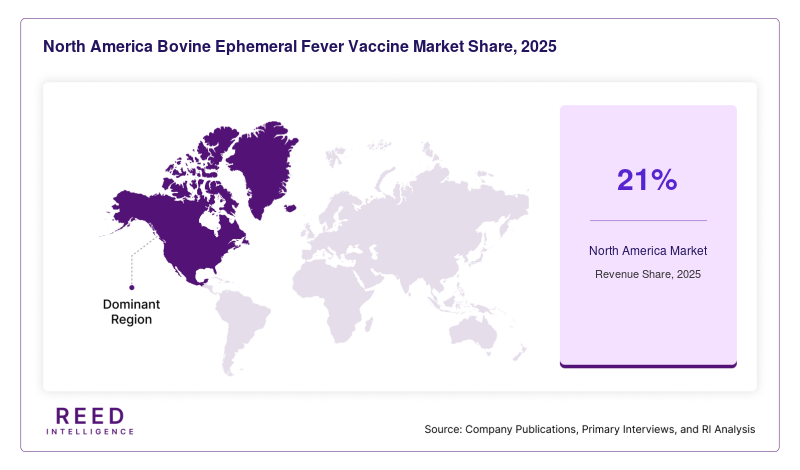
North America accounted for approximately 21% of the global market share in 2025 and is expected to grow at a CAGR of 4.8% during the forecast period. The region’s growth is supported by advanced veterinary healthcare infrastructure and high awareness among livestock producers regarding disease prevention. The presence of well-established pharmaceutical companies further contributes to market stability.
The United States dominated the regional market due to its large-scale commercial cattle farming and strong regulatory framework supporting animal health. The adoption of preventive vaccination practices is widespread, driven by stringent quality standards in meat and dairy production. Continuous investments in veterinary research and development are expected to sustain the country’s growth trajectory.
Europe
Europe held a 19% share of the Bovine Ephemeral Fever Vaccine Market in 2025 and is projected to grow at a CAGR of 4.6% through 2034. The region benefits from structured animal health policies and government-supported vaccination programs aimed at disease control and food safety.
Germany emerged as the dominant country in the region, supported by its advanced livestock management practices and strong focus on animal welfare. The country’s emphasis on sustainable agriculture and biosecurity measures has encouraged consistent vaccine adoption, ensuring steady market growth.
Asia Pacific
Asia Pacific led the global market with a 38% share in 2025 and is anticipated to grow at the fastest CAGR of 6.3% during the forecast period. The region’s dominance is attributed to its large cattle population and increasing demand for dairy and meat products.
Australia played a significant role as the leading country, driven by frequent outbreaks of bovine ephemeral fever and a well-established vaccination framework. The country’s proactive approach to disease management and strong export-oriented livestock industry have contributed to sustained market demand.
Middle East & Africa
The Middle East & Africa region accounted for 12% of the market share in 2025 and is expected to grow at a CAGR of 5.7% through 2034. The region’s growth is supported by rising investments in livestock farming and increasing awareness of animal health management.
South Africa dominated the regional market due to its relatively developed veterinary infrastructure and government initiatives promoting livestock health. The country’s efforts to improve disease surveillance and vaccination coverage are expected to drive further market expansion.
Latin America
Latin America captured a 10% share of the market in 2025 and is projected to grow at a CAGR of 5.4% during the forecast period. The region’s growth is driven by expanding cattle farming activities and increasing exports of beef and dairy products.
Brazil emerged as the leading country in the region, supported by its large cattle population and growing focus on disease prevention. Government-backed vaccination campaigns and improvements in veterinary services are expected to enhance market growth in the coming years.
Competitive Landscape
The Bovine Ephemeral Fever Vaccine Market is moderately fragmented, with several global and regional players competing on product quality, distribution reach, and innovation. Key companies are focusing on expanding their product portfolios and strengthening their presence in emerging markets.
Zoetis Inc. is recognized as a market leader, leveraging its extensive veterinary product portfolio and global distribution network. The company recently introduced an improved vaccine formulation with enhanced immunity duration, strengthening its competitive position.
Other prominent players are investing in research and development to introduce advanced vaccine technologies and expand their geographic footprint. Strategic collaborations, product launches, and partnerships remain key growth strategies in this competitive landscape.
Key Players
- Zoetis Inc.
- Merck Animal Health
- Boehringer Ingelheim Animal Health
- Elanco Animal Health
- Ceva Santé Animale
- Virbac
- Indian Immunologicals Ltd.
- Vetoquinol S.A.
- HIPRA
- Phibro Animal Health Corporation
- Biogénesis Bagó
- Hester Biosciences Limited
- Brilliant Bio Pharma
- Jinyu Bio-Technology Co., Ltd.
- Ringpu Biology
Recent Developments
- 2024: Zoetis Inc. launched an enhanced bovine ephemeral fever vaccine with extended immunity duration.
- 2024: Indian Immunologicals Ltd. expanded its vaccine production capacity to meet rising domestic demand.
- 2023: HIPRA introduced a new recombinant vaccine targeting improved safety and efficacy.
- 2023: Hester Biosciences strengthened its distribution network across Africa.
- 2023: Ceva Santé Animale partnered with regional distributors to expand its footprint in Asia Pacific.
Bovine Ephemeral Fever Vaccine Market Segments
Type
- Inactivated Vaccines
- Live Attenuated Vaccines
- Recombinant Vaccines
Dosage Form
- Liquid
- Lyophilized
End-Use
- Veterinary Hospitals
- Veterinary Clinics
- Farm-Based Settings
Distribution Channel
- Veterinary Clinics
- Retail Pharmacies
- Online Platforms
By Region
- North America
- Europe
- APAC
- Middle East and Africa
- LATAM